
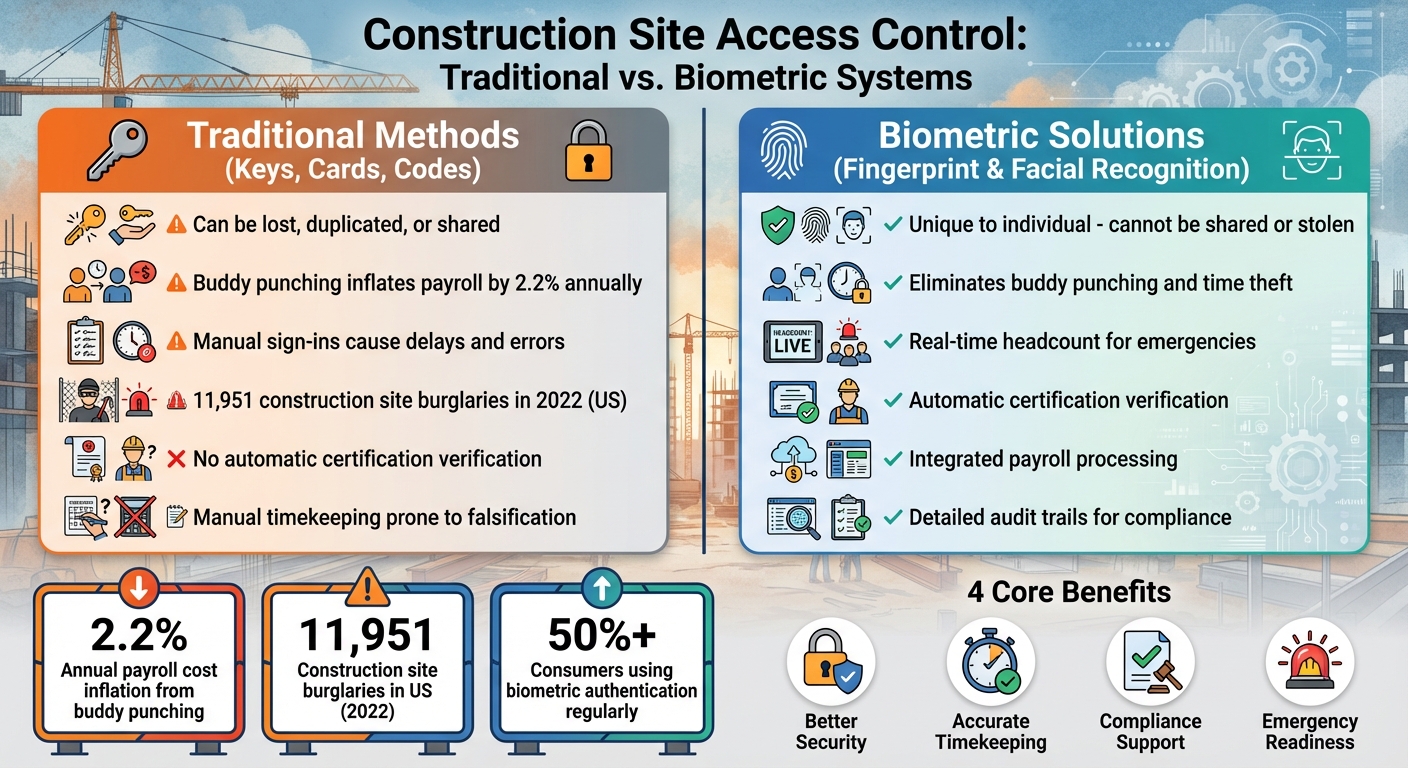
Biometric access control is solving long-standing issues in construction site security and workforce management. Unlike cards or keys, which can be lost or shared, biometrics like fingerprints and facial recognition tie access to an individual worker. This eliminates problems like "buddy punching" (which inflates payroll costs by up to 2.2% annually) and strengthens security by preventing unauthorized entries. These systems also simplify compliance by linking worker qualifications directly to their biometric data, ensuring only certified individuals enter restricted areas.
Key takeaways:
- Better security: Prevents access sharing and tracks real-time site entry.
- Accurate timekeeping: Eliminates manual errors and integrates with payroll.
- Compliance support: Verifies certifications for access to specific zones.
- Emergency readiness: Provides live headcounts and quick communication tools.
Biometric systems are becoming a go-to solution for contractors aiming to secure sites, reduce administrative burdens, and improve safety. The next step? Start with a pilot program, ensure data protection, and integrate with existing systems for a smoother rollout.
Traditional vs Biometric Access Control Systems in Construction
Access Control Problems in Construction
Manual Processes and Workforce Tracking Issues
Relying on paper sign-ins and manual headcounts often leads to entry delays and inaccurate attendance records. These methods are prone to errors, loss, and even falsification, making them unreliable for tracking workforce activity. On large sites, where hundreds of workers and subcontractors come and go daily, managing attendance manually becomes a logistical nightmare.
Supervisors face additional challenges as they must cross-check worker identities with training records, certification dates, and induction requirements. This process not only slows down operations but also makes it difficult to maintain real-time awareness of who is on-site and whether they meet necessary qualifications. These inefficiencies go beyond inconvenience – they can compromise the overall security and safety of the site.
Security Risks and Unauthorized Entry
Traditional access tools, such as swipe cards or proximity tags, are far from foolproof. They can be easily lost, duplicated, or shared, creating significant security vulnerabilities. Practices like "pass-back", where one worker swipes their card and hands it to another, render access control measures ineffective.
The scale of the problem is evident in the numbers: in 2022, there were nearly 11,951 reported burglaries at construction sites across the United States. Beyond theft, the cost of replacing lost access cards adds to operational expenses. Another common issue is "buddy punching", where workers share credentials to clock in for absent colleagues. This practice not only skews attendance data but also results in financial losses due to time theft.
Compliance and Safety Verification Gaps
Security issues are further compounded by the difficulty of verifying worker qualifications. Construction sites often have multiple zones, each with specific safety and skill requirements. Traditional systems cannot automatically link a worker’s identity to their certifications, such as OSHA or SST cards, or their induction status in real time. This reliance on manual verification increases the likelihood of errors and makes it harder to ensure compliance with safety standards.
"There’s lots of zones on a construction site. It’s absolutely critical that people don’t walk into those areas unless they have the appropriate qualifications."
Without automated systems, it becomes nearly impossible to prevent unqualified or non-compliant workers from entering restricted areas. Expired or missing certifications can go unnoticed, exposing sites to greater liability and safety risks.
How Biometric Access Systems Work
Biometric Technologies and Equipment
Biometric access systems use unique physical traits – like fingerprints or facial features – to verify a worker’s identity by matching them to a pre-registered database. This process happens almost instantly, making it both efficient and secure.
Fingerprint recognition works by having workers place a finger on a scanner, which matches the print to stored records. Modern fingerprint readers are built to withstand tough construction environments, including dirt, dust, and even the presence of gloves. This durability makes them a practical choice for outdoor job sites, where conditions are often less than ideal.
Facial recognition has become increasingly popular, especially as contactless solutions gained attention during the pandemic. This method allows workers to authenticate themselves without touching any device, reducing wear and tear on equipment while speeding up the entry process. The system captures the geometry of a worker’s face and compares it to stored images for quick verification. Together, these technologies are seamlessly integrated with workforce management systems, simplifying access control and compliance.
Integration With Workforce Management Systems
Biometric access systems don’t just verify identities – they also connect directly to workforce management platforms. Each worker’s biometric data is linked to their digital profile, which includes essential details like training records, certifications, and health and safety documents. When a worker scans their fingerprint or face, the system confirms not only their identity but also whether they’re authorized to enter specific areas based on their qualifications.
This setup eliminates issues like buddy punching and time theft by ensuring that only the actual worker can clock in. Verified attendance data is automatically sent to payroll systems, reducing the need for manual input and minimizing errors. For large construction sites with multiple subcontractors, this automation significantly lightens administrative tasks while boosting accuracy. By streamlining processes, these systems save time and ensure precise record-keeping.
Privacy and Data Protection Requirements
Handling sensitive biometric data comes with responsibilities. Companies must secure this information with encryption, informed consent, and strong cybersecurity measures to protect it from unauthorized access.
Several U.S. states have introduced specific laws governing biometric data. These regulations often require companies to clearly disclose what data they’re collecting, how it will be used, and how long it will be retained. To comply, businesses should establish transparent policies and ensure workers fully understand their rights regarding biometric information. By prioritizing data protection, these systems not only enhance site security but also build trust among workers and stakeholders.
Benefits of Biometric Access for Contractors
Better Identity Verification and Compliance
Biometric systems take the uncertainty out of access control. Unlike traditional keys, cards, or codes – which can be lost, shared, or stolen – fingerprints and facial features are unique to each individual and can’t be transferred. This ensures that only the right worker gains access, eliminating practices like buddy punching.
By linking biometric data with worker credentials, these systems add another layer of security. When a worker scans their fingerprint or face, the system instantly checks if they have the required certifications, permits, or safety training for specific areas. For example, access to hazardous zones – like confined spaces or areas needing hot work permits – is restricted to those who meet the qualifications.
Additionally, every entry and exit is automatically logged, creating a detailed record that meets regulatory requirements and simplifies inspections. Modern biometric readers are built to perform reliably, even when workers are wearing hard hats, masks, or have dirty hands, ensuring consistent verification in everyday jobsite conditions. This not only supports compliance efforts but also strengthens emergency response planning.
Improved Safety and Emergency Response
Biometric systems also enhance safety by offering real-time headcount capabilities. They provide an accurate, live overview of everyone on-site – broken down by crew or company – so during emergencies, safety managers can quickly confirm who is present without relying on outdated sign-in sheets or manual roll calls.
"There’s lots of zones on a construction site. It’s absolutely critical that people don’t walk into those areas unless they have the appropriate qualifications." – Jasmine James, Bid Manager, Datascope Systems
Some systems even help manage worker fatigue by flagging situations where employees exceed 12-hour shifts or return to work without enough rest, reducing the risk of accidents caused by exhaustion. Emergency coordinators can also use broadcast messaging features to instantly communicate with all on-site workers in critical situations.
Simplified Timekeeping and Payroll
Biometric time-tracking eliminates the errors that come with manual timesheets. Workers clock in and out using fingerprint or facial recognition, and the system automatically records their hours. This ensures accurate payroll processing and prevents issues like time theft or buddy punching, as only the registered worker can authenticate.
Verified attendance data integrates seamlessly into payroll systems, speeding up processing and reducing disputes over hours worked. For large sites with multiple subcontractors, this automation cuts down on administrative work while ensuring accurate and efficient timekeeping.
sbb-itb-aa28329
Implementing Biometric Access on Construction Sites
Evaluating Site Requirements and Risks
Before implementing biometric access systems, contractors need a clear understanding of the site’s layout and potential vulnerabilities. Start by mapping out all entry and exit points, paying extra attention to high-risk zones like confined spaces, hot-work areas, or zones with heavy machinery – these areas often require stricter access controls.
Next, evaluate the site’s current security infrastructure. Ensure biometric readers can integrate smoothly with existing systems like video surveillance and alarms. This step also involves budgeting – not just for the initial hardware but also for future upgrades or expansions.
Define specific access levels for different groups. For instance, workers with specialized certifications should only access areas relevant to their expertise, while visitors or subcontractors might have more restricted privileges. Time-based access restrictions can further enhance security by preventing unauthorized entry during off-hours, ensuring that work only happens during approved times.
Once vulnerabilities are identified and access levels are established, the focus shifts to linking worker profiles with the biometric system.
Linking Worker Profiles to Access Control
The efficiency of biometric systems lies in their ability to connect with detailed worker profiles. These profiles should include essential information like certifications, safety training records, and legal work status. A platform like ABLEMKR simplifies this process by linking pre-approved worker credentials directly to biometric data. When a worker scans their fingerprint or face, the system instantly verifies their identity and confirms whether they’re qualified to enter specific areas.
This integration doesn’t just reduce administrative burdens – it also boosts compliance by enabling real-time monitoring. Additionally, it automates time and attendance tracking, ensuring accurate records without manual intervention. With these systems in place, contractors can roll out biometric access gradually, starting with pilot programs.
Pilot Programs and Access Policies
Testing the system in a controlled environment is key. Begin with a pilot program in a single high-risk area. This allows contractors to gather feedback, identify technical issues, and demonstrate the system’s value before expanding it across the site.
Clear, written policies are essential when handling biometric data. Contractors must outline how data will be collected, stored, and used. For example, under the Illinois Biometric Information Privacy Act (BIPA), explicit written consent from workers is required before collecting biometric data. Policies should also detail how long the data will be retained and the measures in place to protect it. Transparent protocols help address privacy concerns while ensuring compliance with legal standards.
Visitor management, emergency access for first responders, and regular audits of access logs should also be part of the plan. Training all personnel on the new system is critical, and refresher sessions should be conducted as the system expands. As Edgar Ndjatou, Executive Director of Workplace Fairness, aptly puts it:
"How can we accomplish these goals without infringing on employees’ privacy or the appearance of being big brother?"
6 Benefits of Biometric Construction Site Security
Conclusion
Biometric access is quickly becoming the standard on U.S. construction sites. Traditional methods like keys, cards, and codes come with significant security risks – they can be lost, shared, or stolen. In contrast, biometric authentication ensures that only authorized personnel can gain entry, while also addressing issues like time theft, which can inflate payroll costs by as much as 2.2% annually.
But the benefits go beyond just security. These systems improve efficiency in measurable ways. Biometric verification speeds up site entry, automates time tracking, and simplifies payroll processes, cutting down on administrative tasks. Additionally, their accuracy provides real-time data for audits and regulatory compliance – critical in high-risk environments where verifying safety and credentials is a must. The ability to ensure both rapid entry and precise compliance makes these systems a game-changer for operational accuracy.
Adoption of this technology is also becoming easier as it aligns with broader trends toward mobile and contactless solutions. More than half of consumers now regularly use biometric authentication, and nearly 50% rely on it often or always for mobile apps. This growing familiarity makes it simpler for construction crews to embrace biometric systems, especially as mobile-based credentials and contactless facial recognition gain traction.
For contractors, the key to success lies in careful planning. They should assess site-specific risks, integrate worker profiles with access controls, and start with pilot programs to fine-tune their policies. Tools like ABLEMKR make this process seamless by linking pre-vetted worker credentials – such as certifications and safety training – with biometric data. This integration allows for real-time verification and compliance tracking, ensuring smoother operations across critical projects.
FAQs
How do biometric systems enhance security on construction sites?
Biometric systems are transforming security on construction sites by using tools like AI-driven facial recognition and fingerprint scanning to confirm each worker’s identity. This approach removes the common risks tied to lost, stolen, or shared access cards, ensuring that only the right people can access restricted areas.
On top of that, these systems log entry and exit data in real time, giving employers a clear view of who is on-site and when. Built to handle the rugged conditions of construction environments, biometric devices are designed to be durable, weather-resistant, and resistant to tampering, making them a dependable choice for enhancing site security and maintaining compliance.
What privacy concerns come with using biometric data on construction sites?
Biometric data – such as fingerprints, facial recognition, or iris scans – offers a highly secure method to manage access to construction sites. However, it comes with its share of privacy challenges. Unlike passwords, biometric traits are permanent and unique. If breached, this data can’t simply be "reset", making identity theft or unauthorized surveillance a serious concern.
Another issue is the potential misuse of biometric data. For instance, it could be employed for purposes beyond site access without obtaining proper consent. In the construction industry, where numerous contractors and subcontractors often share access systems, unclear data policies can lead to accidental data sharing. This could even result in violations of privacy laws, such as the Illinois Biometric Information Privacy Act (BIPA).
To tackle these challenges, platforms like ABLEMKR implement advanced encryption, secure storage (often directly on the device), and require explicit user consent. These steps ensure that biometric data is used strictly for its intended purpose and aligns with U.S. privacy regulations.
What are the best practices for implementing biometric access control on construction sites?
To set up biometric access control on construction sites, start with choosing rugged, weatherproof biometric devices like fingerprint or facial recognition systems. These devices should be built to handle tough environmental conditions and integrate smoothly with existing entry points, such as turnstiles or doors.
Next, onboard workers by collecting their biometric data – fingerprints or facial scans – and linking it to their individual profiles. Many systems allow this to be done conveniently through mobile apps, making the process quicker and more efficient. Use a cloud-based dashboard to set access permissions, defining who can enter specific areas and at what times.
Make sure to comply with U.S. privacy standards by encrypting biometric data and obtaining clear consent from workers. Regular system updates are essential to counter potential security threats. Additionally, use real-time access logs to monitor site activity and simplify regulatory reporting. These measures not only enhance site security but also help prevent unauthorized access and improve workforce management.


