
The energy industry is evolving fast, and training programs are helping workers stay ahead. Whether you’re in oil and gas, solar, or carbon capture, these programs offer skills for high-demand roles. Here’s a quick breakdown:
- University of Texas at Austin: Carbon capture and storage training for $1,295, covering project lifecycles.
- Stanford University: Renewable energy certificates with online, self-paced courses starting at $495.
- IREC Training: Offers clean energy apprenticeships, professional development, and certifications.
- NREL Internships: Research-focused programs for students, with pathways into federal energy roles.
- ABLEMKR Platform: Matches certified workers with energy projects, simplifying hiring and compliance.
Each program targets specific needs, from entry-level skills to advanced certifications, helping workers transition into today’s energy landscape.
Quick Comparison
| Program | Focus Area | Cost/Format | Key Benefits |
|---|---|---|---|
| UT Austin | Carbon Capture & Storage | $1,295, hands-on + online | Lifecycle training for CCS projects |
| Stanford University | Renewable Energy | $495/course, fully online | Flexible certificates for professionals |
| IREC Training | Clean Energy Jobs | Free to varying costs, online | Apprenticeships and certifications |
| NREL Internships | Renewable Energy Research | Free, hands-on lab work | Pathways to federal energy jobs |
| ABLEMKR Platform | Workforce Deployment | Free, job-matching platform | Direct job connections for workers |
These programs cater to diverse career goals, from technical certifications to research internships. Choose what aligns with your experience and aspirations.
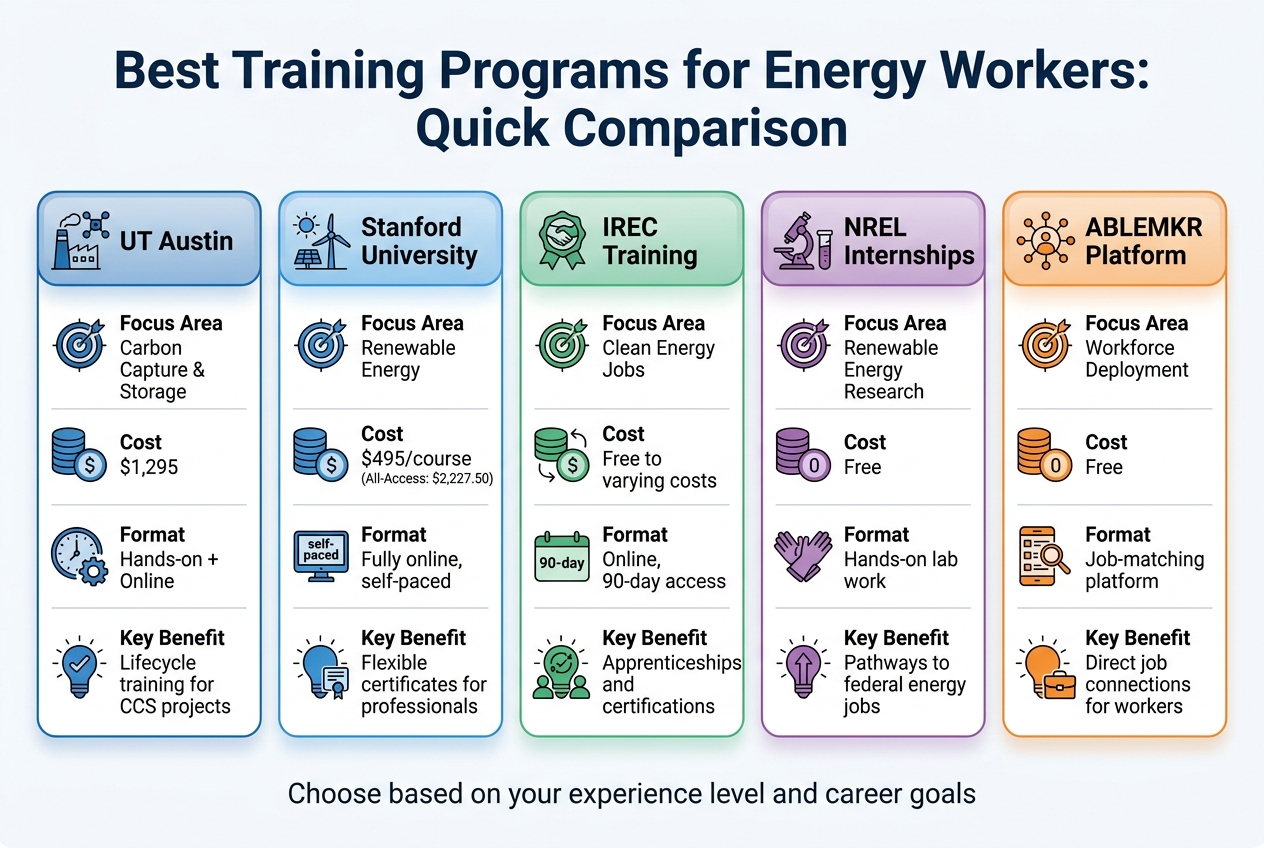
Comparison of Top 5 Energy Worker Training Programs: Costs, Focus Areas, and Benefits
Academy helps Michigan trainees launch energy efficiency careers
sbb-itb-aa28329
1. Stanford University‘s Renewable Energy Certificate Program
Stanford’s Energy Innovation and Emerging Technologies (EIET) program is designed for professionals looking to dive into the energy transition field without the need to enroll in full-time studies. By completing just 5 out of 9 available courses, participants can earn the certificate, which involves at least 30 hours of Stanford coursework. Individual courses are priced at $495, while the All-Access Plan, covering all courses, costs $2,227.50 if purchased by May 4, 2026.
Program Type
Stanford offers two distinct tracks to cater to varying professional needs:
- Professional Certificate: Requires 30–50 hours of coursework and does not require an engineering background.
- Graduate Certificate in Sustainable Energy: Involves 90–120 hours of study, including a core course (CEE 207A: Understand Energy) and a project-based elective.
Both tracks are tailored to help professionals align their expertise with the latest demands in the energy sector.
Delivery Format
The professional track is entirely online and self-paced, giving participants the freedom to work through video lectures, assignments, and exams whenever it suits them. Course materials are accessible for 60 days, or up to 365 days for those enrolled in the All-Access Plan. Additionally, students benefit from ongoing TA support throughout the course.
Danna Frolova, a Business Development Analyst, highlighted the program’s flexibility, noting how it allowed her to enhance her skills while working remotely. This format ensures that busy professionals can gain practical credentials without disrupting their schedules.
Certifications Offered
Graduates receive a Stanford Certificate of Completion, verified through blockchain technology. This digital credential makes it easy for employers to confirm expertise on professional platforms like LinkedIn. The curriculum spans key topics like the hydrogen economy, energy storage, AI-driven grid transformation, and building energy efficiency – skills that are directly applicable to roles in the evolving energy landscape.
Career Support
Although the program does not include traditional job placement services, it provides graduates with insights into the growing energy job market. The blockchain-verified certificate offers a tangible way to showcase specialized knowledge to potential employers.
Katharina Beumelberg, Chief Financial Officer at Siemens, shared her experience:
"Stanford changed my personal perspective on how I can influence the world, my organization, and my environment for the better".
This program’s forward-thinking approach makes it a compelling option for professionals aiming to thrive in the energy sector.
2. Interstate Renewable Energy Council (IREC) Training
As the energy landscape shifts, the IREC Training program plays a key role in preparing workers for new opportunities in the clean energy sector. IREC not only educates but also accredits training programs, certifying over 100 instructors and 200 programs across the U.S..
Program Type
IREC’s training structure includes three main pathways:
- Apprenticeships in Clean Energy (ACE) Network: This initiative offers free technical assistance and has helped over 1,000 individuals secure clean energy apprenticeships.
- Professional Development Courses: These courses focus on specialized areas like solar energy, battery storage, weatherization, HVAC/R, and green building.
- National Accreditation: IREC accredits third-party training providers based on ANSI-recognized standards.
These programs are designed to be flexible, using online platforms and interactive tools to make learning accessible.
Delivery Format
Training is provided through IREC’s Online Learning Hub, featuring self-paced courses with a 90-day access period. The Clean Energy Clearinghouse offers free CEU-accredited courses tailored for professionals like code officials, contractors, and firefighters. Additionally, interactive Career Maps guide job seekers in exploring career growth and salary potential. Since January 2022, the National Clean Energy Workforce Alliance has brought together over 2,800 employers, training providers, and energy justice organizations through virtual gatherings. By combining various learning formats with rigorous certification processes, IREC ensures alignment with industry standards.
Certifications Offered
IREC provides certifications for both instructors and specific job roles:
- Instructor Certification: Based on IREC Standard 01024, this credential requires meeting both educational and practical criteria and is valid for five years.
- Weatherization Roles: Certifications include Energy Auditor, Retrofit Installer Technician, Crew Leader, and Quality Control Inspector.
- Solar Credentials: These align with NABCEP roles such as PV Associate and PV Installation Professional.
All certifications include CEUs recognized by professional organizations like the International Code Council (ICC) and the American Institute of Architects (AIA).
Career Support
IREC also offers tools to support career growth. The Green Workforce Connect platform connects job seekers with local training providers and employers. Meanwhile, the Solar Ready Vets Network is tailored to assist veterans and transitioning service members. IREC’s nationally recognized credentials meet strict industry standards, helping individuals secure jobs and advance their careers.
3. National Renewable Energy Laboratory (NREL) Professional Internship Program
NREL’s internship programs give students the chance to dive into renewable energy research. Through the Research Participant Program, open year-round, undergraduate and graduate students with a minimum 3.0 GPA can join ongoing R&D projects and collaborate directly with lab experts.
Program Type
NREL offers three internship tracks designed to fit various academic levels and career paths:
- The Research Participant Program is open year-round for both undergraduate and graduate students with a minimum 3.0 GPA.
- Graduate students can apply for the Office of Science Graduate Student Research (SCGSR) program, which lasts 3–12 months and has application deadlines in March, July, and December.
- The Mines/NREL Advanced Energy Systems Graduate Program provides a 2–4 year non-thesis option for master’s or Ph.D. candidates.
Delivery Format
Interns at NREL work closely with mentors on hands-on projects within the lab’s research facilities. During the academic year, undergraduate interns can work up to 25 hours per week, while graduate interns can work up to 30 hours. Both groups can put in 40 hours per week during summer or academic breaks. SCGSR participants are required to complete formal deliverables like a Project Plan and Technical Report. Meanwhile, Research Participant Program interns showcase their work through poster presentations.
Career Support
NREL internships provide more than just research experience – they help students transition into professional roles. Those completing DOE Pathways Programs can qualify for non-competitive conversion into term or permanent federal civil service jobs. Additionally, the program includes specialized learning opportunities like the Hands-On Photovoltaic Experience (HOPE) workshop. Scheduled for July 12–17, 2026, this workshop focuses on advanced solar characterization techniques. Housing for the week-long session is approximately $505.
4. TOP Energy Training for Oil & Gas Professionals
TOP Energy Training is designed to equip oil and gas professionals with the skills needed to navigate the industry’s growing focus on carbon management. A key part of this program is its emphasis on Subsurface Skills for Carbon Capture and Storage (CCS), which addresses critical challenges as companies work toward reducing carbon emissions. By focusing on CCS, the program aligns with current industry trends and prepares participants for the sector’s evolving demands.
Program Type
As the energy sector shifts toward decarbonization, technical expertise becomes increasingly important. This program hones in on CCS competencies, covering areas like technical screening, fluid flow modeling, monitoring, and permitting. Participants also gain practical knowledge in risk mitigation, detecting CO₂ leakage, and overcoming regulatory or economic hurdles. These skills are essential for professionals aiming to play a key role in the industry’s transition to lower-carbon operations.
Delivery Format
Although specific details about TOP Energy Training’s format are limited, it likely features a combination of hands-on and online learning modules, similar to other leading oil and gas training programs. This mixed approach may include instructor-led sessions alongside self-paced online components, offering flexibility for professionals who need to balance training with their work schedules. For those currently seeking new opportunities, job-matching platforms can help connect skilled workers with energy companies. Interactive content is often used to enhance engagement and practical application.
Certifications Offered
Certifications are a cornerstone of career progression in the oil and gas industry. Among the most respected are the American Petroleum Institute (API) Individual Certification Programs (ICP), which are recognized globally for validating technical competence. For those completing CCS-specific training, these certifications provide a way to demonstrate their expertise in carbon management, a critical area for advancing decarbonization efforts. Such credentials not only verify skills but also help professionals stand out in a competitive field.
5. ABLEMKR Workforce Deployment Platform

ABLEMKR is a digital platform that connects certified energy workers directly with projects, offering a streamlined alternative to traditional training programs. Designed for professionals in industries like oil & gas, mining, utilities, and heavy infrastructure, ABLEMKR simplifies the hiring process – from certification to employment – across the United States.
Program Type
ABLEMKR functions as a digital labor marketplace, not a standard training program. It pairs pre-vetted workers with job sites based on factors like certifications, safety training, availability, and location. This allows workers to use their existing credentials to secure roles in areas such as pipeline repairs, mine development, or emergency shutdowns. These tailored matching features enhance the platform’s ability to support careers effectively.
Career Support
Workers can create a Verified Profile, which acts as a portable resume showcasing their work history, skills, and performance ratings. Through the mobile-first app, users can manage job searches and administrative tasks with ease, maintaining a continuous record of their career progress.
For employers, automated compliance checks ensure workers meet OSHA certification and trade license requirements. The platform also integrates payroll and tracks worker status in real time, simplifying operations. Workers gain access to flexible, well-paying opportunities with reliable, on-time payments – addressing common delays in the hiring process. With a strong presence in major U.S. energy hubs, ABLEMKR serves as an efficient link between workforce readiness and field deployment.
Advantages and Disadvantages
Traditional training programs for energy workers come with a mix of benefits and challenges, shaped by their structure and target audience. Academic certificate programs, for instance, provide well-rounded credentials and in-depth renewable energy knowledge tailored for leadership roles. On the other hand, certification programs offer standardized qualifications but often lack built-in job placement support, leaving graduates to navigate the job market on their own.
Programs emphasizing hands-on experience, like intensive technical courses or industry internships, offer valuable exposure to real-world practices in fields such as oil and gas. However, these opportunities are often highly competitive and focus on niche skills that may not easily transfer to other sectors. To address these limitations, alternative models have emerged to better align with the energy sector’s changing demands.
One such model is the ABLEMKR workforce deployment platform, which takes a different approach by connecting pre-certified workers directly with active job sites. Workers benefit from features like timely payments and flexible access to opportunities across key U.S. energy hubs. Employers, in turn, gain tools for real-time compliance tracking and automated credential verification. However, this platform requires workers to already possess relevant credentials and safety qualifications. While this streamlines hiring and accelerates the deployment of skilled workers for dynamic energy projects, it does place the responsibility of initial certification on the individual.
When it comes to accessibility and job placement, the outcomes vary significantly. Traditional programs often demand substantial upfront investments of time and money. Some partner with employers to assist with job placement, but others leave graduates to find positions independently. ABLEMKR reduces the uncertainty of job placement by actively matching certified professionals with critical projects. Still, workers must stay up-to-date with certifications and meet the specific requirements of each job site to remain eligible.
Conclusion
Training programs in the energy sector cater to professionals at every stage of their careers, offering tailored opportunities to meet diverse needs. The key is to choose a program that matches your current experience and aligns with your career goals in this dynamic industry.
For entry-level workers with a high school diploma or GED, programs like SkillsReady by API are a great starting point. This free training connects participants directly with major employers such as Chevron, ExxonMobil, and Hess. Similarly, those interested in union roles in utilities might explore the National Grid Energy Infrastructure Academy, which offers over 200 hours of hands-on training, three industry certifications, and even a weekly stipend during its intensive eight-week course.
Experienced professionals aiming to pivot toward emerging technologies will find specialized training essential. For instance, oil and gas experts can transition into carbon capture and storage through UT Austin’s focused program. Meanwhile, energy engineers and facility managers can broaden their credentials by completing the three-day Certified Renewable Energy Professional (REP) training.
For skilled tradespeople already certified in fields like construction, mining, or oil and gas, the ABLEMKR platform provides an alternative route. Instead of classroom-based learning, it connects workers directly to mission-critical projects across U.S. energy corridors, handling compliance tracking and credential verification along the way.
The smartest strategy combines formal education with real-world application. Start with a program that fits your current expertise and ambitions, then leverage job-matching platforms to secure opportunities in this ever-evolving sector.
FAQs
Which program fits my background and goals?
For those exploring programs, the right choice depends on your goals and expertise. If you’re looking for a broad overview of energy technologies, check out Stanford Online’s Energy Innovation and Emerging Technologies Program. Prefer hands-on experience? Solar One’s Green Workforce Program provides practical training. If you’re aiming for a career in utilities, National Grid’s Energy Infrastructure Academy is a solid option. For advanced, specialized skills, UT Austin’s Carbon Capture Program is worth considering. Additionally, ABLEMKR helps skilled workers find opportunities in high-demand energy projects.
Do I need an engineering degree for these programs?
No, an engineering degree is generally not necessary. These training programs emphasize certifications, practical experience, and achieving competency standards instead of requiring formal education in engineering.
How can I turn certifications into jobs fast?
To land a job quickly with certifications, aim for industry-recognized credentials that match what employers are seeking in fields like clean energy or project management. These certifications help employers feel confident in your abilities by proving your skills and reducing hiring risks. Programs such as the Goodwill Clean Tech Accelerator™ are designed to offer certification-focused training while connecting you directly to job opportunities. Focusing on certifications tied to current industry needs can streamline your path to an in-demand role.


