
Miscommunication costs time, money, and safety – especially in industries with diverse, dispersed teams like construction, energy, and tech. Whether it’s a missed safety protocol or unclear instructions, the risks are real. Here’s how to fix it:
- Understand communication styles: Some cultures value direct feedback; others see it as harsh. Tailor your approach to fit the team.
- Use clear tools: Mobile apps with translations, visual aids, and simplified instructions help bridge language gaps.
- Encourage feedback: Offer anonymous options and clear escalation paths to ensure everyone feels heard.
- Train leaders: Teach supervisors to ask open-ended questions and avoid idioms to prevent misunderstandings.
- Leverage technology: Platforms like ABLEMKR centralize training, compliance, and communication in workers’ native languages.
1. Construction and Heavy Infrastructure
Communication Modes
Construction sites present unique challenges for communication due to noise, dispersed teams, and hazardous environments. To address this, face-to-face pre-shift meetings and toolbox talks are essential. These sessions allow for clear demonstrations of procedures, the use of visual aids, and hands-on confirmations. During the workday, quick tailgate huddles help teams address real-time changes, while two-way radios ensure seamless communication between crew members operating heavy machinery across the site.
Mobile apps have become a game-changer, enabling workers to share drawings, photos, and updates. Many apps now include built-in translation tools, allowing non-English speakers to visually report issues. The key to effective communication is redundancy: critical safety information is shared through multiple channels – toolbox talks, visual aids like pictograms and color-coded tags, and radio or digital alerts. This ensures every worker receives and understands the message, regardless of their language or literacy level.
Beyond tools, understanding and adapting to cultural differences is just as important for effective communication.
Adapting to Different Cultures
Cultural differences often influence how workers interact with authority and report concerns. For example, on U.S. job sites with workers from high power-distance cultures, team members may hesitate to question a supervisor or admit confusion, fearing it could be seen as disrespectful. To counter this, leaders should emphasize that raising questions and reporting hazards are not only acceptable but expected. Open-ended questions like, "What potential issues do you see here?" encourage feedback without putting anyone on the spot.
Supervisors should avoid sarcasm and idiomatic expressions, as these can lead to misunderstandings. Instead, they should focus on clear explanations and invite workers to share their own practices, fostering trust. Pairing workers from different cultural backgrounds can also break down barriers and encourage informal learning, provided roles and expectations are clearly defined to maintain productivity.
Technology can further help bridge these cultural divides by providing accessible, easy-to-understand communication tools.
Technology Integration
Mobile-first tools with simple, icon-driven interfaces, large buttons, and multi-language options make it easier for workers with limited English or digital skills to stay informed. Features like photo and video uploads allow workers to report issues visually, which is often faster and more accurate than written descriptions, especially for non-native speakers. On-site training led by peer "tech champions" ensures workers can use these tools without disrupting their workflow.
Apps like ABLEMKR take things further by tracking workers’ language skills, certifications, and safety training histories. This allows supervisors to build balanced teams, such as ensuring at least one bilingual worker is present in each crew. The app also delivers site-specific instructions, safety updates, and compliance reminders in workers’ preferred languages. Employers gain real-time visibility into training statuses, eliminating the need for last-minute calls or scattered emails. This streamlined approach supports fast-paced projects, such as shutdowns or remote repairs, while reinforcing safety standards in diverse, dynamic environments.
Feedback and Escalation Protocols
Providing multiple feedback options – such as verbal channels, simple digital or paper forms, and anonymous submissions – ensures that all workers feel comfortable sharing concerns. Near-miss and hazard reports should be kept straightforward, requiring only a location, brief description, and photo. These can be submitted via mobile apps or physical drop boxes placed in high-traffic areas. Clear escalation procedures should be explained during onboarding and reinforced in toolbox talks, with real-life examples of resolved issues to build trust in the process.
In cultures where direct criticism is seen as overly harsh, supervisors should use structured feedback rather than general critiques. For instance, checklists aligned with U.S. safety standards – such as PPE usage or lockout/tagout procedures – help keep discussions focused and objective. Corrective conversations are best held in private to avoid embarrassment, while public recognition of safe practices reinforces positive behaviors without singling anyone out negatively. To ensure understanding in multilingual teams, supervisors should ask workers to repeat instructions or demonstrate tasks rather than simply asking, "Do you understand?" This approach strengthens both safety and team cohesion in cross-cultural work environments.
2. Energy, Utilities, and Extractives
Communication Modes
In the energy, utilities, and extractives sectors, operations are often spread across remote locations, time zones, and shifts. This setup brings together office engineers and field teams working on offshore platforms, pipelines, and mines. To address this, a layered communication strategy is key, aligning the communication channel with the urgency and environment. Field crews, for example, depend on radios and quick toolbox talks – these tools are critical in noisy, hazardous environments where hands-free, low-latency communication is a must. On the other hand, office and engineering teams lean on email, platforms like Teams or Zoom, and project management tools for tasks like design reviews, regulatory updates, and cross-border coordination. They often add asynchronous options such as recorded briefings or chat threads to bridge time zone gaps.
Defining clear guidelines for communication is essential. For instance, radios should be reserved for safety-critical commands, messaging apps for quick clarifications, and email for formal decisions and regulatory documentation. Training multicultural teams on these protocols ensures that everyone understands how to use the right channel for the right purpose, reducing confusion and ensuring critical messages reach the appropriate people. This structured approach also helps tackle cultural communication barriers.
Adapting to Different Cultures
Cultural differences, particularly around hierarchy and communication styles, can pose safety risks in high-hazard environments. In energy and extractives, teams often include both high power-distance cultures, where employees expect top-down instructions and may hesitate to challenge authority, and low power-distance cultures, where questioning is more common. For example, a technician from a high power-distance background might notice a safety hazard but avoid reporting it, fearing it could be seen as insubordinate.
To counter this, leaders should make it clear that safety and incident reporting are free from rank bias. Reinforce this message during pre-shift briefings, emphasizing that anyone, regardless of position, has the authority to stop work if safety is at risk. Use clear, simple language in English, avoiding idioms or humor that might confuse non-native speakers. When working with cultures that favor indirect communication, ask open-ended questions like, “Do you see any concerns with this process?” and pay attention to non-verbal cues or hesitation. In hierarchical cultures, local supervisors or cultural liaisons can play a vital role in encouraging open dialogue by modeling this behavior themselves.
Technology Integration
Technology plays a critical role in connecting dispersed teams in these industries. Digital work management and collaboration platforms create a single source of truth, minimizing miscommunication. Video conferencing tools are invaluable for pre-job planning and post-incident reviews, especially when multiple countries or contractors are involved, as they allow for visual aids and shared diagrams. To overcome language barriers, translation tools and multilingual templates ensure that safety alerts, standard operating procedures, and signage are accessible in the primary languages used on-site.
Mobile-first apps are particularly effective for delivering time-sensitive updates, micro-learning modules, and incident reporting, even in areas with limited connectivity. Platforms like ABLEMKR take this a step further by ensuring crews meet safety and communication standards before arriving on-site. Through its mobile interface, ABLEMKR provides consistent onboarding, safety updates, and instructions to culturally diverse, rotating workforces. The platform also matches workers based on certifications, availability, and location, ensuring the right mix of skills and language capabilities for specific sites. Employers benefit from real-time visibility into worker status and compliance tracking, making it easy to identify who has completed required training modules and who might need a refresher. This is especially important for fast-paced projects like pipeline repairs, mine development, or shutdowns. By establishing clear digital protocols, these systems also create a foundation for robust on-site feedback mechanisms.
Feedback and Escalation Protocols
Effective feedback systems combine formal escalation channels with accessible informal options, reinforced by leadership behavior. In energy operations, a tiered escalation map – such as crew lead → supervisor → site manager → corporate HSE/ethics – ensures that critical feedback from remote sites is addressed quickly. Visualizing and reviewing this map during onboarding helps workers understand where to direct specific concerns. Additional options like anonymous hotlines, digital forms, surveys, and open-door office hours provide alternatives for those uncomfortable with direct confrontation.
It’s equally important to communicate that safety and ethical concerns will be protected and that retaliation for reporting is prohibited. Sharing examples of past cases where reporting led to positive changes, rather than punishment, can reinforce trust. Supervisors should also be trained in active listening and non-defensive responses, particularly when receiving feedback from junior or foreign workers, to counter cultural norms that discourage speaking up. Regular follow-up communication from management, showing how worker input has led to tangible improvements, helps build trust and encourages ongoing participation in feedback processes.
3. Knowledge-Intensive and Tech Sectors
Communication Modes
In industries like software development, IT services, R&D, consulting, finance, and biotech, where tasks are often complex and teams span the globe, communication relies heavily on digital tools. These teams use a mix of asynchronous tools (like Slack, Teams chat, Jira, wikis, and email) and synchronous tools (such as video calls, standups, and design reviews). To avoid miscommunication, high-performing teams explicitly outline how each tool should be used and set clear expectations for response times – for example, 24 hours for email and 2–4 hours for chat during working hours.
Managing different time zones and workloads often requires thoughtful planning. Teams may rotate meeting times to share the burden of off-hour calls, record key meetings with summaries for those unable to attend, and centralize decisions and action items in searchable systems. Leaders also streamline communication by standardizing a small set of tools and providing onboarding guides like "how we communicate here" to reduce uncertainty. Offering multiple ways to participate ensures that team members, whether they come from direct or reserved communication styles, feel comfortable contributing.
This structured approach helps tech teams navigate the cultural nuances that come with global collaboration.
Adapting to Different Cultures
Cultural differences significantly influence communication in tech teams, particularly in areas like direct versus indirect communication, power distance, and approaches to conflict and criticism. For instance, engineers from direct communication cultures like the U.S. or Northern Europe may give straightforward feedback during a code review, which could come across as harsh to colleagues from more indirect cultures in parts of Asia or Latin America. To bridge this gap, leaders can model feedback techniques such as the "behavior + impact + suggestion" format, which pairs constructive criticism with actionable suggestions and positive reinforcement.
Power dynamics also play a role. Managers can encourage open dialogue by explicitly inviting questions, rotating presentation responsibilities, and using structured turn-taking to ensure everyone, including junior team members or non-native English speakers, has a chance to be heard. Techniques like active listening – where participants paraphrase what they’ve heard to confirm understanding – reduce misunderstandings caused by language or communication style differences.
To support these efforts, teams often use quick e-learning modules and "culture briefs" tailored to the regions represented in the team. Some organizations even appoint cultural liaisons to advise on sensitive communications or region-specific projects.
Technology Integration
Advanced technology plays a big role in bridging cultural and language divides. Tools like real-time translation, AI-powered transcription, and built-in language support in communication platforms make meetings and updates more accessible. Features like auto-transcribed meeting recordings with searchable captions allow non-native English speakers to revisit complex discussions at their own pace. Wikis and knowledge bases act as a central hub, where teams use clear, simplified English, avoid idioms, and include visuals like diagrams to clarify meaning across cultures.
Some companies are even experimenting with AI tools that flag potentially insensitive or unclear language in internal communications, helping teams maintain cultural awareness at scale. By mapping workflows – such as product discovery, design, testing, and release – and assigning specific tools and communication norms to each stage, teams create a structured environment. Templates for design documents, incident reports, and RFCs guide contributors toward concise, organized communication that’s easier to understand across different languages and cultures.
Feedback and Escalation Protocols
Clear feedback and escalation protocols are essential for smooth operations. Teams define specific thresholds – like production incident severity levels or customer-impact criteria – and link them to appropriate escalation paths and timelines. For example, a Sev-1 production outage might trigger immediate action, including paging the on-call engineer, initiating a real-time incident channel, and starting a bridge call. Meanwhile, a Sev-3 issue might be logged, discussed in the next standup, and tracked in the backlog.
To address cultural differences – such as some team members being hesitant to "bother" managers – teams document that raising risks early is encouraged and rewarded. Multiple escalation options, like reaching out to a direct manager, using an incident channel, or submitting concerns anonymously, give employees flexibility to choose what feels most comfortable.
Feedback practices are standardized through 1:1 meetings, sprint retrospectives, and structured code reviews. Using formats like "What went well / What could be better / Experiments for next sprint" helps depersonalize critiques, focusing on processes and outcomes rather than individuals. Post-incident reviews are similarly blameless, emphasizing system and process improvements to encourage transparency in the future. Managers can also set an example by openly seeking feedback themselves and acting on it, showing the team that all voices are valued.
sbb-itb-aa28329
Communication in Multicultural Teams: 6 Steps to Make it Work | Be an Effective Communicator
Pros and Cons
Cross-Cultural Communication Best Practices by Industry: Construction, Energy, and Tech Sectors
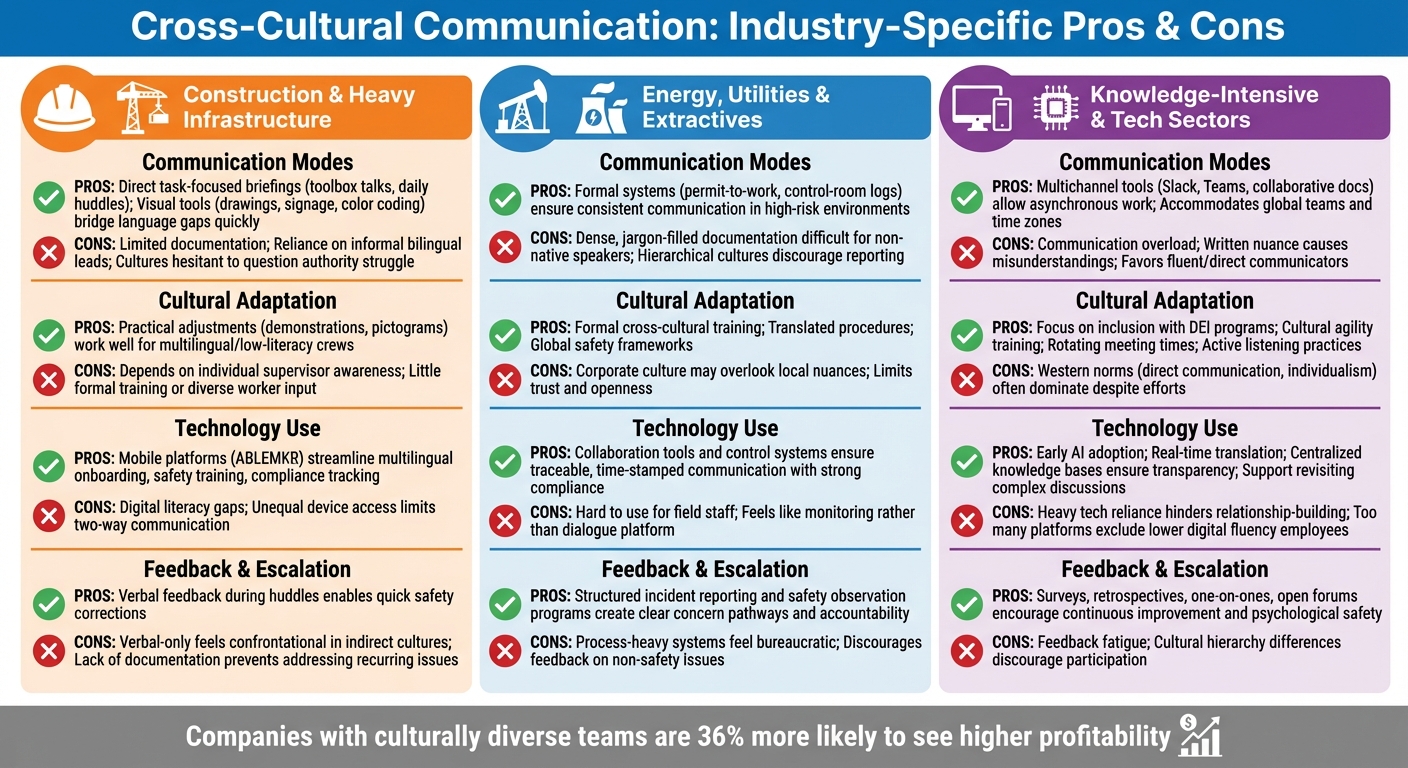
Different industries come with their own set of challenges and advantages when it comes to communication and teamwork. The table below highlights the main pros and cons discussed earlier for each sector.
| Industry | Communication Modes | Adaptation to Different Cultures | Technology Use | Feedback & Escalation Protocols |
|---|---|---|---|---|
| Construction & Heavy Infrastructure | Pros: Direct, task-focused briefings (like toolbox talks and daily huddles) and visual tools (e.g., drawings, signage, color coding) help bridge language gaps quickly. Cons: Limited documentation and reliance on informal bilingual leads can stifle communication, especially in cultures where questioning authority is uncommon. |
Pros: Practical adjustments – like demonstrations and pictograms – are effective for multilingual or low-literacy crews. Cons: These adaptations often depend on individual supervisors’ cultural awareness, with little formal training or input from diverse workers. |
Pros: Mobile platforms like ABLEMKR streamline multilingual onboarding, safety training, and compliance tracking. Cons: Digital literacy gaps and unequal device access can limit the effectiveness of these tools for two-way communication. |
Pros: Verbal feedback during huddles enables quick safety corrections. Cons: Verbal-only feedback may feel confrontational in indirect-feedback cultures, and the lack of documentation can prevent recurring issues from being addressed. |
| Energy, Utilities & Extractives | Pros: Formal systems (e.g., permit-to-work, control-room logs) ensure consistent communication in high-risk environments. Cons: Dense, jargon-filled documentation can be difficult for non-native English speakers, and hierarchical cultures may discourage issue reporting. |
Pros: These industries often provide formal cross-cultural training, translated procedures, and global safety frameworks. Cons: Such measures may impose a corporate culture that overlooks local nuances, limiting trust and openness. |
Pros: Collaboration tools and control systems ensure traceable, time-stamped communication with strong compliance features. Cons: These systems are sometimes hard to use for field staff and may feel more like monitoring tools than platforms for dialogue. |
Pros: Structured incident reporting and safety observation programs create clear ways to raise concerns and ensure accountability. Cons: The process-heavy nature of these systems can feel bureaucratic, discouraging feedback on issues beyond safety. |
| Knowledge-Intensive & Tech Sectors | Pros: Tools like Slack, Teams, and collaborative documents allow for multichannel communication and asynchronous work, accommodating global teams and different time zones. Cons: Communication overload and reliance on written nuance can lead to misunderstandings, often favoring fluent or direct communicators. |
Pros: Inclusion is often a focus, supported by structured DEI programs, cultural agility training, and practices like rotating meeting times and active listening. Cons: Despite these efforts, Western norms of direct communication and individualism often dominate, even in global teams. |
Pros: Early adoption of AI tools, real-time translation, and centralized knowledge bases ensures transparency and supports revisiting complex discussions. Cons: Heavy reliance on tech can hinder relationship-building, and too many platforms may exclude employees with lower digital fluency. |
Pros: Surveys, retrospectives, one-on-ones, and open forums encourage continuous improvement and psychological safety. Cons: Feedback fatigue and cultural differences in hierarchy can discourage participation from some team members. |
This comparison highlights how aligning communication strategies with industry needs can improve safety and efficiency. Multicultural teams, when managed well, can excel in creativity and problem-solving. However, poor communication can lead to conflict and reduced performance. Success depends on tailoring communication practices to the specific demands of the industry – whether it’s the fast-paced environment of a construction site, the strict compliance of an oil field, or the distributed nature of a tech team.
For U.S.-based construction and energy sectors, platforms like ABLEMKR help standardize multilingual safety training and compliance, reducing the inconsistencies that arise from relying solely on bilingual supervisors. In tech, the focus shifts to ensuring that tools, meeting norms, and evaluations don’t confuse communication style with skill or competence. Across all fields, incorporating multiple feedback channels (including anonymous options) and training leaders on cultural differences in hierarchy and feedback styles can turn one-way communication into meaningful dialogue that supports cross-cultural collaboration.
Conclusion
Effective cross-cultural communication in construction and energy hinges on straightforward, repeatable practices that promote clarity and safety. Lessons from various industries show that field teams thrive with plain-language briefings, visual aids, and regular check-ins, while tech teams excel by emphasizing feedback loops and clear documentation. Global teams successfully combine these methods by using simple English, concise confirmations, and digital tools to centralize certifications, procedures, and updates.
For U.S.-based companies managing multicultural crews across multiple sites and time zones, the challenge is balancing standardized communication with the flexibility needed for diverse teams. Establishing clear communication norms – like preferred channels, response times, and escalation procedures – can make a noticeable impact. Training supervisors on active listening and understanding cultural differences in hierarchy and feedback styles is equally important. Pairing critical instructions with visual aids or written summaries and scheduling regular debriefs can help identify and address issues early. This approach directly mitigates risks outlined at the start of any project.
Platforms such as ABLEMKR are designed to scale these practices across industries like construction, oil & gas, mining, and utilities. ABLEMKR’s centralized worker profiles and mobile alerts ensure that essential messages are understood, even across language barriers. By matching workers to sites based on verified skills and compliance status, supervisors can focus on fostering the interpersonal and cultural understanding that keeps teams safe and productive.
Research shows that companies with culturally diverse teams are 36% more likely to see higher profitability. In high-risk sectors, where communication breakdowns are often the root cause of serious incidents, structured workflows, cultural training, and digital tools are indispensable for protecting workers, ensuring compliance, and completing projects on schedule.
FAQs
What are effective ways for supervisors to encourage feedback in cultures with high power distance?
Supervisors can encourage feedback in high power-distance cultures by prioritizing trust and ensuring employees feel respected and valued. A good starting point is creating an environment where communication feels safe – where team members know their ideas will be heard without fear of negative repercussions.
To navigate hierarchical barriers, consider culturally appropriate methods like anonymous feedback tools or informal, private conversations. These approaches can make employees feel more at ease when sharing their perspectives. Supervisors should also take the lead in fostering openness by asking thoughtful, open-ended questions and expressing genuine gratitude for employee input. This helps build a workplace where collaboration and open communication thrive.
What are the most effective tools for breaking language barriers in cross-cultural teams?
Breaking down language barriers in diverse teams is much simpler with the right tools in place. Real-time translation apps, such as Google Translate or Microsoft Translator, allow team members to communicate clearly by instantly converting spoken or written text. On top of that, many communication platforms now offer built-in multilingual features, like chat apps that automatically translate messages, making collaboration more seamless.
Using these technologies can lead to stronger connections, increased productivity, and a work environment that feels welcoming and inclusive for everyone, no matter their language or background.
What are the best ways to maintain effective communication in teams working across time zones?
To keep communication running smoothly in teams spread across different time zones, setting clear expectations and choosing the right collaboration tools is key. Using shared digital calendars can make scheduling meetings easier, while rotating meeting times ensures everyone shares the burden of inconvenient hours.
For day-to-day communication, asynchronous tools like email or project management platforms offer a great solution. They let team members contribute when it works best for them, without the need to be online at the same time.
Recording meetings for those who can’t join live and establishing reasonable response time guidelines can also go a long way in avoiding confusion. These strategies are especially important in industries like construction and energy, where efficient coordination is critical to keep projects on track.


