
The U.S. energy sector is shifting towards advanced digital tools like SCADA systems, GIS mapping, and digital twins, creating a demand for professionals with strong technical skills. Whether you’re a technician aiming for leadership roles or an engineer looking to specialize in automation, online courses provide a flexible way to gain these skills. Below are top programs tailored for energy professionals:
- MITx Future Energy Systems XSeries: Focuses on energy systems analysis and decarbonization strategies.
- Principles of Modeling, Simulation, and Control for Electric Energy Systems (MITx): Teaches power system modeling with tools like MATLAB/Simulink.
- Energy Production, Distribution & Safety Specialization (SUNY on Coursera): Covers power systems, safety protocols, and regulatory compliance.
- Wind Energy Course (Technical University of Denmark): Offers training in wind farm design and turbine performance analysis.
- Solar Photovoltaic Technologies (edX): Focuses on PV system design and performance optimization.
- Modelling and Measuring the Energy Transition (Politecnico di Milano): Explores energy planning and transition modeling.
- Energy Academy Courses (DNV): Provides training in digital twins, AI-driven maintenance, and safety standards.
These courses are fully online, self-paced, and offer certificates to boost your career in the evolving energy industry. Whether you’re new to the field or an experienced professional, there’s a course to match your goals.
EnergyFundamentalstraining | Upskill at no costwith energy experts
1. MITx Future Energy Systems XSeries (MIT Energy Initiative)
The MITx Future Energy Systems XSeries, created by the MIT Energy Initiative and available through edX, is well-regarded for its in-depth focus on energy systems. This program is designed for professionals who want to deepen their understanding of the theoretical aspects of energy systems. Offered entirely online by one of the world’s leading institutions, the course provides a flexible learning experience that fits the schedules of working professionals. Its combination of academic depth and convenience makes it an excellent choice for those looking to build a strong knowledge base in energy-related digital skills.
For those who also want to enhance their practical, job-ready skills, ABLEMKR offers industry-specific certifications and safety training to complement academic learning.
To get the most up-to-date details about the course structure, enrollment options, and curriculum, check out the information provided on edX.
2. Principles of Modeling, Simulation, and Control for Electric Energy Systems (MITx)
Focus on Digital Tools and Analytical Skills Used in Energy Projects
This online course from MITx, hosted on edX, equips professionals with the skills to build mathematical models of power system components and simulate grid behavior during disturbances. Using tools like MATLAB/Simulink or Python, participants learn to create state-space models, run dynamic simulations, and fine-tune controllers for better system performance. Assignments include simulating scenarios like grid disturbances, load variations, or the integration of renewable energy sources. These tasks involve analyzing system responses with digital plotting and numerical solvers, providing a hands-on experience that encourages a deeper understanding of complex systems.
The course emphasizes systems thinking and data-driven analysis, teaching learners to view grids as interconnected dynamic systems. For instance, participants might model the integration of a solar plant and simulate various operating conditions to optimize protection settings and control strategies.
Offered by Recognized Institutions or Platforms
With MIT’s expertise at its core, this course delivers both technical knowledge and enhanced career prospects. Known for its leadership in power systems, renewable energy, and control engineering, MIT’s reputation adds significant value to the course. For U.S.-based engineers and technicians, earning a verified MITx certificate can boost résumés, support career advancement, and demonstrate readiness for roles focused on digital technologies in utilities, system operators, or consultancy firms. While the course can be audited for free, learners can pay a fee – typically between $50 and $300 – for a verified certificate.
Available Online with Flexible Formats
Designed for working professionals, the course is offered entirely online through the edX/MITx platform. It features short video lectures, interactive problem sets, downloadable modeling files, and auto-graded assignments. Spanning several weeks, the course requires an estimated 3–6 hours per week, allowing learners to progress at their own pace. Flexible deadlines, aligned with U.S. time zones, make it accessible for shift workers and field staff.
Skill Outcomes Applicable to Field Operations, Planning, or Safety
Graduates of this course gain critical skills in disturbance and contingency simulations, enhancing their ability to understand system dynamics and control. These skills are essential for identifying unsafe operating conditions, such as voltage instability, overcurrent issues, or oscillatory modes, which could lead to outages or equipment damage. For professionals involved in grid upgrades or substation commissioning, such as those working with ABLEMKR crews, these capabilities are vital for defining technical requirements, ensuring safety, and designing workflows that match the right personnel – those with high-voltage, protection, or automation expertise – to critical tasks.
3. Energy Production, Distribution & Safety Specialization (State University of New York on Coursera)
Practical Skills for Energy Projects
This four-course program from SUNY is all about hands-on learning tailored to the energy sector. It equips participants with the tools to design electrical schematics, model components, carry out engineering calculations, and estimate costs for energy infrastructure projects. Through project-based assignments, learners tackle tasks like mapping safety protocols and designing electrical systems that meet industry standards.
Academic Credibility and Industry Recognition
Offered by the State University of New York through Coursera, this specialization combines academic rigor with the convenience of online learning. With over 63,000 enrollments and an impressive 4.7 out of 5 rating, it’s a trusted choice for professionals aiming to enhance their credentials. Completing the program earns participants a shareable SUNY certificate, which can boost their LinkedIn profiles and résumés. These credentials are well-regarded in industries like oil and gas, utilities, and renewable energy throughout the U.S.
Flexible, Online Learning for Busy Professionals
The program is designed to fit around busy schedules. Requiring around 20 hours of total study time, most participants complete it in four weeks by dedicating 3–5 hours per week. Its self-paced, 100% online format – with no strict deadlines – makes it particularly appealing for those with irregular work hours, such as shift workers or field staff. Enrollment is free, and learners can opt for a certificate by subscribing to Coursera, typically at $49 per month. Plus, all materials, including video lectures and readings, remain accessible indefinitely.
Skills That Translate to Real-World Energy Challenges
Graduates leave the program with expertise in areas like electrical safety, cost estimation, and compliance tracking. These skills prepare professionals – whether technicians, planners, or safety managers – to handle the regulatory and operational demands of critical energy projects, including those led by organizations like ABLEMKR.
4. Wind Energy Course (Technical University of Denmark on Coursera)
Dive into Digital Tools and Analytical Techniques for Energy Projects
This course zeroes in on the technical tools essential for wind energy projects. Students get hands-on experience with computational fluid dynamics (CFD) software to model wind flow and use aeroelastic simulations to evaluate turbine performance under various conditions. A key feature of the program is practical training with FAST (Fatigue, Aerodynamics, Structures, and Turbulence) – a widely used tool for predicting energy output and structural loads. Additionally, learners explore the Global Wind Atlas to perform site-specific energy cost and performance calculations. These skills are directly applicable to planning and optimizing onshore and offshore wind farms across the U.S..
Backed by a Leading Institution and Platform
The course is offered by the Technical University of Denmark (DTU), a respected leader in wind energy research. Hosted on Coursera, it has attracted over 170,000 participants and boasts an impressive 4.7-star rating. Completing the course earns students a DTU certificate, which is highly regarded by employers in the renewable energy sector, especially for roles involving wind farm development and grid integration.
Flexible Online Learning Experience
This fully online program is designed for flexibility, making it accessible to a wide range of learners. It spans about 13 hours over four weeks, divided into 16 modules and 17 assignments. Taught by over 15 DTU experts, the course covers topics like wind forecasting and high-voltage direct current (HVDC) technology for offshore installations. Students can audit the course for free or opt to purchase a certificate for $49. All materials are accessible on any device, ensuring convenience.
Practical Skills for Real-World Applications
Graduates come away with valuable skills in turbine siting, digital load analysis, and risk assessment – critical for optimizing offshore projects and maintaining safety standards. The curriculum incorporates real-world CFD scenarios to refine wind farm layouts, potentially increasing energy yield by 5–10%. These capabilities align with the growing demand for skilled professionals in the wind energy sector. According to the U.S. Bureau of Labor Statistics, the industry is projected to add 45,000 wind technician jobs by 2031. This course equips participants with the technical expertise needed to meet the evolving demands of modern energy projects.
sbb-itb-aa28329
5. Solar Photovoltaic Technologies (EdX Programs)

Focus on Digital Tools and Analytical Skills Used in Energy Projects
EdX offers standout courses in solar photovoltaic (PV) technologies, with TU Delft’s "Solar Energy: Photovoltaic Technologies" being a key highlight from its Solar Energy Engineering MicroMasters program. This course equips learners with the know-how to size PV systems, calculate the levelized cost of energy (LCOE) using simplified numerical methods, and assess energy yield. By working with real-world datasets like irradiance profiles and load curves, students learn to optimize array layouts and configurations. These methods closely align with the workflows engineering teams use when preparing feasibility studies or interconnection applications . The curriculum also covers interpreting PV module datasheets, estimating performance under various conditions, and conducting economic assessments for projects ranging from residential to utility-scale . This technical training is further supported by courses from other top-tier institutions.
Offered by Recognized Institutions or Platforms
TU Delft is widely respected for its contributions to solar energy research, and its MicroMasters program on EdX is consistently ranked among the best renewable energy courses. This program includes over 20 energy-related courses, featuring quizzes and hands-on assignments reviewed by prestigious institutions like MITx, DelftX, and Stanford Online. Learners have rated the solar PV courses highly, with an average score of about 4.5 out of 5, often praising the clear explanations and use of practical examples. Completing these rigorous courses demonstrates a solid understanding of solar PV systems, preparing professionals for quick deployment in U.S. energy projects.
Available Online with Flexible Formats
With a strong academic foundation, these programs are offered entirely online and in flexible formats. U.S.-based professionals can access video lectures, readings, and problem sets on demand, making it easy to balance learning with work schedules, field rotations, or project deadlines. Learners progress through modular content at their own pace, typically dedicating a few hours per week over several weeks. EdX employs a freemium model: courses can be audited for free, while verified certificates range from $100 to $300 per course. Complete MicroMasters programs cost several hundred to over $1,000. For workforce training, employers can license content through enterprise plans, enabling large-scale skill development.
Skill Outcomes Applicable to Field Operations, Planning, or Safety
Graduates acquire practical skills such as interpreting PV module datasheets, assessing site conditions (solar resource, shading, temperature), and designing array layouts with proper balance-of-system sizing . The courses also cover essential topics like electrical safety, overcurrent protection, grounding, and code-compliant designs to minimize arc-fault risks and improve system reliability on U.S. job sites . These competencies are directly relevant to careers in solar installation, PV system design, and renewable energy analysis, aligning with the growing need for digital skills in the U.S. energy sector . Companies can enroll teams in these programs as part of structured training plans, scheduling modules around project timelines and using completion data to measure skill development and assign workers to solar-related projects .
6. Modelling and Measuring the Energy Transition (Politecnico di Milano)
Focus on Digital Tools and Analytical Skills in Energy Projects
This course zeroes in on the essentials of energy accounting, planning, and assessing the impacts of decarbonization efforts. Participants get hands-on experience with Excel-based modeling and the MARIO tool to develop quantitative scenarios and interpret their results. These skills are directly applicable to tasks like planning renewable energy integration, analyzing emissions trajectories, and comparing technology options across utilities, oil and gas sectors, and industrial operations. By working with datasets that include energy balances, technology performance, and emissions factors, learners can create baseline energy system accounts, design transition scenarios (like boosting renewable energy use or improving efficiency), and measure both the emissions reductions and economic effects. This quantitative approach builds on earlier discussions about digital tools, emphasizing the importance of data-driven decision-making in energy projects.
Offered by a Recognized Institution
The course is developed by Politecnico di Milano, one of Europe’s top technical universities, and stands out as part of its highly regarded sustainability and renewable energy programs. Its connection to this prestigious engineering school ensures a rigorous, numbers-focused approach. Completing this program not only adds weight to résumés for roles in energy planning, sustainability, or strategy but also serves as a strong talking point for professionals aiming to specialize in analytics-driven energy transition modeling.
Available Online with Flexible Learning Options
The program is fully online and designed with flexibility in mind. It includes self-paced modules featuring recorded lectures, guided exercises, and practical sessions. Divided into two main modules that address global and regional energy-transition challenges, the course is particularly convenient for U.S.-based shift workers and field professionals, as the content can be accessed at any time, across time zones.
Skill Outcomes for Planning and Operations
By the end of the course, participants will have the skills to build detailed energy and economic accounts, plan focused energy interventions, and evaluate their impacts quantitatively. These analyses can support integrated resource plans, guide internal investment strategies, or enhance stakeholder presentations. The course also delves into the system-wide effects of transition decisions – for instance, how changes in the energy generation mix might influence fuel logistics, maintenance schedules, or the retirement of infrastructure. This knowledge bridges the gap between office-based planners and field operations, improving coordination. These advanced modeling capabilities, combined with earlier digital tool training, prepare energy professionals to tackle the challenges of transitioning to decarbonized systems.
7. Energy Academy Courses (DNV)
A Spotlight on Digital Tools and Analytical Expertise in Energy Projects
As the energy industry increasingly leans on digital solutions for real-time monitoring and operational improvements, DNV’s Energy Academy steps up to meet these demands. Their training programs focus on integrating real-time data and managing digital infrastructure within power systems, renewable energy, and energy transition projects. The curriculum covers essential topics like digital twin modeling for asset management, AI-powered predictive maintenance for offshore wind farms, and data analytics for assessing energy risks. Participants gain hands-on experience with tools like digital twins, AI-driven maintenance systems, and Python-based analytics to simulate long-term energy transitions and optimize infrastructure. These skills are not just theoretical – they’re making a tangible difference in the field. For example, case studies from oil rigs show a 20% reduction in downtime, while North Sea platforms using digital checklists from DNV training reported a 15% decrease in safety incidents. This emphasis on precision and practical application ties seamlessly into the broader context of energy upskilling.
Backed by a Trusted Institution
With over 150 years of expertise in energy assurance, DNV brings unmatched credibility to its training programs. The Energy Academy collaborates with industry bodies to ensure its courses align with real-world needs. Instructors are seasoned consultants and advisors, teaching the same methodologies they use in power system studies and renewable energy projects. Course content is also shaped by authoritative resources like DNV’s Energy Transition Outlook. Each year, more than 50,000 professionals participate in DNV’s programs, and alumni report career benefits such as a 25% faster promotion rate in roles involving digital energy tools. This strong reputation reinforces the program’s practical, job-ready focus.
Flexible Online Learning for Busy Professionals
DNV offers its courses through a mobile-friendly platform designed for professionals working in key U.S. energy hubs. Training options include self-paced modules (lasting 3 to 12 weeks), live webinars, and blended formats, allowing participants to fit learning into their schedules. Most courses require just 3–5 hours of weekly commitment, making them manageable for those juggling shift work, outages, or other operational demands. The platform boasts an 85% completion rate for online modules, a testament to its adaptability for working adults.
Practical Skills for Operations, Planning, and Safety
Participants leave these courses with actionable skills like real-time asset monitoring, drone-based inspections, VR hazard simulations, and blockchain applications for compliance. They also gain expertise in load flow analysis, stability studies, and risk-based maintenance, enhancing both day-to-day operations and long-term strategic planning. The training places a strong emphasis on safety, particularly for high-risk environments like offshore platforms, pipelines, and large-scale renewable installations. Companies using workforce deployment platforms like ABLEMKR can integrate DNV Energy Academy training into their upskilling strategies, ensuring teams arrive on-site equipped with the technical, digital, and safety expertise required for modern energy projects.
Course Comparison Table
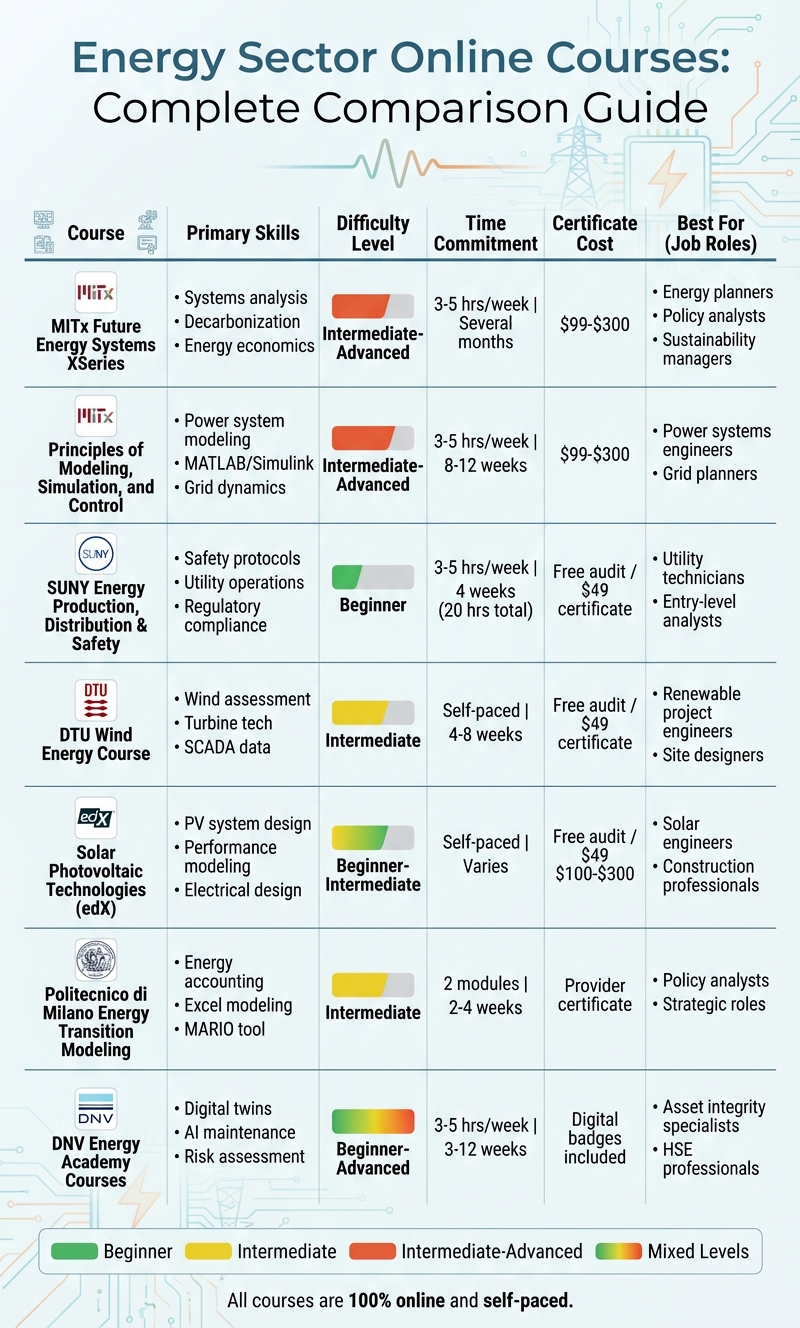
Online Energy Sector Courses Comparison: Skills, Duration, and Certification
The table below provides a detailed comparison of various courses, outlining the skills you’ll acquire, the difficulty level, weekly time commitment, and certification options available upon completion. This side-by-side view makes it easier to find a course that aligns with your career path, schedule, and professional goals. Whether you’re a field technician transitioning into renewables, a grid engineer refining your modeling expertise, or a safety professional preparing for high-risk energy sectors, this guide has you covered.
Courses cater to a range of experience levels. Beginner options like SUNY’s specialization are perfect for those new to the field or shifting from construction. Intermediate programs, such as Wind Energy or Solar Photovoltaic Technologies, suit individuals with some technical background. For advanced learners, MITx offers rigorous courses designed for professionals with a solid grasp of calculus, physics, and programming. DNV’s Energy Academy provides a mix of entry-level awareness modules and technical standards courses for seasoned professionals.
All courses are fully online and self-paced, allowing you to balance learning with your work schedule. Platforms like Coursera and edX offer free auditing options, with payment required only if you want a shareable certificate. Below is a detailed table to help you compare courses based on skills, difficulty, time commitment, and certification options.
| Course & Provider | Primary Skills Covered | Difficulty | Time per Week | Total Duration | Certificate Options | Best For / Job Role |
|---|---|---|---|---|---|---|
| MITx Future Energy Systems XSeries (MIT Energy Initiative) | Systems energy analysis, decarbonization modeling, energy economics, policy, and quantitative methods | Intermediate to Advanced | 3–5 hrs/week | Several months (XSeries) | Paid verified certificate (edX), $99–$300; XSeries certificate upon full completion | Energy planners, policy analysts, sustainability managers, engineers seeking strategic upskilling |
| Principles of Modeling, Simulation, and Control for Electric Energy Systems (MITx) | Power system modeling, grid dynamics, control theory, simulation of electric networks, MATLAB/Simulink-type tools | Intermediate to Advanced | 3–5 hrs/week | Approx. 8–12 weeks | Paid verified certificate (edX), $99–$300 | Power systems engineers, grid planners, control room engineers |
| Energy Production, Distribution & Safety Specialization (SUNY on Coursera) | Electric power systems, natural gas infrastructure, utility operations, safety protocols, regulatory compliance, foundational digital skills | Beginner | 3–5 hrs/week | Approx. 4 weeks (~20 hours total) | Free audit; paid certificate ~$49 (shareable on LinkedIn) | Utility technicians, entry-level energy analysts, workers transitioning to green energy |
| Wind Energy Course (Technical University of Denmark on Coursera) | Wind resource assessment, turbine technology, power curve analysis, wind farm layout, SCADA data interpretation | Intermediate | Self-paced (16 modules) | Varies (typically 4–8 weeks) | Free audit; paid certificate ~$49 (DTU-issued) | Renewable project engineers, site designers, technicians moving into design roles |
| Solar Photovoltaic Technologies (edX Programs) | PV system design, performance modeling, sizing and layout, electrical design, solar calculation tools | Beginner to Intermediate | Self-paced | Varies by program | Free audit; paid verified certificate $99+ | Renewable project engineers, construction professionals entering solar, technicians aspiring to design |
| Modelling and Measuring the Energy Transition (Politecnico di Milano) | Energy accounting, scenario modeling in Excel, impact assessment, MARIO tool for energy/economic analysis | Intermediate | Two modules with practical Excel exercises | Approx. 2–4 weeks | Provider-branded certificate | Policy analysts, energy planners, sustainability managers, strategic roles |
| Energy Academy Courses (DNV) | Power system risk assessment, grid code compliance, digital twin modeling, AI-driven maintenance, asset integrity, HSE standards | Beginner to Advanced (varies by course) | 3–5 hrs/week | 3–12 weeks (varies by course) | Provider-branded digital badges and certificates | Asset integrity specialists, HSE professionals, reliability engineers, utility and oil & gas workers |
When selecting a course, focus on the skills you’ll gain and the recommended job roles. Then, ensure the time commitment and difficulty level fit your current situation and goals.
Conclusion
The energy sector is undergoing a major shift, with digital skills like modeling, simulation, data analysis, and energy transition planning becoming essential for new opportunities. The courses highlighted in this guide – from advanced systems modeling at MITx to SUNY’s safety and distribution training and DTU’s Wind Energy Course – equip professionals with the tools needed for today’s energy jobs.
When selecting a course, think about where you are in your career. If you’re new to the industry or transitioning from fields like construction, beginner-friendly programs such as SUNY’s specialization are a great starting point. For those already in renewables or grid operations, advanced offerings from institutions like MIT, Politecnico di Milano, or DNV can help refine your technical expertise. Many platforms also allow free course audits, with certification options ranging from $49 to $300.
These certifications are in demand, with high enrollment numbers and strong reviews reflecting their value to employers in utilities, oil and gas, mining, and heavy infrastructure. Shareable credentials like these are widely recognized and can open doors to advanced energy projects.
Once certified, platforms like ABLEMKR can help connect you to critical energy projects across the U.S., matching your skills and certifications to roles in areas like pipeline repair, grid operations, and renewable energy installations. This combination of online learning and targeted workforce placement shows how digital upskilling is reshaping the energy industry, making it easier to deploy skilled talent where it’s needed most.
Check out the comparison table, pick a course that fits your goals, and take the next step. The energy transition is moving fast, and those who invest in digital skills today will play a key role in shaping the future of industrial development.
FAQs
What are the advantages of earning a certificate from online energy courses?
Earning a certificate through online energy courses can be a game-changer for your career. It highlights your expertise and specialized skills, making you stand out to potential employers. Plus, it shows you’re dedicated to staying up-to-date with industry standards, safety practices, and the latest digital tools shaping energy-related jobs.
A certification doesn’t just enhance your resume – it can also open doors to better-paying roles and make you a strong candidate for critical projects. In a field that’s constantly evolving, staying certified ensures you’re ready to tackle new challenges and meet industry demands head-on.
How do these courses support professionals with demanding schedules?
These online courses are designed with busy energy professionals in mind, offering flexible learning options like self-paced modules. This setup lets participants complete their training whenever it suits them, making it easier to juggle work responsibilities and personal life.
Additionally, many programs include on-demand content, granting access to materials anytime, anywhere. This is particularly valuable for those working unpredictable hours or in demanding roles, ensuring they can gain new skills without interrupting their routines.
What are the best online courses for someone switching to a career in the energy sector?
If you’re moving into the energy sector from another field, starting with foundational courses can be incredibly helpful. Programs like Energy Industry Fundamentals or Introduction to Oil & Gas are excellent options. They provide a broad understanding of energy operations and introduce key concepts, technologies, and tools commonly used in the industry. These courses lay the groundwork for building expertise in your new career path.
For those who prefer a more practical approach, look into courses that target specific skills or certifications needed for energy-related roles. For example, safety training or mastering digital tools relevant to the sector can be valuable. Not only will these skills deepen your understanding, but they’ll also help you stand out in a competitive job market.


