
Fire safety is critical for renewable energy facilities, especially with the unique risks posed by Battery Energy Storage Systems (BESS), solar panels, and wind turbines. Certifications ensure compliance with safety standards, reduce project delays, and protect workers and infrastructure. Here’s a quick summary of the top certifications:
- NFPA 855: Focuses on safe installation of energy storage systems, covering fire barriers, ventilation, and emergency plans.
- UL 9540: Evaluates the safety of entire energy storage systems, ensuring all components work together to prevent fires.
- UL 9540A: Tests fire behavior and spread in battery systems, shaping safety protocols like spacing and ventilation.
- DNV-SE-0077: Targets fire risks in wind turbines and marine energy systems, ensuring proper fire detection and suppression.
- IREC Fire Safety Training: Provides first responders with essential training for managing solar and energy storage emergencies.
- NABCEP Fire Safety CEUs: Offers continuing education for renewable energy professionals, focusing on fire codes and safety measures.
- CFPS Certification: Validates expertise in fire protection, particularly for managing risks in complex energy systems.
These certifications not only enhance safety but also streamline permitting and reduce financial risks. Early planning and collaboration with fire authorities are key to navigating these processes efficiently.
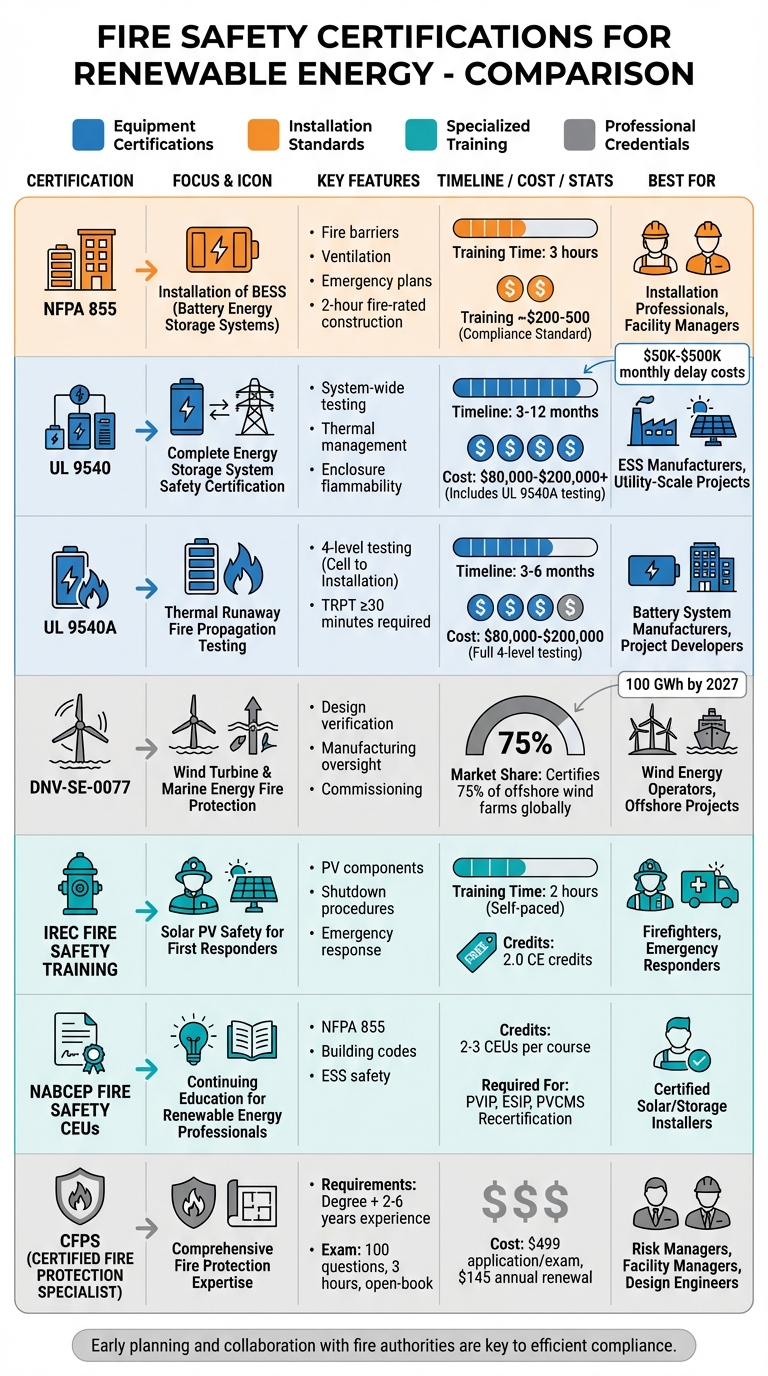
Top 7 Fire Safety Certifications for Renewable Energy Facilities Comparison
1. NFPA 855 Certification

Relevance to Renewable Energy Facilities
NFPA 855, or the "Standard for the Installation of Stationary Energy Storage Systems", sets the groundwork for ensuring safety at sites using Battery Energy Storage Systems (BESS). While UL 9540 focuses on certifying the equipment itself, NFPA 855 governs the proper installation practices. This distinction is key, as compliance with NFPA 855 is often required for installations to pass inspections conducted by local fire marshals.
The standard outlines essential installation requirements, including specifications for room construction, separation distances between units, fire barriers, ventilation systems, and emergency response plans. For instance, NFPA 855 mandates at least 2-hour fire-rated construction unless testing demonstrates a lower level of risk. Additionally, mechanical exhaust systems must ensure that flammable gas concentrations remain below 25% of the Lower Explosive Limit (LEL), further emphasizing safety.
Focus on Fire Safety Standards and Protocols
NFPA 855 addresses every stage of an energy storage system’s lifecycle – covering its design, construction, operation, maintenance, and eventual decommissioning. The risks associated with different battery chemistries are a key consideration. For example, Lithium Iron Phosphate (LiFePO₄) batteries have a thermal runaway onset temperature of about 518°F, much higher than the 392°F threshold for Nickel Manganese Cobalt (NMC) batteries. This difference often results in less demanding requirements for LiFePO₄ systems.
A practical example of this flexibility can be seen in a 2 MWh LiFePO₄ system installed outdoors in California. Thanks to a UL 9540A test report confirming no thermal propagation, the project met NFPA 855 standards with a standard sprinkler system instead of a more expensive clean-agent system. This decision saved around $145,000 – avoiding the $60,000 cost of a 2-hour fire-rated enclosure and the $85,000 expense of a clean-agent system. In contrast, a 1.5 MWh NMC system housed in a New York utility substation required stricter measures, including a clean-agent suppression system and enhanced mechanical ventilation, due to the higher thermal propagation risk. These examples highlight the importance of understanding NFPA 855 protocols and the need for specialized training to ensure compliance.
Ease of Obtaining the Certification
NFPA 855 itself is a compliance standard, but professionals can demonstrate their expertise through focused training programs. Providers like Mayfield Renewables offer courses such as "Fire Codes and NFPA 855 for Energy Storage Systems." These courses can be completed in just 3 hours and offer up to 3 Continuing Education Units (CEUs), which count toward NABCEP recertification in areas like Building or Fire Code, Job Task Analysis, and Renewable Energy Electives.
Early collaboration with local fire departments is another critical aspect of NFPA 855 compliance. The standard requires a site-specific fire safety plan and coordination with local responders for pre-fire planning and familiarization with the site. Engaging with fire departments during the planning phase helps ensure all protocols are met efficiently, paving the way for smoother project approvals and regulatory compliance.
sbb-itb-aa28329
2. UL 9540 Certification
Relevance to Renewable Energy Facilities
UL 9540 plays a vital role in ensuring safety for renewable energy facilities, particularly when following installation protocols specified in NFPA 855. Known as the "Standard for Safety of Energy Storage Systems and Equipment", this certification evaluates the entire Energy Storage System (ESS) rather than individual components. It covers battery packs, power converters, controls, and thermal management as a single, integrated system. This system-wide approach is essential for facilities that depend on ESS to stabilize the grid, incorporate solar and wind energy, and handle peak demand without compromising safety.
The certification incorporates standards like UL 1973, UL 1741, and UL 9540A to ensure robust safety measures. This integration guarantees that all components operate safely together, both during normal conditions and in the event of faults. Compliance with UL 9540 is often necessary to meet local regulations and obtain permits. Similar to NFPA 855, it ensures that all parts of the system work together to reduce fire risks effectively.
Focus on Fire Safety Standards and Protocols
UL 9540 is heavily focused on fire safety. It evaluates key aspects such as thermal management, enclosure flammability, ventilation, and the performance of integrated fire suppression systems. The certification process includes several steps: submitting applications and documentation, verifying components, conducting system-level testing (both electrical and thermal), performing UL 9540A fire testing, and undergoing factory audits on an ongoing basis.
The certification process can take anywhere from 3 to 12 months. Costs can be significant, especially for the comprehensive 4-level UL 9540A fire testing often required for full certification. This testing can cost between $80,000 and $200,000 or more. Testing at the cell level ranges from $8,000 to $20,000, while unit-level testing costs between $25,000 and $60,000.
"UL 9540 certification is the cornerstone of safety for energy storage systems"
Recognition and Credibility Within the Industry
UL 9540 is widely regarded as the global standard for ESS safety. It is a requirement for most U.S. utilities and Authorities Having Jurisdiction (AHJs) to approve projects. Its credibility comes from its comprehensive testing methods and its ability to adapt to emerging technologies. For example, the Fifth Edition, which takes effect on March 12, 2025, introduces protocols for hydrogen detection systems, criteria for rooftop and open garage installations, and expanded guidelines for newer battery chemistries like sodium-ion and flow batteries.
States such as California and New York now require Fifth Edition data for permitting, reflecting stricter safety regulations. Without UL 9540A test data, obtaining permits for most U.S. projects is extremely difficult.
"Without UL 9540A test data, a BESS product cannot be permitted in most U.S. commercial, industrial, or utility-scale projects. Therefore, it is not simply a competitive advantage – it is the entry ticket to the market"
Ease of Obtaining the Certification
Achieving UL 9540 certification is no small feat. The process is complex, expensive, and time-intensive. To streamline it, manufacturers should ensure all sub-components meet their respective UL standards before starting system-level evaluations. Accredited testing labs often have waiting periods of 3 to 6 months, so early planning is crucial. For chemistries that release gases, developers must also ensure the chosen lab has specific IAS or A2LA accreditation for UL 9540 testing and hydrogen detection capabilities.
Verifying UL 9540 certification early in the project planning stage can help avoid delays in permitting and may even lead to lower insurance premiums. With the U.S. utility-scale BESS market expected to surpass 100 GWh of annual deployments by 2027, understanding and navigating the certification process is becoming increasingly important for professionals in the renewable energy sector. While UL 9540 establishes a strong safety foundation, additional certifications further enhance the overall safety framework.
3. UL 9540A Certification
Relevance to Renewable Energy Facilities
UL 9540A, known as the "Standard for Evaluating Thermal Runaway Fire Propagation in Battery Energy Storage Systems", plays a vital role in assessing how battery fires behave and spread. The data gathered from this testing directly impacts key safety measures at renewable energy facilities, such as determining the minimum separation distances between battery units, establishing ventilation needs, and specifying fire suppression systems.
This test is referenced by both NFPA 855 and the International Fire Code (IFC) as a necessary requirement for stationary energy storage systems. With the U.S. utility-scale Battery Energy Storage System (BESS) market expected to surpass 100 GWh in annual deployments by 2027, UL 9540A is no longer just a competitive edge – it’s a baseline requirement. The test results directly shape safety protocols and ensure compliance with industry standards.
Focus on Fire Safety Standards and Protocols
UL 9540A emphasizes fire safety through a four-level testing process, which begins at the cell level (Level 1) and scales up to modules (Level 2), complete units (Level 3), and finally the full installation with active fire protection (Level 4). Testing stops at the earliest level where no fire propagation is detected, helping manufacturers save costs, especially if they use stable chemistries like Lithium Iron Phosphate (LFP). For instance, LFP batteries produce about 86% less hydrogen fluoride during failure compared to Nickel Manganese Cobalt (NMC) batteries.
The Fifth Edition of UL 9540A, effective March 12, 2025, introduced several updates, including mandatory hydrogen detection for chemistries that release gas during thermal runaway, specific criteria for rooftop and garage installations, and expanded guidelines for sodium-ion and flow batteries. A critical addition is the requirement that Thermal Runaway Propagation Time (TRPT) must exceed the combined fire response and evacuation time – typically at least 30 minutes for grid-scale systems.
"UL 9540A data doesn’t just satisfy a regulatory checkbox – it directly influences spacing requirements, ventilation design, suppression system selection, and emergency response protocols." – Wattality Engineering
These rigorous measures highlight UL 9540A’s essential role in ensuring safety across renewable energy projects.
Recognition and Credibility Within the Industry
Since 2020, achieving a UL 9540A test report has been a prerequisite for obtaining the broader UL 9540 system-level safety certification for larger energy storage systems. Most Authorities Having Jurisdiction (AHJs) now require both UL 9540 certification and UL 9540A test reports before approving renewable energy projects. The standard has become a benchmark in the U.S. and Canada, with growing recognition in countries like Singapore, Australia, and China, aiding international market expansion.
Delays in obtaining UL 9540A documentation can have serious financial consequences for utility-scale projects. Monthly carrying costs and penalties due to permit delays can range from $50,000 to $500,000. This financial risk underscores why UL 9540A is treated as a must-have certification rather than an optional extra. However, meeting these requirements does demand a significant investment.
Ease of Obtaining the Certification
Securing UL 9540A test data is a costly and time-intensive process. Completing all four levels of testing typically takes 3 to 6 months and costs between $80,000 and $200,000. Testing at the cell level alone costs $8,000 to $20,000, while installation-level testing can range from $40,000 to $100,000. Accredited testing labs often have a backlog of 3 to 6 months, so manufacturers should plan well in advance.
For manufacturers using thin-wall aluminum enclosures, it’s crucial to verify casing thickness before Level 2 testing. If new temperature thresholds are exceeded, testing escalates to Level 3, adding weeks and tens of thousands of dollars. Additionally, manufacturers must ensure their chosen lab holds IAS or A2LA accreditation for UL 9540A testing and has hydrogen detection capabilities for chemistries that release gas during thermal runaway. Starting the process early can prevent costly delays and keep projects on track.
4. DNV-SE-0077 Certification
Relevance to Renewable Energy Facilities
DNV-SE-0077, titled "Fire Protection of Wind Turbines," is a certification specifically designed to address the fire risks unique to wind and marine energy projects. While other certifications focus on batteries and energy storage systems (ESS), this standard centers on fire detection and suppression systems within wind turbine generators (WTGs). It sets guidelines for assessing, verifying, and testing these systems to mitigate risks associated with high-voltage components, flammable lubricants, and the logistical challenges of fighting fires at significant heights.
Beyond wind turbines, this certification also applies to wave and tidal converters, making it relevant across various renewable energy sectors. The process involves an independent review to ensure that fire safety components meet stringent quality and risk management benchmarks throughout a project’s lifecycle. By addressing these risks, the certification establishes a robust framework for maintaining fire safety throughout the operational life of renewable energy facilities.
Focus on Fire Safety Standards and Protocols
DNV-SE-0077 takes a comprehensive approach to fire safety by covering design verification, manufacturing oversight, and commissioning processes. These measures ensure that fire safety protocols are properly implemented during installation and beyond. This approach helps renewable energy operators showcase their commitment to risk management, offering third-party validation that reassures stakeholders and investors.
What sets DNV apart is its role as a standard-setter. Instead of merely adhering to existing guidelines, DNV actively develops new standards. To date, the organization has issued over 40 service documents that define best practices for offshore, onshore, and maritime renewable energy projects.
Recognition and Credibility Within the Industry
With more than four decades of experience in wind energy, DNV has established itself as a trusted authority in the field. The organization certifies 75% of all offshore wind farms globally and has the largest certification workforce worldwide. DNV has also certified the largest wind turbines in operation, including models that exceed 12 MW.
"Our independent certificate is accepted and renowned around the world and helps to demonstrate the value of investment based on the recognized quality and long-term performance of our customers’ products." – DNV
This global reputation ensures consistent safety standards across projects, no matter their location. DNV’s certifications are recognized in key offshore wind markets such as the U.S., Taiwan, Japan, Korea, and China. This widespread acceptance helps projects certified under DNV-SE-0077 gain credibility and meet regulatory requirements across different regions.
Ease of Obtaining the Certification
DNV makes the certification process straightforward and accessible through its extensive global network. From design to commissioning and even lifetime extension, DNV provides accredited certification services at every stage. A dedicated committee of experts ensures that the standards reflect the latest technical advancements and industry best practices.
This certification is particularly appealing to renewable energy projects seeking investment or insurance. It demonstrates a proactive approach to managing risks and overcoming technical hurdles. Additionally, the certification includes site-specific environmental assessments, design basis reviews, manufacturing surveillance for support structures, and commissioning oversight. These elements make DNV-SE-0077 an essential tool for ensuring both safety and operational excellence in renewable energy initiatives.
5. IREC Fire Safety Training Certification
Relevance to Renewable Energy Facilities
Beyond equipment certifications, specialized training equips first responders to handle the specific challenges posed by renewable energy systems. One standout offering is the Solar PV Safety for Firefighters course from the Interstate Renewable Energy Council (IREC). This free, 2-hour online course is designed to help firefighters effectively manage incidents involving solar power. It covers essential topics like identifying photovoltaic (PV) system components, understanding grid-tied systems, and managing emergencies in both residential and commercial settings. Advanced sections dive into ESS labeling, shutdown procedures, and fire code requirements for safe access and ventilation. The course also incorporates findings from UL experiments, providing practical, evidence-based strategies for minimizing electrical shock risks when dealing with energized solar arrays and water application. This training aligns seamlessly with the industry standards discussed earlier, offering a practical approach to on-site safety.
Recognition and Credibility Within the Industry
This certification, developed in collaboration with the International Association of Fire Fighters (IAFF), holds a strong reputation in both the renewable energy and emergency response sectors. It boasts an impressive 4.51/5 rating on the Clean Energy Training platform and is highlighted by SolSmart – a national program aimed at simplifying solar adoption for local governments – as a valuable resource for municipalities.
"Developed by the International Association of Fire Fighters (IAFF) and the Interstate Renewable Energy Council (IREC), the Solar PV Safety for Firefighters Course is designed to give firefighters the knowledge necessary to feel confident and safe when responding to fires on Solar PV-equipped structures." – SolSmart
The course includes 14 instructional videos and four knowledge checks to ensure participants grasp the material. However, IREC acknowledges that the course does not cover the latest rapid shutdown technologies or recent advancements in energy storage. For these areas, additional training from organizations like NFPA or UL is recommended.
Ease of Obtaining the Certification
This certification is particularly accessible, making it a valuable addition to a comprehensive fire safety program. Registration is free, and the course is self-paced, allowing participants to complete it at their convenience. Upon finishing, participants receive an immediate certificate along with 2.00 continuing education credits.
6. NABCEP Fire Safety Continuing Education
Why It Matters for Renewable Energy Facilities
The North American Board of Certified Energy Practitioners (NABCEP) requires fire safety training as part of its recertification process. This ensures that professionals stay current with safety standards, which is increasingly important as renewable energy systems, like energy storage systems (ESS), become more advanced. NABCEP-approved courses focus on NFPA 855, the standard for stationary ESS installations, a vital guideline for fire prevention in today’s renewable energy setups. These courses also cover solar building codes, fire codes, and safety measures for ESS and electric vehicle (EV) infrastructure. By requiring these continuing education units (CEUs), NABCEP ensures professionals maintain a strong grasp of modern safety practices.
Training on Fire Safety Standards and Protocols
NABCEP offers specialized training modules to meet its high safety standards. For example, one course provides 3 CEUs centered on ESS fire safety, while another allocates 2 CEUs, including 1 hour dedicated to fire and building codes. Providers like Mayfield Renewables and Sean White Solar deliver these courses in various formats – online, in-person, or hybrid – making them accessible to busy professionals.
Industry Recognition and Importance
NABCEP is widely regarded as the leading credentialing body in the renewable energy sector. Fire safety training is a must for maintaining certifications such as PV Installation Professional (PVIP), Energy Storage Installation Professional (ESIP), and PV Commissioning & Maintenance Specialist (PVCMS). These CEU requirements emphasize the necessity of ongoing education, reinforcing knowledge of standards like NFPA 855 and ensuring a thorough understanding of fire safety in renewable energy systems.
Flexible Certification Options
Obtaining NABCEP fire safety CEUs is straightforward. Courses are available in multiple formats – online, in-person, or hybrid – to suit different schedules. For instance, the "Fire Codes and NFPA 855 for Energy Storage Systems" course offers 3 CEUs that fulfill the Building or Fire Code requirement for many NABCEP certifications. However, it’s crucial for professionals to confirm that their selected course is NABCEP-approved for their specific certification to ensure the credits count toward recertification. Like other fire safety certifications, NABCEP’s continuing education ensures that professionals stay up-to-date with the latest safety practices and protocols.
7. CFPS Certification from NFPA
Relevance to Renewable Energy Facilities
The Certified Fire Protection Specialist (CFPS) credential is tailored for professionals focused on minimizing fire-related losses – whether physical damage or financial impact. This makes it particularly applicable to renewable energy facilities. Professionals like risk managers, facility managers, and design engineers working with energy storage systems or power generation face unique fire hazards that demand a deep understanding of fire safety. The CFPS certification confirms expertise in applying fire safety standards to protect both lives and property in these complex settings.
Built around the 21st edition of the Fire Protection Handbook, which draws on contributions from over 200 industry experts, this certification is especially beneficial for those addressing the evolving fire risks in modern renewable energy environments.
Recognition and Credibility Within the Industry
The CFPS is widely acknowledged as the "gold standard" for fire protection certifications. Employers often list it as a preferred qualification for senior safety roles, giving certified professionals a competitive edge in the job market. Colin M., a CFPS-certified Senior Consultant, shared:
"The Certified Fire Protection Specialist’s (CFPS) reputation has provided me the credential necessary to perform assessments… provide trusted feedback to our… clients, and present the latest interpretations… with the NFPA certifications in our corner."
Ease of Obtaining the Certification
Earning the CFPS requires candidates to meet specific educational and professional experience criteria. There are three eligibility paths:
- A bachelor’s or master’s degree in a fire protection-related field (e.g., Mechanical, Civil, Chemical, or Electrical engineering) plus 2 years of relevant work experience.
- An associate’s degree combined with 4 years of experience.
- A high school diploma along with 6 years of verifiable experience.
The exam includes 100 multiple-choice questions to be completed in 3 hours. It’s open-book, with the 21st edition of the Fire Protection Handbook serving as the sole reference. Testing is available globally through Prometric centers in English, Spanish, and Arabic.
Fees for the certification process include a $499 application and exam fee, with a $249 charge for retests if needed. Annual renewals cost $145, but recertification does not require an additional fee. Since the exam allows the use of the handbook, candidates are encouraged to prepare by tabbing the 21st edition with permanent adhesive tabs, as sticky notes and loose markers are prohibited during the test.
Solar+Battery Storage Fire Safety Part 2: Utility-Scale Projects and EVs (7.8.25)
How ABLEMKR Verifies Fire Safety Certifications

Fire safety compliance is non-negotiable for renewable energy facilities, and ABLEMKR makes sure that certified professionals are always on the job. Their platform simplifies the process by verifying worker certifications during onboarding, helping contractors maintain safety standards without unnecessary delays.
When a contractor posts a job – whether for a solar installation or a battery storage facility – they can specify required certifications like NFPA 855, UL 9540, or NABCEP. ABLEMKR’s matching algorithm filters candidates, ensuring only those with verified credentials appear in the hiring pool. This proactive filtering ensures that the right people are considered from the start, especially for specialized roles.
To prevent compliance gaps, the platform also tracks certification expiration dates. Credentials are monitored every 12–24 months, flagging potential lapses before they happen. This helps contractors avoid fines of up to $25,076 per unauthorized worker.
For added transparency, site supervisors can access detailed digital profiles for each worker. These profiles include fire safety credentials, performance ratings, and specialized training. This is especially important for complex certifications like CFPS, where both the credential and the worker’s experience need to be verified.
"Vetting happens once during worker onboarding, not for each job." – ABLEMKR
Conclusion
Fire safety certifications play a critical role in renewable energy, addressing risks like thermal runaway and toxic gas releases that can endanger both workers and infrastructure. These certifications ensure that professionals are trained to understand potential failure modes and respond effectively to emergencies.
The certifications discussed – ranging from NFPA 855 for energy storage systems to the Certified Fire Protection Specialist (CFPS) – establish a solid framework for risk management. They help verify that workers possess the skills to prevent incidents, ensuring safer operations. As UL Solutions explains:
"The UL certification verifies compliance and helps to provide assurance and confidence in the reliability of renewable energy technology"
To maintain compliance across multiple projects, active tracking of certifications is crucial. Platforms like ABLEMKR simplify this by monitoring credentials and recertification schedules in real time. For instance, CFPS certification requires an annual renewal fee of $145, while other certifications demand periodic recertification with updated continuing education units.
As renewable energy technologies continue to advance – covering areas like battery storage, rapid shutdown protocols, and hydrogen systems – it’s vital for workers to keep their certifications up to date. Employers also need efficient verification systems to maintain safety without delaying project timelines.
FAQs
Which certifications do I need for a solar-plus-storage project?
When working on a solar-plus-storage project, having the right certifications is crucial. You’ll need NFPA certifications to ensure compliance with fire, electrical, and life safety standards. These certifications are essential for maintaining safety and adhering to industry regulations.
In addition to certifications, it’s a good idea to complete specialized safety training tailored to photovoltaic (PV) systems and energy storage. This can include courses like:
- Solar PV safety training for firefighters, which focuses on emergency response techniques.
- Hazard identification courses for photovoltaic systems, helping you recognize and mitigate risks effectively.
These steps not only boost safety but also enhance your readiness to handle the unique challenges of solar-plus-storage systems.
What’s the difference between UL 9540 and UL 9540A?
UL 9540 is a safety standard focused on ensuring the safe installation, operation, and performance of energy storage systems (ESS). It certifies that these systems meet rigorous safety and compliance requirements.
On the other hand, UL 9540A is a specialized testing method designed to assess fire risks associated with thermal runaway in lithium-ion batteries. The results from UL 9540A testing often play a crucial role in achieving UL 9540 certification, which is a requirement for safe ESS installations in certain areas, such as California.
How early should I start certification testing to avoid permit delays?
Starting certification testing early is crucial to avoid setbacks when securing permits. While there isn’t a fixed timeline, obtaining major certifications – such as those from NFPA or other respected safety programs – well in advance of project deadlines is a smart move. This approach ensures all necessary requirements are fulfilled before submitting permit applications, minimizing the chances of delays in the approval process.


