
The clean energy sector is expanding rapidly, but there’s a pressing shortage of skilled workers to support this growth. To meet workforce demands, apprenticeship programs have become critical, especially with regulations like the Inflation Reduction Act requiring 15% of labor hours on large renewable energy projects to be completed by registered apprentices.
Here’s a quick breakdown of the most effective models preparing workers for energy transition jobs:
- Registered Apprenticeships: Offer "earn while you learn" opportunities, combining hands-on training with classroom instruction. Graduates earn nationally recognized credentials and average starting salaries of $77,000. These programs align closely with industry needs but require significant time and administrative effort.
- Pre-Apprenticeship Programs: Provide entry-level training and support services, helping underrepresented groups access clean energy careers. While accessible, they often lack guaranteed job placement.
- Community-Based Models: Focus on local workforce needs, offering wraparound services like childcare and mentoring. These programs cater to underserved communities but may lack widespread recognition.
- ABLEMKR Platform: A mobile-first tool that matches certified workers to energy projects quickly, ensuring compliance and on-time payments. Best for short-term workforce needs but less focused on long-term skill-building.
Each model addresses specific challenges in clean energy workforce development, from training gaps to accessibility barriers, ensuring a stronger talent pipeline for the energy transition.
1. Registered Apprenticeships (RA)
Effectiveness in Skill Development
Registered Apprenticeships combine hands-on training with classroom instruction to build technical expertise efficiently. Apprentices train under seasoned mentors while completing at least 144 hours of related technical instruction each year. This blend ensures workers gain both practical experience and theoretical knowledge essential for complex energy roles.
The U.S. Department of Labor (DOL) certifies industry-approved standards to maintain program quality. Employers can tailor these standards by up to 25% to address specific technologies. For example, electricians’ training can include solar design, battery storage, and EV charging systems. In January 2025, the DOL certified new National Guidelines for Apprenticeship Standards for construction craft laborers, developed by IREC and SEIA, which include 300 hours of instruction with modules on solar installation and utility vegetation management.
Industry Alignment
Registered Apprenticeships not only develop skills but also align closely with industry regulations. For instance, the Inflation Reduction Act mandates that 15% of construction labor hours on projects of 1 megawatt or more must be performed by registered apprentices. This has driven broader adoption of apprenticeship programs and created direct entry points into clean energy careers.
These programs are also evolving to include specialized roles beyond traditional trades. The DOL now recognizes over 1,000 apprenticeable occupations, such as wind turbine technicians, energy auditors, and cybersecurity specialists. Additionally, the Battery Workforce Initiative has introduced standards for battery machine operators to support the expansion of domestic manufacturing.
Scalability and Accessibility
Collaborative efforts make these programs more accessible, especially for small and mid-sized businesses. By sharing apprenticeship structures, these companies can reduce administrative challenges. Between 2023 and 2025, the ACE Network helped launch 31 new program agreements and registered over 1,100 apprentices, with 78% coming from underrepresented groups.
"The ACE Network has helped our company immensely in the development of our apprenticeship program. With their mentorship, we went from 1 occupation, 1 employer, and 20 apprentices to 4 approved programs, 11 employer partners, and 160 apprentices in just 9 months." – Nikki Kasper, Director of Business Strategy Consulting and Management Services, Cam Solar Training
In February 2026, the DOL introduced a $145 million Pay-for-Performance funding initiative to expand programs in sectors like nuclear energy infrastructure, aiming to surpass 1 million active apprentices nationwide. This collaborative model not only simplifies program management but also enhances career opportunities for workers.
Worker Benefits and Career Growth
The benefits of these programs extend far beyond training. Apprenticeships typically last 2 to 5 years and culminate in nationally recognized credentials that are portable across the energy sector. Over their careers, individuals who complete apprenticeships earn roughly $300,000 more in wages and benefits compared to those without such training. Employers also see returns, with an average of $1.47 gained for every $1 invested in these programs.
Altogether, Registered Apprenticeships offer a well-rounded solution to meet the workforce demands of the energy transition. Their adaptability and proven benefits make them a strong option among apprenticeship models.
sbb-itb-aa28329
2. Pre-Apprenticeship Programs
Effectiveness in Skill Development
Pre-apprenticeship programs serve as an important starting point for individuals who need basic training before diving into full Registered Apprenticeships. These programs, which can last anywhere from a few weeks to several months, emphasize hands-on learning that mimics real workplace conditions. Participants gain technical skills for roles like electricians, line maintainers, and power-line distribution erectors, while also learning industry-approved safety practices. This step helps bridge the gap and prepares workers for the challenges of clean energy jobs.
In recent years, these programs have expanded to include training in cutting-edge areas. For instance, the E.ON Net Zero Training Academy, launched in 2023 in collaboration with Dudley College, focuses on advanced technologies like AI, renewable energy systems, and smart grid management. By January 2026, E.ON reported a 500% rise in youth applications for its apprenticeship programs and has supported over 1,300 apprentices across 100 similar initiatives since 2018. Some programs also include life skills training, such as personal finance, first aid, and cyber security, to help participants build a well-rounded skill set.
Industry Alignment
Effective pre-apprenticeship programs work closely with Registered Apprenticeship sponsors to ensure their training meets specific industry requirements. The Department of Energy prioritizes programs that have these partnerships, offering graduates direct or preferential entry into full apprenticeship roles. This alignment has become even more crucial since the Department of Labor introduced new National Guidelines for Apprenticeship Standards in January 2025. These guidelines require 300 hours of related instruction, including specialized modules on solar construction and battery technology.
Some programs are also tackling workforce shortages by creating alternative pathways. For example, in 2022, National Grid Electricity Distribution launched the Power Network Craft Assistant (PNCA) program in collaboration with Catch22 and Young Enterprise. This salaried, 12- to 18-month training initiative is designed for individuals without traditional qualifications, offering them a way to enter the energy sector. These innovative approaches demonstrate how pre-apprenticeships are helping to build a skilled workforce for the energy transition.
Scalability and Accessibility
Pre-apprenticeship programs are becoming more accessible by focusing on underrepresented groups and offering support services. These include transportation assistance, child and dependent care, mentoring, and counseling, which help participants stay on track and complete their training. Digital tools have also improved geographic accessibility, connecting job seekers to local training opportunities through platforms that use zip code-based searches. This makes it easier for people in remote areas to find nearby programs.
Worker Benefits and Career Growth
Although pre-apprenticeships are often unpaid and short-term, they open doors to better-paying jobs. Graduates who move on to complete Registered Apprenticeships earn an average of $77,000 in their first year – well above the average salaries of college graduates ($52,000) and those without a degree ($30,000) in the same age group. Skilled trade positions in the energy sector also offer a median hourly wage of $25.60, which is 34% higher than the national median.
For younger participants aged 16–24, some programs allow students to take courses that count toward high school graduation while gaining on-the-job experience. This creates an early entry point into energy-related careers. A 2025 study found that 47% of UK school leavers are aiming for jobs in green industries, highlighting the growing interest in these career paths. These programs not only prepare individuals for the workforce but also broaden opportunities through community-based initiatives.
3. Community-Based Models
Effectiveness in Skill Development
Community-based organizations (CBOs) use High-Road Training Programs (HRTPs) to align workforce training with the specific needs of local employers. What makes these programs stand out is their focus on wraparound services like childcare, transportation, and mentoring. These services are especially valuable for individuals from underserved communities, as they address challenges that traditional training programs often overlook.
One standout example is the Apprenticeships in Clean Energy (ACE) Network, spearheaded by the Interstate Renewable Energy Council (IREC). Between 2023 and 2025, the program expanded from just 15 participants to over 1,000. It supported more than 200 employers and developed three National Guideline Standards for roles such as Construction Craft Laborer and Energy Auditor. Cam Solar Training, a participant in the ACE Network, experienced rapid growth thanks to its mentorship.
"The ACE Network has helped our company immensely in the development of our apprenticeship program. With their mentorship, we went from 1 occupation, 1 employer, and 20 apprentices to 4 approved programs, 11 employer partners, and 160 apprentices in just 9 months." – Nikki Kasper, Director of Business Strategy Consulting and Management Services, Cam Solar Training
This targeted skill-building approach not only benefits individuals but also strengthens connections within local industries.
Industry Alignment
CBOs serve as a bridge between employers, trainers, and government agencies, creating local talent pipelines that address regional workforce needs. By focusing on sector strategies, these organizations help solve workforce challenges at a broader level, rather than leaving individual companies to handle them independently. This ensures that training programs are tailored to meet the specific demands of the renewable energy industry.
The National Clean Energy Workforce Alliance is a prime example, bringing together over 2,800 stakeholders – including community groups and energy justice organizations – to tackle shared workforce challenges. Programs like the one at John A. Logan College in Illinois require employers to provide at least 50% of work-based learning on solar projects, ensuring apprentices gain practical skills like racking installation and module mounting.
"Thanks to the support of the ACE Network, we’re equipped to keep pace with the latest training, tools and technologies in the renewable energy sector. This enables us to provide cutting-edge training to apprentices." – Craig Triplett, Executive Director of the Mid-America Carpenters Regional Council Apprentice and Training Program
This alignment between training programs and industry needs not only expands opportunities but also makes programs more accessible to a wider audience.
Scalability and Accessibility
Community-based models excel at reaching individuals and regions that traditional programs often miss. The ACE Network reports that 78% of its 1,100+ apprentices come from groups underrepresented in apprenticeship programs, such as women and people of color. To achieve this, these programs use "braided funding", which combines various funding sources to cover outreach and support services for underserved communities.
Geographic challenges remain, as 60% of energy jobs require on-site work. Some programs address this directly. For example, in January 2018, Alberta, Canada, launched the Coal Workforce Transition Program to support workers in remote mining areas. This initiative offered Coal and Electricity Transition Tuition (CETT) Vouchers of up to CAD $12,000 for education and relocation assistance of up to CAD $5,000 for those moving at least 25 miles for new opportunities. By 2030, the program aimed to offset nearly 2,890 job losses by creating up to 3,570 annual full-time jobs in the renewable energy sector.
Worker Benefits and Career Growth
Community-based approaches offer flexible training options, such as hybrid or lab-based formats with adjustable timelines, making them ideal for individuals juggling jobs or family responsibilities. These programs are particularly valuable in the clean energy sector, which is growing at twice the rate of overall U.S. job growth. As of 2025, nearly 3.5 million Americans are employed in clean energy. By providing a supportive environment and essential services, CBOs help workers overcome barriers and build lasting careers in the energy transition workforce.
4. ABLEMKR Workforce Deployment Platform
Industry Alignment
ABLEMKR’s mobile-first platform tackles a major challenge in the energy transition workforce: efficiently matching pre-vetted workers to job sites based on certifications, safety training, availability, and location. This targeted approach allows companies in industries like oil & gas, mining, utilities, and heavy infrastructure to quickly mobilize crews – whether it’s for an emergency shutdown, a remote pipeline repair, or a scheduled project.
The platform’s certification-matching system is built to meet the strict requirements of the energy sector. It verifies worker credentials upfront and tracks compliance in real time, removing common bottlenecks in labor deployment. Employers can immediately identify workers with the exact certifications they need, whether it’s OSHA safety training or specialized equipment licenses, ensuring projects stay on track.
Scalability and Accessibility
ABLEMKR’s ability to scale makes it a strong fit for the growing demands of the energy transition. With a presence in key U.S. cities and energy hubs, the platform operates where the work is happening. Its mobile-first design simplifies the hiring and onboarding process, while also helping field workers manage their schedules and access dependable, on-time payments. This is especially important in the energy sector, where roles often require workers to travel to remote and hard-to-reach locations.
Worker Benefits and Career Growth
ABLEMKR provides W2 employment and workers’ compensation coverage, giving employees much-needed stability. Its real-time payroll system ensures workers are paid on time, addressing a frequent pain point in the industry. Beyond financial reliability, the platform lets workers build verified profiles that highlight their certifications and experience, opening doors to better opportunities as energy transition projects expand. By combining advanced deployment tools with traditional apprenticeship models, ABLEMKR ensures skilled workers are placed on vital projects with efficiency and transparency.
ICYMI: Pathways to Power: Pre-Apprentice Training Programs Light the Way for Future Lineworkers
Comparison of Strengths and Weaknesses
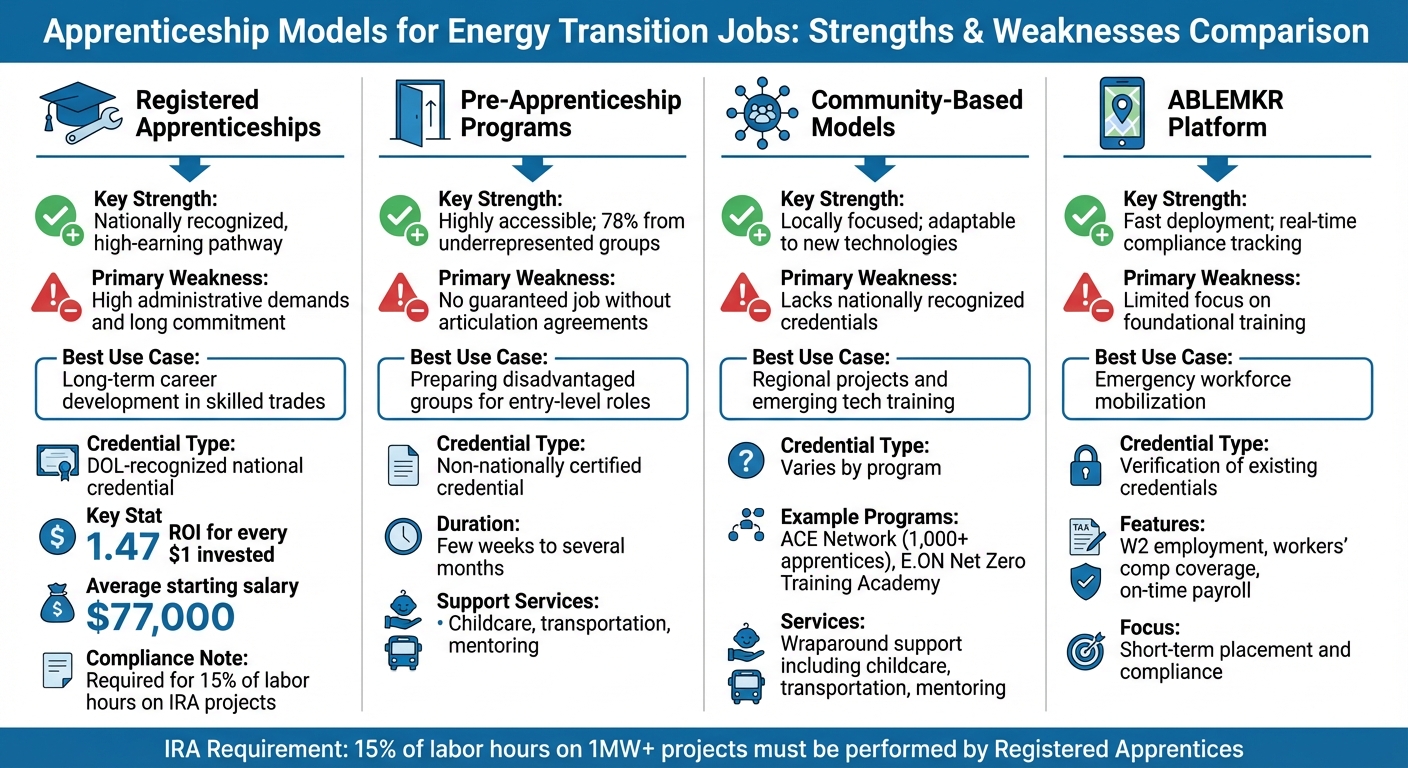
Comparison of Four Apprenticeship Models for Energy Transition Jobs
Each model brings distinct advantages and challenges to the energy transition workforce. Here’s a breakdown of the key points:
Registered Apprenticeships stand out for offering high lifetime earnings and strong returns for employers, with an average of $1.47 earned for every $1 invested. They follow a structured "earn while you learn" approach, making them accessible for many. However, these programs come with significant administrative demands, require years of commitment, and enforce strict journeyworker-to-apprentice ratios (commonly 1:1 or 1:3). Additionally, entry requirements – such as proficiency in math or meeting physical standards – can exclude capable candidates who might otherwise succeed.
Pre-Apprenticeship Programs are designed to be more accessible, particularly for individuals from underrepresented groups. These shorter programs often include support services like childcare and transportation, helping participants who may not yet qualify for Registered Apprenticeships. However, a major drawback is the lack of guaranteed employment. Without formal agreements linking these programs to apprenticeships or jobs, participants may complete training only to face hurdles in advancing their careers.
Community-Based Models excel in tailoring training to local needs and adapting to new technologies. For instance, National Grid’s Power Network Craft Assistant program, launched in 2022 with Catch22 and Young Enterprise, provides a 12- to 18-month salaried pathway for those who don’t meet traditional GCSE criteria. Similarly, E.ON’s partnership with Dudley College in 2023 created the Net Zero Training Academy, offering specialized training in AI, renewable energy, and smart grid systems. While these programs are flexible and regionally focused, they often lack the nationally recognized credentials that many employers value.
ABLEMKR’s platform focuses on rapid workforce deployment and compliance tracking. Its strength lies in quickly matching certified workers to urgent projects, with real-time payroll and W2 employment ensuring stability. However, it prioritizes immediate placement over comprehensive skill-building, making it most effective when paired with traditional apprenticeship programs that provide deeper training. This model is particularly useful for filling short-term gaps in the energy transition workforce.
| Model | Key Strength | Primary Weakness | Best Use Case | Credential Type |
|---|---|---|---|---|
| Registered Apprenticeship | Nationally recognized, high-earning pathway | High administrative demands and long commitment | Long-term career development in skilled trades | DOL-recognized national credential |
| Pre-Apprenticeship | Highly accessible; 78% from underrepresented groups | No guaranteed job without articulation agreements | Preparing disadvantaged groups for entry-level roles | Non-nationally certified credential |
| Community-Based | Locally focused; adaptable to new technologies | Lacks nationally recognized credentials | Regional projects and emerging tech training | Varies by program |
| ABLEMKR Platform | Fast deployment; real-time compliance tracking | Limited focus on foundational training | Emergency workforce mobilization | Verification of existing credentials |
These models also need to align with regulations like the IRA requirement that 15% of labor hours on certain projects be performed by Registered Apprentices, highlighting the importance of these programs for workforce development.
Conclusion
Registered Apprenticeships offer impressive long-term benefits, with employers seeing a return of $1.47 for every $1 invested, while workers enjoy notable lifetime earnings boosts. These programs are essential for meeting IRA requirements tied to renewable energy projects. On the other hand, pre-apprenticeship programs are excellent at creating opportunities for underrepresented groups – 78% of ACE Network participants come from these populations. However, formal articulation agreements are necessary to ensure these participants transition into jobs successfully. Community-based models are great at adapting to regional demands and new technologies, but they often lack the nationally recognized credentials that many employers prioritize.
For employers in the energy sector, the right approach depends on your resources and objectives. Larger companies are better suited for employer-sponsored Registered Apprenticeships, while smaller firms might benefit from group-sponsored programs offered by trade associations or unions. Since "Solar Installer" isn’t currently a DOL-recognized occupation, solar companies can use existing frameworks like "Construction Craft Laborer" or "Electrician" and customize up to 25% of the Work Process Schedule to include solar-specific tasks.
Training organizations play a key role by securing articulation agreements that link pre-apprenticeship graduates directly to Registered Apprenticeships. Free technical assistance is available through groups like IREC’s ACE Network to help organizations navigate registration processes and scale their programs effectively.
Blending traditional apprenticeship pathways with technology-driven tools creates a comprehensive workforce strategy. Tools like ABLEMKR complement these programs by quickly deploying certified workers, tracking compliance, and meeting both immediate and long-term workforce needs. These models help tackle the clean energy talent shortage by addressing urgent project demands while fostering sustained career growth.
FAQs
How do I choose the right apprenticeship model for my energy project?
Picking the right apprenticeship model hinges on the specific requirements of your project. Start by determining if the roles involved are officially classified as "apprenticeable" by the U.S. Department of Labor. These roles typically require a structured combination of hands-on training and instruction.
Next, consider the three main apprenticeship models:
- Time-Based: Focused on completing a set number of training hours.
- Competency-Based: Progression depends on demonstrating specific skills and knowledge.
- Hybrid: A mix of time-based and competency-based approaches.
Your choice should align with your project’s timeline and objectives. Following the National Guidelines for Apprenticeship Standards ensures participants receive industry-recognized training and credentials that are transferable across jobs. Additionally, resources like toolkits can help customize apprenticeship programs to fit the unique demands of clean energy projects.
What qualifies for the IRA 15% registered apprentice labor-hour requirement?
At least 15% of the total construction labor hours on eligible projects must be performed by registered apprentices. This rule is part of the IRA’s guidelines, ensuring that a segment of the workforce is composed of individuals trained through official apprenticeship programs.
How can ABLEMKR help if I need certified workers fast?
ABLEMKR helps you find pre-screened workers fast by matching them to your job site based on their certifications, safety training, availability, and location. This approach ensures workers are deployed quickly for urgent projects while keeping everything compliant and running smoothly.


