
By 2026, industries like construction and energy are heavily relying on AI-powered tools to verify worker identities. These tools address challenges like deepfake threats, credential fraud, and lack of internet access in remote areas. Key players include ABLEMKR, FastPass IVM, Jumio, Onfido, Veriff, Specops Secure Service Desk, Trulioo, Microsoft Entra Verified ID, AU10TIX, and LexisNexis Risk Solutions InstantID. Each platform offers unique features, from biometric verification and fraud detection to offline functionality and compliance tracking. Here’s a quick breakdown of their core strengths:
- ABLEMKR: Focuses on compliance for OSHA, PHMSA, and DOT with real-time credential validation.
- FastPass IVM: Excels in offline verification with biometric and document checks.
- Jumio: Supports global ID verification with advanced fraud detection.
- Onfido: Offers fast, AI-driven document and biometric analysis.
- Veriff: Provides global coverage and rapid verification with high accuracy.
- Specops Secure Service Desk: Enhances service desk security with identity verification during password resets.
- Trulioo: Specializes in global ID and business verification for cross-border teams.
- Microsoft Entra Verified ID: Integrates decentralized credentials and enterprise-grade security.
- AU10TIX: Delivers high-security verification with deepfake detection and reusable digital IDs.
- LexisNexis Risk Solutions InstantID: Combines database matching with advanced fraud prevention.
These tools are reshaping workforce management, making it easier to verify, onboard, and monitor workers while ensuring compliance and security in high-risk environments.
1. ABLEMKR
Advanced Identity Verification
ABLEMKR streamlines identity checks by using digital tools to verify government-issued IDs, licenses, and certifications. This ensures that only individuals with the proper credentials gain access to job sites, reducing the risk of unauthorized entry. This meticulous approach forms the backbone of the platform’s compliance efforts.
Tailored Compliance for Construction and Energy Industries
In industries like oil & gas, mining, and utilities, meeting compliance standards is non-negotiable. ABLEMKR caters specifically to these sectors by validating critical credentials and maintaining up-to-date safety records, such as training certifications and work permits. The platform aligns with key regulatory frameworks, including OSHA, PHMSA, and DOT, ensuring that only properly qualified personnel handle crucial tasks like pipeline maintenance, mine operations, or refinery shutdowns. Its user-friendly design also supports the swift deployment of skilled workers.
Seamless Integration and Scalable Workforce Management
ABLEMKR is built with a mobile-first approach, integrating effortlessly with HRIS and payroll systems through REST APIs and mobile SDKs. It matches pre-qualified workers to job sites based on their certifications, training, availability, and location, making it easier to mobilize teams quickly. Whether responding to urgent shutdowns in remote areas or managing planned infrastructure projects, employers gain real-time insights into worker status and compliance tracking. This streamlines operations while ensuring regulatory standards are met without compromise.
sbb-itb-aa28329
2. FastPass IVM
Biometric and Document Verification Capabilities
FastPass IVM combines facial recognition with its proprietary Motion ID technology to streamline the verification of government-issued IDs, driver’s licenses, certifications, and permits. By cross-referencing state DMV databases, it eliminates the need for manual checks, saving time and reducing administrative workload. This is particularly important in industries like construction and energy, where accurate credential verification is critical. For example, confirming DOT licenses for heavy machinery operators or hazmat transporters becomes seamless with this automated system. This strong verification process helps ensure compliance with strict regulations.
Compliance Support for Construction and Energy Sectors
FastPass IVM is designed to meet the requirements of OSHA, PHMSA, and DOT standards. It generates timestamped audit trails that align with OSHA’s recordkeeping rules and aid in post-incident investigations. The system also integrates with background screening providers, enabling real-time monitoring of drug test results, safety training status, and license suspensions. With more than 60% of energy companies turning to digital compliance solutions and the oil and gas industry reporting over 1,000 workplace injuries annually, FastPass IVM addresses a critical need in these high-risk sectors.
Fraud Prevention and Liveness Detection Features
To prevent unauthorized access to sensitive sites like oil rigs and refineries, FastPass IVM employs active liveness detection, ensuring the individual is physically present during verification. Its Worker ID app provides cryptographically verified credentials that cannot be tampered with, including details like work history, suspension status, and safety training records. Every access event is documented, creating a reliable audit trail for use in incident investigations. As the Fast Verify Media Team explains:
"These tools, designed for the toughest environments, ensure worker safety, regulatory compliance, and operational efficiency, even in remote locations with limited connectivity".
Integration and Scalability for Workforce Deployment
FastPass IVM also simplifies workforce deployment, especially in remote areas. The platform works offline using local encryption and syncs data once connected, making it ideal for isolated energy sites like offshore platforms or remote oil fields. Through its Service Provider Program, FastPass IVM integrates with existing HR and safety management systems and partners with major energy firms like Shell, BP, and Chevron. Real-time dashboards provide visibility into worker presence and task assignments across expansive sites. Features like QR code scanning and geofencing ensure that only verified workers are on-site. These tools not only enhance security but also improve operational efficiency in areas with limited internet access. By automating verification, the platform can onboard workers up to three times faster than traditional manual processes.
Multimodal ID Verification: OCR + Video Validation in One Workflow
3. Jumio
Jumio stands out in the realm of AI verification by offering extensive global ID support and advanced fraud detection tools.
Biometric and Document Verification Capabilities
Jumio supports more than 5,000 types of global IDs, making it a great choice for construction and energy companies with international teams. Using 1:1 face matching and liveness detection, the platform ensures worker presence is verified. With over 1 billion transactions under its belt, Jumio’s machine learning models excel at identifying authentic documents, spotting forgeries, and confirming age requirements for roles involving hazardous tasks. These features provide a strong foundation for preventing fraud.
Fraud Prevention and Liveness Detection Features
Jumio uses automated biometric checks to counter advanced spoofing techniques like deepfakes and face morphing. Its fast processing speeds make it easier to onboard new workers during busy hiring periods, such as when staffing pipeline projects or managing emergency shutdowns. The Jumio Identity Graph, which includes over 30 million identities, analyzes transaction patterns to detect potential fraud.
The platform’s cross-transaction risk assessment streamlines processes by recognizing previously verified workers while blocking repeat offenders. It also includes AI-driven AML (anti-money laundering) screening that checks global sanctions lists, PEP (politically exposed persons) lists, and adverse media – an essential feature for companies in regulated industries. With more than 300 patents backing its technology, Jumio delivers a sophisticated fraud detection system.
Integration and Scalability for Workforce Deployment
Jumio easily integrates with HR and safety management systems, simplifying tasks like background checks, certification verification, and compliance monitoring. Through a single connection point, it accesses numerous global data sources. For construction and energy firms already using workforce management platforms, Jumio can be added without requiring a complete system overhaul. Its vast ID database and quick verification capabilities are particularly useful for managing diverse, cross-border teams – whether staffing a new project or addressing an urgent shutdown.
4. Onfido
Onfido provides advanced tools for document recognition and biometric analysis, supporting over 4,500 document types from 192 countries. This extensive global reach makes it an essential resource for verifying international construction and energy workforces.
Biometric and Document Verification Capabilities
Onfido combines biometric precision with fast anomaly detection to deliver accurate and efficient verification. The platform validates government-issued IDs by matching them with facial biometrics and detecting anomalies using AI – all in just 15 seconds. It also includes liveness checks to confirm the applicant is physically present, preventing attempts at spoofing. For edge cases, human experts step in to manually verify identities. To enhance security, the system cross-references identity documents against international watchlists.
Fraud Prevention and Liveness Detection Features
To combat fraud, Onfido employs targeted liveness detection and optional fraud signals, which help refine automated verification processes. These features simplify decision-making for HR teams, especially during peak hiring periods when rapid onboarding is critical.
Integration and Scalability for Workforce Deployment
For construction and energy companies needing flexible solutions, Onfido offers mobile and web SDKs, as well as API integrations, enabling seamless verification within existing HR and workforce management systems. This allows companies to automate verification processes without disrupting their current workflows. While its technical capabilities in document and biometric analysis are impressive, Onfido is particularly valued for its global coverage rather than industry-specific compliance tailored to the construction or energy sectors.
5. Veriff
Veriff continues to lead the way in AI-driven identity verification, offering tools designed to meet the needs of global, diverse workforces. With support for over 12,500 government-issued documents from more than 230 countries and territories, the platform is particularly helpful for industries like construction and energy, where managing international teams across multiple sites is common.
Biometric and Document Verification Capabilities
Veriff uses advanced biometric technology to verify identities by extracting data from photos and optional background videos. Its passive liveness detection, certified to ISO/IEC 30107-3 Level 1 and Level 2 standards, ensures users don’t have to perform unnatural movements during the process. The system boasts impressive metrics: 98% of checks are automated, 99.6% accuracy is achieved, and verifications are completed in just 6 seconds. Real-time feedback during selfie and document capture helps users avoid common issues like poor lighting or glare, enabling 95% of genuine users to pass on their first attempt. These features not only streamline the process but also enhance fraud detection capabilities.
Fraud Prevention and Liveness Detection Features
Veriff goes beyond basic verification by analyzing over 1,000 data points, including behavioral patterns, device information, and network metadata, to detect deepfakes and tampering in real time. For high-risk industries like energy and construction, Veriff offers a Hybrid IDV (Identity Verification) model. This combines AI automation with manual review by verification specialists, ensuring broader document coverage tailored to specific markets. For lower-risk, cost-sensitive scenarios, the Full Auto option provides a more economical solution.
Integration and Scalability for Workforce Deployment
Veriff integrates seamlessly with existing workforce management systems through REST APIs and pre-built SDKs for iOS, Android, and web platforms. With support for 48 languages and dialects, the platform ensures localized user experiences. Companies can also customize verification screens with their branding, such as logos and color schemes. Payment is structured per verified session, allowing businesses to control costs during large-scale hiring. These features are particularly valuable for managing remote job sites and maintaining safety standards across multiple locations.
6. Specops Secure Service Desk
Specops Secure Service Desk focuses on safeguarding service desk workflows against social engineering attacks. Unlike tools designed for onboarding, Specops ensures help desk processes remain secure during password resets and account recovery. This is particularly valuable for industries like construction and energy, where remote job sites often require workers to reset passwords or recover accounts. By extending identity verification to operational support, Specops complements the onboarding process while addressing ongoing security needs.
Biometric and Document Verification Features
The Specops Verified ID add-on uses AI to scan government-issued IDs, such as passports, driver’s licenses, and national ID cards. With training on over 16,000 document types from 254 countries, it offers global coverage – a key feature for energy and construction companies deploying international teams. The platform also employs biometric liveness detection, ensuring the person presenting the ID is physically present, effectively blocking spoofing attempts using photos, videos, or masks. Additionally, the Specops Fingerprint Authenticator app allows workers to verify their identity through Touch ID on iOS or the Fingerprint API on Android during password recovery.
Fraud Prevention and Liveness Detection
To counter sophisticated threats like AI-driven voice cloning, Specops replaces traditional knowledge-based questions with phishing-resistant verification methods. The system matches scanned document attributes with records in Active Directory or Entra ID before approving high-risk actions. Darren James, Senior Product Manager at Specops Software, explains:
"User verification must go beyond voice recognition, given advances in AI vishing. Threat actors can now use AI tools to accurately mimic the voice of people within your organization".
Organizations can further enhance security by implementing any of the 15+ supported MFA factors, including Duo, Okta, PingID, and YubiKey.
Compliance for Construction and Energy Sectors
To meet strict compliance standards, Specops enables the export of verification events to SIEM or SOC platforms via its Event API. This ensures detailed audit trails are available for regulatory reviews. The platform’s usability and customer service have earned high praise, with a 4.4/5 rating on Gartner Peer Insights and a perfect 5.0/5 on Capterra.
Seamless Integration and Scalability
Specops goes beyond initial identity verification by supporting continuous compliance and secure help desk operations. It integrates effortlessly with IT service management tools like ServiceNow and Jira through its API, allowing service desk agents to verify user identities directly within their ticketing systems. By leveraging existing Active Directory or Entra ID data, Specops eliminates the need for additional user enrollment, simplifying deployment across multiple sites. Importantly, the platform’s AI and machine learning algorithms are pre-trained and do not store customer data, addressing privacy concerns in heavily regulated industries.
7. Trulioo
Trulioo stands out for its global reach and ability to streamline business verification, making it a go-to solution for construction and energy firms. With connections to 450+ data partners across 195 countries, the platform simplifies worker verification, no matter where they’re from. This extensive network is a game-changer for industries that rely heavily on migrant labor or manage cross-border projects. Let’s break down Trulioo’s strengths in document verification, compliance, and fraud prevention.
Biometric and Document Verification Capabilities
Trulioo supports verification for over 14,000 document templates using OCR technology across 20+ character sets, including Latin and Chinese. Its biometric system, trained on 25 million images with 200+ markers, ensures highly accurate identity verification. A standout feature is its passive liveness detection, which assesses texture, lighting, and holograms without requiring user gestures. Additionally, its mobile SDKs for web, Android, and iOS leverage AI-powered autocapture to minimize issues like glare and blur. The platform is also localized in 43 languages, making it operational in 181+ countries.
Compliance Support for Construction and Energy Sectors
For industries operating in high-risk, international environments, Trulioo offers KYB verification to confirm the legitimacy of legal entities, directors, and ultimate beneficial owners, as well as to verify worker credentials. It provides access to global business registries and trusted data sources for AML and sanctions screening. To aid compliance, organizations can access anonymized transaction records, creating detailed audit trails for regulatory oversight.
The platform’s Workflow Studio allows users to set up no-code hosted interfaces in under 15 minutes. Its modular design supports both document-based and alternative verification methods, which can be tailored to match the risk profiles of different workforce scenarios.
Fraud Prevention and Liveness Detection Features
Trulioo’s iBeta Level 2 certification guarantees a 100% detection rate for forgeries, deepfakes, and injection attacks. The system’s biometric algorithms are ranked among the top 5 out of 82 by NIST for both security and ease of use. With "fuzzy matching", the platform enhances verification success rates even when ID data contains minor discrepancies – a common issue in practical applications.
Real-world results back up Trulioo’s effectiveness: EQ Bank reported a 10% improvement in onboarding completion, while a global fintech company saw an 18% increase in match rates, highlighting how smoother verification processes can positively impact workforce management.
8. Microsoft Entra Verified ID
Microsoft Entra Verified ID provides a robust solution for enterprise identity verification, leveraging decentralized digital credentials and advanced biometric matching. Priced at $12.00 per user per month (with annual billing), this service is part of the Microsoft Entra Suite and integrates seamlessly with existing infrastructure, making it a practical choice for construction and energy companies.
Biometric and Document Verification Capabilities
One of the platform’s standout features is Face Check, which ensures high-assurance facial matching. It compares a worker’s real-time selfie with photos from trusted documents like driver’s licenses or employee IDs. Using advanced algorithms, Face Check performs this verification without storing biometric data. Instead, it shares only a confidence score with verifiers. Additionally, it includes liveness detection to prevent spoofing attempts.
Workers benefit from storing their verified certifications and identity claims in a W3C-compliant digital wallet, adding another layer of convenience and security. These features make the platform well-suited for large-scale deployment.
Integration and Scalability for Workforce Deployment
The service’s Quick Setup feature allows administrators to onboard quickly with just a single click. For example, NEC Corporation successfully issued digital employee IDs to 20,000 workers in 2023, under the leadership of Takefumi Tozawa, Chief of the Digital ID/Workstyle DX Development Group.
The platform supports strict industry standards, including NIST-compliant P-256 curves and FIPS-compliant signing keys, ensuring it meets regulatory requirements for sensitive sectors like energy infrastructure.
In early 2023, cellcentric adopted Microsoft Entra Verified ID to secure privileged access. IT Architect Christian Lang highlighted its importance in strengthening organizational security.
The platform has also proven to save time significantly. For instance, BEMO achieved a 90% reduction in manual identity validation time, cutting the process from 5.5 hours to just 30 minutes. CEO Bruno Lecoq remarked:
"BEMO’s implementation of Microsoft Entra Verified ID has reduced the average time for identity manual validation from 5.5 hours to 30 minutes, a 90% process efficiency gain for addressing our customer’s issues."
Developers can easily integrate the service through REST APIs and wallet libraries for Android and iOS, embedding verification capabilities directly into workforce management applications.
9. AU10TIX
In industries where security is a top priority, AU10TIX delivers verification solutions that match the rigor of airport-level checks. Supporting over 5,000 document types worldwide, the platform achieves a 98% authenticity rate and a 91% completion rate for identity checks – handling three times the digital checks of most platforms. This makes it especially valuable in sectors like construction and energy, where safety protocols are non-negotiable.
Biometric and Document Verification Capabilities
AU10TIX uses advanced technologies such as face matching, liveness detection, and deepfake identification to prevent impersonation during both remote and on-site verification. For highly secure environments, the platform incorporates NFC verification to authenticate chip data in IDs, ensuring compliance in sensitive facilities like energy plants. It also captures voice and video consent to meet compliance requirements.
On the document side, AU10TIX employs automated OCR (Optical Character Recognition) to process passports, driver’s licenses, and national IDs. This system achieves a 99% pass rate and reduces processing times from days to under 10 seconds. A notable example is FXCM’s 2026 integration of AU10TIX’s Web SDK and biometric tools, which led to a 29% increase in conversion rates.
Fraud Prevention and Liveness Detection Features
AU10TIX goes beyond basic verification with multi-layered fraud prevention features. Its Serial Fraud Monitor identifies coordinated attacks, which are common during high-volume hiring periods. Consortium validation has also helped save an estimated $5 billion annually by reducing fraud.
In 2026, Fiverr adopted AU10TIX’s IDV Suite, cutting fake accounts by 5%, achieving a conversion success rate of over 90%, and lowering customer service inquiries by 10%. Similarly, PayU saw a 25-point jump in conversion rates after deploying AU10TIX.
Nadav Naaman, Chief Product Officer at PayU, highlighted the importance of this technology:
"Deploying such technology has enabled us to counter the growing threat of fake identification documents that criminals are using to scam merchants and payment platforms."
Compliance Support for Construction and Energy Sectors
For construction and energy companies, AU10TIX offers secure access solutions, enabling contractors and employees to use verified digital IDs instead of physical badges or PINs to enter restricted areas. The platform also automates audit-ready documentation to meet GDPR, CCPA, BIPA, and AML compliance requirements – crucial for facilities relying on biometric access. Continuous authentication and re-verification are triggered by changes in roles or risk signals.
In March 2026, Microsoft integrated AU10TIX’s Reusable ID technology into its onboarding process for third-party contractors. This streamlined validation while maintaining compliance with regulatory standards.
Deepak Marda, Senior Product Manager at Microsoft, explained:
"Microsoft plans to include the Reusable ID technology in its third-party onboarding flow to streamline repeated validation of user identity verification at critical steps while preventing fraudulent activity and ensuring regulatory compliance."
Integration and Scalability for Workforce Deployment
AU10TIX simplifies integration with a 4-click process that reduces setup time from days to hours. Using REST APIs and wallet libraries, the platform embeds seamlessly into existing workforce management systems. Its "verify once, use everywhere" approach allows workers to authenticate across multiple project sites without redoing the entire verification process.
Pricing starts at $500 per month for basic ID verification, biometrics, and a case management dashboard. Enhanced KYC options include features like deepfake detection, proof of address, Serial Fraud Detector, and AML screening, while Enterprise plans offer custom pricing with advanced tools like reusable digital IDs and continuous risk monitoring. These capabilities make AU10TIX a go-to solution for industries like energy and construction, where security and compliance are critical.
10. LexisNexis Risk Solutions InstantID
LexisNexis Risk Solutions InstantID brings advanced precision to identity verification, combining layered database matching, biometric face verification, and forensic document analysis. By matching personally identifiable information (PII) against an impressive 91 billion public and proprietary records with 99.99% accuracy, this platform effectively covers almost the entire U.S. adult population. This makes it particularly useful for industries like construction and energy, where verifying workers across multiple sites and jurisdictions is crucial.
Biometric and Document Verification Capabilities
InstantID incorporates multiple verification tools to ensure accuracy and security. Names, Social Security numbers, and birth dates are cross-referenced against over 10,000 data sources through InstantID. IDVerse matches live selfies to ID portraits with an exceptional 99.998% accuracy. Meanwhile, TrueID examines over 16,000 document types, applying up to 300 checks to uncover tampering. Optical character recognition (OCR) extracts text with 99.98% accuracy, and video-based liveness detection prevents the use of AI-generated images. Additionally, Instant Verify checks licenses and Social Security numbers against databases of deceased individuals, providing a robust defense against identity theft. These capabilities are essential for managing large, diverse workforces in industries with complex operational needs.
Fraud Prevention and Liveness Detection Features
To tackle the growing sophistication of fraud, LexisNexis employs proprietary AI to detect threats like deepfakes, synthetic identities, and AI-generated IDs – a type of fraud that has skyrocketed by 500% between 2020 and 2023. The platform’s Conceal Mode enhances liveness detection by hiding the user’s image during selfie capture, encouraging natural behavior. Advanced depth perception technology eliminates the need for specific user actions, simplifying the process while maintaining security.
Kimberly Sutherland, Global Head of Fraud and Identity at LexisNexis Risk Solutions, highlighted the platform’s dual focus on user experience and fraud prevention:
"This enhanced version of IDVerse delivers both. It enables efficient onboarding, sharper fraud detection and renewed trust at every stage of the customer lifecycle. We integrate innovative deepfake defenses and a more intuitive user experience, so organizations gain stronger protection without adding barriers for legitimate users."
Integration and Scalability for Workforce Deployment
InstantID also stands out for its ability to integrate smoothly into existing systems and scale to meet the demands of large projects. With high-performance APIs, mobile SDKs for iOS and Android, and standard XML interfaces, the platform can be embedded into a variety of workflows. For large-scale operations, such as construction and energy projects, it supports real-time verification as well as bulk data submissions – allowing companies to verify hundreds of workers simultaneously during peak periods.
The modular architecture of InstantID enables organizations to combine physical, digital, and behavioral intelligence into one API. This flexibility allows businesses to create tailored verification workflows that adapt to changing risks and requirements.
LexisNexis emphasizes this adaptability:
"There is no one-size-fits-all solution to identity verification. Along with your specific business objectives, different regions, industries, regulation or use case require a different IDV strategy. Taking a modular approach to verification allows you to construct IDV solutions that meet your needs."
Feature Comparison
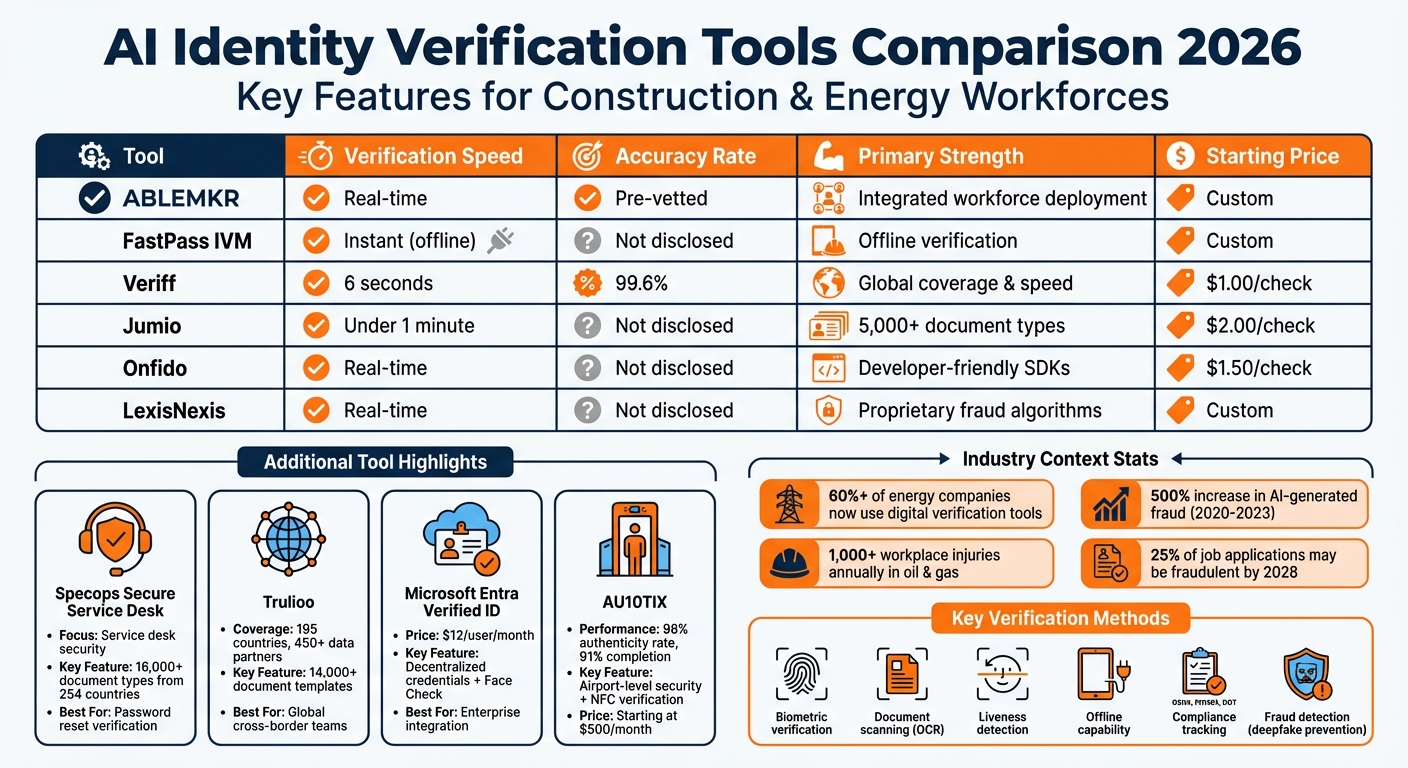
Top 10 AI Identity Verification Tools for Construction and Energy Industries 2026
When you’re evaluating AI identity verification tools for construction and energy workforces, it’s important to assess them across five key areas: verification methods, fraud detection, compliance features, and pricing models. Here’s a closer look at how some of the top tools stack up in these categories.
Verification Methods are tailored to address the specific risks of high-stakes industries. For example, ABLEMKR integrates pre-verification of certifications, safety training, and geo-location matching into its platform, ensuring workers are ready for the job. FastPass IVM’s Fast Verify stands out with offline functionality, making it ideal for remote locations like oil rigs or mining sites. It uses Motion ID and biometric checks to verify identities in challenging environments. Veriff, on the other hand, processes over 1,000 signals per session and supports more than 12,500 document types across 230+ countries. It delivers decisions in as little as 6 seconds with an impressive 99.6% accuracy rate. Meanwhile, Jumio offers international verification of a wide range of document types.
Fraud Detection has become increasingly sophisticated to counter advanced AI threats. Veriff employs real-time analysis of behavioral signals and biological cues to detect impersonation attempts. Fast Verify leverages Motion ID and video-based liveness detection, specifically calibrated for high-risk environments like oil and gas sites. LexisNexis uses proprietary algorithms and Conceal Mode liveness detection to combat AI-generated fraud, which has surged by 500% between 2020 and 2023. These platforms combine OCR, biometric matching, and liveness detection to deliver the robust fraud prevention needed for operational safety, particularly in remote or high-risk work settings.
Compliance Requirements vary significantly between general-purpose tools and those designed for specialized industries. In construction and energy, where safety and regulatory adherence are critical, compliance features play a major role. Fast Verify integrates OSHA and PHMSA compliance checks, along with drug test verification and safety certification tracking – essential for industries like oil and gas, which see over 1,000 workplace injuries annually. ABLEMKR takes it a step further by embedding real-time compliance tracking into its platform, offering visibility into worker certifications and regulatory needs. Microsoft Entra Verified ID follows enterprise IAM standards, while Trulioo focuses on KYB verification for global operations.
Pricing Models often depend on usage volume. Veriff starts at $1.00 per check for high volumes, with self-serve plans beginning at $199 per month. Onfido offers pay-per-check pricing starting at $1.50, while Jumio’s pricing begins at $2.00 per verification, with annual contracts typically starting at $20,000. Enterprise-level solutions, such as those from LexisNexis and Microsoft Entra, require custom quotes. With over 60% of energy companies investing in digital verification tools, scalable pricing is becoming a key factor, especially for managing both steady-state operations and peak hiring periods.
Here’s a quick comparison of some key tools:
| Tool | Speed | Accuracy Rate | Strength | Starting Price |
|---|---|---|---|---|
| ABLEMKR | Real-time | Pre-vetted | Integrated workforce deployment | Custom |
| FastPass IVM | Instant (offline) | Not disclosed | Offline verification | Custom |
| Veriff | 6 seconds | 99.6% | Global coverage & speed | $1.00/check |
| Jumio | Under 1 minute | Not disclosed | Extensive document coverage (5,000+) | $2.00/check |
| Onfido | Real-time | Not disclosed | Developer-friendly SDKs | $1.50/check |
| LexisNexis | Real-time | Not disclosed | Proprietary fraud detection algorithms | Custom |
Conclusion
AI-powered identity verification is reshaping workforce compliance and security in industries like construction and energy. With over 1,000 workplace injuries reported annually in oil and gas and a projected 25% of job applications potentially being fraudulent by 2028, these tools address critical risks while improving safety measures. They help block unauthorized access to dangerous areas, automate compliance with OSHA and PHMSA regulations, and detect advanced threats like deepfake interviews and synthetic identities – issues that traditional background checks often fail to catch.
Choosing the right platform depends on your specific needs. For companies operating in remote locations like offshore rigs, rural mines, or pipeline projects, it’s essential to look for solutions with offline capabilities and local data syncing. Meanwhile, organizations dealing with large-scale hiring should prioritize platforms that integrate smoothly with existing HR systems and provide instant results.
"These tools, designed for the toughest environments, ensure worker safety, regulatory compliance, and operational efficiency, even in remote locations with limited connectivity." – Fast Verify Media Team
Advanced platforms can validate licenses, safety certifications, and drug tests in real time by cross-referencing authoritative databases. With more than 60% of energy companies now investing in digital compliance tools, the industry is rapidly moving from manual document checks to AI-driven verification. This focus on real-time credential validation ensures a more streamlined and compliant workforce deployment process.
For construction and energy companies, platforms like ABLEMKR embed verification directly into workforce deployment workflows. This ensures that workers arrive on-site fully verified and compliant, meeting the rigorous security standards required in high-risk environments.
FAQs
How do AI tools stop deepfake identity fraud?
AI tools are stepping up to tackle deepfake identity fraud by leveraging advanced biometric verification techniques. These include facial recognition, liveness detection, and document scanning. By analyzing subtle facial movements and spotting inconsistencies in images or videos, these tools can identify altered content with precision.
Additionally, they cross-check trusted databases and validate government-issued IDs to confirm that the individual matches official records. This process ensures a higher level of security and authenticity.
In industries such as construction and energy, these methods play a key role in maintaining safety, ensuring compliance, and keeping operations running smoothly by effectively preventing fraud.
Which features matter most for remote sites with no internet?
For locations where internet access is unavailable, AI-based biometric verification and offline-friendly identity tools are game-changers. These systems rely on stored data or the device’s local capabilities to securely verify workers. This means authentication can happen seamlessly, even without a constant internet connection, ensuring secure and efficient access in remote environments.
How does ABLEMKR handle OSHA, PHMSA, and DOT compliance?
ABLEMKR helps employers stay on top of OSHA, PHMSA, and DOT regulations by offering real-time visibility into worker status. It ensures that all safety and certification requirements are met, making compliance tracking easier and aligned with industry rules. This approach not only simplifies workforce management but also helps maintain regulatory standards seamlessly.


