
The construction industry faces a labor shortage, with 1.9 million positions potentially unfilled by 2033. Automation is stepping in to address this by reshaping training methods and job roles. Workers now need skills to operate advanced tools like robotics, drones, and AI systems, rather than performing physical tasks. Traditional training methods, like long apprenticeships, are too slow to keep up with the pace of innovation. Automation-driven training, on the other hand, is faster and more targeted, offering solutions like robotic simulators, VR/AR platforms, AI-powered modules, and automated certification systems.
Key Highlights:
- Faster Training: Workers can learn to program robots in under an hour or complete system orientations in eight hours.
- Safety and Efficiency: Automation reduces injury risks and shifts workers to higher-paying technical roles.
- VR/AR Tools: Immersive platforms allow workers to practice complex tasks in risk-free environments.
- AI-Driven Learning: Personalized modules focus on specific skill gaps, offering micro-certifications for immediate needs.
- Automated Compliance: Digital systems track certifications, flagging expirations and ensuring only qualified workers are deployed.
Companies like Siemens, Bechtel, and Rockwell Automation are leading this shift, making training quicker and more accessible. Platforms like ABLEMKR streamline worker matching and certification updates, ensuring the workforce is always ready for evolving demands. Automation isn’t just filling the skills gap – it’s transforming how construction workers learn and thrive.
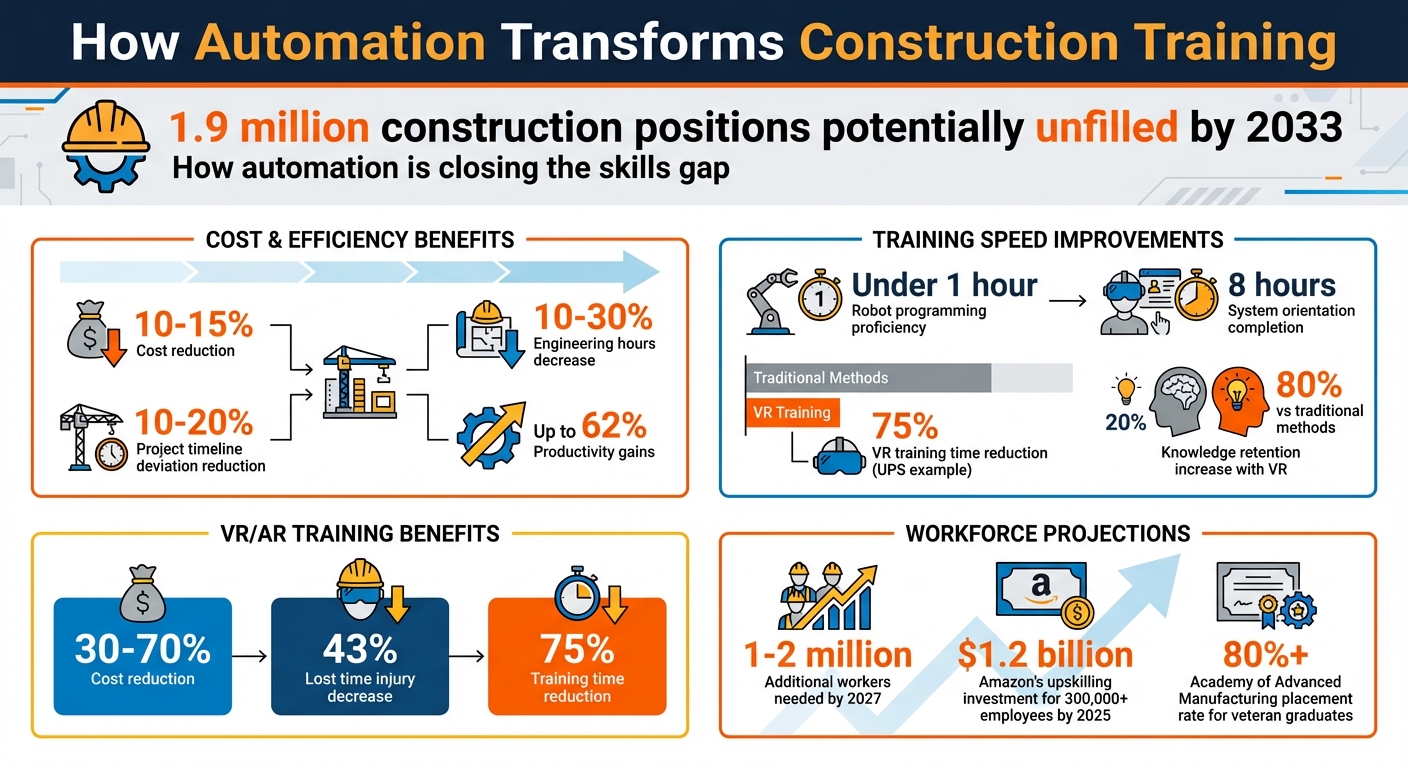
How Automation Transforms Construction Training: Key Statistics and Benefits
AI in Construction Training Course (Lesson 1/7) – Course Introduction
sbb-itb-aa28329
Robotic Simulators for Hands-On Training
Robotic simulators provide a controlled, risk-free setting for mastering heavy machinery and precision tasks. By integrating real industrial robots and equipment into training centers and labs, workers can seamlessly transition from theoretical knowledge to practical application. This method proves especially critical in high-stakes environments – like working with hazardous materials, operating in extreme heat, or handling explosives – where even small errors can lead to severe consequences.
A standout example comes from Alabama-based KTECH, which, in 2024, introduced a mechatronics training program using Siemens technology. Aimed at military veterans and young adults aging out of foster care, the program employs industrial-grade tools to prepare participants for the workforce. It also serves as a recruitment and retention strategy, addressing industry labor shortages. With modern software and pendants, trainees can achieve basic programming proficiency in less than an hour. These simulators not only help attract new tech-savvy talent but also assist in retaining seasoned workers in industries grappling with workforce challenges.
The financial advantages of automation are hard to ignore. Automation in construction reduces costs by 10% to 15% and cuts project timeline deviations by 10% to 20%. Additionally, engineering hours can decrease by 10% to 30%, while productivity gains have reached as high as 62% through strategic automation.
Rather than hiring additional staff, many companies are focusing on upskilling their existing workforce. CNC and heavy machinery operators, for instance, are being trained to program and oversee robotic systems, transitioning them into higher-paying technical roles. This shift not only reduces physical strain and injury risks but also accelerates the learning curve. The introduction of VR and AR-based training further enhances this hands-on learning, offering immersive experiences that refine skills even faster.
VR/AR Platforms for Immersive Skill Building
Virtual and augmented reality (VR/AR) platforms provide workers with hyper-realistic digital environments to practice complex tasks without the risks of real-world errors. VR, in particular, places trainees in scenarios that closely replicate actual job sites, enabling them to master skills like structural assembly or emergency protocols before ever stepping foot on a construction site. These platforms work hand-in-hand with robotic simulators, offering dynamic, hands-on experiences that reflect real construction challenges.
For example, Bechtel Construction teamed up with Industrial Training International in January 2025 to create VR modules tailored for crane operators. These modules focused on essential skills such as boom rotation, load leveling, and managing cargo swings. The results? Improved screening for operators, reduced wear and tear on expensive equipment during training, and overall cost savings. Similarly, BOND Civil & Utility Construction in Norwood adopted Pixaera‘s VR program to simulate high-risk scenarios, allowing workers to practice fall protection techniques and emergency rescues in a controlled virtual setting.
The financial benefits of VR training are hard to ignore. Companies have reported cost reductions of 30%-70%, a 43% decrease in lost time due to injuries, and, as demonstrated by UPS, a 75% reduction in training time – all without sacrificing quality. Kaefer, for instance, introduced a VR-based induction program covering essential safety procedures like PPE usage, working at heights, hot work operations, and safe work permits. This approach significantly reduced the need for extensive on-site supervision.
"VR training can happen anywhere, anytime – perfect for distributed teams. It also allows for customization, ensuring that training is consistent and meets the unique needs of a company or project." – ArborXR
Beyond training, VR platforms are increasingly integrated with Building Information Modeling (BIM) to enhance construction planning and execution. These tools allow workers to visualize entire construction processes, refining their diagnostic and precision skills in a virtual environment before tackling real-world tasks. Teams can identify workflow bottlenecks, practice diagnosing structural issues like compromised foundations, and fine-tune site planning – all within a virtual space. This approach is especially beneficial for tasks like structural assembly, where workers can repeatedly practice precision techniques. Studies show that VR training boosts knowledge retention by 80% compared to traditional methods.
AI-Powered Personalized Learning Modules
AI-powered learning systems are reshaping how companies approach employee training by tailoring programs to address specific skill gaps. Instead of pushing everyone through the same outdated curriculum, these systems analyze individual performance data – like assessments, performance reviews, and workplace monitoring – to pinpoint where improvements are needed. This means businesses can stop guessing and start focusing their training efforts where they’ll make the biggest difference.
One standout feature of AI-driven training is the delivery of micro-certifications. These are short, targeted sessions designed to tackle immediate technical needs. For instance, by December 2024, BlueBay Automation showed how CNC machine operators could quickly learn to program and manage collaborative robots (cobots) in just 30 to 60 minutes. With user-friendly software, a single worker could then manage multiple machines, boosting efficiency.
"Upskilling programs don’t always have to take years, months, or even weeks to complete. Technical orientation on a new robot could take as little as eight hours." – Kyle Crum, Director, Advanced Technology, Rockwell Automation
Beyond quick certifications, the broader impact of AI-powered upskilling is evident in major industry investments. Amazon, for example, is committing over $1.2 billion to provide free upskilling for more than 300,000 U.S. employees by 2025. The goal? To prepare workers for high-demand roles in fields like machine learning, robotics, and mechatronics. Similarly, the Academy of Advanced Manufacturing (AAM), a partnership between Rockwell Automation and ManpowerGroup, has achieved an impressive placement rate – over 80% of its veteran graduates have secured advanced manufacturing and technical roles by 2024, all through accelerated, cost-free training programs.
These investments highlight the growing trust in AI-driven learning. By tracking progress in real time and dynamically updating training content, these systems ensure workers stay equipped for changing job requirements. This approach doesn’t just build skills – it fosters a mindset of curiosity and adaptability, helping workers embrace technological advancements and stay engaged in their roles over the long term.
Automated Certification and Progress Tracking Systems
Keeping track of certifications manually often leads to compliance headaches. Automated platforms tackle this problem by centralizing all certification data into a single digital system, cutting out the hassle of paperwork. These platforms securely store contracts, safety reports, permits, and training records, complete with version control. This ensures managers always have access to the most up-to-date information when they need it.
By digitizing these processes, companies can take a more proactive approach to compliance management.
The real strength of automation is its ability to provide constant compliance monitoring. These systems automatically flag issues like missing permits, expired certifications, or upcoming recertification deadlines – well before they become problems. Workers and managers get automated alerts 30, 60, and 90 days before a credential expires, eliminating the stress of last-minute recertifications. This kind of real-time tracking ensures that only workers with valid certifications are assigned to specialized or high-risk tasks.
"Automation can facilitate compliance tracking by flagging missing permits, expired certifications, or regulatory requirements that need attention." – Wunderbuild
Digital credentials make verification even easier. For example, when a worker completes a micro-certification – like an eight-hour robot orientation – their profile is updated instantly. These standardized digital credentials can be verified on the spot, even across multiple job sites, allowing for the quick deployment of qualified workers. With the construction industry expected to require an additional 1 to 2 million workers by 2027, this kind of efficiency is critical. Plus, these automated systems integrate seamlessly with other tools, making it easier to manage worker deployment and skill development across various projects.
How ABLEMKR Supports Automated Worker Matching and Upskilling
ABLEMKR’s mobile platform brings together essential automation tools into a single, streamlined deployment system. It matches qualified workers to job sites by evaluating three key factors: their current certifications, specific skill sets, and real-time availability. This automated process takes the uncertainty out of crew assignments, ensuring that only workers with the proper credentials are assigned to specialized or high-risk tasks. By building on earlier automation methods, ABLEMKR delivers a complete workforce deployment solution.
The platform also provides real-time visibility into worker status, enabling more agile labor allocation. Similar to its VR and AI-driven training modules, ABLEMKR uses real-time data to enhance decision-making. Instead of relying on manual processes, project managers can check worker availability, location, and certifications directly from a mobile device. This feature becomes especially useful during last-minute shutdowns or when urgent projects demand immediate crew mobilization.
ABLEMKR also incorporates automated certification tracking. Compliance is monitored in real time, with the system instantly verifying worker credentials. It flags potential issues, such as expiring certifications or incomplete safety training, which is crucial as the industry increasingly shifts toward technical roles requiring specialized micro-credentials to operate advanced machinery and robotics.
Upskilling is another area where ABLEMKR stands out. The platform automatically updates worker profiles with new certifications gained during training, enabling those workers to be immediately matched to relevant projects. This seamless integration not only accelerates career growth but also ensures projects benefit from up-to-date skills. By combining certification updates with automated worker matching, ABLEMKR highlights how automation can drive both workforce development and project success.
Conclusion
With labor shortages persisting, automation is reshaping how construction workers gain and refine their skills. Tools like robotic simulators, VR/AR platforms, AI-driven learning modules, and automated certification systems are replacing traditional apprenticeships. These innovations focus on micro-credentials, enabling workers to acquire specific skills faster and more efficiently.
This shift doesn’t just streamline skill development; it’s redefining roles across the industry. Workers are moving away from physically taxing, repetitive tasks and stepping into better-paying technical positions that require problem-solving and collaboration with advanced machinery. Employers, in turn, gain teams that can quickly adapt to new technologies and operate cutting-edge equipment.
"Upskilling will become so innate that we don’t even think about it anymore. It will just be the nature of work." – Kyle Crum, Director of Advanced Technology, Rockwell Automation
Platforms like ABLEMKR highlight the advantages of combining learning with on-the-job application. By automatically aligning workers’ updated certifications with projects requiring those skills, these systems create a seamless cycle of career growth and project success that benefits everyone in the construction ecosystem.
FAQs
Which construction roles are most affected by automation upskilling?
Field jobs, such as electricians and equipment operators, are seeing the biggest changes due to automation-focused upskilling. These roles remain essential on-site, requiring a blend of traditional expertise and modern tech know-how. Meanwhile, administrative positions – like project management, estimating, and safety coordination – are shifting toward remote or hybrid setups, thanks to advanced digital tools. This transition not only improves efficiency but also highlights the growing demand for strong digital skills across the construction industry.
How do VR/AR and robotic simulators cut training time on U.S. job sites?
Virtual Reality (VR), Augmented Reality (AR), and robotic simulators are transforming training on U.S. job sites. These tools let workers hone their skills in a safe, controlled environment, cutting down training time significantly. By practicing without the risks tied to on-site mistakes, employees can build confidence and master tasks more quickly. This not only boosts efficiency but also promotes safety when transitioning to real-world scenarios.
How does ABLEMKR verify certifications before sending workers to a site?
ABLEMKR doesn’t outline the exact steps it takes to verify certifications before sending workers to a job site. However, it does confirm that all workers are pre-screened. This includes checking certifications, safety training, and other qualifications to ensure they meet the specific needs of the job.


