
Protecting yourself from electrical hazards requires the right gear. Arc flash suits and insulated gloves are two critical types of PPE, but they serve different purposes:
- Arc flash suits shield your entire body from intense heat, pressure, and debris during an arc flash event. They are rated in cal/cm² to measure their thermal protection.
- Insulated gloves protect your hands from electrical shock by creating a non-conductive barrier. They are classified by the maximum voltage they can handle safely.
Key Takeaways:
- Arc flash suits are for thermal protection during electrical faults.
- Insulated gloves are for preventing electrical current from flowing through your body.
- Both are often used together for tasks involving high-voltage systems, especially in renewable energy work.
Quick Comparison
| PPE Type | Primary Hazard | Rating System | Coverage | Key Use |
|---|---|---|---|---|
| Arc Flash Suits | Thermal energy/burns | cal/cm² (ATPV or EBT) | Full-body | Arc flash events with high heat risks |
| Insulated Gloves | Electrical shock | Voltage Class (00-4) | Hands only | Direct contact with energized equipment |
Both types of PPE are critical for safety, but understanding when and how to use them together is essential for reducing risks on the job.
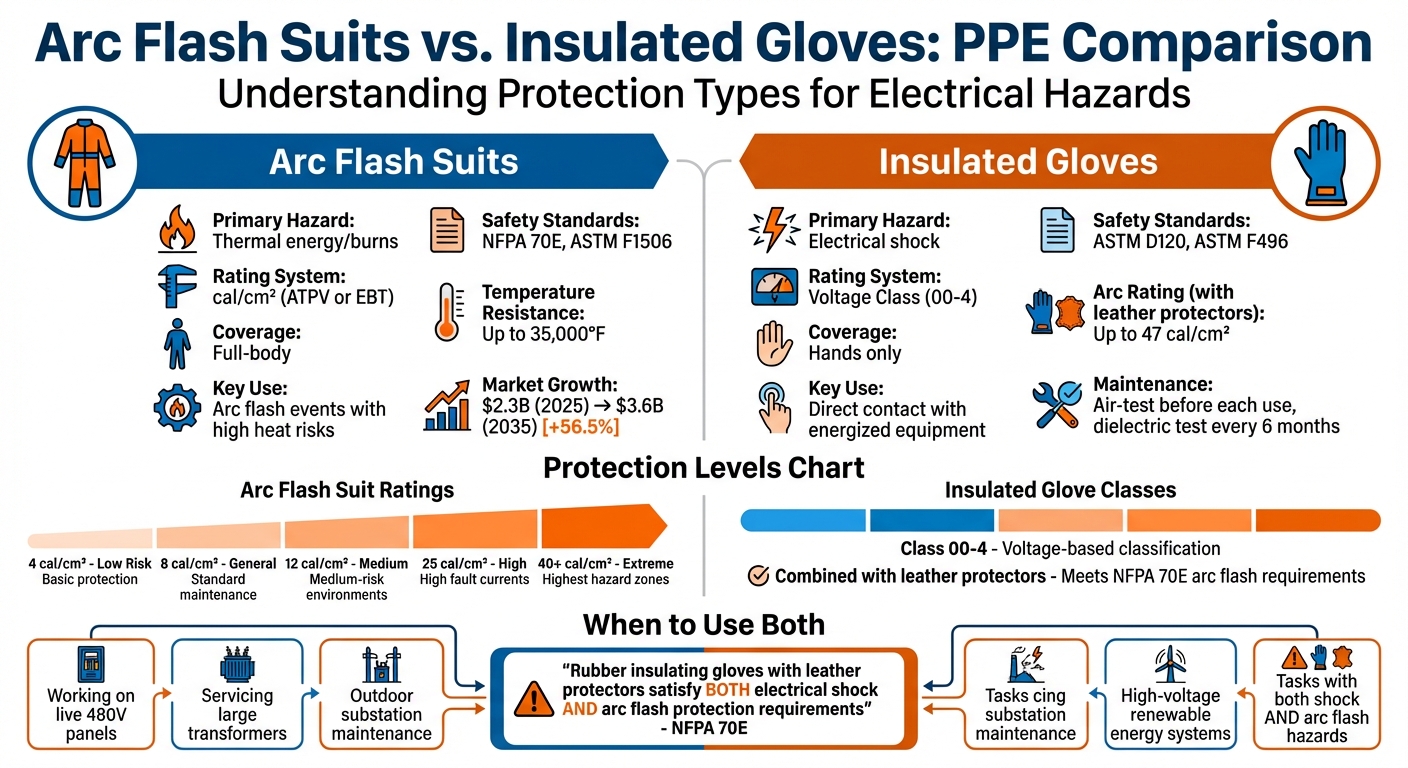
Arc Flash Suits vs Insulated Gloves PPE Comparison Chart
Understanding Arc Flash & Shock PPE
sbb-itb-aa28329
Arc Flash Suits: How They Work and When to Use Them
Arc flash suits are built to withstand the intense conditions of electrical faults. Made from flame-resistant materials that comply with ASTM F1506 and ASTM F1959 standards, these suits are designed to resist ignition, self-extinguish, and handle temperatures as high as 35,000°F.
What Arc Flash Suits Are Made Of
The effectiveness of an arc flash suit is measured by its arc rating, expressed in cal/cm². This rating indicates the amount of thermal energy the fabric can endure before there’s a 50% likelihood of a second-degree burn. Modern suits cater to a range of risks, starting from 4 cal/cm² for low-risk tasks to over 40 cal/cm² for extreme hazards.
Here’s a breakdown of arc ratings and their applications:
| PPE Rating (cal/cm²) | Risk Level | Typical Application |
|---|---|---|
| 4 cal/cm² | Low | Basic protection for low-risk tasks |
| 8 cal/cm² | General | Standard maintenance protection |
| 12 cal/cm² | Medium | Medium-risk electrical environments |
| 25 cal/cm² | High | High-risk tasks with higher fault currents |
| 40+ cal/cm² | Extreme | Highest protection for extreme hazard zones |
Modern advancements have made these suits lighter and more breathable, which helps reduce worker fatigue. However, it’s important to layer appropriately beneath the suit. Workers should wear natural fibers like cotton, wool, or silk that won’t melt under heat, as synthetic materials can worsen injuries in the event of an arc flash.
Why Workers Use Arc Flash Suits
Arc flash suits provide comprehensive protection against thermal blasts, molten metal, and flying debris. In industries like renewable energy, they are critical for tasks like servicing large transformers, outdoor substations, and motor controls where incident energy levels exceed the capabilities of standard workwear. Unlike insulated gloves, which protect specific areas, arc flash suits shield the entire body.
"The goal is not to over-armor your team; it’s to provide just enough protection without impairing mobility or comfort." – Chris Guffey, Wessler Engineering
The demand for arc flash protection is on the rise, with the global market projected to grow from $2.3 billion in 2025 to $3.6 billion by 2035 – a 56.5% increase. This growth is fueled by stricter safety regulations and insurance requirements that now view arc flash PPE as mandatory rather than optional.
Drawbacks of Arc Flash Suits
While arc flash suits are essential for safety, they do have limitations. Their multi-layered construction can restrict movement and lead to heat buildup, particularly in outdoor environments. Workers performing intricate tasks may find the bulk of the suit hinders precision and dexterity.
Additionally, arc flash suits are not a standalone solution. They often need to be paired with additional PPE like balaclavas, face shields, and safety glasses to ensure no skin is left exposed. Proper care is also crucial. Suits must be inspected before every use for signs of wear, such as fraying, holes, or contamination. They should be stored in cool, dry, and dark conditions, as prolonged exposure to sunlight can weaken the protective fibers.
Insulated Gloves: How They Work and When to Use Them
Insulated gloves are designed to protect workers from electrical shocks, while arc flash suits shield against thermal blasts. These gloves work by creating a non-conductive barrier between the worker’s hands and energized equipment, stopping electricity from traveling through the body.
What Insulated Gloves Are Made Of
Insulated gloves are typically crafted from materials like rubber or PVC, which have high electrical resistance. These materials block electrical current by tightly binding their electrons, preventing them from moving freely.
"In insulators, electrons are bound tightly to their atoms, restricting their movement. If an insulative material is electrically charged, its stationary particles block the flow of electricity… That’s why the rubbery insulative coating around electrical wires prevents shocks." – StaticWorx
For added safety, workers often pair insulated gloves with leather protector gloves. This combination helps shield against cuts, punctures, and other physical hazards, while also offering extra protection from arc flash risks.
Why Workers Use Insulated Gloves
Insulated gloves are a must-have for precise electrical work. Workers in renewable energy, for instance, depend on them when servicing 480V panels, performing maintenance within arc flash boundaries, or working with energized equipment. These gloves allow for the fine motor control needed to connect wires, adjust components, or operate controls – all without compromising safety.
The human body is a natural conductor because of its water and salt content. Insulated gloves protect workers by keeping the electrical charge on the glove’s surface, preventing it from traveling through the body. In high-voltage renewable energy systems, this mix of safety and dexterity is especially important.
However, while insulated gloves are excellent for targeted hand protection, they don’t offer the same comprehensive coverage as arc flash suits.
Drawbacks of Insulated Gloves
Maintaining insulated gloves is critical to ensure their effectiveness. Before each use, workers must inspect and air-test them for cracks, punctures, or contamination. Additionally, gloves must undergo dielectric testing every six months to confirm they still provide adequate protection.
It’s also important to note that insulated gloves offer limited defense against arc flash events. For tasks where energy levels exceed 1.2 cal/cm², workers need full arc flash suits and face shields since insulated gloves alone won’t protect the rest of the body. This makes them unsuitable for situations involving higher incident energy levels.
How Arc Flash Suits and Insulated Gloves Compare
Protection Levels: Arc Flash vs. Electrical Shock
Arc flash suits and insulated gloves are designed to address distinct hazards. Arc flash suits protect your entire body from the intense thermal energy released during an arc flash. On the other hand, insulated gloves act as a barrier against electrical shock by preventing current from passing through your hands when working with energized equipment.
The ratings for these items differ based on the type of hazard they address. Arc flash suits are measured in cal/cm², which indicates the amount of energy exposure that has a 50% chance of causing a second-degree burn. Insulated gloves use a Class system (ranging from Class 00 to Class 4), which specifies the maximum voltage they can safely handle. Unlike arc flash suits, the Class system doesn’t account for thermal protection.
One key point to remember: rubber insulating gloves, when paired with leather protectors, provide a dual layer of protection against both electrical shock and arc flash. According to NFPA 70E guidelines, this combination meets the arc flash safety requirements, even in environments requiring up to 40 cal/cm² protection. Some rubber insulating gloves have been tested for an Energy Breakopen Threshold (EBT) as high as 47 cal/cm², adding an extra layer of assurance.
Safety Standards for Each PPE Type
Each type of personal protective equipment (PPE) adheres to specific safety standards. Arc flash suits must meet the requirements of NFPA 70E (focused on workplace electrical safety) and ASTM F1506 (which governs fabric performance). Insulated gloves follow ASTM D120 for the rubber material and ASTM F496 for maintenance and ongoing care.
| PPE Type | Primary Standards | Rating System | Primary Hazard |
|---|---|---|---|
| Arc Flash Suits | NFPA 70E, ASTM F1506 | cal/cm² (ATPV or EBT) | Thermal energy/burns |
| Insulated Gloves | ASTM D120, ASTM F496 | Voltage Class (00-4) | Electrical shock |
| Arc-Rated Gloves | ASTM F2675 | cal/cm² | Thermal energy only |
Rubber insulating gloves that are specifically tested for arc flash protection must comply with ASTM F2675 standards. Combining these gloves with leather protectors ensures compliance with NFPA 70E arc flash requirements, making them indispensable for high-energy tasks.
When to Use Each Type of PPE
Choosing the right PPE depends on the specific risks present at your worksite. For tasks involving only the risk of electrical shock, insulated gloves are sufficient. For arc flash hazards, arc-rated suits are the go-to option. However, when both risks are present – such as when working on live 480V panels – you’ll need the full combination: arc flash suits, insulated gloves, and leather protectors.
"If rubber insulating gloves with leather protectors are used, additional leather or arc-rated gloves shall not be required. The combination of rubber insulating gloves with leather protectors satisfies the arc flash protection requirement." – NFPA 70E
It’s critical to avoid using standard high-heat gloves in place of arc-rated gloves, as they can ignite or melt during an arc flash event. Always check that your PPE matches the incident energy levels indicated on arc flash labels. For example, NFPA 70E Category 1 requires a minimum of 4 cal/cm², while Category 4 demands at least 40 cal/cm².
Understanding the differences between these PPE types is essential for maintaining a layered safety strategy, especially in high-risk environments like renewable energy maintenance.
Using Arc Flash Suits and Insulated Gloves Together
Why Using Both Types Works Better
Arc flash suits and insulated gloves work together to create a powerful safeguard against electrical hazards. The arc flash suit shields your body – torso, arms, and legs – from extreme heat and flying debris, with temperatures reaching over 35,000°F. Meanwhile, insulated gloves are specifically designed to protect your hands from electrical shock when handling energized components.
Since your hands are often the first to come into contact with live electrical systems, insulated gloves are a must. But during an arc flash event, the intense heat, pressure, and debris demand full-body coverage – something only an arc flash suit can provide. Modern arc-rated protective gear has advanced significantly, offering better dexterity and breathability. This means you can stay protected without sacrificing mobility, which is especially important in tight spaces like wind turbine nacelles or during long shifts at solar farms.
"Arc-rated clothing and protective systems are now viewed as essential tools – just as important as meters, insulated tools, and testing devices." – Novarlo LLC
This combination of safety measures is essential for handling the everyday challenges of renewable energy work.
Real-World Applications in Renewable Energy
This layered protection approach isn’t just theoretical – it’s a cornerstone of safety in the renewable energy sector. Take solar panel troubleshooting, for example: technicians face both shock hazards from energized busbars and arc flash risks. Similarly, voltage testing or verifying lockout/tagout procedures on wind turbine systems often involves working with energized equipment.
Other tasks, like servicing outdoor substations, inspecting high-voltage transformers, or maintaining industrial motor controls, also demand this dual protection. For instance, a technician working on a 480V switchboard at a solar substation would need insulated gloves rated for the appropriate voltage level (such as Class 0 or Class 00) alongside an arc flash suit designed to handle the calculated incident energy – often up to 40 cal/cm² for Category 4 tasks. To further enhance safety, leather protectors worn over insulated gloves help prevent mechanical damage, ensuring the gloves maintain their shock protection capabilities.
How to Choose the Right PPE for Your Job
Selecting the right PPE starts with understanding the specific hazards you’re dealing with. For example, if you’re working within restricted approach boundaries and need shock protection, rubber insulating gloves with leather protectors are essential. When it comes to arc flash protection, always refer to the incident energy level (measured in cal/cm²) noted on the equipment’s arc flash label – don’t rely solely on the voltage rating.
A common misconception is that all 480V equipment carries the same level of risk. As Chris Guffey from Wessler Engineering points out:
"Just because a piece of equipment is 480V doesn’t mean it presents the same arc flash hazard as another 480V panel down the hall".
Two panels with the same voltage can have drastically different incident energy levels. This depends on factors like the available fault current and the time it takes for the fault to clear.
When choosing PPE, base your decision on the calculated incident energy. If the energy exceeds 40 cal/cm², carefully evaluate the task, the likelihood of an arc flash, and the condition of the equipment before proceeding. The goal is to balance safety and practicality – providing enough protection without unnecessarily burdening workers, which can lead to reduced mobility and fatigue.
Building consistent safety habits is just as important. Chris Guffey recommends always defaulting to minimum PPE, even for hazards below 1.2 cal/cm². This practice helps avoid confusion and reinforces good habits. Additionally, rubber insulating gloves should be air-tested and inspected for cracks or contamination before every use. Perform dielectric tests every six months and replace any PPE that shows stains or wear. Regular maintenance like this is a critical part of any safety program.
Rubber insulating gloves with leather protectors offer dual protection against electrical shock and arc flash hazards. For higher arc flash protection, thicker, higher-class gloves are available, with some models tested to handle up to 47 cal/cm². For tasks requiring more precision outside restricted boundaries, arc-rated fabric gloves provide better dexterity while still protecting against incident energies up to 12 cal/cm².
FAQs
How do I know what cal/cm² rating I need?
To figure out the necessary cal/cm² rating, you’ll need to conduct an incident energy analysis. This process estimates the amount of thermal energy (measured in calories per square centimeter) that could reach a person during an arc flash event. Once you have this value, select PPE with a rating that meets or exceeds the calculated energy level to provide proper protection.
Which insulated glove class should I use for my voltage?
When selecting insulated gloves, the class you need depends on the voltage you’re working with. Class 0 gloves are designed for voltages up to 1,000 volts, while Class 4 gloves can handle up to 36,000 volts. Always opt for gloves that are rated for the voltage of your specific application – or higher. Regular inspections for any signs of damage are crucial to maintaining safety.
When do I need both an arc flash suit and insulated gloves?
When working on energized electrical equipment, both an arc flash suit and insulated gloves are critical for safety. The arc flash suit shields you from the intense heat, pressure, and light generated by an arc flash. Meanwhile, insulated gloves are designed to stop electrical current from traveling through your hands, protecting you from electric shock. Together, these pieces of gear provide essential protection in high-voltage environments or when dealing with live components.


