
Arc flash incidents in renewable energy systems – like solar panels, wind turbines, and battery storage – pose serious risks due to high voltages, DC arcs, and bidirectional power flows. Proper arc-rated PPE (Personal Protective Equipment) is the last line of defense against burns, blasts, and molten metal spray. Here’s what you need to know:
- DC arcs are harder to extinguish and last longer than AC arcs, increasing danger.
- Solar installations often operate at 1,000 VDC, exceeding NFPA 70E‘s standard 600V PPE category limits.
- NFPA 70E requires arc flash risk assessments every 5 years or after system changes.
- PPE must match incident energy levels: from basic safety glasses and natural fiber clothing for low-risk tasks to full arc flash suits for high-risk tasks.
- Daily PPE inspections and regular maintenance (e.g., glove air tests, fabric checks) are critical.
Employers can use tools like ABLEMKR for tracking certifications, PPE compliance, and inspection schedules, ensuring workers are equipped and trained for high-risk environments. Safety starts with understanding the hazards and choosing the right gear.
Arc Flash Hazards in Renewable Energy
What is Arc Flash?
An arc flash is a powerful and dangerous electrical explosion that happens when current leaps through the air between conductors or to the ground. This risk is present in both AC and DC components of renewable energy systems.
DC arcs are particularly dangerous in solar installations and battery systems. Unlike AC systems, DC systems lack a natural "zero-crossing" point where the current momentarily drops to zero, making DC arcs last longer and harder to extinguish. As Trenton M. from 70E Consultants explains:
"DC systems in photovoltaic arrays can keep arcs going longer than AC systems. This is because DC current doesn’t have natural zero-crossing points, making it harder to stop arcs".
Solar panels add another layer of complexity since they generate electricity continuously during daylight hours, making it nearly impossible to fully de-energize these systems while performing maintenance. Wind turbines, on the other hand, are prone to arc flash incidents due to wear on slip rings and sudden load changes caused by fluctuating wind speeds. Battery storage systems also pose significant risks, as they store massive amounts of energy and can produce high fault currents during maintenance.
The unpredictable nature of renewable energy sources – such as varying sunlight and wind conditions – adds to the challenge of managing electrical loads and preventing arc flash events. Additionally, outdoor exposure to UV radiation, moisture, and salt can degrade insulation and electrical connections faster than in controlled indoor environments, further increasing the risk of arc faults over time.
These technical challenges highlight the importance of understanding NFPA 70E thresholds and how they influence PPE requirements in renewable energy environments.
NFPA 70E and Energy Thresholds
Given the range of arc flash hazards in renewable energy systems, compliance with NFPA 70E standards is crucial for worker safety. NFPA 70E serves as the foundation for arc flash protection in the U.S., establishing 1.2 cal/cm² as the incident energy threshold where wearing arc-rated PPE becomes mandatory. This threshold marks the point where an unprotected individual could sustain a second-degree burn. The standard also mandates that arc flash risk assessments be reviewed every five years or whenever significant changes are made to the electrical system.
However, renewable energy systems present unique challenges. For instance, many modern solar installations operate at 1,000 VDC, exceeding the 600V limit used in NFPA 70E’s standard PPE category tables. Scott Francis, Technical Sales Manager at Westex: A Milliken Brand, explains the implications:
"In the solar industry, due to the generation of 1,000 VDC, the incident energy analysis method is used for the DC before the inverter since the 1,000 VDC parameter exceeds the 70E PPE category maximum voltage parameter of 600 V".
This means standard PPE selection tables alone are insufficient for high-voltage solar systems. Instead, a site-specific incident energy analysis (arc flash study) is required to determine the actual energy levels workers may encounter. This analysis considers the unique characteristics of DC systems, bidirectional power flows from inverters and batteries, and the specific equipment configurations at the site.
sbb-itb-aa28329
Understanding Arc-Flash Hazards in Solar PV Systems
PPE Requirements by Hazard/Risk Category
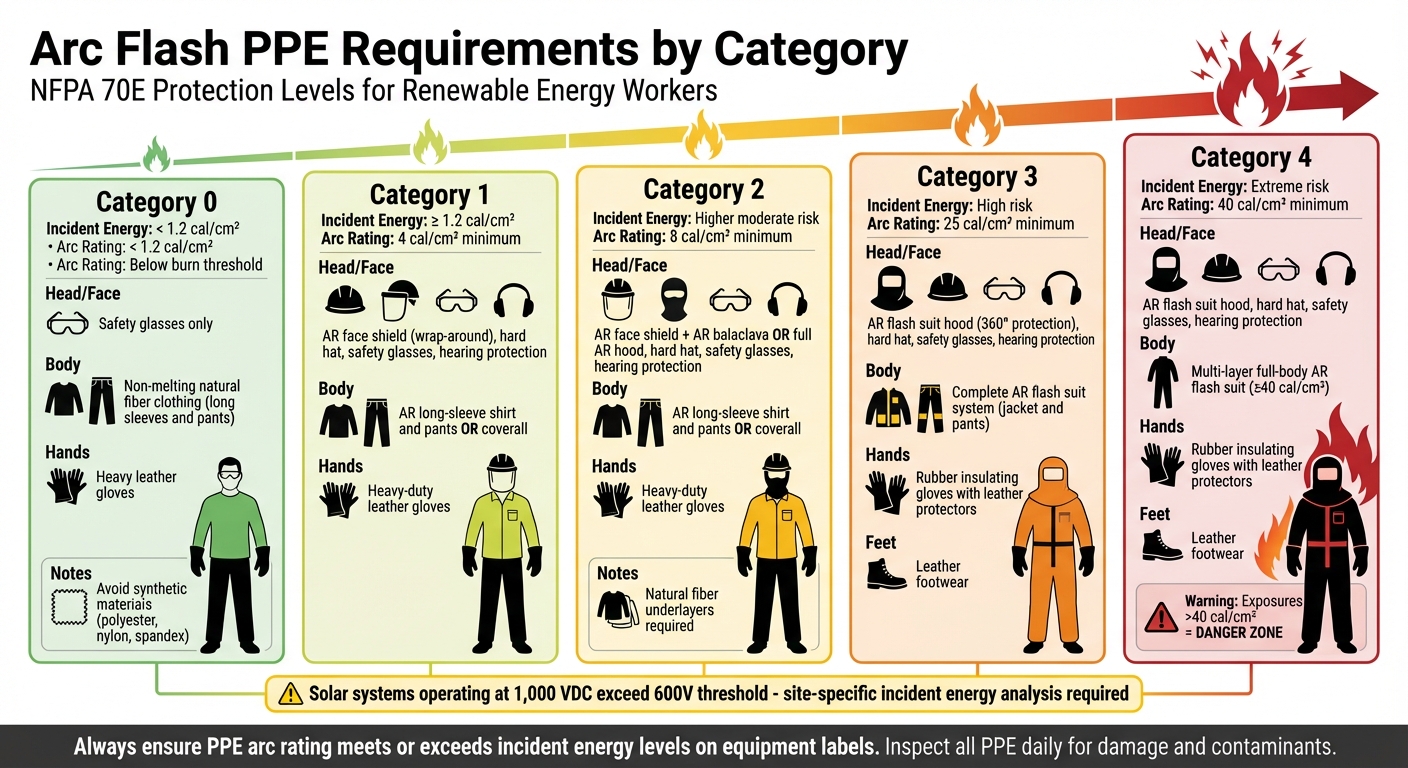
NFPA 70E Arc Flash PPE Categories and Requirements Chart
In renewable energy environments, especially where DC arcs can surpass standard thresholds, NFPA 70E outlines PPE requirements based on incident energy levels. Workers determine these requirements using either a site-specific incident energy analysis or PPE category tables. It’s crucial for renewable energy workers to understand these guidelines, as exposure risks can vary depending on the task and system voltage. However, the PPE Category Method may not apply to solar installations operating at 1,000 VDC, which exceed the 600V threshold defined by NFPA 70E tables.
Categories 0 and 1
Category 0 applies to incident energies below 1.2 cal/cm², the threshold for second-degree burns. While NFPA 70E removed Category 0 from its tables in 2015, it remains a useful benchmark for low-risk tasks. In these scenarios, workers should wear non-melting natural fiber clothing (long sleeves and pants), safety glasses, and heavy leather gloves. Avoid synthetic materials like polyester, nylon, or spandex, as they can melt and fuse to the skin during an arc flash.
Category 1 requires a minimum arc rating of 4 cal/cm². Workers need an arc-rated (AR) long-sleeve shirt and pants or coverall, along with an AR face shield providing wrap-around protection, a hard hat, safety glasses, hearing protection, and heavy-duty leather gloves. It’s important to note that while all AR clothing is flame-resistant, not all flame-resistant gear is arc-rated. Always confirm that the gear displays an ATPV or ELIM rating.
Category 2
For tasks with moderate risk, Category 2 mandates a minimum arc rating of 8 cal/cm². In addition to the PPE required for Category 1, workers must wear an AR balaclava (if using a face shield) or a full AR hood to protect the head and neck. At this level, proper layering becomes critical, and underlayers should consist of non-melting natural fibers like cotton.
Categories 3 and 4
Category 3 requires protection at 25 cal/cm². Workers must wear a complete arc flash suit system, including a specialized hood, jacket, and pants. Rubber insulating gloves with leather protectors are mandatory, along with a hard hat, safety glasses, hearing protection, and leather footwear. Full hoods replace face shields to ensure 360-degree protection for the head and neck.
Category 4 represents the highest protection level, with a minimum arc rating of 40 cal/cm². This level requires a multi-layer, full-body arc flash suit system rated for at least 40 cal/cm². Exposures above 40 cal/cm² are often classified as "Danger" zones, as no PPE can fully shield against the extreme thermal and blast energy. As William Conklin from the Electricity Forum emphasizes:
"Clothing does not make hazardous work safe. It only limits injury when other controls fail".
The table below summarizes the PPE requirements for each category:
| PPE Category | Min. Arc Rating | Required Head/Face Protection | Body Protection |
|---|---|---|---|
| Category 0 | < 1.2 cal/cm² | Safety glasses | Non-melting natural fiber clothing (long sleeves/pants) |
| Category 1 | 4 cal/cm² | AR face shield, hard hat, safety glasses | AR long-sleeve shirt and pants or coverall |
| Category 2 | 8 cal/cm² | AR face shield with balaclava (or AR hood), hard hat, safety glasses | AR long-sleeve shirt and pants or coverall |
| Category 3 | 25 cal/cm² | AR flash suit hood, hard hat, safety glasses | AR flash suit jacket and pants |
| Category 4 | 40 cal/cm² | AR flash suit hood, hard hat, safety glasses | Full AR flash suit (multi-layer, ≥40 cal/cm²) |
Always ensure the PPE’s arc rating meets or exceeds the incident energy levels specified on equipment labels. For solar systems operating above 600V, a site-specific incident energy analysis is essential. Additionally, inspect all PPE daily for contaminants like grease, oil, or solvents, as these can compromise their protective capabilities.
Proceed to the next section to learn about daily PPE inspection and maintenance practices.
PPE Inspection and Maintenance
Keeping personal protective equipment (PPE) in top condition is essential for reducing arc flash risks in renewable energy settings. Arc flash PPE can only shield workers effectively if it’s in good working order. Even a small defect can render it useless during an arc flash, which can reach temperatures over 35,000°F. Regular inspections and proper upkeep not only extend the life of protective gear but also ensure compliance with NFPA 70E standards.
Daily Visual Inspections
Before every shift, workers should carefully inspect their arc flash PPE. For arc-rated clothing, look for tears, holes, burns, or worn seams and closures. Make sure zippers and buttons are functional, and check that arc-rating labels are still readable. Any clothing showing signs of damage should be removed from use immediately.
Rubber insulating gloves need extra care. Perform an air test by rolling the gauntlet end toward the fingers and checking for leaks. As ISHN advises:
"Even the tiniest pinhole in electrical gloves can be dangerous, so it’s extremely important to air test gloves before wearing them – every time".
Additionally, roll the gloves between your hands to feel for debris embedded in the material. Inspect for cuts, punctures, stiffness, cracks from ozone exposure, or sticky residues.
For face shields and hoods, check for cracks, scratches, or cloudiness that could impair visibility. Confirm that visor attachments and chin guards are secure. Inspect footwear for cuts in the soles, embedded metal, and the condition of toe caps. Be vigilant for flammable contaminants like grease, oil, or solvents, as dirty PPE offers less protection. Contaminated gear should either be laundered promptly or taken out of service.
Periodic laboratory testing is also crucial to ensure ongoing reliability.
Testing and Certification Schedules
In addition to daily checks, scheduled testing and certifications are necessary to meet NFPA 70E standards. Rubber insulating gloves require electrical testing every six months. If gloves go unused for a year after their last test, they must be retested before being used again. Annual professional evaluations of all PPE by qualified safety experts further ensure compliance with NFPA 70E standards.
The lifespan of arc-rated clothing depends on its material. Treated 100% cotton flame-resistant (FR) clothing typically lasts 12 to 16 months with weekly use and washing. Cotton-nylon blends (88/12) can last 18 to 30 months, while premium 93% Nomex® blends often last 2.5 to 4 years. Face shields and hoods should be replaced every 2 to 5 years or sooner if they become scratched or cloudy. The table below outlines key testing and replacement intervals:
| PPE Component | Testing/Inspection Frequency | Replacement Schedule |
|---|---|---|
| Rubber Insulating Gloves | Air test daily; lab test every 6 months | Replace per test outcome |
| Arc-Rated Clothing | Visual inspection before each use | 12–24 months, depending on fabric |
| Face Shields/Hoods | Visual inspection before each use | 2–5 years or earlier if visibility is compromised |
| Insulating Sleeves | Visual inspection before each use | Every 6 months |
| Dielectric Footwear | Monthly inspection | Every 12–18 months |
Proper storage can greatly extend PPE longevity. Keep gear in a clean, dry, temperature-controlled area, away from sunlight and chemicals. Avoid stacking heavy items on arc flash hoods or gloves, as this can deform them and reduce their effectiveness. When washing flame-resistant clothing, use mild detergents and warm water on a gentle cycle. Don’t use chlorine bleach, fabric softeners, starch, or anti-static dryer sheets, as they can weaken the flame-resistant properties. Tumble dry on low heat or line dry in a shaded area. Any clothing that has been through an arc flash incident must be discarded immediately, even if no visible damage is present.
Managing Compliance with Workforce Platforms
Ensuring renewable energy workers’ safety goes beyond PPE maintenance – digital compliance tools now play a key role in keeping workers protected.
Employers in the renewable energy sector must confirm that every high-risk site worker has up-to-date certifications, training, and PPE. Relying on manual tracking is often inefficient and prone to mistakes. As Scott Francis, Technical Sales Manager at Westex, explains:
"PPE is one of the controls that is most susceptible to human error. The best hazard assessment… does no good if human error… takes place and the arc flash holding PPE is not worn at the appropriate time".
Digital workforce platforms help address these challenges by automating compliance management and reducing the likelihood of oversight.
Using ABLEMKR for Certification Management

ABLEMKR simplifies certification and training management by verifying worker qualifications in real time. For instance, if an employer posts a renewable energy project requiring NFPA 70E-certified workers, the platform ensures that only workers who have completed the necessary safety courses are matched to the job. This guarantees that only qualified personnel are deployed.
The platform also centralizes all certifications, training records, and PPE documentation, making audits more manageable. For example, arc flash risk assessments, which are required every five years or when electrical systems change, are easier to manage with automated alerts for updating equipment labels and PPE requirements. By combining digital compliance tools with on-site PPE checks, employers can create a seamless safety management system that addresses both training and daily operational needs.
Beyond certifications, ABLEMKR ensures that workers’ on-site gear meets the specific hazard requirements of their tasks, providing an added layer of safety.
Tracking PPE Compliance in High-Risk Deployments
ABLEMKR also ensures workers arrive at job sites with the correct PPE for their assigned tasks. The platform stores site-specific incident energy data and matches it with the necessary PPE. For example, if maintaining a solar farm involves Category 3 work requiring a full arc flash suit rated for 25 cal/cm², the system verifies that the worker’s gear meets or exceeds the required rating. This connection between digital tracking and arc flash injury prevention ensures workers are equipped to handle the hazards they face.
The platform also manages PPE inspection and maintenance schedules. Workers are prompted to perform pre-shift inspections to check for tears, contamination (like grease or oil), or other damage before entering an arc flash boundary. For specialized items like rubber insulating gloves, which require lab testing every six months, ABLEMKR tracks certification dates and flags gear nearing expiration. This prevents non-compliant equipment from being used in the field, reducing the risk of accidents and enhancing overall safety.
Conclusion
Arc flash PPE plays a crucial role in protecting renewable energy workers from severe injuries. During an arc flash, temperatures can soar beyond the surface of the sun in less than a second. Because of this, PPE must be carefully rated to match the specific incident energy levels associated with each task. Properly selected PPE shields workers from thermal burns, pressure blasts, and molten metal sprays.
Daily visual inspections are essential for maintaining PPE effectiveness. Workers should look for tears, contaminants, and ensure that underlayers are made of natural fibers to avoid the risk of synthetic materials melting. Gloves require an air test to check for leaks, and any damaged equipment must be tagged and removed from service immediately.
Employers also have a responsibility to maintain safety standards by using digital compliance systems, such as ABLEMKR. These tools help track PPE records, inspection schedules, and certifications, ensuring that only qualified workers use gear tailored to specific hazards. Automated reminders further reduce the risk of oversights, fostering a strong safety culture across renewable energy operations.
Scott Francis from Westex highlights the importance of vigilance:
"Complacency is a safety killer, and it can occur in the assessment procedure or the reassessment procedure."
Even the most thorough hazard assessments are ineffective if workers don’t use the correct PPE. Digital compliance tools provide the structure needed to uphold consistent safety practices across all projects.
FAQs
How do I choose the right arc-rated PPE for my specific task?
To choose the right arc-rated PPE, begin with a thorough hazard assessment to pinpoint potential risks, such as arc flash incidents. Refer to standards like NFPA 70E, which classify PPE based on incident energy levels measured in calories per square centimeter (cal/cm²). Select PPE with an arc thermal protective value (ATPV) that matches or surpasses the identified hazard level. Ensure the PPE is inspected regularly, properly maintained, and worn according to the manufacturer’s instructions to maintain its protective capabilities.
Why don’t NFPA 70E PPE tables cover 1,000 VDC solar systems?
The NFPA 70E PPE tables do not cover 1,000 VDC solar systems because they are primarily designed for AC systems. DC systems differ significantly in their electrical properties and arc flash risks, which means they require their own specific risk assessments and PPE guidelines. These differences highlight the importance of addressing DC hazards independently from AC systems.
What PPE inspection checks should I do before every shift?
Before starting a shift, it’s essential to inspect your arc flash PPE to confirm it’s safe and ready to use. Here’s what to focus on:
- Clothing: Look for any tears, holes, burns, or worn-out areas. Also, ensure that all seams and closures are secure and in good condition.
- Face shields and hoods: Check for cracks, cloudiness, or any loose fittings. Make sure the lenses are clean and clear.
- Gloves: Examine for cuts, punctures, stiffness, or any signs of damage that could compromise insulation.
Taking a few moments to inspect your gear can make a big difference in ensuring your safety.


