
AI is transforming safety monitoring in high-risk industries like construction, energy, and mining. Traditional surveillance systems rely on human operators and are often reactive, reviewing footage only after incidents occur. AI-powered surveillance changes this by analyzing video feeds in real time to detect hazards, violations, and unsafe behaviors before accidents happen. Here’s how it works:
- Real-Time Hazard Detection: AI identifies risks like workers entering dangerous zones, operating without proper safety gear, or interacting unsafely with heavy equipment.
- Integrated Data Sources: Combines video with site maps, geofencing, equipment telemetry, and workforce data to provide context-aware monitoring.
- Automated Alerts: Sends immediate notifications for safety violations, reducing response times and improving prevention.
- Improved Compliance: Tracks PPE use, behavior, and certifications, making it easier to enforce safety protocols and meet OSHA standards.
- Continuous Monitoring: Detects fire hazards, structural risks, and environmental dangers, offering 24/7 oversight even in tough conditions.
Data Sources and Inputs for AI Surveillance
Video Data from Job Sites
AI safety systems rely heavily on video feeds from various camera types strategically placed across construction sites, refineries, and energy projects. These include fixed cameras, PTZ (pan-tilt-zoom) cameras, mobile units, and cameras mounted on equipment, all working together to monitor critical areas.
However, construction sites are not the most camera-friendly environments. Dust, shifting light conditions, glare, rain, and even vibrations can degrade video quality. To address these challenges, AI systems use preprocessing techniques like noise reduction, stabilization, automatic exposure adjustments, and frame interpolation. In tougher conditions, such as low-light or dusty environments, thermal or infrared cameras can complement optical data, enhancing the detection of people and vehicles. These enhanced video streams then serve as the foundation for more detailed analysis.
Additional Data Integration
While video is a key component, it’s not the whole picture. To move beyond basic object detection and achieve context-aware safety analysis, AI systems incorporate data from other sources. For instance, access logs help verify authorized entry, while site maps and digital floor plans define work zones, restricted areas (like crane swing zones or energized sections), and evacuation routes. GPS-based geofences add another layer of precision by marking high-risk zones, such as excavation pits or overhead lift areas.
Here’s how this works in practice: If someone appears on video inside a geofenced no-entry zone without corresponding access authorization, the system flags it as a potential safety or compliance issue. Similarly, equipment telemetry – like engine status, speed, load weight, or boom angle – can differentiate between a parked excavator and one actively swinging a loaded bucket near workers. IoT sensors also play a role, tracking variables like gas levels, temperature, smoke, or vibrations. These sensors can trigger cameras to confirm hazards such as fires, gas leaks, or structural shifts.
Workforce Data for Better Analysis
To add even more precision, workforce data is integrated into the system. ABLEMKR maintains real-time information on worker roles, certifications, and training through mobile devices or badges. By combining this workforce data with video and location inputs, AI systems can make nuanced distinctions – like identifying a certified crane operator at the controls versus an unqualified worker entering the cab, or recognizing a trained confined-space entrant compared to someone unauthorized attempting to cross a barrier. Geo-data from smartphones, beacons, and RFID further syncs with camera feeds and site maps for detailed monitoring.
Since ABLEMKR specializes in high-risk industries like construction, energy, and extractives, its certification records are tailored to the specific skills required in these sectors. This integration enables AI to assess not just "who is present", but also "who is qualified to perform this high-risk task" in real time. For example, the system can enforce rules like ensuring no pedestrians are within 20 feet of a reversing haul truck or restricting access to a 50-foot crane swing radius to authorized personnel only. This level of analysis ensures safer, more compliant work environments.
Surveillance tech disrupting construction site safety and workers comp claims
How AI Processes Surveillance Footage for Safety
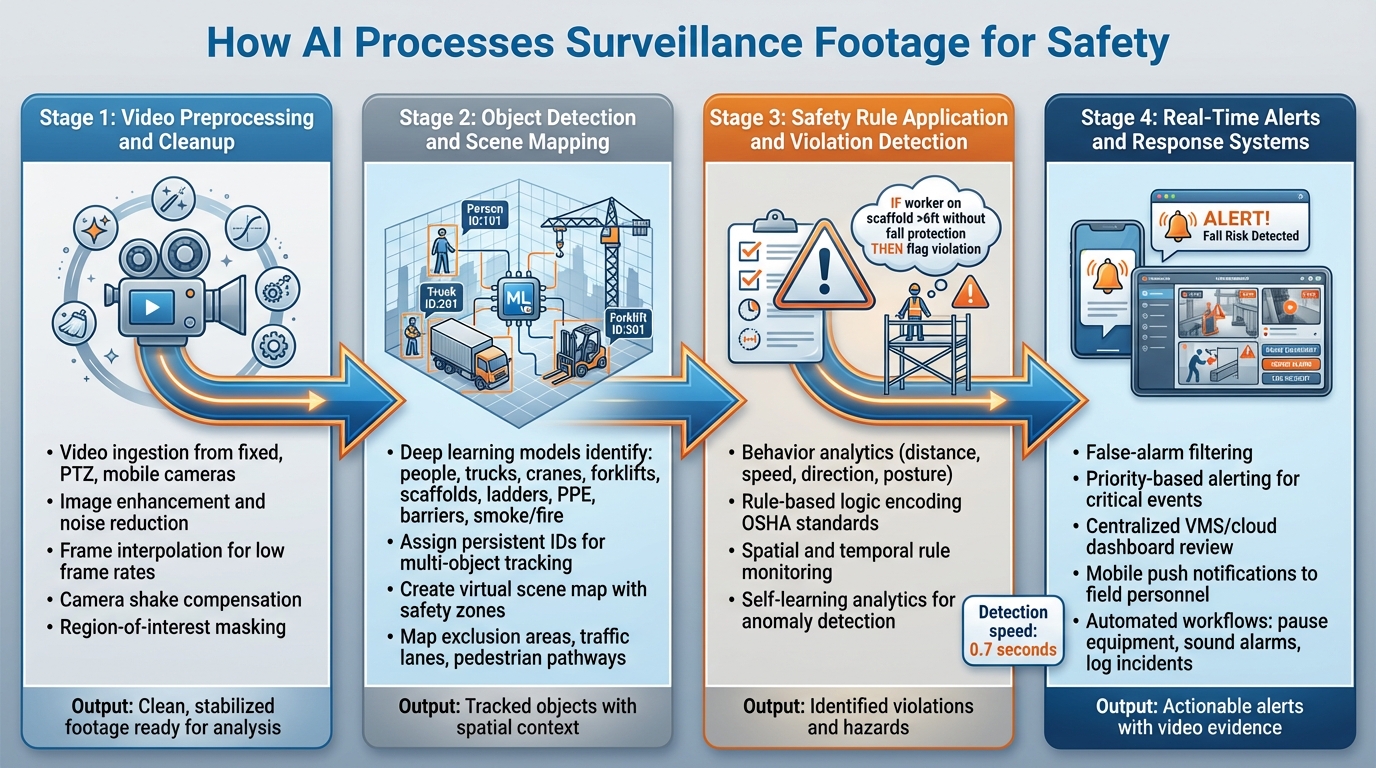
How AI Processes Surveillance Footage for Safety: 4-Stage Workflow
Video Preprocessing and Cleanup
Before AI can effectively identify potential hazards, it must first tackle the challenges that often come with raw video footage from construction sites, refineries, and mines. These environments can present issues like dust, glare, rain, shaky cameras, and poor lighting – all of which can confuse detection systems or lead to false alarms.
The process begins with video ingestion and preprocessing, where footage from various sources – fixed, PTZ, and mobile cameras – is stabilized, cleaned up, and standardized in resolution and frame rate. This step includes image enhancement to improve clarity and noise reduction to smooth out grainy visuals. For footage with low frame rates, frame interpolation is used to fill in gaps, while camera shake compensation ensures that tracking remains consistent, even with footage from moving or unstable cameras.
To reduce unnecessary processing and false positives, many systems use region-of-interest masking, which directs attention to active work areas while ignoring irrelevant zones like public roads or the sky. These preprocessing tasks often happen at the edge – on devices like network video recorders (NVRs) or smart cameras – helping to maintain real-time performance and avoid overloading network bandwidth.
Once the video is cleaned and stabilized, AI can more accurately detect objects and assess the scene.
Object Detection and Scene Mapping
With the footage prepared, deep learning models analyze each frame to identify and classify objects. These models can recognize a wide range of items, including people, trucks, cranes, forklifts, scaffolds, ladders, hard hats, vests, barriers, and even smoke or fire. This allows the system to separate genuine risks from background activity.
Each identified object is assigned a persistent ID, enabling multi-object tracking that follows workers and vehicles as they move through the site. These IDs are critical for assessing how objects interact with predefined safety zones. At the same time, the system creates a virtual scene map with zones and boundaries set by safety teams, such as exclusion areas around excavation pits, equipment traffic lanes, pedestrian pathways, and restricted access points. By monitoring how objects move relative to these zones, the AI gains context and can assess risk. For instance, a worker entering a "heavy equipment only" zone without a hard hat would trigger a higher-priority alert than the same action in a less hazardous area.
Some systems, like those integrated with ABLEMKR, go a step further by linking zone-level analytics to specific teams, roles, or certifications. This helps safety managers identify trends, such as tasks or crews that experience frequent near-misses, and adjust schedules or team assignments accordingly.
Safety Rule Application and Violation Detection
After identifying objects, the AI shifts focus to interpreting their behavior and determining if any safety rules are being violated. Recognizing objects is only part of the job – understanding their actions is just as important. This is where behavior analytics, visual classification, and rule engines come into play, analyzing factors like distance, speed, direction, and posture (e.g., climbing, bending, running).
The system uses rule-based logic to encode OSHA standards and site-specific protocols into "if/then" decision trees. For example, if a worker is detected on a scaffold above a certain height without visible fall protection, then the system flags a violation. Spatial and temporal rules further enhance this process by monitoring proximity and duration, such as someone lingering in a high-risk area or repeatedly failing to wear required PPE. Persistent violations can even trigger progressive coaching or escalation.
Advanced systems also incorporate self-learning analytics, which adapt to the unique patterns of each site. By learning what "normal" operations look like – such as typical traffic flow or standard shift behaviors – the AI can flag anomalies that might indicate unsafe or non-compliant conditions.
Real-Time Alerts and Response Systems
When a safety violation or hazard is detected, the system sends alerts with detailed event information and video snippets to ensure timely action. To minimize unnecessary disruptions, false-alarm filtering and priority-based alerting ensure that only high-risk events or critical zone breaches are flagged for immediate attention.
Alerts are managed through a centralized video management system (VMS) or cloud dashboard, where safety managers can review, annotate, or reclassify incidents. These events are overlaid on site maps or floor plans for added context. Simultaneously, mobile apps and push notifications deliver critical alerts directly to foremen and safety leads in the field, allowing them to respond without needing to return to a control room.
In more advanced setups, alerts can also trigger automated workflows. For example, a detected hazard could pause equipment operations, sound an on-site alarm, notify platforms like ABLEMKR to reassign crews, or log the incident into compliance systems for further investigation. This seamless integration ensures that AI insights lead to immediate, meaningful actions, rather than becoming just another notification in a busy inbox.
sbb-itb-aa28329
AI Applications in Safety: Key Use Cases
Fall Prevention and Working at Heights
AI-powered surveillance systems are changing how elevated work areas are monitored. These systems are designed to detect workers near drop-offs who aren’t using proper fall protection gear. For example, if someone enters a "no-protection" zone – typically 6 feet or higher on construction or energy sites in the U.S. – or approaches an edge without visible personal protective equipment (PPE), the AI immediately triggers an alert to warn safety personnel.
In addition to real-time alerts, these systems use geofencing to define safe work zones and help spotters intervene before accidents occur. They also analyze past footage to identify patterns that often lead to near-misses. This data is then used to enhance training programs and refine job hazard analyses, making work-at-height protocols more effective. By integrating seamlessly with site-wide safety measures, this technology adds an extra layer of protection.
Heavy Equipment Safety and Worker Interaction
AI systems are also improving safety around heavy machinery. By simultaneously tracking equipment and workers, these systems establish dynamic safety zones that adapt in real time. If a worker enters a high-risk area – such as a blind spot, swing radius, or travel path – the system sends alerts to both safety personnel and equipment operators.
Beyond proximity alerts, these tools monitor for unsafe practices like speeding, sudden stops, unauthorized equipment use, or workers moving between backing vehicles and fixed objects. Over time, the data collected reveals high-risk zones, such as congested loading areas or laydown yards. This information helps planners redesign traffic patterns and staging areas to minimize struck-by and caught-in/between incidents. These efforts go hand-in-hand with PPE monitoring and behavioral analysis, creating a more comprehensive safety strategy.
PPE and Behavioral Compliance Monitoring
AI takes worker safety a step further by monitoring compliance with PPE requirements and safe workplace behaviors. Advanced systems can detect whether workers are wearing hard hats, safety vests, gloves, safety glasses, ear protection, or respirators, depending on the camera quality and the model’s training. They also flag risky behaviors such as running, horseplay, climbing on unapproved structures, working under suspended loads, bypassing barriers, or entering restricted areas.
When violations occur, the AI logs them along with precise time and location data. Dashboards then provide safety managers with detailed compliance reports broken down by crew, shift, or subcontractor. These insights allow for targeted coaching and toolbox talks instead of relying solely on sporadic manual observations. By integrating with verified training records from ABLEMKR, the focus shifts toward corrective coaching rather than punitive actions, which is especially valuable in high-risk industries like construction and energy. This approach creates a safer and more supportive work environment.
Detecting Fire, Environmental, and Structural Risks
AI video analytics are also being used to detect fire hazards and structural risks more effectively. These systems can identify smoke, flames, and heat signatures faster than traditional detectors, especially in large, open, or semi-outdoor spaces where conventional point detectors may fall short. Trained to recognize visual patterns like smoke movement, flame color, and behavior, these models provide early alerts even in challenging environments like high-ceiling industrial buildings.
Additionally, AI monitors material storage areas, scaffolding, formwork, and temporary structures for signs of instability. It can detect issues like excessive lean, deflection, overhanging loads, or improperly stacked materials. By comparing current video footage to baseline images, the system flags anomalies such as sagging beams, misaligned scaffolds, or unexpected cracks. While this technology doesn’t replace engineering inspections, it offers continuous monitoring between scheduled checks, which is especially valuable for sprawling or remote sites common in oil and gas or heavy infrastructure projects. These capabilities add another layer of safety, ensuring that potential risks are addressed before they escalate.
Connecting AI Insights with Workforce Operations
Linking Safety Alerts to Workforce Actions
AI safety alerts become truly effective when they go beyond simple notifications and lead to structured, actionable responses. By integrating video analytics systems with workforce platforms through APIs and shared metadata, alerts can automatically initiate response protocols tailored to the type, severity, and location of an incident.
For example, if AI detects repeated fall protection violations, it doesn’t just flag the issue; it notifies workers and supervisors, schedules a toolbox talk, and temporarily restricts the workers involved from high-risk tasks until they complete refresher training. In cases of high-severity incidents, such as near-misses involving heavy equipment, the system can escalate actions – immediately informing safety managers, scheduling a root-cause analysis, and reassigning operators or spotters until their certifications are revalidated.
A tiered alerting system ensures that minor issues are directed to foremen for resolution, while more serious or recurring problems lead to work stoppages until hazards are fully addressed. This approach shifts the role of AI from passive observation to active improvement, focusing on coaching and targeted training rather than punitive measures. By embedding this structured response process into workforce operations, companies can drive continuous safety improvements while laying the groundwork for smarter crew management.
Improving Crew Composition for High-Risk Tasks
AI insights don’t just stop at identifying risks – they can also enhance how crews are assigned to high-risk tasks. For instance, AI analytics might identify recurring risks like frequent line-of-fire exposures during crane lifts, consistent PPE non-compliance in hot work zones, or near-misses between spotters and equipment. These insights can be directly fed into workforce platforms, such as ABLEMKR, to fine-tune crew selection.
By leveraging detailed worker data – like certifications, training history, and performance records – these platforms can ensure that critical tasks, such as confined space entries or crane lifts, are assigned to workers with the right credentials and proven safety records. If chronic issues are flagged, the system can even suggest alternative workers from pre-vetted labor pools to minimize risk.
Over time, this data-driven approach to crew assignments not only reduces OSHA-recordable incidents but also helps demonstrate a company’s commitment to safety – a critical factor for both regulators and insurers.
Documenting Safety Management for Compliance
Integrating AI with workforce platforms doesn’t just improve safety – it also simplifies compliance. By combining time-stamped AI-detected events with workforce data, companies can create detailed, audit-ready safety logs. These records capture not only what happened but also how the company responded, which is invaluable during OSHA inspections, insurance evaluations, or internal safety reviews.
For instance, systems can generate incident timelines that detail unsafe acts or conditions flagged by AI, including who was on shift, their roles and certifications, and the corrective actions taken. Additionally, they can track metrics like PPE compliance rates, line-of-fire exposures, and equipment interactions by crew, contractor, or project phase. Exportable reports in formats like PDF or CSV align with U.S. regulatory requirements – such as OSHA 300/301 narratives – providing clear, structured evidence that can help resolve claim disputes and even secure better insurance terms.
This seamless integration of AI insights and workforce operations not only enhances safety management but also demonstrates accountability and preparedness in the face of regulatory scrutiny.
Conclusion: The Future of AI and Safety Monitoring
AI is transforming job site safety by shifting from after-the-fact reviews to real-time risk prevention. With the ability to detect actual threats in just 0.7 seconds – while ignoring distractions like weather, shadows, or animals – it enables quicker responses, reduces workplace injuries, and lowers costs across high-risk projects in the U.S..
When paired with workforce platforms like ABLEMKR, AI takes safety a step further by turning alerts into immediate, actionable steps. These responses are directly tied to worker certifications and crew assignments, simplifying compliance and making corrective actions more efficient. This marks a significant leap toward more proactive safety management.
Looking ahead, AI will likely evolve beyond incident detection to predicting high-risk scenarios. By using tools like behavior analytics, dynamic risk scoring, and pattern recognition, it can help assign the most suitable crews for hazardous tasks – taking into account both historical performance and current site conditions.
FAQs
How does AI monitor safety in real time in tough environments?
AI leverages cutting-edge computer vision to monitor surveillance footage in real time, spotting potential safety threats such as dangerous conditions or risky behaviors. By identifying these issues instantly, it enables operators to act right away, reducing the likelihood of accidents and ensuring safety protocols are followed.
This capability proves particularly useful in high-stakes environments where swift action is essential to protect workers and keep operations running smoothly.
How does workforce data improve AI safety monitoring in surveillance footage?
Workforce data is a game-changer when it comes to using AI for safety monitoring. It gives a clear picture of worker behavior, movement patterns, and potential risks. By analyzing this data in real time, AI systems can spot unsafe actions or conditions right away, enabling swift action to prevent accidents.
This data also plays a big role in ensuring compliance. It can verify that workers on-site have the necessary safety training and certifications. This forward-thinking approach doesn’t just make workplaces safer – it also helps operations run more smoothly by cutting down on delays caused by safety incidents.
How does AI ensure compliance with safety standards like OSHA?
AI plays a crucial role in improving workplace safety by analyzing surveillance footage in real-time to detect unsafe behaviors or conditions. For example, it can spot improper equipment usage or employees not wearing necessary protective gear. By leveraging advanced algorithms, the system compares observed activities against OSHA safety standards and flags any potential violations for quick review.
This approach helps prevent accidents before they happen and simplifies the compliance process, creating a safer and more efficient workplace.


