
Agile leadership in construction means empowering teams to make decisions on-site, focusing on flexibility, collaboration, and quick problem-solving. It replaces rigid, top-down approaches with methods that improve efficiency and reduce delays. Key strategies include:
- Daily Stand-Ups: Quick 15-minute meetings to align on progress and resolve issues.
- Short Planning Cycles: Breaking work into 1–2 week sprints to address constraints early.
- Retrospectives: Regular reviews to identify and fix workflow problems.
- Servant Leadership: Supporting crews by removing obstacles and fostering trust.
- Cross-Trade Collaboration: Aligning trades to prevent clashes and improve coordination.
These practices help avoid costly rework, streamline workflows, and keep projects on schedule. Tools like real-time scheduling apps and platforms for tracking worker certifications enhance decision-making and team efficiency. Start small – introduce daily huddles or short planning cycles – and measure improvements like fewer delays, reduced rework, and higher task completion rates.
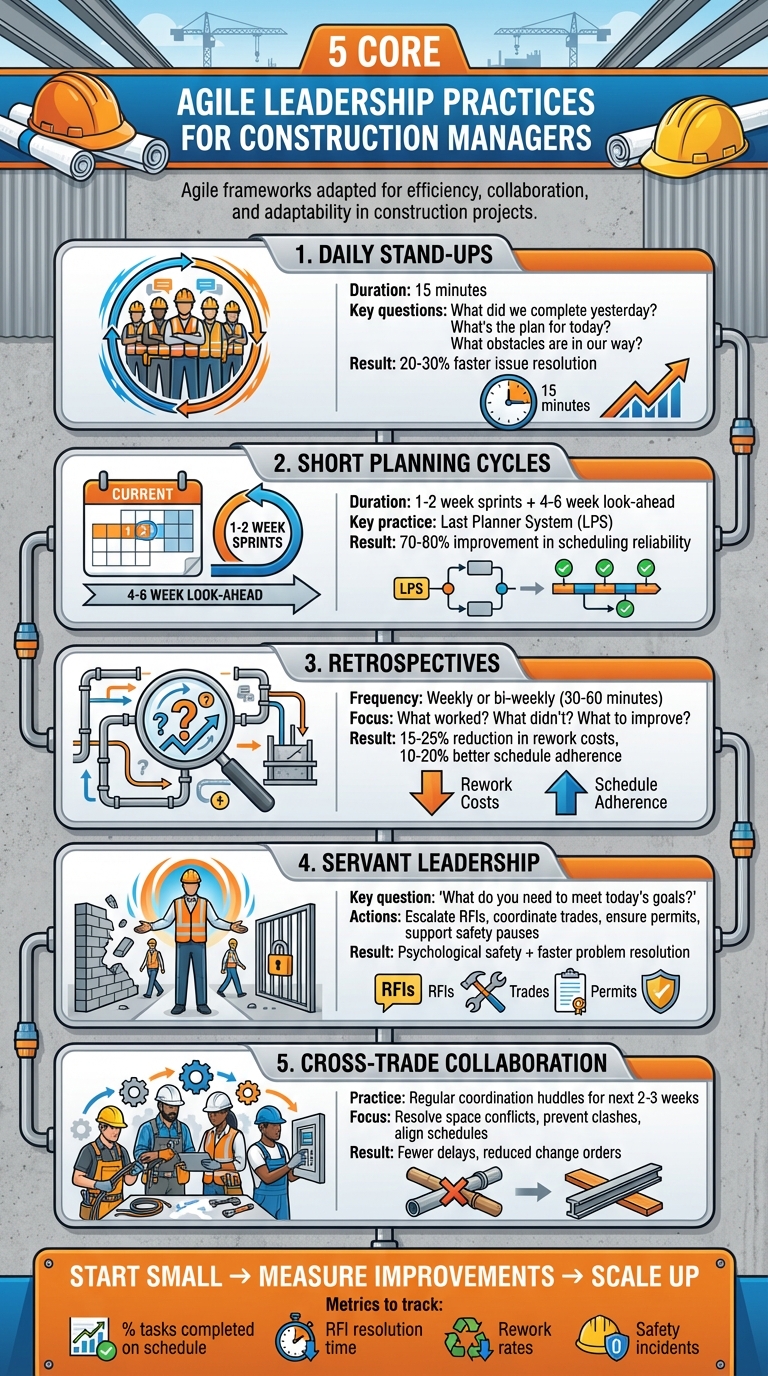
5 Core Agile Leadership Practices for Construction Managers
Agile construction: How to improve your projects with scrum and lean techniques
Core Agile Mindsets for Construction Leaders
Adopting agile leadership principles can significantly improve project outcomes in construction. These mindsets shape how daily operations are managed on the job site. Agile leadership shifts the focus from traditional management roles to empowering teams. Leaders set clear goals, define boundaries, and prioritize tasks, enabling crews to self-organize. Instead of assigning blame when issues arise, the emphasis is on refining systems and workflows – like handoff processes, material staging, and information flow – so crews can work more safely and efficiently. These foundational mindsets pave the way for practical strategies that can transform on-site leadership.
Using Servant Leadership
Servant leadership plays a pivotal role in agile construction management, emphasizing on-site support. Managers frequently ask foremen, "What do you need to meet today’s goals?" and quickly address issues such as equipment conflicts, missing RFIs, or safety concerns. This leadership style fosters psychological safety, encouraging workers to raise quality or safety concerns without fear of blame.
Practical examples of servant leadership include escalating RFIs promptly, coordinating trades to resolve workspace conflicts, ensuring permits and inspections are completed before crews begin work, and supporting workers who pause work for safety reasons. Servant leaders also lead by example by wearing PPE, showing up on time, admitting mistakes, and keeping their promises – actions that build trust across union and non-union teams. Additionally, they define clear decision-making boundaries, allowing foremen to adjust task sequences as long as safety, quality, cost, and schedule standards are upheld.
Using Inspect-and-Adapt Cycles
Continuous feedback is central to agile management. Agile leaders rely on frequent, short feedback loops instead of waiting for monthly updates. Common routines include daily stand-ups or field huddles (lasting 10–15 minutes) to review progress, discuss plans, and address blockers; end-of-week retrospectives with foremen to identify what slowed progress, what worked well, and what adjustments are needed; and 2–4 week look-ahead planning sessions to confirm readiness – ensuring drawings, materials, inspections, and access are in place before committing to tasks.
Construction firms using iterative planning methods report fewer RFIs during execution and less rework because potential issues are identified early. Managers should document successful adaptations in standard playbooks to make improvements repeatable. Tools like real-time location tracking and digital time cards provide immediate feedback, helping managers assess progress and make adjustments quickly.
Building Cross-Trade Collaboration
Agile leaders align all trades around shared goals, moving away from isolated milestones. Regular coordination huddles bring trade foremen together to review the next 2–3 weeks, resolve space conflicts, and negotiate task sequencing in real time. This approach supports Lean/Last Planner methods and helps minimize delays caused by trade stacking.
Encouraging cross-trade problem solving is another key practice. For example, electrical, mechanical, and drywall foremen can collaborate during layout to design a clash-free installation, avoiding costly RFIs and change orders later. On larger or remote projects, digital tools like ABLEMKR streamline crew mobilization and provide real-time visibility, ensuring schedules, certifications, and site access are aligned across subcontractors. Effective communication in agile settings is frequent, concise, and structured, using standardized daily huddle agendas, visual boards for look-ahead plans and constraints, and plain language with imperial units (feet, inches, pounds) to prevent misunderstandings on U.S. job sites.
Agile Practices You Can Use on Job Sites
Turning agile principles into tangible actions means adopting routines that keep job sites flexible and responsive. On U.S. job sites, these practices are especially effective because they’re straightforward, repeatable, and built for the fast-paced nature of fieldwork. The goal? Start small, see what works, and refine based on direct feedback from foremen and crews. These methods build on agile concepts to ensure projects stay on track day by day.
Short Planning Cycles and Look-Ahead Planning
Agile planning breaks work into short, manageable timeframes – 1–2 week sprints and 4–6 week look-ahead schedules. The Last Planner System (LPS) makes this approach practical by requiring foremen to commit to tasks only when the prerequisites – like completed prior work, staged materials, and necessary permits – are in place. On U.S. job sites using LPS, scheduling reliability has jumped by 70–80%, as teams identify and address constraints like missing RFIs, weather delays, or labor shortages before they disrupt progress. This approach mirrors agile leadership by enabling quick, informed responses to challenges.
Weekly pull planning sessions bring trade foremen together to map out the upcoming sprint. They focus on critical questions: Are the drawings finalized? Is the concrete cured? Are inspections scheduled? This collaborative pull model replaces the traditional top-down "push" scheduling, ensuring tasks are assigned only when crews are ready. For example, if electrical work depends on a framing inspection, the look-ahead session can confirm the inspector’s availability and keep the framing crew on schedule, eliminating potential delays weeks in advance.
Digital tools like ABLEMKR, with its mobile-first platform offering real-time insights into worker certifications, availability, and locations, further streamline this process. These tools ensure the right teams are deployed quickly, which is especially useful for large or remote projects. Integrating such technology supports agile leadership’s emphasis on fast, effective decision-making.
Daily Stand-Ups and Field Huddles
Daily huddles are quick, 15-minute on-site meetings held before work begins. During these check-ins, foremen and trade leads answer three core questions: What did we complete yesterday? What’s the plan for today? What obstacles are in our way? Visual aids help keep everyone aligned without dragging the meeting out.
On infrastructure projects, teams using daily huddles have resolved issues 20–30% faster, as problems are escalated immediately rather than waiting for weekly updates. These huddles aren’t just about reporting to managers – they’re tools for crew coordination. Holding them at the same time and place each day builds a dependable routine, fostering trust and enabling quicker problem-solving.
Retrospectives and Continuous Improvement
Beyond daily coordination, teams should regularly evaluate overall progress. Retrospectives, held at the end of each sprint (weekly or bi-weekly), are 30–60 minute sessions where teams discuss what worked, what didn’t, and what could improve next time. Using sticky notes, anonymous apps, or open discussions helps surface issues without assigning blame.
These reviews uncover root causes – like design flaws, late material deliveries, or unclear task handoffs – and lead to adjustments that reduce rework and improve schedules. Projects incorporating retrospectives have seen rework costs drop by 15–25% and schedule adherence improve by 10–20%, thanks to these timely feedback loops.
For instance, if drywall crews are consistently delayed waiting for mechanical sign-off, a retrospective might reveal that HVAC inspections are being scheduled too late. A solution could be to include inspection scheduling in the look-ahead plan, assigning a specific owner – such as “Project engineer will confirm all RFIs by Thursday” – to ensure accountability. This structured approach builds a no-blame culture where trade partners and managers work together to resolve bottlenecks and improve future workflows. Experts recommend tracking metrics like percent plan complete (aiming for over 80%), roadblock resolution time (under 24 hours), and rework rates (below 5%) to measure the success of these agile practices.
sbb-itb-aa28329
Building and Supporting Agile Teams
Agile practices thrive when U.S. construction teams are organized around work zones and value streams instead of rigid trade hierarchies. For instance, in a hospital project, teams might be divided into zone-based groups – like the North Wing, South Wing, or MEP core. Each group would manage its own look-ahead planning, daily huddles, and constraint resolution. Meanwhile, a central leadership team would handle contracts, client communication, and broader risks. This setup moves decision-making closer to where the work happens, enabling faster identification and resolution of issues. With this structure in place, teams can focus on the detailed practices that follow.
Defining Roles and Decision Rights
For field teams to work effectively, they need clear guidelines on what decisions they can make independently and which ones require escalation. Start by mapping out decision categories – such as sequencing changes, labor adjustments, minor rework, RFIs, temporary structures, and material substitutions – and assigning decision-making responsibilities . For example, a foreman might have the authority to re-sequence tasks within a three-day window, reassign one or two crew members on the same floor, or approve minor fixes under $2,500. However, decisions impacting safety, critical milestones, or design intent should be escalated to the superintendent or project manager . Summarize these roles in a one-page RACI (Responsible, Accountable, Consulted, Informed) chart, and review it during onboarding and weekly coordination meetings.
Trust is the cornerstone of this approach. Leaders should model openness by sharing their own mistakes and lessons learned, which fosters psychological safety and encourages innovation . On-site, this could mean starting daily huddles with a quick review of "yesterday’s misses and lessons", where workers are acknowledged for flagging near-misses or constraints – like missing embeds or misaligned sleeves – before they escalate into costly rework . Adopting a "no-blame, fix-first, learn-later" mindset, and holding structured debriefs with questions like, "What slowed you down? What should we adjust next cycle?" , normalizes speaking up and speeds up decision-making at the field level. Once internal roles are sorted, the next step is aligning external partners.
Aligning Subcontractors with Agile Practices
When multiple subcontractors with different contracts and work cultures come together, it can disrupt agile workflows if expectations aren’t clear. To prevent this, include agile requirements in preconstruction and subcontract agreements. These should cover participation in look-ahead planning, daily huddles, constraint tracking, and quick responses to RFIs and design changes . During preconstruction meetings, explain the benefits for subcontractors, such as smoother access to work areas, fewer clashes and rework, and clearer priorities.
Introduce these practices gradually. Start with regular coordination meetings, then add short retrospectives at key milestones to discuss what worked – like joint layouts or shared hoist schedules – and what could improve in the next phase . Reward subcontractors who align with these practices by offering earlier access to information, preferred sequencing, or better access to work areas. Use performance data – such as percent plan complete, RFIs per week, or rework hours – to demonstrate how agile methods can improve productivity and profitability. Keep it simple by standardizing meeting agendas and using digital or physical boards to track commitments and progress. Make it clear that failing to participate could increase risks or affect future bid opportunities .
Using Technology to Support Agile Teams
Technology plays a key role in helping agile teams make real-time decisions. Construction teams need immediate access to information about worker availability, qualifications, and clearances to quickly reassign crews as priorities shift. Tools like ABLEMKR connect pre-qualified workers to critical projects based on certifications, safety training, location, and availability. This allows superintendents and project managers to scale labor up or down without lengthy hiring processes. Features like integrated compliance tracking and real-time worker status reduce administrative burdens, letting field leaders focus on sequencing, safety, and resolving constraints.
Beyond labor platforms, agile teams benefit from lightweight, mobile-friendly tools. These include collaborative scheduling software, digital plan viewers, 2D/3D/BIM model coordination tools, issue-tracking apps for RFIs and defects, and digital safety and quality checklists accessible via smartphones or tablets . These tools enable instant updates on drawings, clash detections, and sequence changes, cutting down on delays caused by waiting for paper documents or office-based decisions. Data like percent plan complete, rework hours, and tool-time versus wait-time ratios can be displayed on simple dashboards and reviewed during weekly meetings. This helps teams identify areas for improvement, such as adding a material handler to reduce wait times or resequencing tasks to handle variability in MEP rough-ins .
To ensure these tools are widely adopted, limit the number of systems in use, provide brief hands-on training, and appoint a "field tech champion" to help crews and subcontractors with setup and troubleshooting.
How to Implement Agile Leadership on a Project
Turning agile leadership from concept into practice requires a clear plan. Start by mapping your current workflows using tools like whiteboards or digital platforms to track how long key processes take – such as resolving RFIs, approving submittals, or managing changes. Speak with key stakeholders to uncover common delays, rework issues, and decision-making bottlenecks. Compare planned versus actual schedules, labor productivity, and safety incidents over the last two to three months to identify recurring patterns, like repeated delays in specific trades or frequent punch-list rework. From this analysis, pinpoint three to five major challenges that agile practices could address, such as slow decision-making, poor coordination among trades, or a lack of on-site transparency. Using the agile techniques and roles discussed earlier, this groundwork helps shape practical steps for implementation.
Assessing Current Practices and Identifying Challenges
Start by analyzing the objective data your project controls and field systems already collect. Look at metrics like the percentage of tasks completed on schedule in look-ahead plans, the difference between planned and actual crew hours, RFI and change order cycle times, safety observations, and rework or inspection defect rates. Examine meeting notes, daily reports, and cost data to identify recurring problems, such as missing materials or unclear drawings. Cross-check these findings with cost reports – like contingency draws or overtime expenses – to uncover inefficiencies in budget and scheduling. In high-demand environments, platforms like ABLEMKR can help pinpoint staffing and compliance bottlenecks in real time, enabling quicker, more informed decisions. This analysis sets the stage for targeted agile strategies.
Starting with a Pilot Phase
Begin with a manageable pilot project – like one floor or a specific trade package – that has enough complexity to show measurable results without significant risk. Choose an area with a committed superintendent or field leader open to experimenting and subcontractors willing to try shorter planning cycles and feedback loops. Introduce agile practices like daily stand-ups, retrospectives, and short planning cycles while keeping existing contracts, safety protocols, and quality frameworks intact. This way, the management approach is the only variable being tested.
Set a pilot duration of six to eight weeks, aligning it with a meaningful work package to ensure progress and outcomes are clear. Frame the pilot around benefits for subcontractors – like fewer surprises, more predictable work fronts, reduced rework, and smoother inspections. Kick things off by gathering all involved subcontractors to explain the new routines, expected time commitments, and success criteria. Invite feedback on schedules and information needs. Highlight quick wins, such as resolving a constraint in one day instead of a week, to demonstrate the value of agile practices. For workforce-heavy tasks, tools like ABLEMKR can quickly match pre-vetted workers to immediate needs, showing how agile leadership and responsive staffing go hand in hand. With the pilot underway, focus shifts to measuring its impact and planning for broader adoption.
Measuring Success and Scaling Up
To validate agile leadership and guide its expansion, measure improvements during the pilot phase. Before starting, document baseline metrics like task completion rates, labor productivity, RFI and change order cycle times, schedule delays, rework rates, and safety incidents per 1,000 work hours. During the pilot, track these metrics weekly and compare them to the baseline. Pair this data with qualitative feedback from foremen and crew members about daily plan clarity, leadership responsiveness, and cross-trade collaboration. For workforce-heavy scopes, data from ABLEMKR – such as crew mobilization times and worker certifications – can provide additional insights.
Compare pilot results to both pre-pilot baselines and similar non-pilot areas on the same project. Look for improvements like higher plan reliability (e.g., tasks completed as planned improving from 55% to 75%), reduced rework, faster RFI turnaround times, better labor productivity, and more proactive safety practices with fewer incidents. Balance these gains against any added overhead, such as extra meeting time, and assess whether crew leaders see value in the changes. If results are mixed, identify which agile practices – like daily huddles – offer the most benefits and refine those that need adjustment, such as meeting lengths or planning detail.
Scaling up requires consistent performance improvements over two to three pilot cycles, field leaders who can run stand-ups and retrospectives effectively with minimal coaching, positive feedback from subcontractors, and minimal disruptions to core processes like contracts and safety protocols. Organizational readiness also depends on executive support, a clear justification for adopting agile leadership (e.g., better schedule reliability or safety outcomes), and accessible training materials for new teams. Systems must also support scaling – such as scheduling tools for short planning cycles and platforms like ABLEMKR to reallocate crews based on availability, certifications, and location.
Once these conditions are met, document lessons learned from the pilot, create a flexible framework for planning cycles, daily huddles, and retrospectives, and provide targeted training for project managers, superintendents, and foremen. Gradually expand the approach to a range of projects of varying sizes and complexities to ensure broad applicability and success.
Conclusion
Agile leadership offers a hands-on way to navigate the constant changes found on U.S. construction sites. By adopting tools like short planning cycles, daily team huddles, and regular retrospectives, leaders can shift from a traditional command-and-control mindset to a servant leadership approach – clearing obstacles and empowering crews to work more effectively on-site.
When put into practice consistently, the benefits are clear. Agile leadership enhances schedule reliability, safety, quality, and stakeholder satisfaction, especially for complex or high-risk projects. It also fosters strong communication and a sense of psychological safety, encouraging trades and subcontractors to address issues early. This proactive approach reduces change orders and rework. Tools like ABLEMKR can further streamline this process by connecting job sites with pre-vetted workers based on certifications, location, and availability – making it easier to scale or adjust crews as project priorities change.
To get started, focus on small, manageable steps. Over the next 30 days, try introducing a 10–15 minute daily stand-up meeting, piloting a two-week look-ahead planning cycle, and holding a brief retrospective to identify what to start, stop, or continue. Track metrics such as the percentage of planned tasks completed and the number of RFIs per week to evaluate the effectiveness of these changes. If you see steady improvement, it’s a sign that these practices are worth expanding.
Finally, treat agile leadership as an ongoing journey. Regularly reflect on your own behavior, seek feedback from your crew, and stay engaged with industry groups and peer networks to keep learning. By modeling adaptability, openness, and respect, you can weave agile practices into the culture of your job site – ensuring they become a lasting part of how work gets done.
FAQs
How does agile leadership help minimize rework in construction projects?
Agile leadership reduces the need for rework by emphasizing open communication, ongoing feedback, and flexible planning. These elements help teams spot issues early, tackle them promptly, and stop small problems from turning into major setbacks.
By promoting team collaboration, adaptability, and fast decision-making, agile leadership ensures plans can shift as project requirements evolve. This approach supports precise execution, minimizes delays, and cuts down on expensive errors during project implementation.
How does servant leadership support agile practices in construction management?
Servant leadership is a cornerstone of agile construction management, emphasizing trust, teamwork, and empowering individuals. Leaders adopting this style prioritize listening to their team members and addressing their needs, creating an environment where everyone can perform at their highest potential.
This leadership approach perfectly complements agile principles by promoting adaptability, quick responses to change, and a focus on ongoing improvement. By giving team members the autonomy to take charge of their responsibilities, servant leadership not only strengthens the team dynamic but also drives more efficient and effective project outcomes.
How do shorter planning cycles enhance construction project performance?
Shorter planning cycles give construction teams the ability to respond to changes quickly, tackle challenges as they come up, and improve communication. This method helps cut down on delays, make better use of resources, and boost project efficiency overall.
By staying adaptable and prioritizing steady progress, teams can achieve stronger results while keeping projects on track with their goals and schedules.


