
Want to break into the energy sector or advance your career? Online courses offer an accessible way to gain the skills and certifications employers need. With the global shift toward renewable energy, jobs in solar, wind, battery storage, and smart grids are booming. These courses are:
- Flexible: Study at your own pace, even with a full-time job.
- Affordable: Prices range from $50 to $1,200, with financial aid covering up to 90%.
- Effective: 98% of learners rate their experience positively.
Whether you’re looking to learn the basics of renewable energy, gain safety certifications, or specialize in project management, these programs cater to diverse career paths. Certifications like NABCEP (solar) and GWO (wind) can boost your employability and salary. Platforms like ABLEMKR even connect certified workers directly to energy projects.
Start today. Affordable courses and certifications make it easier than ever to join one of the fastest-growing industries.
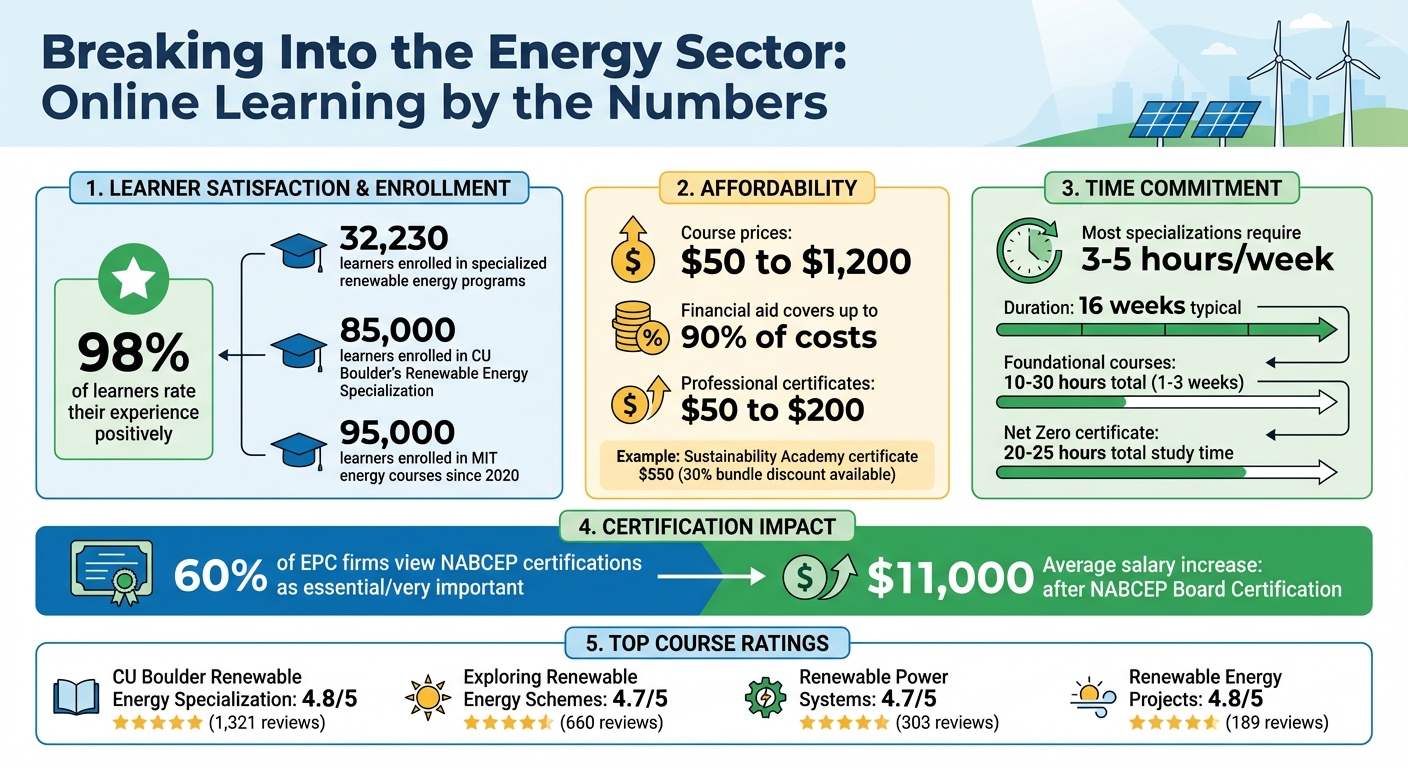
Online Energy Courses: Key Statistics and Benefits
Energy Efficiency Online Training That Works: Avoiding Red Flags & Building Real Skills
sbb-itb-aa28329
Why Online Learning Works for Energy Careers
Online learning offers energy professionals a way to enhance their skills without stepping away from their careers. The flexibility is a game-changer – many platforms provide 24/7 access to materials, allowing workers to study during downtime, between shifts, or even from remote locations like offshore rigs or rural installations. This constant availability is crucial in an industry where irregular schedules and remote work are the norm.
The demand for accessible training is evident, with over 32,230 learners enrolling in specialized renewable energy programs online. Felipe M., a participant, summed up the appeal perfectly:
To be able to take courses at my own pace and rhythm has been an amazing experience. I can learn whenever it fits my schedule and mood.
Online courses are also budget-friendly. They save on travel costs, reduce time away from work, and avoid the high fees of traditional in-person programs. Professional certificates in energy-related fields typically cost between $50 and $200, with many platforms offering financial aid that covers up to 90% of the expense. Additionally, these courses are designed to fit busy lives – most specializations in renewable energy require just 3 to 5 hours of study per week over 16 weeks, making them manageable alongside a full-time job.
Closing Skill Gaps in Energy Work
Online courses are not just convenient – they tackle the energy sector’s skill shortages head-on. Many jobs in the field require highly specialized knowledge that traditional education often overlooks. These programs focus on areas like grid integration, battery storage systems, safety protocols, project finance, and environmental regulations. Some even include gap analysis tools to help learners pinpoint their weaknesses and create a targeted learning plan. Jennifer J., a learner, shared her success story:
I directly applied the concepts and skills I learned from my courses to an exciting new project at work.
Learning on Your Own Schedule
The self-paced structure of online courses is a perfect fit for the demanding schedules of energy professionals. Participants can adjust their learning speed depending on their workload, with some certifications allowing up to 45 days for completion. Mobile-friendly platforms and apps make it easy for field workers to access lessons during downtime or commutes, and offline modes let them download content for areas with limited internet access. Microlearning modules break complex topics into short, 5–10 minute lessons, ideal for squeezing into busy days.
Specialized certificates, like those covering Net Zero fundamentals, typically require only 20–25 hours of total study time, which can be spread out over a flexible schedule. This approach is highly appreciated – 98% of foundational renewable energy learners praise the self-paced format. The Renewable Energy Institute showcases this success, having trained over 5,000 professionals from 150 countries through online and virtual classroom models. This flexibility makes online learning a powerful tool for addressing the energy sector’s evolving needs.
Main Course Categories for Energy Sector Jobs
Training for energy sector jobs typically falls into three key areas: renewable energy systems, technical safety skills, and leadership development. These courses are designed to help workers quickly acquire essential skills for the energy industry, with options ranging from free audits to professional certifications costing less than $700.
Renewable Energy Training
Courses in renewable energy focus on the technical aspects of solar, wind, and hydroelectric systems. For instance, the University of Pennsylvania offers "Exploring Renewable Energy Schemes," a 2-week program that covers off-grid photovoltaic systems, wind turbines, and low-head hydroelectric installations. This course has attracted 32,230 learners and boasts a 4.7/5 rating from 660 reviews.
For those interested in grid-scale operations, the University of Colorado Boulder‘s "Renewable Power and Electricity Systems" teaches how to integrate renewables like wind and solar into power grids using battery storage and demand flexibility. This 1-week course has enrolled 19,513 participants and holds a 4.7/5 rating from 303 reviews. Another standout program, CU Boulder’s "Renewable Energy Specialization," combines four courses covering fundamentals, power systems, project management, and industry trends. Spanning 16 weeks with a commitment of 3 to 5 hours per week, it has enrolled 85,000 learners and maintains a 4.8/5 rating from 1,321 reviews.
The Sustainability Academy also offers an "Online Certificate in Renewable Energy Fundamentals: The Path to Net Zero" for $550. This program, accredited by CMI and CPD, requires 20–25 hours of study and explores emerging topics like hydrogen energy and smart grids. Learners can save 30% by bundling it with other courses such as ESG Reporting. With these technical foundations in place, workers can pursue additional training in safety and operational protocols to meet on-site demands.
Technical Skills and Safety Certifications
Technical training focuses on areas like electrical systems, power plant operations, and safety protocols. Coursera, in partnership with institutions like the University of Pennsylvania and the University of Colorado Boulder, offers courses on electrical safety standards, NEC compliance, and grid reliability. These programs prepare workers for hands-on roles in utilities, power generation, and transmission.
The Sustainability Academy’s renewable energy certificate demonstrates expertise across various technical disciplines and is accredited by CPD and CMI. For wind turbine technicians, the Wind Trade Academy provides GWO-approved certifications for working at height or in confined spaces. While most technical courses are beginner-friendly, some advanced programs recommend a basic understanding of algebra. Beyond technical skills, leadership training is crucial for managing complex energy projects.
Project Management and Leadership Training
Leadership courses equip energy professionals for supervisory roles and project management. The University of Colorado Boulder’s "Renewable Energy Projects" program covers the entire project lifecycle, including feasibility studies, financial modeling, construction management, and stakeholder engagement. This course has earned a 4.8/5 rating from 189 reviews.
For those focusing on investment analysis or project development, the Renewables Valuation Analyst (RVA) certification offers training in financial modeling for solar, wind, and battery energy storage systems (BESS). The program costs $397 for yearly access or $697 for lifetime access. A student, Nicklas M., shared his experience:
Lukas provides all the knowledge and skills necessary to build integrated and flexible financial models that live up to the highest industry standards. All in all, the perfect course!
MIT also offers advanced energy training, with 95,000 learners enrolled since 2020. These courses, which cover systems thinking and energy economics, are free to audit, with certificates available for $50 to $200. Financial aid is available for up to 90% of the cost for eligible participants. Duke University‘s "Renewable Energy and Green Building Entrepreneurship" focuses on business planning, team management, and ESG strategies, earning a 4.7/5 rating from 2,900 reviews.
Industry-Recognized Certifications
Certifications play a crucial role in landing jobs within the energy sector. In fact, 60% of Engineering, Procurement, and Construction (EPC) firms view NABCEP Board Certifications as either "essential" or "very important" for hiring decisions. On top of that, professionals often see an average salary bump of $11,000 after earning a NABCEP Board Certification. These credentials demonstrate technical expertise and safety training – qualities that are especially valuable for positions like solar installer or wind turbine technician. This kind of recognition not only validates your skills but also enhances your employability in a competitive field.
Key Certifications for Energy Jobs
The North American Board of Certified Energy Practitioners (NABCEP) offers some of the most respected certifications in solar and energy storage. For those just starting out, the PV Associate certification is a great option. It focuses on foundational knowledge and doesn’t require extensive hands-on experience, making it perfect for career changers. Meanwhile, certifications like PV Installation Professional (PVIP) and Energy Storage Installation Professional (ESIP) are tailored for seasoned professionals working with solar and storage systems. In certain states, such as Illinois, NABCEP certification is even a legal requirement for installing renewable energy systems on buildings.
For wind energy professionals, Global Wind Organisation (GWO) certifications are essential. These include training in Working at Heights, First Aid, and Fire Awareness. If you’re interested in energy auditing or efficiency, the Building Performance Institute (BPI) offers respected certifications in those areas. For those in oil and gas, credentials in Pipeline Fundamentals, Upstream Oil & Gas operations, and Natural Gas Production are highly recommended. Many of these certifications come with accessible, cost-effective exam prep options online, making it easier to get started.
Affordable Platforms for Certification Prep
Several online platforms provide budget-friendly courses that include certification exam fees, making it easier to get certified without breaking the bank. For example, Auburn University and Odessa College offer NABCEP PV Associate training online, with the exam costs already included in the course fees. If you have volunteer experience in the solar industry, the Les Nelson Scholarship Fund can help subsidize costs for certifications, Board Certification, and continuing education. Additionally, veterans can take advantage of the Veterans Pathway program, which provides funding for NABCEP exams.
For oil and gas, Oak Leaf Energy Training offers online courses covering topics like natural gas production, wind energy fundamentals, and carbon/net-zero transitions. If you’re looking for safety certifications in wind and solar, RenewAcad provides GWO-approved training. Refresher courses, such as First Aid training, start at €140 + VAT, while Working at Heights with Manual Handling costs €224 + VAT. These platforms make it easier to gain the qualifications needed to advance into higher-paying and specialized roles within the energy sector.
Creating Your Learning Path
Shape your energy career with a clear and structured learning plan. Begin with foundational knowledge and gradually move toward specialized certifications tailored to your target role. Over 17,000 learners have already enrolled in foundational renewable energy courses to kick-start their career journeys. Breaking your development into manageable steps makes the process more achievable.
Starting with Entry-Level Courses
The best way to begin is by diving into entry-level courses that help you uncover your interests and outline a solid career roadmap. The energy sector is vast, so exploring areas like solar, wind, green building, and sustainability can help pinpoint what excites you most. A great example is the University at Buffalo‘s course, Renewable Energy: Fundamentals and Job Opportunities. With over 17,000 enrollees, this course provides a roadmap for defining your target job, identifying skill gaps, and planning your training pathway. It boasts a 4.7-star rating from 228 reviews, with learners praising its "clear and concise explanations" and describing it as "a good introduction for beginners".
Before jumping into technical training, it’s crucial to understand safety basics. Entry-level courses often cover essential safety topics like Lock-out/Tag-out (LOTO) procedures, Personal Protective Equipment (PPE), and electrical hazards. For instance, the University of Colorado Boulder’s Renewable Energy Technology Fundamentals course, which has enrolled more than 47,000 students, includes these safety essentials along with technical skills like using electrical meters and basic algebra. Most beginner courses require between 10 to 30 hours of study and can be completed in 1 to 3 weeks with a commitment of around 10 hours per week.
Moving to Specialized Skills and Certifications
Once you’ve built a strong foundation, it’s time to focus on specialized skills tailored to your target role. For example, solar technicians can benefit from Solar Energy International’s Introduction to O&M for Large-Scale PV Systems. This course, requiring about 30 contact hours, focuses on utility-scale, ground-mounted systems and includes field-ready safety protocols.
If wind energy sparks your interest, certifications from the Global Wind Organisation (GWO) in areas like Working at Heights, First Aid, and Fire Awareness are essential. Providers like RenewAcad offer these certifications, with refresher training starting at €140 + VAT for 4-hour modules. For advanced technical expertise, consider courses like PVSyst Introduction (Design and Production Estimation), which costs around €1,000 and takes approximately 8 hours to complete. Ensuring your training meets industry standards is key to gaining recognition.
"The Intro to O&M is going really well, our new hires are gaining valuable experience and it’s already helping to strengthen the team. Really appreciate the support, thank you!" – Gunnar Johnson, O&M Manager, Standard Solar
How Long It Takes to Get Certified
The timeline for certification varies depending on your starting point and career goals. Foundational courses generally take 1 to 3 weeks, requiring 10 to 30 hours of study. If you’re aiming for a technical role, such as a Solar O&M Technician, plan to dedicate around 30 contact hours to introductory training before moving on to advanced modules. Specialized certifications and technology-focused courses typically take 1 to 2 weeks per module, though some roles may also require on-the-job experience to fully prepare you.
For added flexibility, platforms like Coursera Plus provide unlimited access to thousands of courses, often with discounts like 40% off for the first three months. Additionally, initiatives such as the Solar O&M High Road Training Partnership offer DOE-funded scholarships, specifically supporting individuals from disadvantaged communities. To stay on track, consider setting SMART goals – Specific, Measurable, Achievable, Relevant, and Time-bound.
How ABLEMKR Connects Trained Workers with Energy Jobs
After earning your certifications through affordable online courses, the next step is landing the right job. That’s where ABLEMKR comes in – a mobile-first workforce platform designed to connect skilled workers with energy projects.
With the ABLEMKR app, workers create digital profiles showcasing their verified skills, certifications, and ratings. Energy companies post projects – whether it’s an urgent pipeline repair or scheduled utility work – and the platform matches pre-vetted workers based on their certifications, safety training, availability, and location. From OSHA tickets to renewable energy certifications, your qualifications are put to work immediately. This system simplifies the hiring process, making it quicker and more efficient.
The app also streamlines onboarding, time card management, and contract signing, so you can transition from certification to job site with minimal hassle. Workers benefit from guaranteed on-time payments and access to well-paying opportunities, while energy companies gain real-time insights into worker status and compliance tracking.
Tradespeople can sign up for free job alerts within the app, receiving instant notifications tailored to their certifications. For employers, ABLEMKR serves as a flexible HR partner, offering hiring options like flex work, flex-to-hire, and direct placement to meet project demands swiftly.
To top it off, ABLEMKR prioritizes transparency and accountability. Employers can directly message workers, track their real-time location, and view verified profiles, ensuring a smooth and reliable hiring process.
Conclusion
Affordable online courses are opening doors for workers to build and grow their careers in the energy sector. Whether it’s learning the basics of renewable energy, gaining safety certifications, or mastering project management, these courses deliver the skills and credentials that employers are actively looking for. With financial aid options, flexible schedules, and certifications from respected institutions, there’s no better time to invest in your energy career.
For instance, 98% of learners have expressed satisfaction with introductory renewable energy courses. CU Boulder’s Renewable Energy Specialization also boasts an impressive 4.8/5 rating from over 1,300 reviews. These programs are designed to provide you with practical, job-ready skills that you can apply immediately.
Whether you’re just starting your journey or aiming to specialize further, the steps are straightforward. Begin with foundational courses to build a strong understanding of clean energy. Identify any certification gaps that need to be addressed, and use available financial aid to make your education more accessible. Once you’ve earned your credentials, adding shareable certificates to your LinkedIn profile and resume can help set you apart from the competition.
After completing these courses, platforms like ABLEMKR can connect you directly to energy projects across the U.S., bridging the gap between education and employment. This combination of affordable learning and targeted job placement creates a seamless pathway into one of the nation’s fastest-growing industries.
Start today: find the courses and certifications that match your career aspirations and take the first step toward a rewarding future in the energy sector.
FAQs
Which certification should I get first for my target energy job?
If you’re looking to enter the energy sector, starting with foundational certifications in renewable energy technologies is a smart move. Programs like ‘Renewable Energy: Fundamentals and Job Opportunities’ or Yale’s ‘Clean and Equitable Energy Development’ offer a solid understanding of energy systems, policies, and sustainable practices. These courses lay the groundwork for understanding how renewable energy works and its role in shaping the future.
From there, you can build on this base with more specialized certifications tailored to your career goals. For example, if you’re interested in hands-on work, certifications in solar panel installation could be a great fit. Alternatively, if you’re drawn to the operational side of things, energy management certifications might align better with your ambitions. These targeted credentials can help you carve out a path in the growing renewable energy field.
Do I need prior experience or math skills to start these courses?
Most courses in the energy sector are designed with beginners in mind, requiring no prior experience or advanced math skills. They emphasize core concepts and practical insights, ensuring accessibility for learners from various backgrounds.
How can ABLEMKR help me get hired after I’m certified?
ABLEMKR connects certified workers with in-demand energy projects across the U.S., simplifying the hiring and onboarding process. The platform speeds up crew mobilization by handling compliance and administrative tasks efficiently. Workers benefit from competitive pay, flexible schedules, and reliable, on-time payments, making it a smoother path to enter or grow within the energy industry.


