
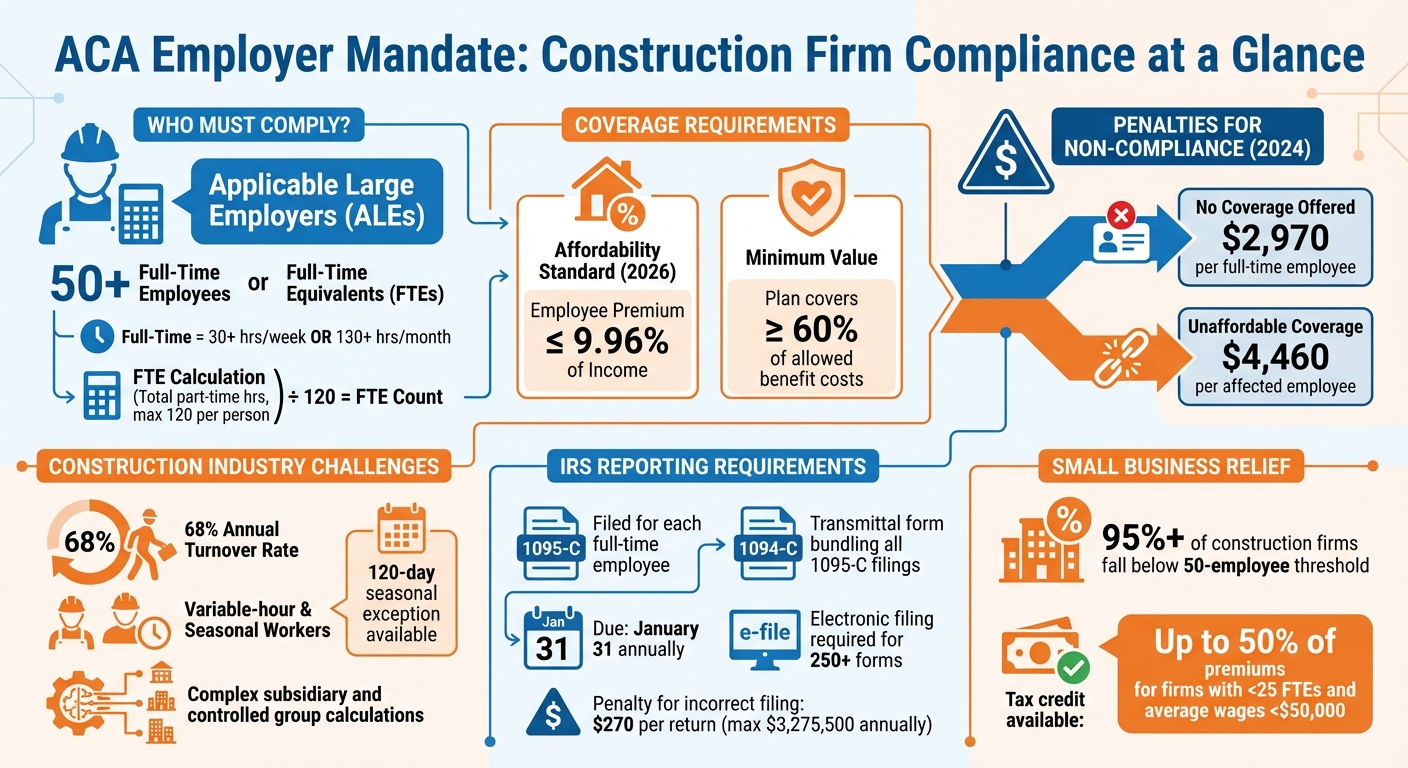
The ACA employer mandate requires businesses with 50 or more full-time or full-time equivalent employees to provide affordable health insurance that meets minimum value standards. Construction firms face unique challenges due to high turnover, seasonal workers, and complex workforce structures. Non-compliance can lead to steep penalties.
Key Points:
- Who’s Affected? Applicable Large Employers (ALEs) with 50+ full-time employees or equivalents.
- What’s Required? Offer affordable coverage (costing ≤ 9.96% of employee income in 2026) and meeting minimum value (60% coverage of allowed benefit costs).
- Penalties: $2,970 per full-time employee for failing to offer coverage or $4,460 per affected employee if coverage is unaffordable.
- Unique Construction Challenges:
- High turnover (68% annually) complicates tracking eligibility.
- Seasonal workers and subsidiaries must be included in ALE calculations.
- Managing variable-hour employees requires accurate tracking and documentation.
- IRS Reporting: ALEs must file Forms 1094-C and 1095-C annually to demonstrate compliance.
To simplify compliance, construction firms can leverage automated tools for tracking hours, managing look-back periods, and ensuring accurate reporting.
ACA Employer Mandate Compliance Requirements for Construction Firms
How to Use FOUNDATION‘s Affordable Care Act Features
ACA Compliance Requirements for Construction Firms
To comply with the Affordable Care Act (ACA), construction firms must confirm their status as an Applicable Large Employer (ALE), provide affordable coverage that meets minimum-value standards, and accurately track employee hours. Staying compliant helps avoid penalties and safeguards your company’s financial stability.
Full-Time Employees and Applicable Large Employers (ALEs)
Construction firms need to determine their ALE status every year based on the workforce size from the prior calendar year. A full-time employee is defined as someone working an average of 30 or more hours per week or 130 or more hours per month. To calculate full-time equivalent employees (FTEs) for part-time workers, add up all their monthly hours (capping at 120 hours per individual), divide the total by 120, and combine this number with your full-time employee count. Then, average these totals over 12 months. If the result is 50 or more, your firm qualifies as an ALE. When rounding, always round down.
For firms under common ownership or part of controlled groups, employee counts must be combined across all related entities to determine ALE status. For example, if one entity has 35 employees and another has 20, the total of 55 qualifies the group as an ALE.
If your workforce exceeds 50 employees for 120 days or fewer, and the excess is due to seasonal workers, you may not meet the ALE criteria. Certain individuals, such as sole proprietors, partners, 2-percent shareholders in S corporations, or employees with military coverage (Tricare or Veterans’ benefits), are excluded from the 50-employee threshold calculation.
Given the seasonal and transient nature of construction labor, these calculations are essential for determining compliance responsibilities.
Meeting the Affordability Standard
Once classified as an ALE, your firm must offer health insurance that is both affordable and meets minimum-value requirements. For coverage to be deemed affordable, the employee’s share of the premium for self-only coverage cannot exceed the IRS’s allowable percentage of their income. Additionally, the plan must cover at least 60% of the total allowed benefit costs to satisfy the minimum-value standard.
Since full household income is typically unavailable, employers often use the W-2 or Rate of Pay safe harbor methods to determine affordability. These approaches can shield your firm from penalties, even if the coverage is later found unaffordable.
Failure to meet these standards results in the "B" penalty, which is $4,460 per affected employee in 2024 if even one employee receives a premium tax credit through the Health Insurance Marketplace.
Tracking and Reporting Employee Hours
To comply with ACA requirements, firms must track all worked and paid hours, including those for vacation, holidays, illness, jury duty, and other types of leave. These hours count toward the 30-hour threshold for full-time status.
Construction companies can choose between two methods for measuring employee hours:
- Monthly Measurement Method: Tracks hours worked on a month-by-month basis.
- Look-Back Measurement Method: Determines full-time status based on hours worked during a prior measurement period. This method is particularly useful for firms with variable-hour or seasonal workers, as it provides stability in coverage eligibility and simplifies administration.
All ALEs are required to file Form 1094-C (a transmittal form) and Form 1095-C (an employee statement) with the IRS annually, even if no health insurance was offered. Additionally, Form 1095-C must be provided to each full-time employee by January 31, though the IRS has often granted 30-day extensions. Firms filing 250 or more forms must do so electronically via the ACA Information Returns (AIR) system. Penalties for failing to file correctly are $270 per return, with a maximum annual penalty of $3,275,500.
| Requirement | Description |
|---|---|
| Full-Time Employee | Averages 30+ hours/week or 130+ hours/month |
| FTE Calculation | (Total non-full-time hours, max 120 per person) divided by 120 |
| ALE Threshold | 50+ full-time employees (including FTEs) |
| Form 1095-C | Filed for each full-time employee to report offers of coverage |
| Form 1094-C | The transmittal form used to bundle all 1095-C filings |
Next, we’ll explore the unique challenges construction firms face in maintaining ACA compliance.
ACA Compliance Challenges for Construction Firms
Navigating the Affordable Care Act (ACA) is no easy feat for construction companies. The industry’s project-based nature, combined with unpredictable labor demands and tight budgets, creates a maze of compliance challenges. These difficulties grow even more complex when factoring in workforce variability and the financial strain of providing health coverage that meets ACA standards.
Managing Variable and Seasonal Workers
Construction projects often deal with unpredictable work hours due to factors like weather, permit delays, and shifting client deadlines. This makes it tough to determine upfront if a worker averages 30 hours per week – one of the key thresholds for ACA compliance.
Adding to the complexity, firms must distinguish between workers included in Applicable Large Employer (ALE) calculations and those eligible for benefits under the ACA’s look-back method. For example, a job qualifies as "seasonal" only if it lasts six months or less and starts around the same time each year.
"While most seasonal employees are unlikely to make it through a measurement period to qualify for eligibility, employers still have to apply a measurement period to properly make that determination."
– Christy Abend, Director of Product Management, Equifax Workforce Solutions
High turnover rates – common in construction – create even more administrative headaches. For instance, if a worker returns after a 13-week break, the employer must restart the measurement period, leading to additional tracking and paperwork. For firms managing large, dispersed teams, this manual tracking of variable hours increases the risk of errors and potential IRS penalties.
There is some relief under the ACA’s 120-day exception. If a company’s workforce exceeds 50 employees for 120 days or fewer during the year – and the extra workers are seasonal – the firm may avoid ALE status. However, taking advantage of this exception requires detailed records that justify how and why workers were classified as variable-hour, based on past practices or the nature of their assignments.
Balancing Insurance Costs with Profitability
Tracking hours is only one part of the equation. Construction firms also face the challenge of balancing the cost of offering ACA-compliant health coverage with their notoriously thin profit margins. Non-compliance can lead to steep penalties.
For companies operating on tight budgets, the affordability standard is a major hurdle. Employers must ensure that the employee’s share of the premium doesn’t exceed a certain percentage of their income to meet ACA requirements. Smaller firms, however, may have some financial relief available. Businesses with fewer than 25 full-time equivalent employees and average annual wages under $50,000 could qualify for a tax credit covering up to 50% of premium costs through the Small Business Health Options Program (SHOP). On top of that, most construction companies – over 95% – fall below the 50-employee ALE threshold, meaning they’re exempt from the ACA mandate altogether.
For larger firms, the strategy often boils down to workforce management. ALEs are required to offer coverage only to full-time employees, not part-time workers, to avoid shared responsibility penalties. This leads many construction companies to carefully monitor worker hours and project assignments, trying to strike a balance between compliance costs and operational efficiency – all while ensuring they have the skilled labor needed to complete projects on time and safely.
sbb-itb-aa28329
Using Technology to Simplify ACA Compliance
Construction firms dealing with ACA compliance no longer need to rely on spreadsheets or manually track hours. Today’s platforms automate calculations and reporting, saving HR teams time and reducing the risk of errors. These tools directly address the time-consuming challenges that many companies face.
Automated Workforce Tracking
Platforms like ABLEMKR simplify compliance by automatically recording hours across job sites. They determine full-time eligibility based on the ACA’s 30-hour-per-week rule without manual calculations. The system also calculates Full-Time Equivalent (FTE) counts by combining hours from part-time, seasonal, and temporary workers, helping firms determine if they meet the 50-employee threshold to qualify as an Applicable Large Employer (ALE). For construction companies with fluctuating headcounts, this automation is a game-changer.
Another key feature is the automatic handling of look-back periods. These systems track variable hours over periods ranging from 3 to 12 months, eliminating the need for manual tracking. This level of automation can reduce ACA filing time by up to 70% compared to traditional methods.
Real-Time Compliance Monitoring
Beyond tracking, real-time compliance monitoring ensures potential issues are flagged immediately. Automated tools calculate eligibility and alert HR teams when variable-hour workers are nearing thresholds, enabling timely offers of coverage. This proactive approach helps companies avoid penalties, which in 2026 are expected to reach $3,340 per employee for failing to offer coverage to 95% of full-time staff, or $5,010 per employee receiving a premium tax credit due to unaffordable coverage.
With the IRS no longer offering "good-faith transition relief" for incorrect forms, accuracy is more critical than ever. Brian Costello, Field Marketing Manager at Mitratech, emphasizes this point:
"One mistake, like failing to offer coverage once an employee is deemed eligible after the measurement period ends, is an unnecessary risk to take".
Simplified Worker Onboarding
Compliance starts with onboarding, and digital systems make this process seamless. These tools capture vital data required for ACA reporting, such as employee identification, coverage offer dates, and consent for electronic delivery of Form 1095-C. ABLEMKR integrates compliance tracking into the onboarding process, ensuring all necessary certifications, safety training, and ACA-related information are collected from day one.
This upfront data collection helps prevent errors like incomplete or incorrect returns, which can lead to IRS penalties of $270 per return, with total penalties reaching up to $3,275,500 annually for larger ALEs. Additionally, by integrating with payroll systems, these platforms automatically perform affordability calculations using safe harbor methods, such as the Rate of Pay safe harbor for hourly workers. This ensures that premiums stay within the 2026 affordability limit of 9.96% of household income.
Conclusion
ACA compliance can be a tough nut to crack for construction firms, especially those managing variable-hour and seasonal workers. From figuring out if your company qualifies as an Applicable Large Employer (ALE) to tracking hours across multiple job sites and filing precise IRS reports, the administrative load can feel overwhelming. And let’s not forget – mistakes can lead to hefty penalties, as mentioned earlier.
Relying on manual processes only increases the chances of errors, making compliance even harder to manage.
That’s where ABLEMKR steps in. This platform simplifies compliance by embedding tracking into your workforce management. Right from onboarding, it captures critical data like certifications, hours worked, and eligibility for coverage. Real-time monitoring helps catch potential issues as they arise, while built-in payroll workflows handle affordability calculations using IRS-approved safe harbor methods.
FAQs
What’s the best way for construction firms to track employee hours for ACA compliance?
To meet ACA compliance requirements, construction firms should consider using automated, mobile-friendly time-tracking tools. These tools are designed to accurately log employee hours, making it easier to identify workers who average 30 hours or more per week, which is a key threshold under ACA guidelines.
By adopting technology capable of producing ACA-ready reports, firms can streamline the compliance process, minimize errors, and save valuable time. This not only simplifies verification but also ensures precision in fulfilling employer mandate responsibilities.
What are the penalties for construction firms that don’t comply with ACA requirements?
Under the ACA employer mandate, construction companies that don’t provide minimum essential coverage to their full-time employees could face penalties. For 2026, that penalty is $3,340 per full-time employee, though the first 30 employees are exempt from this calculation.
If coverage is offered but is considered unaffordable or doesn’t meet minimum value standards, the penalty rises to $5,010 per full-time employee. These fines can escalate fast, making compliance a top priority to avoid hefty charges.
How does the ACA employer mandate affect seasonal and variable-hour construction workers?
Under the ACA employer mandate, businesses classified as applicable large employers (ALEs) – those with 50 or more full-time employees (or full-time equivalents) – are required to provide affordable health insurance that meets minimum value standards. This coverage must be offered to employees working 30 or more hours per week and their dependents. Failing to meet this requirement could result in penalties.
For construction companies that rely heavily on seasonal or variable-hour workers, figuring out who qualifies for coverage can be tricky. One option is the monthly measurement method, where an employee is deemed full-time if they average 30 hours per week in a given calendar month. While straightforward, this method can be cumbersome when work hours fluctuate significantly.
To address this, many construction firms prefer the look-back measurement method. This approach averages an employee’s hours over a longer timeframe, such as three months, making it easier to account for seasonal shifts in workload. It also helps determine which employees meet the 30-hour threshold while still including seasonal workers in the total workforce count for ALE status.
Tools like ABLEMKR can make compliance less of a headache. By automating hour tracking and ensuring consistent use of measurement methods, these platforms help reduce administrative work and lower the risk of penalties.


