
Energy projects come with inherent risks, from chemical spills to electrical hazards. Preventing accidents requires a proactive approach, combining hazard assessments, proper safety protocols, and skilled teams. Here’s what you need to know:
- Key Hazards: Chemical exposure, thermal burns, electrical shocks, moving machinery, and stored energy.
- Risk Mitigation Steps: Pre-planning hazard assessments, energy isolation (Lockout/Tagout), and implementing safety controls.
- Worker Safety: Verified certifications, PPE compliance, and real-time monitoring are critical.
- Technology’s Role: Platforms like ABLEMKR streamline worker matching, certification tracking, and compliance monitoring for safer worksites.
Electrical Hazards and Safety in Oil & Gas Facilities
sbb-itb-aa28329
Common Hazards in Energy Projects
Energy worksites are notorious for exposing crews to a variety of dangers, ranging from immediate injuries to long-term health issues. Breaking these hazards into categories helps teams better prepare, implement controls, and react effectively when risks arise. Below, we dive into the primary hazard groups and their associated risks.
Chemical and Thermal Hazards
Chemical exposure and extreme heat are serious threats on energy worksites, with risks including toxic inhalation, corrosive injuries, and severe burns. One particularly dangerous scenario is a thermal runaway – an uncontrolled chemical reaction that rapidly escalates, leading to extreme temperature and pressure spikes, explosions, and releases of toxic gases.
For example, a documented incident involving the decomposition of di-tert-butyl peroxide (DTBP) in a 20% toluene solution showed how quickly things can spiral. The reaction began around 45°C but soon surged to 225°C, generating 43 bar of pressure.
Flammable substances and high-temperature fluids in pipelines further amplify the risks. Pipelines often carry combustible gases or hot liquids that can ignite during maintenance or when connections are broken. Before opening a chemical line, workers must follow key safety steps: locate safety showers and eye wash stations, ensure the line is fully depressurized using vents and drains, and maintain a defensive stance to avoid harm.
"An adequately designed ERS [Emergency Relief System] will help manage chemical reactivity hazards and provide increased manufacturing safety for plant personnel and surrounding communities by providing containment of flammable as well as toxic mixtures."
– Jens Conzen, Vice President of Strategy and Business Development, Jensen Hughes
To tackle these risks, the hierarchy of controls is essential. Start by eliminating or substituting hazardous chemicals. Then, implement engineering controls like ventilation or enclosures, followed by administrative measures. Personal protective equipment (PPE) should always serve as the last line of defense.
Energy projects also face additional dangers from electrical systems and moving machinery.
Electrical and Kinetic Hazards
Electrocution, arc flashes, and moving machinery are major causes of injuries in the energy sector. In 2020 alone, electrical shocks claimed the lives of 126 workers, with roughly 70% of these fatalities involving non-electrical personnel. This underscores a critical issue: many workers lack adequate knowledge of power distribution systems, leaving them vulnerable during routine tasks.
Live electrical panels, rotating machinery, and high-voltage connections demand constant vigilance. Arc flash events, for instance, release intense heat and pressure in milliseconds, leading to severe burns and blast injuries. Meanwhile, moving parts on drilling rigs or processing equipment can unexpectedly strike or crush workers, unleashing dangerous kinetic energy.
"For non-electrical workers, a general lack of understanding around the power distribution system can lead to incidents or events during routine drilling operations."
– Helmerich & Payne
Clear labeling is a must in harsh environments where dust, weather, and vibrations can obscure markings. Durable, visible labels help prevent incorrect connections that could lead to unintended energy releases and injuries.
But electrical risks aren’t the only concern – stored energy in high-pressure systems presents its own unique challenges.
Stored Energy Hazards
High-pressure systems, such as hydraulic lines and mud circulation equipment used in drilling, store enormous amounts of energy. If not properly controlled, these systems can release that energy violently, causing serious harm.
"Powerful mechanical equipment on drilling rigs generates high levels of energy, posing a serious risk without proper controls in place."
– Helmerich & Payne
The rig move process – rig down, power down, and rig up – is particularly hazardous. Damaged high-pressure hoses or cables can fail catastrophically when systems are re-energized, releasing stored energy in an instant. Similarly, pipeline pressure explosions can occur when relief systems fail to manage rapid gas generation or when workers inadvertently open pressurized lines.
To mitigate these risks, teams rely on robust Lockout/Tagout/Tryout procedures during power-down and rig-up phases. Comprehensive inspections of high-pressure components after equipment moves are equally important. These checks allow crews to spot and replace damaged parts before systems are pressurized, reducing the likelihood of catastrophic failures.
Pre-Planning and Hazard Assessment
Skipping pre-planning hazard assessments isn’t just risky – it can compromise safety and stall projects. A well-thought-out pre-planning process identifies potential risks, ranging from overhead power lines to underground utilities, and establishes a clear strategy to manage them throughout the project.
"Mitigation plans are key to breaking the cycle of disaster damage and reconstruction." – FEMA
Hazard assessments are more than just a safety measure – they’re a legal requirement. In the U.S., jurisdictions applying for federal aid or Hazard Mitigation Assistance (HMA) grants must have a FEMA-approved hazard mitigation plan. This involves documenting the location, scope, and history of natural hazards as part of a formal risk assessment. This systematic approach sets the groundwork for targeted site surveys and thorough safety planning.
Conducting Site Surveys
Site surveys are crucial for understanding the geographical layout of potential hazards and their impact on workers. Identifying risks like overhead power lines, underground utilities, and confined spaces helps pinpoint areas where energy release could occur. Today, advanced tools like drones are revolutionizing these surveys. They provide detailed inspections of utility facilities and help report damages with precision.
For instance, the Fayetteville, NC, Public Works Commission (PWC) uses drones to inspect utility facilities, enhancing their ability to document disaster-related damage. The data collected is combined with geospatial analyses, overlaying infrastructure imagery with hazard and climate projection maps. This integration aids in creating mitigation strategies and reducing future recovery costs. Tools like GIS technology further enhance this process by mapping hazards and identifying weaknesses in critical infrastructure.
These surveys feed directly into the development of comprehensive health and safety plans.
Developing a Health and Safety Plan
Once hazards are mapped out, the next step is crafting a Health and Safety Plan that addresses all types of energy risks – electrical, kinetic, thermal, chemical, and stored energy. A performance-based approach ensures these plans are practical and effective, supporting risk awareness and readiness.
Safety plans should be customized to address risks associated with DER (Distributed Energy Resources), microgrids, BESS (Battery Energy Storage Systems), and virtual power plants. Gap analyses are also essential to prevent cascading failures across infrastructure.
A notable example is LUMA Energy, LLC’s work in Puerto Rico. Since 2020, LUMA has managed the transmission and distribution system of the Puerto Rico Electric Power Authority (PREPA). Their efforts included comprehensive risk assessments, vegetation management programs, and grid modernization plans – all aimed at bolstering resilience against hazards. This kind of detailed pre-planning not only enhances safety but also supports long-term energy stability.
Additionally, conducting a Benefit-Cost Analysis (BCA) during the planning phase helps validate the financial and operational feasibility of proposed mitigation strategies. These steps ensure the site is secure and safety-certified crews are deployed efficiently.
Energy Isolation and Lockout/Tagout Procedures
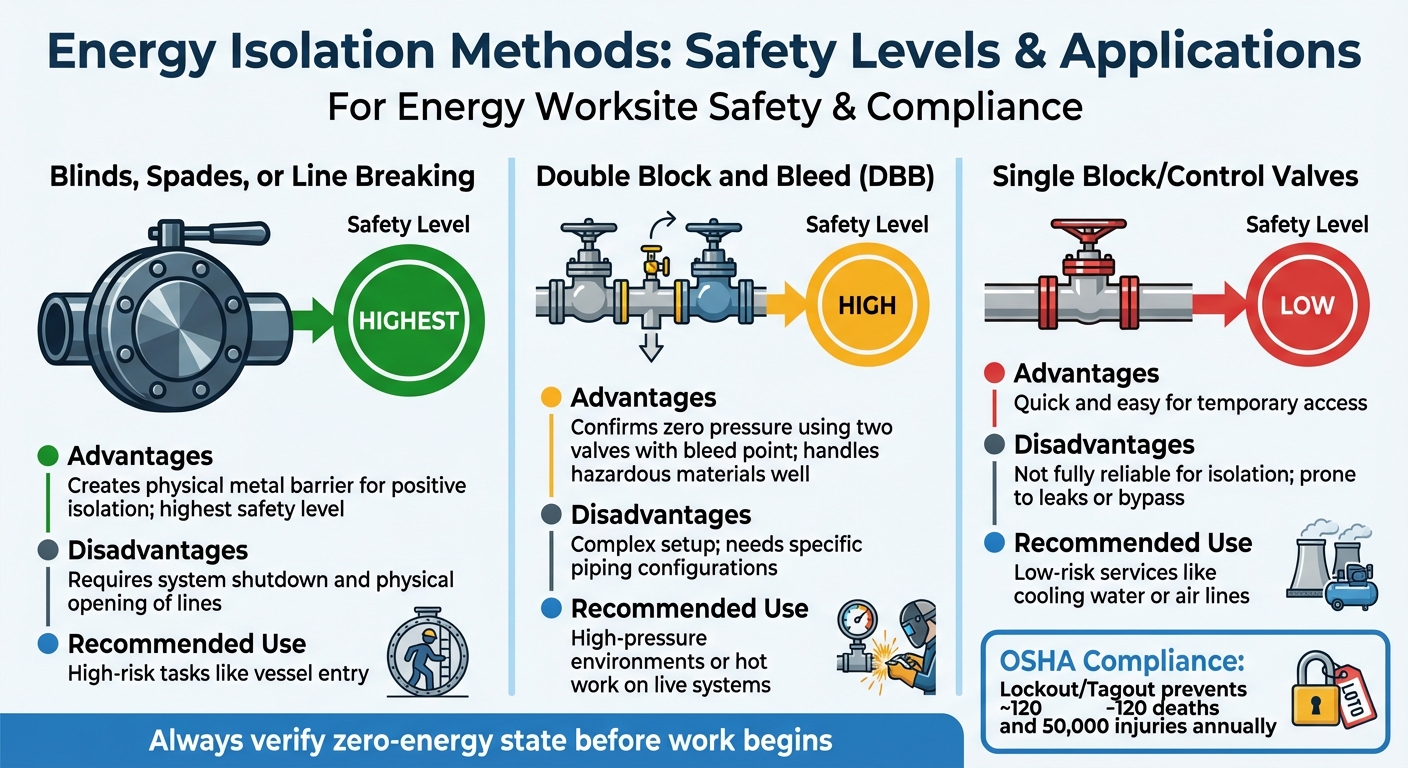
Energy Isolation Methods Comparison for Worksite Safety
Once hazards are identified and safety plans are in place, the focus shifts to isolating energy sources to achieve a zero-energy state. This involves disconnecting equipment from all potential energy sources – whether electrical, mechanical, hydraulic, pneumatic, chemical, thermal, or gravitational. Without proper isolation, workers are exposed to severe risks such as amputations, electrical shocks, and even fatalities. According to OSHA, compliance with the lockout/tagout (LOTO) standard helps prevent around 120 deaths and 50,000 injuries annually.
The isolation process follows a well-defined sequence: identify all energy sources, inform affected employees, shut down equipment using standard procedures, physically disconnect the equipment from its energy sources, apply lockout devices, release any stored energy (e.g., bleed hydraulic lines or discharge capacitors), and verify isolation by attempting to restart the equipment. Importantly, every worker involved must attach their own personal lock to the energy source.
"The lock and tag themselves are a worker’s personal declaration: ‘I am working on this equipment. It cannot be turned on until my lock is off. I am in control.’" – Enterprise Staffing
Verification is often where procedures fall short. After locks are applied, workers must conduct a "tryout" by attempting to restart the equipment using its normal controls. Instruments like voltmeters or pressure gauges are then used to confirm a zero-energy state. This step ensures the equipment is fully isolated and safe to handle, setting the stage for choosing the appropriate isolation technique.
Overview of Isolation Techniques
Different methods of isolation provide varying degrees of protection. For tasks requiring the highest safety standards, blinds, spades, or line breaking are the go-to solutions. These methods involve inserting a physical metal barrier into the system, ensuring complete separation. While highly effective, they require shutting down the system and physically opening lines, making them ideal for high-risk operations like vessel entry.
For high-pressure environments or hazardous materials, double block and bleed (DBB) is commonly used. This method uses two valves with a bleed point in between to confirm zero pressure. While effective, it requires specific piping configurations and careful monitoring of the bleed point. On the other hand, single block valves are a simpler option for lower-risk tasks like cooling water or utility air. However, they are not reliable for full isolation as they can leak or be bypassed.
In a notable example, Roy Hill, a major iron ore operation in Australia, introduced the IntelliPERMIT digital system in November 2025. This system replaced paper-based LOTO processes, enabling real-time tracking of over 700 permits during maintenance shutdowns and reducing human error. Similarly, Tronox Namakwa Sands in South Africa automated plant clearance and isolation verification across its mining and smelting operations, improving compliance and reducing safety lapses.
"Positive isolation is not just about stopping flow; it is about proving that separation exists and that safety is certain." – Gavin Halse, Process Engineering Expert
It’s critical to avoid relying on control valves, check valves, or selector switches for isolation. These components are not designed to provide the physical barrier needed to block hazardous energy. Additionally, systems should typically be brought to atmospheric pressure and temperatures between 14°F and 60°F before work begins.
Comparison of Isolation Methods
The table below summarizes key isolation methods for quick reference:
| Isolation Method | Advantages | Disadvantages | Recommended Use |
|---|---|---|---|
| Blinds, Spades, or Line Breaking | Creates a physical metal barrier for positive isolation; highest safety level | Requires system shutdown and physical opening of lines | High-risk tasks like vessel entry |
| Double Block and Bleed (DBB) | Confirms zero pressure using two valves with a bleed point; handles hazardous materials well | Complex setup; needs specific piping configurations | High-pressure environments or hot work on live systems |
| Single Block / Control Valves | Quick and easy for temporary access | Not fully reliable for isolation; prone to leaks or bypass | Low-risk services like cooling water or air lines |
Tagout devices are another crucial component. They provide visual warnings and must be able to withstand at least 50 pounds of unlocking strength to prevent accidental removal. The importance of lockout/tagout compliance cannot be overstated, as violations of these procedures are consistently among OSHA’s most cited infractions.
Hazard Controls and Safe Work Practices
Once energy isolation is complete, the next step is implementing controls that protect workers from potential hazards. This involves using engineering solutions like barricades, following strict procedures, and providing targeted training. These measures align with the hierarchy of controls, beginning with engineering fixes, followed by administrative protocols, and finally, personal protective equipment (PPE). OSHA reports that 20% of energy sector fatalities (362 deaths in 2022) stem from falls or struck-by incidents – many of which could be avoided with proper hazard controls.
A Job Safety Analysis (JSA) is mandatory before high-risk activities, such as hot work, confined space entry, or elevated tasks. During this process, specific behaviors and safety risks are evaluated. If hazards are identified, work must stop immediately until a safe work plan is approved by corporate management.
Verification plays a key role in hazard control. For example, before entering confined spaces, workers must confirm oxygen levels are between 19.5% and 23.5%, flammability is below 10% of the Lower Explosive Limit (LFL), and toxic gas levels are within OSHA’s Permissible Exposure Limits. Additionally, trade tests are used to ensure workers have the necessary skills to handle site-specific challenges.
These controls, combined with the risk assessments and energy isolation procedures already discussed, form a solid foundation for worker safety. PPE then acts as the final layer of protection.
Personal Protective Equipment Requirements
PPE serves as the last line of defense when other controls are insufficient. For chemical and thermal hazards, OSHA requires flame-resistant clothing (FRC) such as arc-rated garments that meet NFPA 70E standards. These are designed to guard against flash fires and arc flashes, common in oil and gas operations. Workers handling corrosive substances, like acids, must use chemical-resistant suits, gloves, and boots that comply with 29 CFR 1910.132. For environments exceeding 140°F, insulated gloves rated from Class 00 to Class 2 under ASTM F2676 are essential.
Electrical and kinetic risks call for specific protections. Tasks near live electrical lines up to 15kV require rubber insulating gloves rated for 1,000 volts (ASTM D120), dielectric boots, and arc-rated hoods or balaclavas under NFPA 70E Category 2. For falling-object dangers, hard hats that meet ANSI Z89.1 Type I/II standards, high-visibility vests, and full-body harnesses with shock-absorbing lanyards (per OSHA 1926.502) are critical. In pipeline repairs, using harnesses for work above six feet has reduced fall-related deaths from 12% to 3%, according to 2023 Bureau of Labor Statistics data.
PPE selection must align with hazard assessments outlined in OSHA 1910.132(d). For arc flash risks, workers need flame-resistant clothing with an Arc Thermal Performance Value (ATPV) above 8 cal/cm². Annual training, documented fit-testing, and regular equipment inspections are required to ensure PPE is effective and properly used. These records should integrate with JSA processes to confirm ergonomic fit and verify compliance before high-risk activities.
A Department of Energy case study highlights the importance of PPE compliance. In one hydropower retrofit project, stricter protocols for insulated gloves prevented 15 electrical shocks annually.
| Hazard Type | Required PPE | Standard/Rating | Application Example |
|---|---|---|---|
| Chemical/Thermal | Flame-resistant clothing, chemical-resistant suits, insulated gloves | NFPA 70E, ASTM F2676 (Class 00-2), 29 CFR 1910.132 | Oil & gas refining, handling acids, high-heat environments |
| Electrical | Rubber insulating gloves, dielectric boots, arc-rated hoods or balaclavas | ASTM D120 (1,000V+), NFPA 70E Category 2 | Utility work near live electrical lines |
| Kinetic/Falls | Hard hats, full-body harnesses, shock-absorbing lanyards, high-visibility vests | ANSI Z89.1 Type I/II, OSHA 1926.502 | Pipeline repairs, elevated tasks |
While PPE protects individuals, physical barriers play a critical role in securing hazardous zones.
Barricades and Advanced Safety Measures
OSHA requires barricades to secure high-risk areas. These barriers, ranging between 6 and 42 inches in height and equipped with proper signage, are essential for worker safety. For example, OSHA 1926.502 mandates Type I/II barricades (reflective orange with "Danger" signage per ANSI Z535) for floor openings. Elevated platforms require either retractable tape or chain-link fencing at least six feet high. In chemical zones, containment berms with splash guards are used. For mining projects, rigid railings with a 42-inch height and 200-pound top-rail strength mark exclusion zones around heavy equipment.
More advanced measures go beyond basic barricades. Polycarbonate splash shields are used in process operations to protect workers from chemical splashes. Horizontal lifelines rated for 5,000 pounds (per ANSI Z359.6) are essential for elevated work zones. In confined spaces, motion-sensor lighting and alarms alert teams to unauthorized entries. These integrated systems have reduced fall injuries by 70% at Department of Energy-monitored sites.
Before starting activities like pigging, dewatering, or equipment operations, construction sites must establish barricaded perimeters and communicate safety guidelines to all crew members. Safe work plans for these tasks should include piping and instrumentation diagrams (P&IDs), isolation plans, and energy isolation checklists. For elevated oil rig work, guardrail systems with toeboards and self-retracting lanyards provide multiple layers of protection.
The process for implementing these measures involves several steps: conducting a pre-job JSA to identify hazardous zones (e.g., a 10-foot radius around excavators), installing OSHA-compliant barricades with clear signage, testing railing integrity through load-testing, training workers via toolbox talks, and performing daily inspections. In utility projects, this integrates with lockout/tagout procedures to ensure zero-energy states before barricade setup, preventing breaches during high-risk tasks.
Technology also simplifies compliance. Platforms like ABLEMKR use mobile-first tools to match safety-trained workers with verified PPE certifications. These tools provide real-time compliance tracking through geo-fenced check-ins and PPE inventory scans. This approach has reduced non-compliance by 40% in high-risk scenarios, such as shutdowns or remote repairs, while ensuring only qualified workers enter hazardous areas.
Technology for Hazard Mitigation and Workforce Management
Energy projects often grapple with a tough challenge: pairing the right workers with high-risk tasks while keeping safety front and center. Traditional hiring methods – reliant on manual checks and paper-based documentation – slow down deployment and introduce risks. Digital platforms step in to bridge these gaps by automating worker verification and ensuring compliance in real time.
These platforms seamlessly integrate with existing safety protocols. For example, procedures like lockout/tagout and PPE requirements form the backbone of worker safety. Digital systems ensure that only certified personnel handle these critical tasks. Tools like software-based job safety analysis (JSA) allow teams to identify and plan for job-specific hazards before work begins, enabling proactive safety measures rather than reactive fixes. Validation software keeps track of training dates, renewal schedules, and compliance gaps, reinforcing safety policies in energy facilities. The shift to digital workflows has also improved hazard identification. For instance, falls from ladders – a leading cause of fatal and lost workday injuries in energy jobs – can be reduced by adhering to OSHA standards and using effective safety tools. Digital permit-to-work systems and real-time attendance tracking further enhance on-site visibility and ensure isolation protocols are followed. These advancements create a framework for precise worker matching and comprehensive safety management.
Automated Matching of Safety-Trained Workers
Deploying the right workers is key to effective hazard management. ABLEMKR automates this process by matching pre-vetted workers to job sites based on certifications, safety training, availability, and location. Each worker’s profile includes verified certifications in areas like electrical safety, confined space entry, and hazard communication. When a project requires specific credentials – such as OSHA lockout/tagout certification – the platform filters candidates who meet these criteria and are ready for quick deployment.
This system addresses a vital safety requirement. OSHA mandates proper training for energy-control procedures, and platforms like ABLEMKR ensure workers have up-to-date certifications before assignment. The system also flags certifications nearing expiration, preventing workers from being deployed with outdated credentials. Here’s how the process works: workers upload certifications during onboarding, the platform validates them with issuing authorities, evaluates job-specific requirements (e.g., PPE training), and uses geo-location data to identify candidates nearby – minimizing travel fatigue and scheduling issues.
For energy projects with specialized demands, this level of precision is critical. By ensuring the workforce meets specific safety criteria, the platform reduces risks tied to complex tasks and avoids deploying under-qualified personnel.
Real-Time Compliance and Workforce Visibility
Once workers are on-site, real-time tracking ensures compliance and safety. ABLEMKR’s mobile-first platform monitors three key areas: worker status (clock-in/clock-out times, location, and task assignments), compliance and safety data (certifications, site-specific safety briefings, PPE usage), and operational metrics (machinery status, energy isolation steps, stored energy assessments).
The system sends automated alerts if workers approach hazardous conditions without proper isolation verification, if certifications are about to expire, or if tasks fall outside their certified scope. It prevents unqualified clock-ins, ensuring only compliant workers access high-risk areas. Geo-location technology enforces work boundaries, alerting workers and supervisors if someone enters a restricted zone. This data also aids in incident reviews by detailing movement timelines and exposure points.
ABLEMKR integrates compliance tracking with payroll, ensuring workers are only paid for hours worked in certified areas. This connection reinforces safety practices and provides audit trails for OSHA inspections. The platform also maintains a digital registry of energy-isolating devices, tracking their location, assigned workers, and status. During maintenance, the system guides workers through essential steps – like shutting down equipment, clearing personnel, verifying isolation, and documenting stored energy checks. In group lockout scenarios, it ensures individual accountability by tracking each authorized worker’s contributions. These features strengthen adherence to safety protocols.
On-Demand Staffing for High-Risk Scenarios
Emergencies like equipment failures or safety incidents demand immediate action. ABLEMKR simplifies rapid workforce deployment by providing instant visibility into available, certified workers. It maintains a pool of pre-verified candidates, ensuring response times of 24 to 72 hours – much faster than traditional hiring methods. Project managers can post jobs, receive matches, and notify workers via mobile alerts. Workers can then accept assignments and access onboarding materials digitally.
This quick response reduces operational costs and protects grid reliability. Unplanned downtime can lead to hefty financial losses, but faster crew mobilization minimizes disruptions while maintaining safety standards. Real-time compliance tracking eliminates manual verification delays, while pre-loaded worker profiles streamline onboarding. Automated alerts ensure emergency crews operate under the latest safety protocols.
Geo-location matching further enhances response times by identifying the nearest qualified workers for tasks like remote pipeline repairs. Supervisors can monitor worker locations and clock-in times via the mobile app, ensuring accountability and adherence to designated routes on multi-site projects. By combining speed with safety, ABLEMKR helps energy facilities manage emergencies effectively without cutting corners.
Conclusion
To ensure safety and efficiency in energy projects, a combination of thorough pre-planning, constant monitoring, and implementing measures like detailed site surveys, health and safety plans, and energy isolation procedures is essential. These steps are critical for safeguarding workers from hazards such as chemical exposure, thermal risks, electrical dangers, and stored energy threats.
Modern digital platforms like ABLEMKR are revolutionizing workforce management and compliance. By automating skill matching, tracking certifications in real time, and providing instant updates on worker status, these tools make it easier to deploy certified teams that meet OSHA standards and site-specific requirements.
With automated compliance tracking, worker credentials are verified at every stage – qualification, assignment, and site entry – ensuring that personnel with expired certifications are not deployed. Features like real-time alerts and integrated payroll workflows create audit-ready records, enhancing accountability and reducing potential disputes.
Centralized workforce management further streamlines operations by eliminating communication gaps. Real-time dashboards allow teams to monitor labor costs, shift statuses, and worker availability, helping projects remain on budget while upholding safety standards. Additionally, pre-vetted standby rosters and proactive planning help address risks posed by unexpected absences.
FAQs
What hazards should I prioritize on an energy jobsite?
When working on energy jobsites, it’s crucial to focus on three key areas of safety: chemical hazards, physical risks, and ergonomic challenges. Each of these presents unique dangers that require specific strategies to address effectively.
Chemical hazards demand careful management. This includes ensuring all chemicals are clearly labeled, maintaining up-to-date safety data sheets (SDS), and providing thorough training for workers handling these substances. Proper education and labeling are the first line of defense against accidents or exposure.
Physical risks often involve threats like falls, trench collapses, or hazardous leaks. To minimize these dangers, implement strict emergency protocols, provide appropriate safety equipment, and enforce regular inspections to identify and address potential issues before they escalate.
Ergonomic risks, such as injuries from heavy lifting or repetitive motions, can be reduced through measures like job rotation and ergonomic assessments. Taking these steps helps protect workers from long-term strain or injury.
Finally, regular risk assessments and strict adherence to OSHA standards are non-negotiable for maintaining a safe and compliant work environment. These ongoing efforts are key to identifying hazards early and ensuring the safety of everyone on site.
How do I confirm equipment is truly in a zero-energy state?
To ensure equipment is in a zero-energy state, you need to isolate all potential energy sources – this includes electrical, mechanical, thermal, hydraulic, pneumatic, chemical, gravitational, and kinetic energy – and make sure any residual energy is completely discharged.
Here’s how to do it:
- Identify and isolate energy sources using proper lockout/tagout devices to prevent accidental re-energization.
- Release any stored energy, such as hydraulic pressure or residual heat, through safe procedures.
- Verify the absence of energy using appropriate tools or devices to confirm the equipment is safe for work.
These steps are essential for maintaining a safe working environment.
How does ABLEMKR help maintain certifications and PPE compliance?
ABLEMKR makes staying compliant easier by automating the process of tracking credentials, sending alerts before they expire, and keeping all worker data in one place. This approach minimizes mistakes and allows employers to monitor certifications and PPE compliance in real time, ensuring they’re always up-to-date without added hassle.


