
Becoming a wind turbine technician offers a promising career path with high demand, competitive pay, and opportunities for growth. Here’s what you need to know:
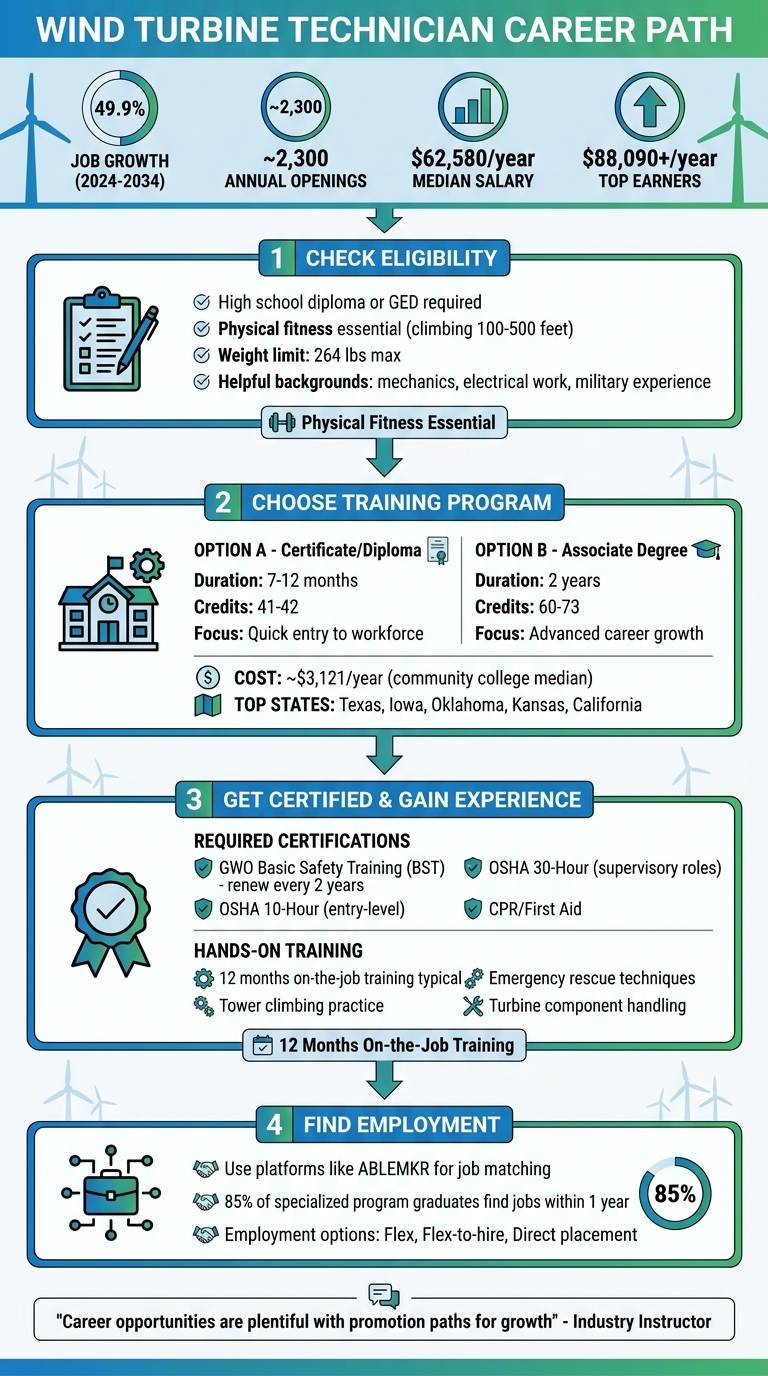
- Job Outlook: Employment is projected to grow by 49.9% from 2024 to 2034, with around 2,300 annual job openings.
- Earnings: Median annual pay is $62,580 (as of May 2024), with top earners making over $88,090.
- Requirements: A high school diploma or GED is essential, along with physical fitness for climbing towers and handling tools.
- Training Options: Choose between 7–12 month certificate programs or 2-year associate degrees, often available at community colleges in wind-rich states.
- Certifications: GWO Basic Safety Training and OSHA certifications are key for entry-level roles.
- Job Placement: Platforms like ABLEMKR connect certified technicians with employers, offering flexible job opportunities.
This career is ideal for those who enjoy hands-on work, are comfortable with heights, and want to contribute to renewable energy efforts. Ready to get started? Keep reading for detailed steps to enter this growing field.
4-Step Path to Becoming a Wind Turbine Technician
The Blueprint to Become a Wind Turbine Technician! CTQ Ep // 11
sbb-itb-aa28329
Check Your Eligibility and Get Ready for Training
Before diving into wind turbine technician training, make sure you meet the basic requirements. While the entry barriers aren’t steep, the job’s physical demands are serious and unavoidable.
Education and Physical Fitness Requirements
You’ll need a high school diploma or GED to start. Classes in subjects like algebra, trigonometry, physics, electronics, computer science, shop, or metalworking can give you a strong foundation for the technical skills this job requires. Beyond academics, physical fitness is a must. Technicians regularly climb towers ranging from 100 to over 500 feet, work in tight spaces, and handle heavy tools. Many employers also enforce a weight limit of 264 pounds.
Charlie Tran, a wind turbine technician, shares:
"What I wish I would have known before I got into this job is how physically demanding everything is. Everything from the climb, to the maintenance, to the torquing, and even troubleshooting… You have to be mentally and physically fit."
Some training programs might require you to demonstrate your ability to climb at least 30 feet before enrollment. If heights or confined spaces make you uneasy, this career could be particularly tough.
Meeting these educational and physical criteria sets the stage for leveraging prior work experience.
Skills from Related Work Experience
If you have experience in mechanics, electrical work, or industrial maintenance, you’re already ahead. These backgrounds can sharpen your knowledge of troubleshooting, hydraulics, and electrical theory. Familiarity with diagnostic tools and mechanical repairs might even qualify you for shorter, employer-led training programs lasting just 3–6 months, compared to the typical 1–2 years for degree programs.
Military veterans are especially well-suited for this field. Many programs offer credit for military technical training, which can significantly reduce the time needed to get certified. Employers often view military experience in mechanics or electronics as equivalent to months of formal schooling. Plus, the discipline and safety protocols ingrained in military service align perfectly with the demands of wind energy work.
If you’ve worked in physically demanding trades like construction, roofing, or tower work, you’ll likely find it easier to meet the fitness standards and adapt to working at heights.
Choose and Enroll in an Accredited Training Program
Once you’ve confirmed you meet the basic requirements, the next step is finding the right training program. The quality of your education plays a big role in shaping your career opportunities and earning potential.
Available Training Program Options
There are two main paths to consider: a 7–12 month certificate or diploma program or a 2-year associate degree.
- Certificate or diploma programs are shorter, typically requiring around 41–42 credits, and focus on the technical skills needed to get you into the workforce quickly.
- Associate degrees, on the other hand, provide a broader technical education, requiring 60–73 credits. These programs often better prepare you for advanced roles, such as lead technician or management positions.
Most programs are offered through community colleges and technical schools. Community colleges, for instance, have a median tuition of about $3,121 per year. You’ll find these programs in wind-rich states like Texas, Iowa, Oklahoma, Kansas, and California. However, East Coast schools are also expanding their offerings as offshore wind projects grow. Some schools, like Northeast Community College, even include mandatory summer internships for credit, giving students hands-on experience.
Training programs often combine online lectures with in-person lab sessions. This blended format ensures you gain access to turbine components, climbing towers, and specialized labs – key for developing practical skills.
Once you’ve decided on the type of program, it’s important to evaluate its credentials and resources.
What to Look for When Choosing a Program
When selecting a program, pay close attention to certifications, facilities, and industry connections that can enhance your training.
- Certifications: Look for programs that include Global Wind Organisation (GWO) certification. Most employers require GWO Basic Safety Training (BST), and some programs also offer Advanced Rescue Training (ART) and Basic Technical Training (BTT) as part of their curriculum.
- Facilities: Hands-on training is essential, so make sure the program provides access to key equipment like nacelles (which can weigh over 300,000 lbs), climbing towers, and labs for hydraulic and electrical repair training.
- Industry Partnerships: Programs that partner with major turbine manufacturers like GE, Vestas, or Siemens Gamesa often offer internships and improve job placement rates. These connections can make a big difference – 85% of graduates from specialized wind programs find related jobs within one year.
Lastly, check that the program’s physical requirements, such as climbing and lifting assessments, align with your abilities. Also, find out if you’ll need to supply your own mobile learning device or personal safety gear, like steel-toed boots.
Get Hands-On Experience and Earn Certifications
Classroom learning lays the groundwork, but nothing beats the experience of climbing towers, performing emergency rescues, or repairing gearboxes to truly develop the skills needed for this field. Working at heights of 100 to 400 feet while diagnosing electrical, hydraulic, and mechanical systems demands more than just theoretical knowledge. Practical, real-world training is what bridges the gap between classroom concepts and the demands of the job. This is where apprenticeships and certification programs come into play.
Hands-On Training and Apprenticeship Programs
Training programs often include activities like tower climbing, handling turbine components such as rotors, and practicing emergency rescue techniques. Beyond these foundational exercises, new hires usually undergo an additional 12 months of on-the-job training. This period helps them refine troubleshooting skills under the guidance of seasoned technicians, something no classroom can replicate.
Apprenticeships and internships are also excellent avenues for gaining practical experience. For instance, Global Wind Service offers an Entry Level Program that combines two weeks of structured training with immediate on-site placement, letting participants learn and earn simultaneously. Similarly, Cloud County Community College takes a hands-on approach by operating its own wind farm and offering internships at wind farms in Kansas, giving students direct exposure to turbine operations.
This field is demanding, both physically and mentally, requiring endurance for tasks like climbing, maintenance, torquing, and troubleshooting.
Required Certifications
While hands-on experience is essential, certifications provide formal proof of your skills and safety knowledge. Employers expect certifications that meet strict safety and technical standards. One of the most common is the GWO Basic Safety Training (BST), which covers First Aid, Working at Heights, Manual Handling, Fire Awareness, and Sea Survival (for offshore roles). For entry-level positions, the OSHA 10-Hour certification is often required, focusing on fall protection and hazard awareness, while supervisory roles may demand the more advanced OSHA 30-Hour certification.
Other certifications can further boost your qualifications. These include NCCER’s "Wind Turbine Maintenance Level I", CPR/First Aid for emergency situations, and specialized credentials like Rope Access (IRATA/SPRAT) for blade repair work. Keep in mind, GWO BST certifications need to be renewed every two years to stay valid.
Use Technology Platforms to Find Job Opportunities
After earning your certifications and gaining hands-on experience, the next logical step is connecting with employers who need your expertise. Traditional job hunting can be a slow grind, but modern workforce platforms have simplified the process. They match skilled technicians with energy projects based on factors like certifications, location, and availability. If you’re ready to jump into the wind energy sector, platforms like ABLEMKR can help you land a job quickly.
How ABLEMKR Connects You with Jobs
ABLEMKR specializes in linking certified wind turbine technicians with energy companies across the U.S. through its mobile platform. It uses a matching system that considers your certifications (like GWO Basic Safety Training and OSHA credentials), safety training, availability, and geographic location. This ensures you’re only paired with roles that align with your qualifications. Before placement, ABLEMKR conducts a thorough vetting and interview process to confirm candidates meet industry standards and employer needs.
The platform is simple to use: download the free ABLEMKR app, create your profile, and start receiving instant job alerts. You can also schedule appointments and message employers directly. ABLEMKR offers various employment options, including Flex for short-term gigs, Flex-to-hire for trial-to-permanent roles, and Direct placement for full-time positions. This flexibility allows you to choose the work style that suits you best.
What Workers and Employers Gain
For technicians, ABLEMKR offers a range of benefits. You’ll receive real-time job notifications, tools to manage appointments, and direct communication with project managers. The platform’s built-in rating system lets you build a professional reputation, which can pave the way for higher-paying roles. Considering the median annual salary for wind turbine technicians is $62,580, with top earners making over $88,090, maintaining a strong profile can significantly impact your career. On top of that, workers enjoy guaranteed on-time payments and clear compliance tracking, making the employment process both smooth and reliable.
Employers, on the other hand, gain access to a pool of pre-vetted, skilled technicians who can be deployed quickly for urgent needs. Whether it’s an emergency turbine repair, routine maintenance, or a new installation, ABLEMKR ensures companies have the right people on-site when they’re needed most. The platform also provides tools for real-time worker status updates, integrated payroll management, and compliance tracking. As ABLEMKR puts it, their platform is designed to bring "accountability and transparency" to the skilled workforce hiring process.
Your Next Steps to Start This Career
Evaluate your physical readiness: Working as a wind turbine technician requires comfort with heights – sometimes over 200–300 feet – and the ability to climb towers multiple times a day while carrying gear weighing 25+ pounds. If you’re uncertain about your capabilities, consider visiting a training facility for a climbing assessment.
Decide on your training path: If you’re eager to start quickly, a 7–12 month certificate program might be the way to go. For those aiming for long-term growth and advancement, a 2-year associate’s degree could be a better fit. Financial aid options, like Federal Pell Grants (up to $7,395 for the 2026–27 academic year), can help cover costs. Community college tuition averages about $3,121 per year, so completing the FAFSA is a smart step.
Secure essential certifications: Start with the GWO Basic Safety Training and OSHA 10-hour certification (or the 30-hour version if you’re aiming for supervisory roles). If you’re interested in offshore work, adding GWO Sea Survival training is a must. These certifications will make you job-ready and set you apart in the hiring process.
Find your first opportunity: Once you’re trained and certified, it’s time to connect with employers. Platforms like ABLEMKR allow you to match with job opportunities based on your credentials, location, and availability.
The wind energy sector is actively seeking skilled professionals, and getting started is straightforward. By completing your training, earning the required certifications, and using modern tools to find job openings, you’ll be well on your way. As Tracey Butts, Wind Turbine Instructor at Centura College, puts it:
"The career opportunities are plentiful and there are so many companies that like to do promotion within for those who choose to become a wind turbine technician, so you’ll always have a route of what you can do next".
FAQs
How much does wind turbine technician training cost?
The price of training to become a wind turbine technician can differ significantly. For instance, the University of Houston-Downtown offers a certificate program priced at $1,750. Meanwhile, basic safety training courses typically cost about $170. Other training programs might range from a few hundred dollars to several thousand, depending on factors like the institution and the duration of the course.
How dangerous is wind turbine tech work, really?
Wind turbine technicians face a job that comes with its fair share of risks, primarily because much of the work happens at dizzying heights – sometimes exceeding 300 feet – and involves handling heavy, intricate machinery. To keep these dangers in check, strict safety protocols are non-negotiable. This includes the use of fall protection systems and specialized rescue equipment to ensure workers stay secure.
Certifications such as GWO (Global Wind Organization) and OSHA training play a key role in maintaining safety standards. These certifications not only prepare technicians for the challenges they face but also help make this high-risk profession safer. Despite the risks, the job comes with perks like competitive pay, opportunities to travel, and the satisfaction of contributing to the renewable energy sector.
What should I do if I’m not good with heights yet?
If you’re uneasy with heights, start by easing into it with proper safety training and practice in controlled settings. Wind turbine technicians often operate at heights of 200–300 feet or more, so certifications like GWO (Global Wind Organization) or OSHA (Occupational Safety and Health Administration), which include specialized working-at-heights modules, are incredibly helpful. Many training programs and employers emphasize safety and will provide the support and resources you need to build the confidence and skills required to handle these heights effectively.


