
Wind tech jobs are set to grow by about 50% from 2024 to 2034, but getting into the field means passing a few hard checks first.
If I had to sum up this guide in plain English, it comes down to this: you need the right age, work status, education, physical fitness, safety training, and site-clearance records before you can work on turbines. Most programs also follow a set path for hours, classroom training, travel, and pay growth.
Here’s the short version:
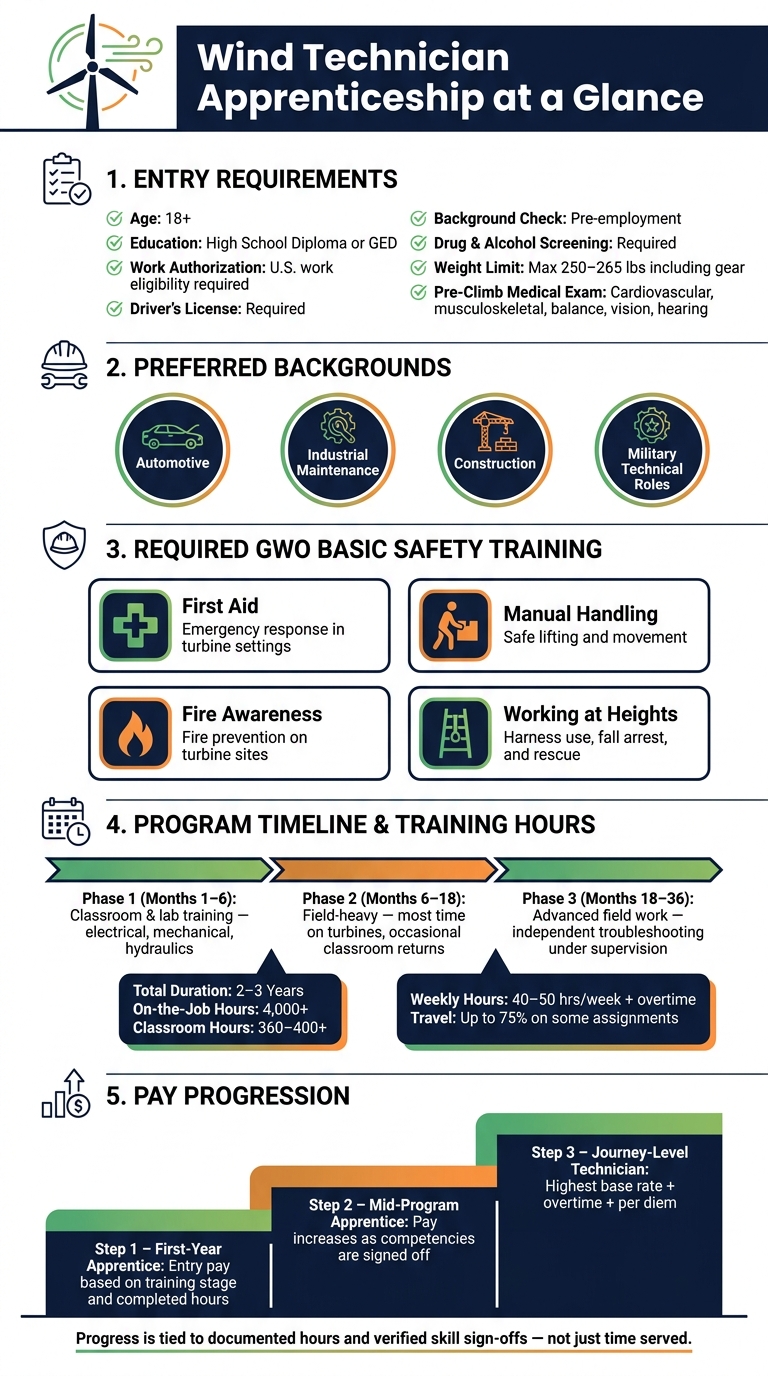
- You usually must be 18+, have a high school diploma or GED, and be allowed to work in the U.S.
- Many employers also ask for a driver’s license, a background check, and drug and alcohol screening
- You should expect climbing, lifting, tight spaces, outdoor work, and rough weather
- A lot of programs require GWO Basic Safety Training, including:
- First Aid
- Manual Handling
- Fire Awareness
- Working at Heights
- Most apprenticeships last 2 to 3 years
- Many include 4,000+ job hours and 360 to 400+ classroom hours
- Work often includes travel, 40 to 50 hours per week, and overtime
- Pay usually moves up as hours and skills are signed off
- Before deployment, employers check training, medical clearance, climb clearance, rescue training, work hours, and location
This article is for two groups: people who want to join a wind apprenticeship and teams that need to staff turbine sites. I’ll keep it simple and focus on what you need to know first.
Wind Technician Apprenticeship: Requirements, Training & Pay Progression
Tower Training Academy‘s Renewable Apprenticeships
sbb-itb-aa28329
Who can start a wind technician apprenticeship
Most U.S. wind technician apprenticeships start with a few basic gate checks. Candidates usually need to be at least 18 years old, have a high school diploma or GED, and be legally allowed to work in the U.S. A valid driver’s license is also standard. That makes sense. Wind farms are often far from town, and the job involves safety-heavy training from day one.
Education, age, and technical prerequisites
Employers usually want people who are comfortable with basic hand tools and equipment troubleshooting. They also look for a working grasp of basic electrical and mechanical concepts.
Hands-on experience can help a lot here. If someone has worked in electrical, hydraulic, or mechanical settings, that often carries over well. The same goes for people coming from:
- Automotive
- Industrial maintenance
- Construction
- Military technical roles
Those backgrounds tend to line up well with turbine work. Many wind technicians also come in with a postsecondary nondegree credential and then build their skills through on-the-job training.
Most programs also require pre-employment background checks plus drug and alcohol screening because this is high-risk work. Programs such as Wind Academy by Siemens Gamesa use that same baseline screening process.
Physical and medical requirements for turbine work
This job is physical. Turbine technicians climb again and again, carry tools, lift gear, bend, reach overhead, and work in tight spaces and rough weather.
Because of that, many employers set a maximum body weight limit of about 250 to 265 pounds including gear. That limit is tied to ladder systems and fall-arrest equipment ratings.
A pre-climb medical exam is also common before a worker is cleared to go up-tower. These exams may check:
- Cardiovascular health
- Musculoskeletal fitness
- Balance
- Vision
- Hearing
Once candidates clear those baseline checks, they move on to climb, rescue, and fall-protection training.
Climb, rescue, and safety training apprentices must complete
Working at heights, rescue, and fall protection training
After screening and climb clearance, apprentices move into tower safety training.
GWO safety and training requirements
GWO certifications are widely recognized in wind training. Many wind apprenticeship programs require the GWO Basic Safety Training (BST) suite.
At the center of that requirement is GWO BST, which covers four baseline safety modules. Put simply, this is the training that gets apprentices ready to work on-site without guessing their way through high-risk tasks.
| GWO BST Module | What It Covers |
|---|---|
| First Aid | Emergency response in turbine settings |
| Manual Handling | Safe lifting and movement |
| Fire Awareness | Fire prevention and basic firefighting on turbine sites |
| Working at Heights | Harness use, fall arrest, and rescue |
Programs often schedule BST early because it clears apprentices for field work.
Schedule, travel, and program timeline for apprentices
Travel demands and day-to-day job conditions
Once apprentices finish safety training, the next thing people want to know is simple: what does the schedule actually look like?
In wind work, travel is part of the job. Apprentices may commute 30 to 90 minutes, rotate between regional sites, or spend 4 to 6 weeks on the road during construction-phase projects or blade-repair work. In those roles, full-time travel is common. Job postings often spell this out pretty clearly, with notes like up to 75% travel or a service area within a 250-mile radius of a home base.
The daily work itself is physically demanding. Wind techs spend time at heights almost every day, often inside cramped nacelles and outside no matter the weather. Data on working conditions shows that 97% work at heights, 83% work in cramped spaces, and 79% work outdoors.
A typical day usually starts between 6:30 and 8:00 a.m. with a safety briefing and a weather check. From there, crews move into inspections, maintenance, or repairs. Most apprentices work 40 to 50 hours per week, and overtime is common during peak maintenance periods.
Program length and the mix of classroom and field training
That travel-heavy setup also affects how apprentices move through training. The more time spent in the field, the faster those job hours start to add up.
Most U.S. wind technician apprenticeships last 2 to 3 years. Time-based tracks are often close to 2 years, while competency-based tracks can run up to 3. Along the way, apprentices usually complete 4,000+ on-the-job hours and 360 to 400+ classroom hours.
The first part of the program tends to lean more on classroom and lab training. That usually includes electrical systems, mechanical basics, and hydraulics, with only limited site visits. By months 6 through 18, the balance shifts. Most of the week is then spent on turbines, with occasional returns to the classroom for advanced modules and assessments.
Near the end of the program, apprentices are in the field most of the time. They start handling harder tasks, building troubleshooting skills, and working with more independence under general supervision.
Many apprentices begin with a certificate or associate degree in wind, renewable energy, or a related trade. That background can cut down classroom time, but it usually doesn’t replace field hours. Companies still need apprentices to learn site-specific equipment, paperwork, and work procedures on the job.
How pay grows and how teams check site readiness
Pay progression from apprentice to fully qualified technician
After training, the next thing most people want to know is simple: how does pay change, and when does someone become ready for site work?
Pay usually moves up as apprentices log more training hours and show verified skill on the job. It doesn’t always follow a fixed calendar. In many cases, completed hours and signed-off competencies are what move someone forward. And base pay is only part of the picture. On travel-heavy assignments, overtime and per diem can add a lot to total earnings.
| Stage | Typical pay drivers | Notes |
|---|---|---|
| First-year apprentice | Training stage and completed hours | Entry pay reflects limited field experience. |
| Mid-program apprentice | More hours completed and stronger technical performance | Pay increases as competencies are signed off. |
| Journey-level technician | Completed program and relevant credentials | Highest base rate; overtime and per diem still matter. |
Once that pay path is understood, the next checkpoint is site readiness.
How employers and ABLEMKR verify wind worker readiness before deployment
Before a worker is sent to a turbine site, employers check that the person has the right safety training, role-specific credentials, and medical fitness for the job. Common checks include required safety training, along with the technical credentials a given project asks for. Employers also confirm availability and geographic location so they can match the right worker to the right site.
Medical fitness is checked before a worker is sent up-tower. That helps make sure the person can handle the physical demands of turbine work.
ABLEMKR matches pre-vetted workers to job sites based on certification, safety training, availability, and location, with real-time status and compliance tracking.
| What’s verified | How it’s used |
|---|---|
| Safety training | Confirms required training for turbine-site work |
| Role-specific credentials | Matched to what the project calls for |
| Medical fitness | Confirms readiness for the physical demands of turbine work |
| Availability and location | Supports accurate job matching and deployment |
Key facts to know before joining or staffing an apprenticeship
Joining or staffing an apprenticeship takes planning. It’s a multi-step path that starts with training and ends with deployment. Before anyone gets sent to a jobsite, the main things to sort out are how long completion takes, which credentials are required, how pay moves up, and whether the site is ready.
Before deployment, apprentices and staffing teams should confirm GWO training, site-required safety credentials, and role-specific technical certifications.
Pay goes up as hours and competencies are signed off. That means progress isn’t just about time on the job. It’s tied to documented work and skill checks.
For staffing teams, the last checkpoint is site readiness. Cross-check site requirements before deployment, including:
- Certifications
- Training history
- Medical clearance
- Climb clearance
- Rescue training
- GWO basics
- Verified work hours
ABLEMKR supports this process with verified worker profiles and real-time compliance tracking.


