
Working in wind energy is risky. From climbing 100-foot turbines to managing high-voltage systems, safety is critical. Risks vary by region due to weather, geography, and regulations. For example:
- Cold climates (Northeast) can freeze crane hydraulics, requiring operational changes.
- Midwest storms demand precautions against tornadoes and lightning.
- Southern heat and hazardous dust call for ventilation and protective gear.
- West Coast offshore projects face seismic activity, fog, and complex sea operations.
- Plains and Southwest deal with dust storms, extreme heat, and frequent lightning.
Key Takeaways:
- OSHA mandates fall protection starting at 6 feet for construction and 4 feet for maintenance.
- Offshore safety involves additional training (e.g., sea survival) and more complex emergency plans.
- Pre-task risk assessments and checklists are vital for reducing accidents.
- Compliance tools like ABLEMKR can simplify tracking worker certifications and safety measures.
Safety protocols must address regional challenges, ensuring workers are equipped to handle site-specific risks. Documentation, training, and real-time compliance tracking are essential for maintaining workplace safety.
GWO (BST) Wind Turbine Training – WHAT YOU NEED TO KNOW!
Regional Safety Checklists for Wind Energy Jobs
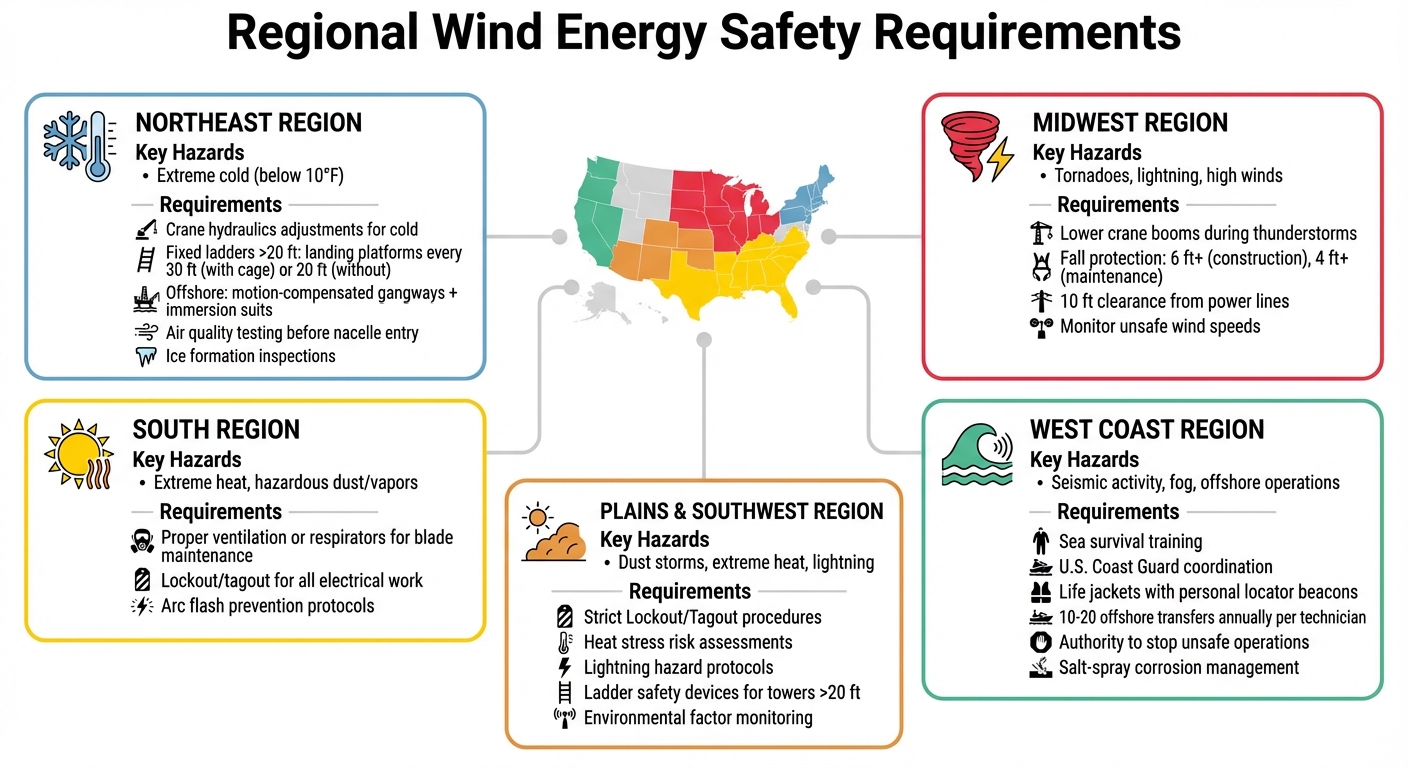
Regional Wind Energy Safety Requirements by U.S. Region
Addressing the challenges of wind energy work across different U.S. regions, these checklists offer tailored safety practices. Each checklist adapts general safety guidelines to meet the unique conditions of specific areas.
Northeast Region
In the Northeast, extreme cold – temperatures dropping below 10°F – can impact crane hydraulics and stability. This requires reducing lifting capacity and making constant adjustments to account for the conditions. Fixed ladders over 20 feet must follow specific requirements: landing platforms every 30 feet if a cage is present, or every 20 feet if not. Offshore projects demand motion-compensated "walk to work" gangways and immersion suits for safe personnel transfers from vessels. Before entering a nacelle, technicians must test the air quality using portable gas monitors. Regular inspections are critical, as freezing rain or snow can disable components by forming ice.
Midwest Region
In the Midwest, weather hazards like tornadoes and lightning require extra precautions. Unsafe wind speeds, often overlooked in standard crane load charts, must be identified and monitored. If thunderstorms are approaching, crane booms should be lowered, and workers evacuated immediately. Fall protection is required at heights of 6 feet or more for construction and 4 feet or more for maintenance. Additionally, workers must maintain a clearance of at least 10 feet from overhead power lines to avoid the risk of electrocution.
South Region
In the South, turbine blade maintenance calls for strict safety measures. Tasks like buffing and resurfacing expose workers to hazardous dust and vapors, making proper ventilation or respirators a necessity. Electrical work requires isolating, locking, and tagging all energy sources to prevent arc flashes and shocks.
West Coast Region
The West Coast presents unique challenges, including seismic activity, coastal winds, and dense fog. Offshore projects require specialized sea survival training and coordination with the U.S. Coast Guard. Technicians often complete 10–20 offshore transfers annually, with each transfer requiring life jackets equipped with personal locator beacons. Vessel-mounted cranes must contend with salt-spray corrosion and dynamic positioning issues. Importantly, anyone involved in offshore transfers – whether crew or technicians – must have the authority to stop operations if conditions become unsafe. Emergency evacuation plans should also be developed in partnership with local authorities.
"The offshore environment places the technician into a larger logistical system, one in which no individual can operate independently and one that requires additional training, extra equipment, vessel coordination, weather monitoring, and emergency response capabilities." – Transportation Research Board
Plains and Southwest Region
In the Plains and Southwest, the harsh environment demands thorough safety protocols. Dust storms, extreme heat, and frequent lightning strikes are key concerns. A fatal arc flash incident in Oklahoma City, caused by a failure to test for de-energization, underscores the importance of strict Lockout/Tagout procedures. Risk assessments should also address heat stress and lightning hazards before starting any task. Dust and moisture can compromise equipment, so environmental factors must be accounted for in safety plans. For towers with fixed ladders over 20 feet, ladder safety devices are required to prevent falls.
Onshore vs. Offshore Safety Requirements
When it comes to wind energy, safety protocols differ significantly between onshore and offshore operations. Each environment comes with its own challenges, requiring tailored safety measures to address the unique risks.
Onshore work follows standard OSHA guidelines. For instance, fall protection is mandated at heights of 6 feet or more for construction and 4 feet or more for maintenance tasks. Workers typically drive to job sites, climb turbines using fixed ladders, and rely on local emergency services for support when needed.
Offshore operations, however, involve a far more complex set of safety requirements. The Transportation Research Board highlights the unique challenges:
"The offshore environment places the technician into a larger logistical system, one in which no individual can operate independently and one that requires additional training, extra equipment, vessel coordination, weather monitoring, and emergency response capabilities – all of which create hazards and risks beyond those encountered on land".
Offshore technicians face hazards like falling into the water, hypothermia, drowning, and the risk of being caught between vessels and turbine structures. Each year, they perform 10–20 vessel-to-turbine transfers, with every transfer requiring a formal risk assessment to ensure safety.
Pre-Task Risk Assessments
Risk assessments are essential before any work begins, whether onshore or offshore. For onshore sites, Job Hazard Analysis (JHA) focuses on factors like soil stability, weather conditions, and maintaining a safe distance of at least 10 feet from power lines. Offshore assessments, however, dive deeper into environmental conditions such as wave height, vessel stability, current speed, and weather windows. Every team member is empowered to halt operations if conditions become unsafe.
PPE and Fall Protection
Personal protective equipment (PPE) is a cornerstone of safety, but the requirements differ between onshore and offshore environments. Onshore workers use OSHA-approved fall arrest systems, while offshore crews need additional gear like immersion suits, life jackets with locator beacons, and marine-specific harnesses. Regulatory oversight also varies: OSHA governs onshore projects, while offshore sites fall under the jurisdiction of BSEE, BOEM, and the U.S. Coast Guard. Training requirements reflect these differences, with onshore workers completing OSHA programs and offshore technicians needing Global Wind Organisation (GWO) certifications, including Sea Survival, and U.S. Coast Guard STCW training.
Confined Space Entry Protocols
Both onshore and offshore environments classify nacelles as confined spaces, requiring portable gas monitors to check for oxygen deficiency before entry. Onshore sites typically rely on local EMS and fire services for rescue operations. Offshore, confined space incidents demand more intricate responses, often involving vessel coordination, helicopter evacuations, or diving support for subsea tasks. Communication systems must be adapted for remote locations, and rescue plans include the additional step of transferring injured workers from turbines to vessels before medical transport.
sbb-itb-aa28329
Compliance and Training Verification
To maintain operational safety, verifying and documenting adherence to safety protocols is non-negotiable. Workers must comply with OSHA standards, such as 29 CFR 1910.269 for electric power and 29 CFR 1926.1417 for crane operations, before engaging in high-risk tasks like crane operation or lockout/tagout (LOTO) procedures. Additionally, workers must be classified as either "qualified" or "authorized" to perform these tasks. Following lockout/tagout standards alone helps prevent approximately 120 deaths and 50,000 injuries annually.
Verification of Regional Certifications
Onshore workers need to have the required OSHA training, while offshore personnel must hold GWO certifications. These certifications include essential BST modules such as Fire Awareness, First Aid, Working at Heights, Manual Handling, and Sea Survival. Employers can verify training records through WINDA, a global database dedicated to tracking GWO certifications. For added reliability, certifications should be audited every two years by accredited third parties.
Documenting Equipment and Training Records
Keeping accurate records is crucial for protecting both employees and employers. Companies must maintain up-to-date lists of "authorized employees" qualified to handle specific high-risk tasks. For heavy machinery like cranes, a competent person must inspect controls and rigging before use. Additionally, load charts and operator manuals should always be accessible in the equipment cab. Proper documentation not only ensures safety but also mitigates the financial and productivity losses associated with workplace injuries, which can average 24 lost workdays per incident. Simplifying these processes helps ensure smooth compliance tracking.
Using ABLEMKR for Compliance Tracking

Digital tools like ABLEMKR can make compliance tracking far more efficient. The platform matches pre-vetted workers to projects based on their certifications, safety training, availability, and location. With its built-in compliance tracking, ABLEMKR provides real-time updates on worker qualifications, ensuring that only properly trained personnel are dispatched to job sites. This automation supports audit readiness for biennial GWO reviews and significantly reduces administrative workloads.
Conclusion
Key Points for Regional Safety Compliance
Safety compliance in wind energy varies depending on the region, with distinct differences between onshore and offshore operations. Onshore projects are primarily governed by OSHA, while offshore projects fall under the jurisdiction of BSEE and BOEM. Onshore workers need training in areas like electrical safety and fall protection under 29 CFR 1910.269. Offshore personnel, however, often complete GWO certifications, including specialized modules like Sea Survival, to address maritime-specific hazards. Regional environmental factors also play a significant role – extreme cold (which can require crane hydraulic derating below 10°F) and high wind speeds (which impact load capacity) necessitate tailored risk assessments for each site. These regional differences emphasize the importance of thorough documentation and up-to-date compliance tracking.
Maintaining effective safety management requires proactive measures. Employers must keep personnel records updated, verify certifications through centralized systems like WINDA, and conduct regular compliance audits. Emergency preparedness is equally critical; calculating medical response times helps determine whether on-site first aid is necessary. The transition to performance-based Safety Management Systems, highlighted by the January 2023 transfer of offshore renewable energy safety regulations to BSEE, places additional emphasis on demonstrating safety performance. Digital tools can help organizations navigate these complexities by streamlining documentation and compliance processes.
How ABLEMKR Supports Safety Standards
Managing the diverse challenges of regional safety compliance calls for tools that simplify training and documentation. ABLEMKR’s platform addresses this need by matching pre-vetted workers to projects based on their certifications, training, availability, and location. This ensures that only qualified personnel are dispatched to job sites, reducing the risk of deploying undertrained crews – an essential safeguard for projects operating under varying OSHA and GWO requirements.
The platform also automates real-time tracking, making it easier for employers to confirm that workers hold current certifications for specific tasks, such as crane operation under 29 CFR 1926.1417 or offshore GWO modules. By digitizing these processes, ABLEMKR supports audit readiness while cutting down on the administrative workload tied to managing compliance. With injured workers missing an average of 24 workdays per incident, these streamlined systems are critical not only for maintaining safety but also for ensuring operational continuity.
FAQs
What safety measures are required for wind energy workers across different U.S. regions?
Safety requirements for wind energy workers differ significantly depending on the region, largely because of the unique challenges posed by various environments. For example, onshore wind farms in areas like the Midwest and Great Plains place a strong focus on fall protection, confined-space safety, and electrical hazard protocols. This includes procedures like lock-out/tag-out systems and routine inspections of grounding equipment. These safety measures are built around OSHA standards and often incorporate additional guidelines, such as the Wind Turbine Safety Rules (WTSR).
In regions like the mountainous West and Northeast, safety protocols expand to include wildlife and habitat considerations. These might involve pre-construction surveys and strategies to mitigate risks to birds and bats. Meanwhile, coastal and offshore wind projects – such as those along the Gulf of Mexico or the Atlantic and Pacific coasts – demand marine-specific safety measures. These include the use of personal flotation devices, constant weather monitoring, and offshore rescue training, as required by the Bureau of Ocean Energy Management (BOEM).
To navigate the complexities of compliance, many companies turn to tools like ABLEMKR. This platform helps align workers with the necessary certifications and region-specific safety training. By ensuring adherence to OSHA, BOEM, and other regulatory standards, ABLEMKR simplifies tasks like crew deployment and documentation, making workforce management more efficient.
What are the key safety differences between onshore and offshore wind energy jobs?
Onshore wind energy jobs come with specific challenges tied to land-based operations. These include working at heights on turbine towers, managing vehicle traffic, excavation activities, and dealing with wildlife. To address these risks, workers rely on fall-arrest systems, follow lockout/tagout procedures for electrical safety, and engage in wildlife monitoring. Adherence to OSHA standards and tailored site safety protocols is also essential to ensure a secure work environment.
Offshore wind jobs, on the other hand, introduce additional risks due to the marine setting. Workers need to be trained in vessel safety, use personal flotation devices, and understand helicopter evacuation protocols. Certifications such as STCW and participation in Coast Guard safety drills are mandatory. Offshore turbines present unique challenges, requiring specialized tools like marine-grade insulation and adherence to underwater cable handling standards to ensure operational safety.
Given the distinct skill sets and certifications needed for these environments, platforms like ABLEMKR play a crucial role. They connect companies with pre-vetted workers who meet all safety and compliance requirements, simplifying the process of assembling qualified crews for both onshore and offshore projects.
How does ABLEMKR help ensure safety and compliance in wind energy jobs?
Although the sources don’t directly outline ABLEMKR’s involvement in wind energy safety compliance, the platform is tailored to serve industries where safety and regulatory standards are critical. By matching pre-vetted workers to projects based on their certifications, training, and geographic location, ABLEMKR simplifies workforce deployment while ensuring that only skilled professionals are assigned to job sites.
This method helps companies adhere to regional safety regulations and lowers risks in demanding and high-risk industries, such as wind energy.


