
Construction apprenticeships usually take 2 to 5 years because paid, supervised work and required classes take time to complete. Before enrolling, I’d check the program’s written standards and state licensing rules – not just its advertised finish date.
For example, 8,000 work hours takes about four years at 2,000 hours per year. But the finish date also depends on:
- Trade and program rules: Required skills, classes, safety training, and any minimum-year rules.
- Training approach: Whether progress is measured by hours, verified skills, or both.
- Work and class schedules: Layoffs, missed classes, and gaps in required tasks can add time.
- Accepted credit and records: Prior training may reduce remaining work, but credit must be approved and hours documented.
My takeaway: track what counts, not just time worked. <u>Finishing an apprenticeship and qualifying for a license can have different requirements.</u>
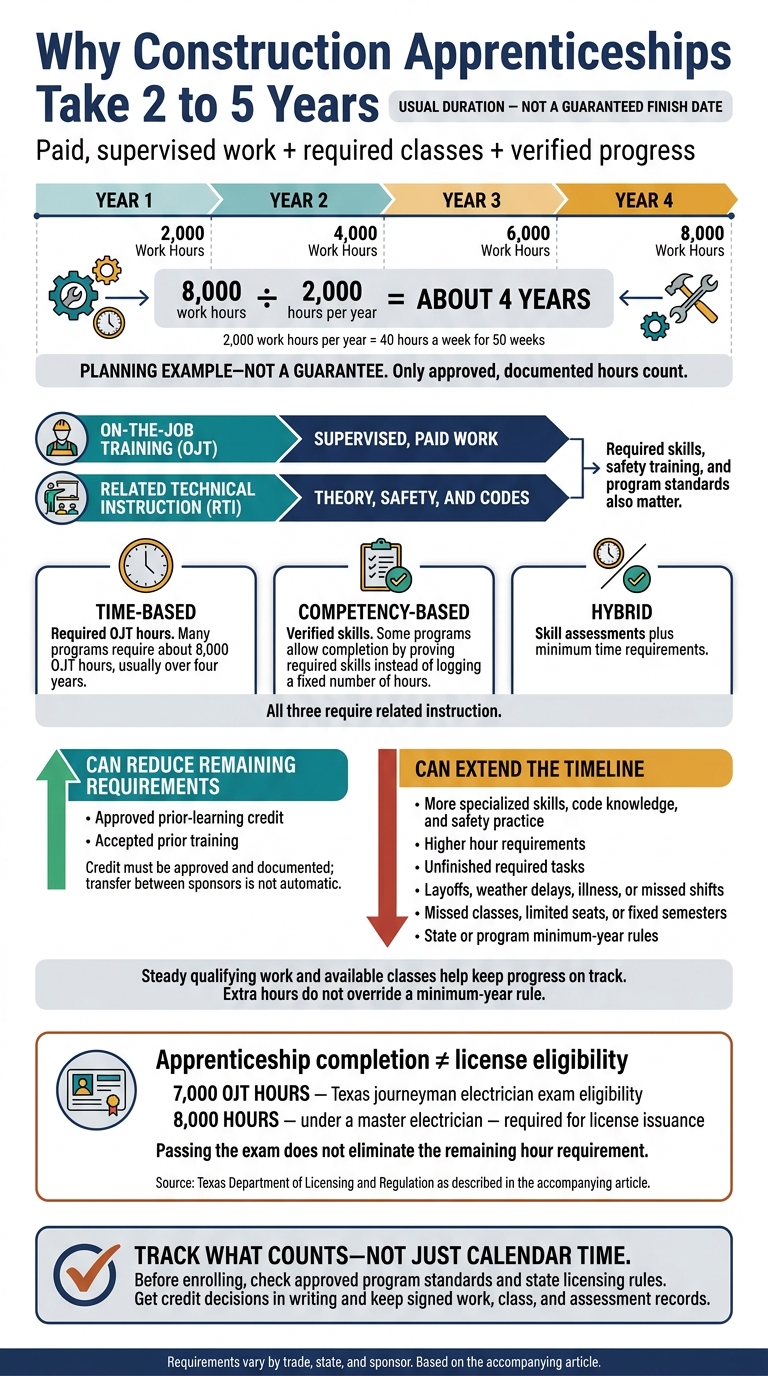
Why Construction Apprenticeships Take 2 to 5 Years
Everything you need to know about construction apprenticeships
sbb-itb-aa28329
How Do Trade Skills and State Rules Affect Length?
Total hours are only part of the timeline. Your trade and state rules also affect how long an apprenticeship takes.
Which Trade Skills Take More Time to Learn?
Trades that require more training in codes, safety, and hands-on systems usually take longer. Some apprenticeships take about 2 years. Others run closer to 5 because they require more instruction and supervised practice.
State requirements that go beyond federal minimums can also add time.
How Do State Requirements Differ?
State apprenticeship rules, licensing rules, and sponsor standards can each set different requirements. Apprenticeship rules establish minimum work and classroom hours. Licensing rules may require more experience before you can practice a licensed trade, while sponsors may require training beyond state minimums.
State summaries aren’t a substitute for your program’s written standards.
In Texas, the Department of Licensing and Regulation allows apprentices to take the journeyman electrician exam after 7,000 OJT hours, but license issuance requires 8,000 hours under a master electrician. Passing the exam does not eliminate the remaining hour requirement.
Which Program Requirements Should You Check?
Get the approved program standards before enrolling. Confirm which work hours, classes, and safety training count toward completion, and get any credit decisions in writing.
Check signed work record requirements with the licensing authority. Keep those signed records – you may need them to get your license.
Even when you follow the right standards, class time and missed work can delay completion.
How Do Work Hours and Classes Shape the Timeline?
On-the-job training (OJT) builds field skills through supervised, paid work. Related technical instruction (RTI) covers theory, safety, and codes. Time on the calendar doesn’t always match progress toward completion.
About 2,000 work hours per year – 40 hours a week for 50 weeks – is a planning estimate, not a guarantee. Finishing depends on documented hours, required skills, and program standards. Even with a full-time schedule, missing documentation or unapproved hours can delay completion.
How Can Class Schedules Delay Completion?
Class requirements are separate from work hours, so they can affect your finish date. Evening classes, release time from work, and block or semester schedules all play a part. Many state programs require hundreds of classroom hours on top of OJT. Missing classes or work shifts can add more time.
How Do the 3 Training Approaches Compare?
Programs generally follow one of three models: time-based, competency-based, or hybrid. All three still require related instruction, but each measures progress differently.
| Approach | How progress is measured | What it means for completion |
|---|---|---|
| Time-based | Required OJT hours | Many programs require about 8,000 OJT hours, usually over four years. |
| Competency-based | Verified skills | Some programs let apprentices finish by proving required skills instead of logging a fixed number of hours. |
| Hybrid | Skill assessments plus minimum time requirements | Apprentices must pass skill checks and meet minimum-hour requirements. |
How Does Missed Work Extend Training?
Published timelines assume steady work, classes, and approved hours. Weather delays, layoffs, illness, scheduling conflicts, or a job change can create gaps in counted hours and push completion past the original estimate. Document missed time and arrange to make it up.
What Happens When Training Is Incomplete?
Missed work hours mean you’ll need more credited work. Missed classes may require make-up instruction or a later course. If task requirements remain unfinished, you’ll need more supervised practice – even if you’ve worked steadily in other areas.
Credit does not transfer automatically between sponsors. Before switching, ask the new sponsor to review your records and confirm which credits it accepts. That way, you’ll know which requirements you still need to meet. Keep copies of signed hour records, class records, and assessments.
How Can Workers and Employers Track Progress?
Review counted hours, class attendance, assessments, safety instruction, and certifications with the sponsor. After an interruption, agree on what’s missing and set a timetable to complete it. Get supervisor sign-offs as you finish work rather than waiting until the term ends.
Progress tracking tools help sponsors spot gaps before they delay completion.
ABLEMKR tracks worker status, certifications, safety training, availability, and compliance alongside sponsor progress reviews. It does not replace sponsor oversight, official records, or decisions about requirements and training credit.
What Can Shorten or Lengthen an Apprenticeship?
Even when training goes as planned, program rules can shorten or extend your apprenticeship.
Factors That Can Shorten or Lengthen the Timeline
| Factor | Shorter-timeline conditions | Longer-timeline conditions |
|---|---|---|
| Trade complexity | Fewer specialized skills mean less supervised practice. | More specialized skills, code knowledge, and safety practice add time. |
| Required hours | Steady qualifying on-the-job training (OJT) hours keep completion on track. | Higher hour requirements or unfinished work requirements extend training. |
| Class schedules | Required courses are available when you need them. | Fixed semesters, limited seats, or work conflicts delay required classes. |
| State and program standards | Approved routes reduce remaining requirements. | Some state rules require a minimum number of years. |
| Approved prior-learning credit | Accepted credit for prior training reduces remaining requirements. | Prior training that receives no credit leaves the full hours requirement in place. |
| Missed work | Consistent work keeps credited hours adding up. | Work interruptions stretch the schedule. |
Completion depends on approved hours, required classes, and accepted credit – not just how long you’ve been on the job.
Before enrolling, get written confirmation of which hours count toward apprenticeship completion and which count toward licensing. These are separate requirements, so ask which prior-learning credits apply to each.
Track credited OJT and classroom hours rather than calendar time alone. Advertised timelines are estimates, not guarantees, and extra hours won’t override a minimum-year rule.
FAQs
Can overtime help me finish my apprenticeship sooner?
It depends on your program. In a time-based program, overtime may help you complete your required on-the-job training hours sooner. But the program’s schedule and classroom instruction may still limit how soon you can finish.
In competency-based or hybrid programs, proving your skills sooner may let you move ahead faster. Check your program’s requirements to see if you can finish early.
Will my apprenticeship hours count if I move states?
Whether your apprenticeship hours count in another state depends on your program’s registration and state reciprocity agreements. Hours and classroom credits usually transfer most easily within the same national or multi-state program.
Contact the apprenticeship agency in your new state to check whether your completed hours and classroom instruction meet local requirements. Some states accept out-of-state licenses and experience, but the rules vary by state and trade.
How can I stay on track during a layoff?
Stay connected with your professional network to reduce time between jobs. Build your skills through cross-training or additional certifications, and keep your profile current with your skills and safety training milestones.
ABLEMKR matches pre-vetted workers with projects based on certifications, safety training, and location. It helps you find new assignments and gain experience as you work toward becoming a journeyworker.


