
If you see “welding cert required,” it usually means two different things: safety training and a welding test record. Those are not the same, and most U.S. employers check them separately.
I’d sum it up like this: a welding safety certificate only counts if it shows job hazard training tied to OSHA welding rules, PPE, fumes, fire risk, shock risk, and safe work practices. A weld qualification record, on the other hand, shows you can make a weld that meets code. One covers safe work. One covers weld quality. Many jobs want both.
Here’s the short version:
- OSHA does not issue a personal welding license
- Employers must train workers on welding hazards
- Hot work training may also be required
- AWS, ASME, and API records prove welding ability, not safety training
- Safety training often gets refreshed every 2–3 years, but OSHA has no single set expiration date
- Welder continuity often must be kept every 6 months, depending on the code
- Workers and employers should keep certificates, hot work records, and WPQ/WQR documents ready
One number helps show why this matters: 6,990 nonfatal injuries and illnesses were reported for welding, soldering, and brazing workers in a recent BLS reporting year.
Quick comparison
| Record | What it proves | Common rule set | Same as safety training? |
|---|---|---|---|
| Welding safety training certificate | Hazard training, PPE, fumes, shock, fire, safe work steps | OSHA 29 CFR 1910 Subpart Q, 1926 Subpart J, ANSI/AWS Z49.1 | No |
| Hot work training record | Permit rules, fire watch, combustible control | NFPA 51B, OSHA 1910.252 | No |
| WPQ/WQR | Ability to make a code-accepted weld | AWS D1.1, ASME Section IX, API 1104 | No |
So if you’re asking what counts, my answer is simple: a generic attendance card is not enough. You need training records that show what was taught, when it was taught, who gave it, and which welding hazards were covered. And if the job involves production welding, you’ll likely need your qualification record too.
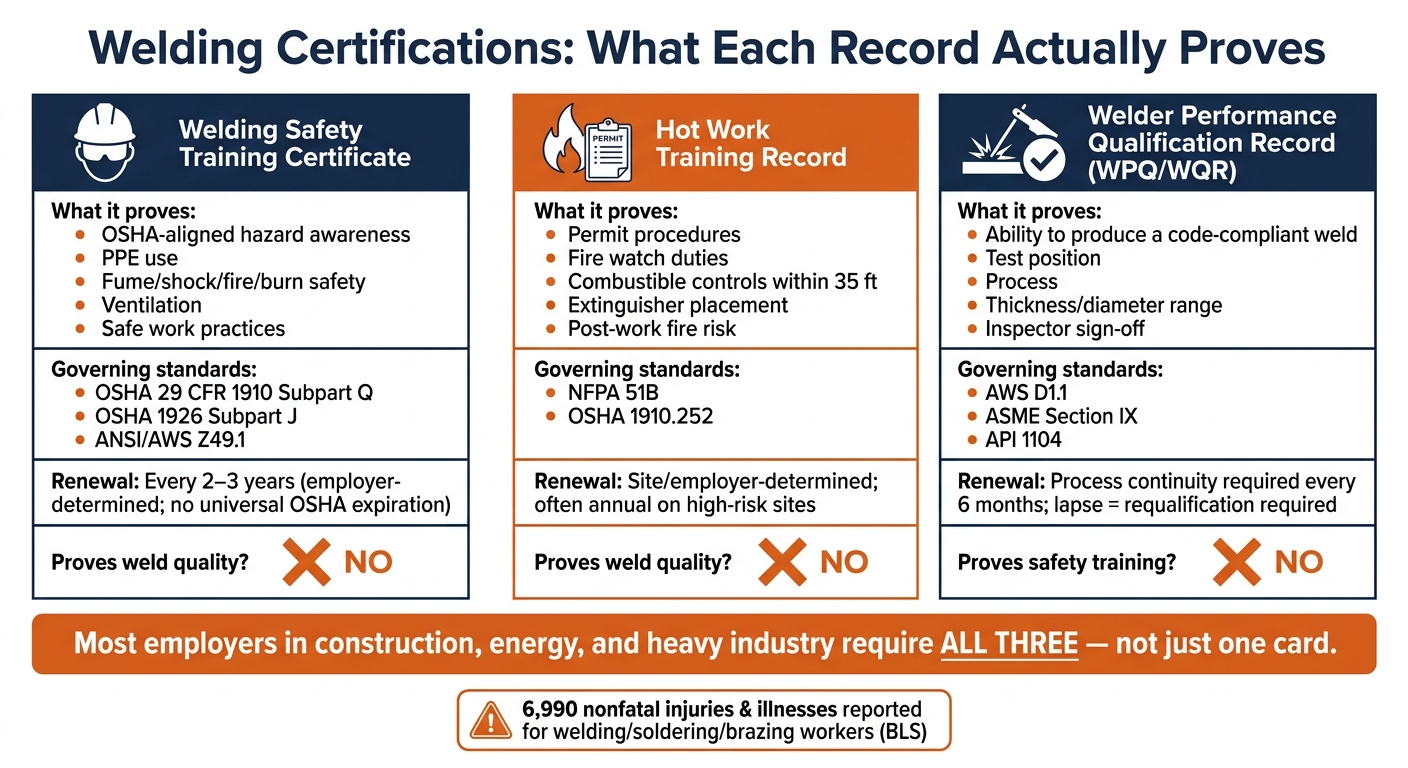
Welding Safety Certification vs. Welder Qualification: Key Differences
Do You Really Need Welding Certifications? Here’s the Truth!
sbb-itb-aa28329
What employers mean when they ask for welding safety certification
In the U.S., welding safety certification usually means employer-accepted proof of safety training, hot work training, and performance qualification. OSHA does not license individual welders; it requires employers to train workers to work safely and control welding hazards.
So when a job posting says "welding safety certification required," the employer is usually asking for a mix of documents, not one single card or certificate. In most cases, that means documented OSHA-aligned safety training, hot work training if the site requires it, and code-based performance qualifications that show welding skill. That difference matters because employers often check paperwork before they let anyone onto the site.
Safety training vs. welder qualification: the key difference
OSHA-aligned safety training is about hazard awareness. It covers things like hazard recognition, PPE selection, ventilation, electrical safety, and fire prevention. The point is to show that the worker knows how to spot risks and work safely before site access.
Welder performance qualification under AWS, ASME, or API is different. It focuses on weld quality. A welder completes test coupons in stated positions and processes, and those coupons are then tested visually or by code-required methods against a code standard. One does not replace the other. A welder can have a current AWS D1.1 qualification and still need separate safety training records. Employers who know the difference usually check for both.
Documents employers commonly ask to see
What an employer asks for can change by site and industry, but in construction, energy, and heavy industry, the paperwork usually looks something like this:
| Document | What It Shows | Common Standard |
|---|---|---|
| Welding safety training certificate | OSHA-aligned hazard and PPE training completed | OSHA 29 CFR 1910 Subpart Q |
| Hot work and fire-safety training proof | Permit procedures, fire watch, combustible controls | NFPA 51B, OSHA 1910.252 |
| Welder Performance Qualification Record (WQR) | Code-compliant weld test results, process, position, date | AWS D1.1, ASME Section IX, API 1104 |
The exact paperwork can vary from one site to the next, but employers often ask for this three-part set. And there’s one more layer to watch for: local rules.
Local fire codes can add hot work or fire-watch requirements beyond federal OSHA minimums.
What a welding safety certificate should cover
Once an employer asks for proof, the next step is simple: what does the certificate need to include?
The answer isn’t just "some safety training." It needs documented training tied to OSHA 1910 Subpart Q, OSHA 1926 Subpart J, and ANSI/AWS Z49.1. If that connection isn’t clear, the certificate won’t mean much during an audit.
OSHA hazard and PPE topics that belong in the training
The training should cover the main welding hazards workers face on the job:
- Thermal burns
- Arc flash
- Ultraviolet and infrared radiation
- Welding fumes and gases
- Electrical shock
- Compressed gas cylinder handling
PPE is just as important. A solid course should include welding helmets with the right filter lenses, eye and face protection, gloves, flame-resistant clothing, respiratory protection when ventilation can’t keep fumes under control, and safety footwear.
Eye protection deserves special attention. Welding eye injuries still happen often when workers skip the proper lenses.
The training should also include pre-use checks for leads, hoses, regulators, electrode holders, and flashback arrestors.
And it shouldn’t stop with personal protection. It also needs to cover fire control.
Hot work controls and NFPA 51B requirements
NFPA 51B training should cover removing or shielding combustibles within at least 35 feet of the work area, assigning a fire watch when needed, keeping extinguishers within reach, and using a hot work permit whenever welding takes place outside a designated welding area. Many sites require that permit before work starts, so this isn’t just paperwork. It’s part of how the job gets done safely.
Workers also need training on post-work fire risk, not just what happens during the weld. Sparks can travel, smolder, and cause trouble later. That’s why workers should understand when they have the authority to stop unsafe work, like when sparks can reach hidden combustibles.
AWS-based safety training and employer compliance
Training providers can meet this need with documented courses and topic-based materials. AWS offers safety courses and fact sheets on topics such as metal fume fever, lockout/tagout, eye and face protection, and respiratory protection.
That material helps with employer compliance when the course content clearly maps to OSHA, NFPA 51B, and ANSI/AWS Z49.1 topics.
A strong training record should list:
- Course title
- Provider
- Date
- Hours
- Topics covered
- Standards referenced
- Instructor name
- Worker’s completion status
That kind of record makes the certificate audit-ready, no matter who issued it.
How long welding safety training is valid and when renewal is needed
Once a certificate covers the right hazards, the next step is figuring out how long it remains valid.
OSHA does not set a universal expiration date for welding safety training. Employers decide when refresher training is needed based on job hazards and site rules.
In many workplaces, welding or hot work training is refreshed every 2 to 3 years. On higher-risk sites – like refineries, chemical plants, and confined spaces – annual refreshers are often required.
When employers should require refresher training
Employers should retrain workers after:
- New equipment
- New materials
- New tasks or job sites
- Incidents or near misses
- Changes to hot work permits
That’s why a written refresh policy matters. A certificate date by itself doesn’t tell the whole story. During an OSHA inspection or contractor audit, it helps when an employer can show a documented reason for the refresher schedule – such as risk assessments, client requirements, or insurance guidance – instead of pointing to a date alone.
Why welding qualification renewal rules are separate from safety training
Welder qualification follows separate, code-specific continuity rules. In many AWS D1.1, ASME Section IX, and API 1104 applications, each qualified process must be used at least once every 6 months to stay current. If continuity lapses, the welder must requalify.
This is where people sometimes get tripped up. Safety training and welding qualification are not the same thing.
During onboarding and audits, contractors often review performance qualification records and continuity logs alongside safety training certificates. A welder may be current on safety training but still not allowed to do a task if process continuity has lapsed. The reverse can also happen too. Mixing those up can leave compliance gaps.
Tracking credentials digitally to avoid lapses
A digital record system makes it easier to track issue dates, refresher dates, and continuity logs in one place. Keep the certificate, refresh dates, and continuity logs ready to show.
What proof welders and employers should keep ready
The right records help avoid gate delays and audit problems. Even if credentials are tracked in a system, workers and employers still need the source documents ready when someone asks to see them.
Documents workers should carry or store digitally
A welder should keep a current safety training record on hand, either as a paper copy or in digital form. It should include the worker’s name, course title, training provider, date, and the topics covered. That can smooth things over at the gate, but it doesn’t replace the employer’s full qualification file.
If the job involves hot work outside a designated welding area, the worker should also keep proof of hot work training and any required site-specific orientation. This comes up a lot at refineries, power plants, steel mills, and similar sites.
Welders should also keep a copy of their Welder Performance Qualification record (WPQ) or Welder Qualification Test Record. That record should show:
- The welder’s name or ID
- The test date
- The welding process and position
- The thickness and diameter range
- The welding procedure specification used
- The witnessing inspector’s name and signature
Wallet cards and digital badges can speed up field checks. But they do not replace the WPQ.
Workers also need a government-issued photo ID for I-9 verification and site badging. And if a site has its own orientation record – like a refinery card, digital badge, or PDF saved in a secure folder – it helps to keep that ready too. Otherwise, you may end up repeating onboarding you already finished.
Records employers must keep for compliance
Employers need the full compliance file, not just whatever copy the worker carries. Each welder’s training file should include names, dates, the course title, topics covered, and instructor credentials. Those records should also tie back to the right OSHA standard, such as 29 CFR 1910.252 or 1926 Subpart J. That’s the kind of paperwork OSHA staff and client auditors usually want to review.
For qualification records, employers are responsible for keeping WPQRs, continuity logs, and code references for each qualified welder. For hot work, completed permits should be filed by date, location, or project so they can be pulled fast during an inspection or audit.
ABLEMKR can centralize certificates, WPQs, continuity logs, and onboarding records, which makes mobilization and compliance tracking easier.
Conclusion: The short answer on what counts
After looking at training content, renewal timing, and recordkeeping, the short answer is pretty simple: a welding safety certificate counts only if it shows OSHA-aligned hazard training, not just a generic attendance card.
That means the certificate should identify the worker, date, provider, and the hazards covered. For welding, that includes fumes, shock, fire, burns, eye hazards, PPE, ventilation, and safe work practices. If the certificate points to standards like 29 CFR 1910 Subpart Q or 1910.252, employers have stronger proof that the training was tied to actual welding hazards.
Hot work training counts too when the jobsite requires it, especially under NFPA 51B permit systems.
AWS, ASME, and API qualification records prove weld quality, not safety knowledge; employers need both. Training shows hazard awareness. Qualification shows weld performance.
Welders should keep their safety certificate, hot work proof, and qualification records ready in either paper or digital form. That’s why digital record access matters.
ABLEMKR puts certificates, hot work training, and qualification records in one place, so employers can track expiring credentials and workers can pull up proof on mobile devices.
FAQs
Do I need both safety training and a weld test record?
Yes, in most cases, you need both.
Safety training, like an OSHA 10- or 30-hour DOL wallet card, shows that you’ve completed safety training and met site safety rules. On many job sites, that’s a basic requirement just to get through the gate.
A separate weld test record serves a different purpose. It shows that you’re qualified to do the welding work itself and that you can meet the required standard.
So while the OSHA card covers safety compliance, the weld test record covers job skill qualification. Employers usually want both on file for compliance.
What should a valid welding safety certificate include?
A valid welding safety certificate should show the worker’s full name, a card number or other ID, the training completed, and the name of the trainer or issuing group.
It should also list the completion date and expiration date. For OSHA-related cards, check for the official logo, a serial number, and, on newer cards, a QR code. The certificate should be easy to read and signed by the trainer.
When do welding safety training and qualifications expire?
Federal OSHA certifications for Construction and General Industry do not have official expiration dates. That said, many welding qualifications and employer-required safety trainings do expire.
The catch is that renewal rules can shift based on state rules, industry standards, and company policy. So if you’re an employer, you can’t just file the paperwork away and call it a day. You need to track renewal deadlines and make sure people stay current.
As a general rule, refresher training is recommended every 3 to 5 years.


