
If you misclassify a worker in Washington, you may owe back taxes, premiums, interest, and penalties. That is the main point. In this state, worker status drives almost every payroll duty: federal withholding, unemployment insurance, workers’ comp, PFML, WA Cares, reporting, and year-end forms.
Here’s the short version of what I need to check:
- Classify each worker first: employee or independent contractor
- Set up the right accounts: UBI, EIN, ESD, and L&I for employees
- Run payroll the right way: withhold federal taxes, Social Security, Medicare, PFML, and WA Cares for W-2 workers
- File quarterly reports on time: UI, PFML/WA Cares, and L&I
- Track 2026 rates and limits:
- PFML: 1.13% up to $184,500
- WA Cares: 0.58% of all wages, no cap
- UI wage base: $78,200
- Meet year-end deadlines: send Form W-2 and Form 1099-NEC by January 31
- Keep records ready: Washington agencies can review past records, and penalties can apply for bad filings or weak recordkeeping
A few rules stand out. Washington has no state personal income tax, but that does not mean payroll is simple. Employees usually trigger state UI, workers’ comp, PFML, and WA Cares. Properly classified contractors usually do not. And in construction and trade work, state license, bond, insurance, and registration checks matter even more.
Here’s a quick side-by-side view:
| Topic | Employee (W-2) | Independent Contractor (1099) |
|---|---|---|
| Federal withholding | Employer withholds | No withholding by payer |
| Washington UI | Employer pays | Usually not paid |
| Workers’ comp | Employer reports and pays | Usually not covered |
| PFML | Applies | Usually does not apply |
| WA Cares | Applies | Usually does not apply |
| Payment path | Payroll | Accounts payable |
| Year-end form | W-2 | 1099-NEC |
Bottom line: I would treat classification as the first checkpoint, payroll setup as the second, and quarterly filings as the third. If those three pieces match, the rest of the process is much easier to keep in line.
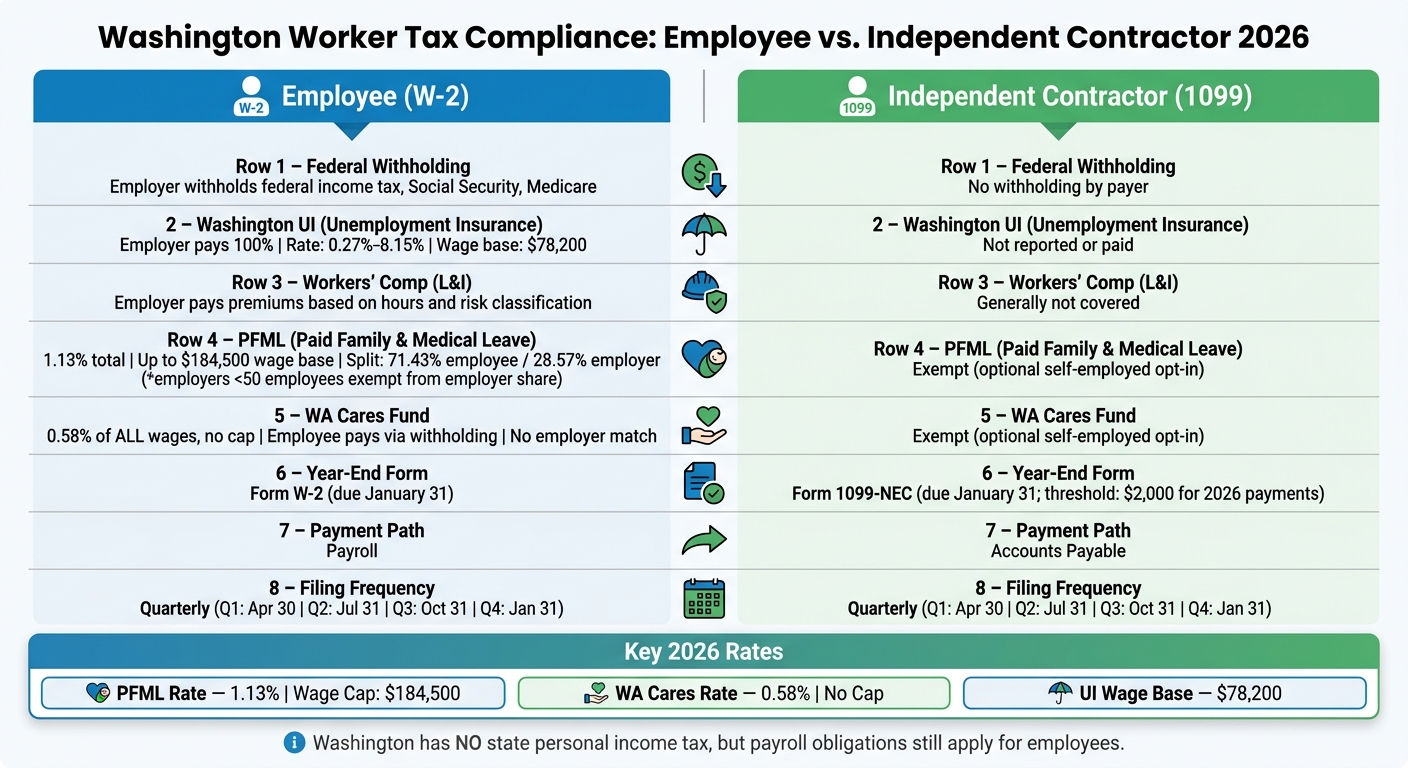
Washington State Employee vs. Independent Contractor Tax Compliance 2026
1. Confirm Worker Classification Before You Run Payroll
Before you run payroll, confirm whether the worker is an employee or an independent contractor. Then line that up with the right Washington registrations and payroll setup.
Gather Facts About the Working Relationship
Start with the way the job actually works day to day, not just the label in the agreement. A contract that calls someone an "independent contractor" does not decide the issue if your business controls when, where, and how the work gets done. The facts on the ground matter more than the title.
Get these points in writing before onboarding:
- Who controls the work? Write down whether you direct how, when, and where the work happens, or whether you only care about the end result.
- Who provides tools, equipment, and crew? Note whether the worker brings more than labor. In construction and energy work, include whether the worker brings equipment, crew, and takes on business risk.
- How is the worker paid? Hourly or salary pay leans toward employee status. Per-project or per-job pay leans toward contractor status.
- Is the work ongoing or project-based? A continuing role looks more like employment. A set project looks more like contractor work.
- Does the work match your core business? If it does, employee status is more likely.
Apply Federal and Washington Classification Standards
Next, check the federal and Washington tests that apply.
| Framework | Used By | Key Focus |
|---|---|---|
| Common-Law Control Test | IRS (federal taxes) | Behavioral, financial, and relationship-type control |
| ABC Test (RCW 50.04.140) | ESD (unemployment insurance) | Freedom from control, work outside usual business, independently established business |
| 6-Part Statutory Test (RCW 51.08.195) | L&I (workers’ comp) | Direction and control, UBI registration, financial risk, and more |
The result drives which Washington taxes, reports, and premiums apply. In construction, plumbing, and electrical trades, workers also have to meet the Construction Industry Exception under RCW 51.08.181. That includes valid state registration or licensing before they can qualify as independent contractors. Miss even one test, and that worker may be treated as an employee by that agency.
Use the result to decide whether the worker should go on payroll or stay in contractor status.
Document the Decision and Supporting Records
Once you’ve reviewed the facts and applied the right tests, document the decision. Before you issue any payment, collect and store:
- Written contract that defines the project-based work and payment terms
- Form W-9 from the contractor
- Proof of UBI registration with the Washington Department of Revenue
- Active state business license
- Certificates of insurance, when needed
- Dated classification memo that explains the decision, the supporting facts, and who approved it
Keep these records with your payroll files so tax, HR, and jobsite teams all work from the same decision. Washington’s Employment Security Department has been direct about the risk:
"If we discover a mistake on your report, you will need to pay back taxes for all misclassified workers, plus penalties and interest."
Keep the file tidy and easy to pull up if L&I or ESD asks for it.
With classification documented, move on to your Washington accounts and tax setup before the first filing.
sbb-itb-aa28329
2. Verify Washington Accounts, Registrations, and Tax Setup
Once you’ve confirmed worker classification, the next step is simple: get the right accounts open and verify any contractor records before the first payroll run. Employees need payroll and employer accounts. Contractors don’t. Their setup is more about checking business status than opening payroll accounts.
Use worker status to decide what belongs in place before payroll starts.
Set Up Core Business and Employer Accounts
Every Washington business that pays workers needs a registered business and an active UBI from DOR. The UBI is your state business ID. It connects your tax filings, license status, and employer accounts.
The Business Licensing Service (BLS) application is the main form used to open or reopen both your Employment Security Department (ESD) unemployment insurance account and your Department of Labor & Industries (L&I) workers’ compensation account. Timing matters here. File no earlier than 90 days before your first hire. And if you’re forming a new legal entity with the Secretary of State, wait at least one business day before sending the BLS to the DOR.
Here’s the core setup Washington employers should have ready:
| Account / Registration | Issuing Agency | What It Covers |
|---|---|---|
| Unified Business Identifier (UBI) | Dept. of Revenue (DOR) | State business identification |
| IRS Employer Identification Number (EIN) | Internal Revenue Service (IRS) | Federal tax identification |
| ESD Unemployment Insurance Account | Employment Security Dept. (ESD) | Quarterly UI tax reporting |
| L&I Workers’ Comp Account | Labor & Industries (L&I) | Work-related injury coverage |
| State Business License | Business Licensing Service (BLS) | State business registration |
| City Business License | Local jurisdiction | Required in many Washington cities |
You’ll also need to file ESD and L&I quarterly reports even during zero-payroll quarters. That’s one of those easy-to-miss rules that can come back to bite you. Failure to register with ESD can lead to a fine of $1,000 or two times the total amount of unpaid taxes for that quarter, whichever is greater.
Verify Contractor Business Information When Using 1099 Labor
If you’re paying a contractor instead of an employee, the paperwork load is lighter. But the verification work still matters. With 1099 labor, the job is verification, not payroll setup.
Check that the contractor has an active UBI, any required licenses, and – if the work involves construction – the right bonding and insurance before you pay them. For construction work, use the L&I Verify Tool to confirm the contractor is properly bonded and insured under RCW 18.27. Contractors handle their own Washington Business & Occupation (B&O) tax filings.
Store Account Numbers and Worker Classification in Your Payroll System
Your payroll system should store the UBI, EIN, ESD account number, L&I account ID, and worker classification for each worker. For employees, keep a bit more on file: full name, Social Security Number (SSN) or Individual Taxpayer Identification Number (ITIN), and the Standard Occupational Classification (SOC) code or job title.
If you’re managing mobile crews across Washington job sites, ABLEMKR can help keep worker status, job-site data, and compliance records in one place alongside these required fields.
Recordkeeping isn’t optional. Employers who fail to keep and preserve required work records can face a penalty of up to $250 or 200% of the quarterly tax for each offense, whichever is greater. With these accounts and worker records set up, you’re ready to move into withholding, deposits, and quarterly reporting.
3. Run Payroll and File Reports Correctly in Washington
Start with the worker-status call from Section 1. That choice decides where each person goes: payroll or accounts payable. Keep those lanes separate from day one. Employees and contractors do not follow the same rules, and mixing them up can cause tax, reporting, and premium problems fast.
Withhold and Deposit the Correct Taxes for Employees
Before you send the first paycheck, make sure each W-2 employee has a current Form W-4 on file. That form controls federal income tax withholding.
You also need to withhold Social Security and Medicare taxes. On top of that, withhold PFML and WA Cares each pay period: PFML at 1.13% of taxable wages and WA Cares at 0.58% of all wages with no cap.
If someone is a properly classified 1099 contractor, none of those deductions apply. Their payments should run through accounts payable, not payroll, and no withholding should be taken.
Report Unemployment Insurance and Workers’ Compensation Correctly
Employees go on ESD and L&I reports. Properly classified contractors do not.
Each quarter, file two main reports with the ESD:
- A UI tax and wage report
- A combined PFML/WA Cares report
The UI report must include employee names, Social Security numbers, gross wages, actual hours worked, and SOC codes. Use actual hours. If an employee is salaried, use 40 hours per week by default. Round up to the next whole hour.
For workers’ compensation, report hours and pay premiums directly to L&I each quarter. Rates depend on the worker’s risk classification. If you code field labor, shop labor, or office staff the wrong way, your premium costs change.
| Quarter | Period Covered | Filing Deadline |
|---|---|---|
| Q1 | Jan 1 – Mar 31 | Apr 30 |
| Q2 | Apr 1 – Jun 30 | Jul 31 |
| Q3 | Jul 1 – Sep 30 | Oct 31 |
| Q4 | Oct 1 – Dec 31 | Jan 31 |
Issue Year-End Forms and Keep Audit-Ready Records
By January 31 of the next year, W-2 employees must get Form W-2, and qualifying contractors must get Form 1099-NEC. For 2026 payments, the 1099-NEC threshold is $2,000.
Match your annual payroll totals to the quarterly reports filed with ESD and L&I. That’s a simple step, but it can save a lot of cleanup later. L&I can look back three years of premium payment records, so keep payroll registers, timesheets, and deduction records for at least three years.
Pay stubs must clearly show:
- The basis of pay
- The rate
- All specific deductions
Next, check whether PFML, WA Cares, and any local assessments apply to your workforce.
4. Check Washington Payroll Programs and Assessments
Washington payroll has a few extra moving parts beyond the usual taxes. The big ones are PFML, WA Cares, and, in some cases, local payroll taxes. One thing trips people up all the time: keep UI separate from the combined PFML/WA Cares quarterly filing —especially when managing craft workers across multiple job sites..
Miss a payment, and the state doesn’t shrug it off. Late payments can lead to interest at 1% per month, plus penalties that start at 5% in the first month and climb to 20% by the third month.
Paid Family and Medical Leave and WA Cares
Both programs apply to W-2 employees. But they don’t work the same way. They have different rates and different wage-base rules, so set them up as separate payroll items.
For 2026, the PFML total premium is 1.13% of gross wages, capped at the $184,500 taxable wage base. That amount is split 71.43% from the employee and 28.57% from the employer. If your business has fewer than 50 employees, you don’t owe the employer share. You still have to withhold and send in the employee share.
WA Cares is more straightforward. Withhold 0.58% of all wages with no cap and remit it quarterly. There is no employer match.
Before you process payroll, review WA Cares exemption status. Nonimmigrant visa holders are automatically exempt starting January 1, 2026, and veterans with a 70% or greater disability rating also qualify.
Once you’ve handled the state programs, look at local payroll tax rules.
Health and Local Assessments That May Apply
Local payroll taxes can sit on top of state programs.
If you do business in Seattle, review the JumpStart Payroll Expense Tax. It applies when annual payroll is more than $9.07 million and at least one employee earns $194,452 or more. Rates range from 0.7% to 2.5%, based on the payroll bracket. Seattle employers should also check the Social Housing Tax.
For hourly employees, gross pay should reflect the local minimum wage where it applies. For 2026, the rates are:
- Seattle: $21.30 per hour
- Tukwila: $21.65 per hour
- SeaTac: $20.74 per hour
Then apply PFML and WA Cares withholding to that gross pay.
Employee vs. Independent Contractor Compliance Comparison Table
Use the table below to sort employee and contractor duties side by side.
| Program | Employee (W-2) | Independent Contractor (1099) | Agency | Filing Frequency |
|---|---|---|---|---|
| Unemployment Insurance (SUI) | Employer pays 100% (0.27%–8.15% on a $78,200 wage base) | Not reported or paid | ESD | Quarterly |
| Workers’ Comp (L&I) | Employer pays premiums; rates are based on hours worked and risk classification | Generally not covered | L&I | Quarterly |
| PFML | Split: 71.43% employee / 28.57% employer* (1.13% total, up to $184,500) | Exempt; optional self-employed opt-in | ESD | Quarterly (combined) |
| WA Cares | Employee pays 0.58% via withholding; no employer share | Exempt; optional self-employed opt-in | ESD | Quarterly (combined) |
*Employers with fewer than 50 employees are exempt from the employer share of PFML premiums but must still collect and remit the employee portion.
Review these items before each quarterly filing.
5. Monitor Changes, Audit Regularly, and Final Compliance Checklist
Review Classifications and Accounts on a Set Schedule
Once payroll, filings, and accounts are set up, review them before each quarterly deadline. In Washington, that kind of routine review isn’t optional in practice. Before every quarterly filing, reconcile wages, SOC codes, and workers’ comp classifications.
Worker classification also needs a second look any time job duties shift or the working relationship changes. If the work changes, check the level of control again. A contractor may now meet the test for employee status. Washington law puts the burden of proof on the employer, so your records need to back up each classification call.
Use that same quarterly audit to review ownership and officer changes. Those updates must be reported with your tax and wage filings. And don’t wait to register until the last minute – register before hiring, because late registration can lead to penalties.
Keep classification, payroll, and filing records for four years.
Use Technology to Cut Manual Errors
Once you have a review schedule, the next step is simple: keep worker data in one place. A central system helps keep status, coding, and reporting in sync across payroll and filings.
For employers managing field operations, ABLEMKR can help centralize workforce deployment, maintain W-2 visibility, and coordinate compliance for fast-moving job sites. It can also help flag status changes before payroll mistakes spread. Filing quarterly reports through the Employer Account Management System (EAMS) cuts manual entry mistakes and gives you a clear record of submission.
Conclusion: Key Washington Worker Tax Compliance Checks
Scheduled reviews and centralized records help catch mistakes before they hit a filing. Classify workers the right way, keep quarterly UI, PFML, and WA Cares filings matched to payroll records, and fix errors in EAMS as soon as you spot them. Washington worker tax compliance starts with classification and ends with accurate filings.
FAQs
How do I know if a worker is really a contractor?
In Washington, workers are presumed to be employees by default. Calling someone an independent contractor in a contract doesn’t settle it. What matters is the actual working relationship and whether it passes Washington’s state tests.
When a worker provides only personal labor, the bar is strict. They must meet all six statutory criteria. In construction, there’s also a seventh requirement. If even one part of the test fails, the worker is treated as an employee and must have workers’ compensation coverage.
What happens if I misclassify a worker in Washington?
If you misclassify a worker in Washington, you may have to pay back taxes, plus interest and financial penalties.
Washington also uses different classification tests for unemployment insurance and industrial insurance. That means a mistake can trigger back premiums, interest, and penalties under both programs.
Which Washington payroll taxes apply to W-2 employees?
Washington has no state personal income tax. So if you employ W-2 workers there, you don’t withhold state income tax from their paychecks.
That said, payroll in Washington isn’t a free pass. Employers still need to deal with several state-run programs, including:
- Unemployment Insurance (UI)
- Paid Family and Medical Leave (PFML)
- The WA Cares Fund payroll deduction
- Contributions to the state workers’ compensation fund run by Labor & Industries
In short, there’s no state income tax withholding, but there are still state payroll items you need to track and pay.


