
Worker safety certifications ensure employees are trained to handle workplace hazards, especially in high-risk industries like construction and energy. Verifying these certifications is crucial to avoid legal and safety risks. Here’s how you can confirm their authenticity:
- Gather Certification Details: Collect the worker’s name, card number, course type (e.g., OSHA 10-hour or 30-hour), trainer name, and training date. For plastic OSHA cards, scan the QR code for verification.
- Check with Official Sources: Use the OSHA Card Portal or contact the trainer or OTI Education Center listed on the card. Verify the trainer’s credentials through OSHA’s authorized trainer list.
- Spot Fake or Expired Cards: Look for missing QR codes, unlisted trainers, or suspicious delays in card issuance. Report suspected fraud to OSHA’s outreach fraud hotline or email outreach@dol.gov.
Employers should maintain a digital record of certifications, train hiring staff to verify them properly, and periodically re-verify advanced credentials to ensure compliance and safety.
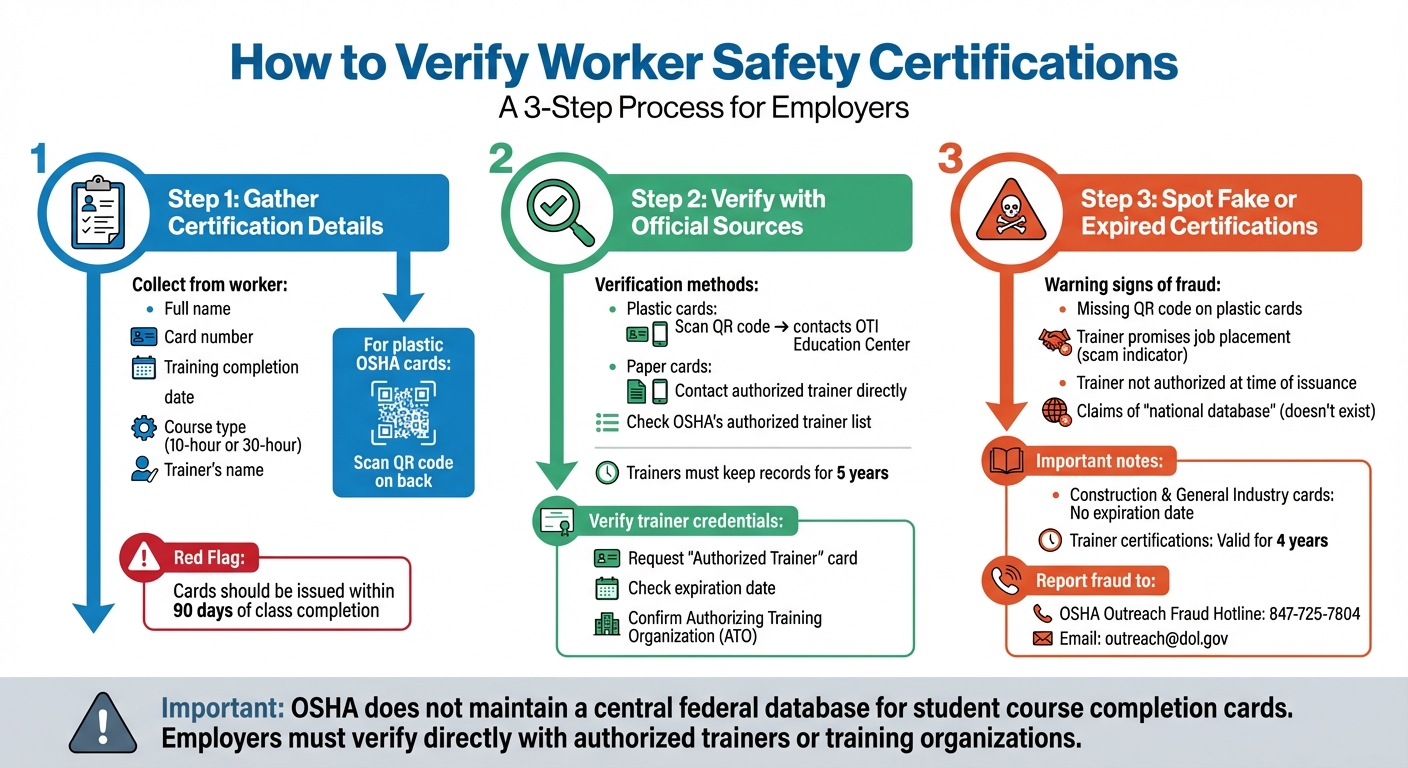
3-Step Process to Verify OSHA Worker Safety Certifications
How to Verify If Your OSHA 10 Card Is Real | Complete Verification Guide
How to Verify Worker Certifications
Making sure worker safety certifications are legitimate takes a thorough process, especially because OSHA doesn’t maintain a central federal database for individual student course completion cards. Instead, employers need to verify directly with authorized trainers or training organizations. Here’s how you can confirm certification authenticity and avoid compliance issues.
Step 1: Gather Certification Details
Start by collecting key information from the worker, such as their full name, card number (if available), training completion date, course type (e.g., Construction 10-hour or General Industry 30-hour), and the trainer’s name. For workers with plastic OSHA cards, check the QR code on the back for immediate verification. Also, ask for any other role-specific certifications they hold, along with their expiration dates. Keep in mind that trainers are required to issue course completion cards within 90 days of the class ending. If there’s a long delay in receiving the card, it could be a red flag.
Step 2: Verify Credentials with Official Sources
For modern plastic OSHA cards, simply scan the QR code on the back using your smartphone. This will provide contact details for the OTI Education Center that processed the card. If the card is paper or doesn’t have a QR code, reach out to the authorized trainer directly. Trainers are obligated to keep student training records for five years. To confirm the trainer’s credentials, check OSHA’s public list of authorized trainers or ask to see their "Authorized Trainer" card. This card includes their expiration date and the name of their Authorizing Training Organization (ATO). If you can’t reach the trainer, contact the OTI Education Center listed on the card to verify the worker’s training record.
Step 3: Spot Fake or Expired Certifications
There are several warning signs of fraudulent certifications. Be wary of trainers who promise job placement after completing the course – this is often a scam. Plastic OSHA cards should always have a QR code; if it’s missing, that’s another red flag. Additionally, confirm that the trainer was authorized at the time the card was issued, as OSHA trainer certifications are valid for four years and require periodic updates.
It’s also important to note that OSHA cards for Construction, General Industry, and Disaster Site work don’t have official expiration dates. However, Maritime cards issued after April 1, 2019, also do not expire. If you suspect fraud, reach out to the OSHA outreach fraud hotline at 847-725-7804 or email outreach@dol.gov. Be cautious of websites claiming to be a "national database" for OSHA cards – OSHA has confirmed it doesn’t operate or endorse any such database.
Verification Tools and Resources
When it comes to verifying OSHA certifications, having the right tools can make the process quicker and more dependable. Since OSHA doesn’t maintain a centralized federal database for students who’ve completed Outreach Training Program courses, employers must rely on multiple sources to confirm credentials. These tools and resources help automate checks and centralize records, making the process more efficient.
Government and Industry Databases
The OSHA Card Portal is a key resource for verifying 10-hour and 30-hour cards. To use it, you’ll need the worker’s full name and card number. For more advanced certifications, like the Safety & Health Fundamentals certificates – which require a minimum of 68 contact hours for Construction or General Industry, or 77 hours for Maritime – the National OSHA Foundation provides an online tool to validate certificate numbers. Alternatively, you can contact the relevant OTI Education Center for official transcripts or course completion records.
Another essential step is verifying that the trainer who issued the card was authorized at the time of training. OSHA’s authorized trainer list is available for this purpose. As OSHA explains:
"Only OSHA-authorized trainers may teach 10- and 30-hour safety courses and issue OSHA student course completion cards".
These databases offer a quick and reliable way to complement manual verification efforts.
Workforce Management Platforms
Workforce management platforms simplify the process even further. For example, ABLEMKR pre-verifies worker certifications and tracks them alongside safety training and location data. This allows employers to access pre-vetted workers without having to check each credential individually. The platform also includes compliance tracking, offering real-time updates on worker certifications. This can be especially helpful when mobilizing crews for last-minute projects, such as emergency repairs or shutdowns.
By integrating with official verification tools and cross-referencing authorized trainer lists, platforms like these help reduce the risk of fraud. This is particularly important given the documented rise in counterfeit 10-hour and 30-hour safety course cards.
Creating Internal Verification Systems
While external tools are invaluable, building strong internal systems ensures long-term compliance. Start by requiring workers to submit official certificates or transcripts from OTI Education Centers as proof of completion. Store these verified credentials in a centralized digital repository, keeping track of the verification date and method. Train your hiring and compliance teams to check OSHA’s authorized trainer list before accepting certifications.
It’s also a good idea to schedule periodic re-verifications, especially for advanced roles. Authorized trainers are required to maintain student training records for five years, so you can always request records if needed. If you suspect fraudulent activity, contact the Department of Labor’s Office of Inspector General and document your findings in your internal system.
sbb-itb-aa28329
Best Practices for Employers
Employers need to go beyond basic verification steps and establish clear, consistent practices to ensure compliance and workplace safety.
Set Up a Standard Verification Process
A reliable verification process shields your company from compliance risks and guarantees that workers meet safety standards before entering a job site. Require employees to provide physical or digital copies of their certifications during the hiring process. Check for the training organization’s logo and the trainer’s name on the documents. To confirm the trainer’s authorization at the time of training, consult OSHA’s public list of authorized trainers. For plastic OSHA cards, scan the QR code to verify details through the OTI Education Center. If automated tools don’t work, reach out directly to the Authorizing Training Organization (ATO) or the trainer listed on the card.
If the training took place more than five years ago and records are unavailable, you might need to require the worker to complete refresher training. While OSHA cards for Construction and General Industry courses don’t officially expire, employers can choose to implement internal policies requiring periodic updates. Having a structured process makes it easier to maintain organized records and uphold safety standards.
Keep Digital Certification Records
Since OSHA does not maintain a national database for student course completion cards, employers must create their own systems for record-keeping and verification. Establish a centralized digital repository to store verified certifications, along with details like the verification date and method. Include the trainer’s name and contact information, as they are the only ones authorized to verify training or request replacement cards. For plastic OSHA cards, save the contact details obtained from QR code scans.
Keeping these records well-organized ensures they are readily available for audits or when preparing crews for new projects. Proper documentation not only demonstrates compliance but also supports workforce planning and reliability.
Train Your Hiring and Compliance Staff
Equip your hiring and compliance teams with the knowledge to verify certifications effectively. Train them to use the OSHA Outreach Card portal by inputting the worker’s full name and card number, and show them how to scan QR codes on plastic cards. Ensure they understand the difference between 10-hour courses (basic safety awareness) and 30-hour courses (designed for supervisors with safety responsibilities) to match workers with site-specific requirements.
Your team should also know that OSHA-authorized trainers must renew their credentials every four years by completing an update course. When hiring independent safety trainers, staff should ask to see their "Authorized Trainer" card, which includes an expiration date and the name of the authorizing training organization. Additionally, teach your team to spot fraudulent certifications and report any suspicious activity to the Department of Labor’s Office of Inspector General or OSHA’s outreach fraud hotline. For every verification, collect key details such as the student’s full name, training completion date, course type, and the trainer or training center’s name. Proper training for your staff ensures your verification process supports safety and compliance in high-risk environments.
Conclusion
Main Points to Remember
A thorough verification process is key to protecting your team and ensuring compliance with workplace safety standards. Start by collecting OSHA certification cards and verifying their authenticity – either by scanning QR codes on the cards or contacting authorized trainers directly. Keep in mind that trainers need to renew their credentials every four years, and records should be retained for five years.
"Verifying employee safety training is a vital step for employers to stay compliant with workplace regulations. Making sure a worker has the right credentials helps lower risks and shows that a company is doing its part to keep people safe." – LegalClarity Team
Set up a consistent verification process, maintain organized digital records with trainer details and verification dates, and educate your team on the differences between OSHA’s 10-hour courses (for entry-level workers) and 30-hour courses (for supervisors with safety duties). If you suspect fraud, report it to the OSHA outreach fraud hotline at 847-725-7804. By following these steps, businesses can lay a solid foundation for compliance while staying proactive about safety.
How ABLEMKR Simplifies Verification
ABLEMKR takes the hassle out of manual verification by automating certification checks and maintaining up-to-date digital records for all workers. The platform connects pre-vetted workers to job sites based on their certifications, safety training, availability, and location – ensuring that only qualified personnel are assigned to projects.
Employers benefit from real-time compliance tracking, gaining instant visibility into worker certification statuses. Whether it’s a last-minute shutdown, a remote pipeline repair, or scheduled mine development, ABLEMKR ensures crews meet all safety requirements before they arrive on-site. This streamlined credential management system supports industries like construction, energy, oil & gas, mining, and heavy infrastructure, helping companies stay compliant while deploying skilled labor quickly and with confidence.
FAQs
How can employers verify the authenticity of OSHA safety certifications?
Employers can ensure OSHA certifications are legitimate by checking specific details on the document. Key elements to look for include the official OSHA logo, a unique serial number, the type of training completed (such as 10-hour or 30-hour courses), and the issue and expiration dates.
Some certifications also feature a QR code, which allows for quick verification when scanned. Employers can further confirm authenticity by using authorized verification tools or portals to match the worker’s name and certification details with official records. These steps help confirm that the certification is valid and issued by an approved provider.
How can I spot a fake or expired OSHA card?
To spot a fake or expired OSHA card, pay attention to details that might be off. Look for a missing hologram, QR code, or trainer’s signature – these are essential features of authentic cards. Outdated designs or formatting that don’t align with official OSHA standards are also red flags. For extra assurance, use authorized OSHA verification systems to confirm the card’s validity. Verifying credentials is key to ensuring safety and compliance on the job site.
Why should you keep digital records of worker safety certifications?
Keeping digital records of worker safety certifications is a smart way to maintain accurate and current compliance tracking. It allows for quick verification of qualifications, reduces the risk of manual errors, and makes it easier to meet workplace safety requirements.
Having these records digitally also lowers legal and operational risks by ensuring certification details are readily accessible when needed. This ensures workers are properly qualified for their roles, improving overall safety. Plus, it simplifies hiring and onboarding, helping employers save both time and resources.


