
The battery storage industry is booming, with U.S. capacity growing by 52% in 2025 and projections of 500 GWh deployment from 2026 to 2031. However, a major challenge persists: the workforce can’t keep up. By 2026, the sector will need 9,800 skilled workers, with job openings growing at 28% annually. Roles like technicians, commissioning engineers, and grid storage experts require specialized skills that many workers from related industries lack.
Key barriers include:
- Knowledge gaps in areas like battery chemistry and safety standards (e.g., NFPA 855, UL 9540).
- Limited training access, with programs concentrated in a few states.
- Cost and time hurdles for certifications like NABCEP ESIP.
Workers from electrical, construction, solar, or oil & gas industries can transition by addressing skill gaps through targeted training, certifications, and regional programs. Platforms like ABLEMKR also help connect trained workers with employers quickly, reducing hiring delays and compliance issues.
The industry’s growth depends on building a skilled workforce now. Workers and employers must act to close the gap.
How Battery Energy Storage Systems (BESS) Work – Video Course Sample
sbb-itb-aa28329
The Skills Gap in Battery Storage Roles
The battery storage industry is growing at a breakneck pace, but it’s running into a major obstacle: a lack of qualified workers. By 2026, the sector will need to fill around 9,800 positions for battery storage technicians, with job openings increasing at a 28% annual growth rate. The problem isn’t just about finding people – it’s about finding people with the right expertise.
Key Roles in Battery Storage
The battery storage field depends on a handful of specialized roles, each demanding a unique skill set:
- ESS/Field Service Technicians focus on the physical aspects, such as wiring, high-voltage switching, and maintaining systems that can run as high as 1,500V DC.
- BESS Commissioning Engineers take a broader view, integrating Battery Management Systems (BMS) with SCADA platforms and ensuring compliance with grid codes before systems go live.
- Grid Storage Engineers handle the most advanced tasks, from designing systems to managing high-voltage switching (up to 33kV) and optimizing long-term performance.
Here’s the catch: these roles demand a mix of skills that don’t align neatly with traditional trades. Workers from solar or oil and gas backgrounds may bring useful experience, but they often lack knowledge in areas like thermal runaway mitigation, battery chemistry, or real-time state-of-charge optimization – all critical for Battery Energy Storage Systems (BESS). This mismatch makes hiring a constant struggle.
Why Employers Struggle to Hire
Utility-scale BESS projects have only been around for about five to seven years in most U.S. markets. That’s not a lot of time to build a deep pool of experienced professionals. Employers are finding it tough to attract candidates who meet their needs.
But it’s not just about technical know-how. Many roles now require what Hayatte Loukili, Executive Search Director at EnableGreen, describes as a "commercial-technical hybrid":
"The most underestimated shortage is not purely technical. It is the commercial-technical hybrid: the asset manager who can model dispatch strategy and present revenue assumptions to an investment committee in the same day."
On the technical side, employers are looking for candidates with high-voltage DC experience, BMS/SCADA proficiency, and NFPA 855 safety knowledge. These aren’t skills that come from general electrical training – they require specialized education and hands-on experience.
How the Skills Gap Affects the Industry
This skills gap has real consequences. Without the right certifications and software expertise, commissioning teams can cause costly delays. For large-scale BESS projects, a delay doesn’t just increase expenses – it can disrupt grid reliability across entire regions. States like California, Texas, and Arizona, which have some of the highest storage demands, are particularly vulnerable.
Safety is another pressing issue. Grid-scale BESS sites operate at voltages ranging from 480V to 1,500V DC, and untrained workers increase the risk of thermal runaway events – where overheating battery cells can lead to fires. Proper training in standards like UL 9540/9540A and NFPA 855 is essential to prevent accidents and ensure regulatory compliance. As LSP Renewables explains:
"Engineers who can combine electrical skills with data insight are in high demand. They reduce downtime and prevent system loss."
The pressure is on to address this gap quickly. California’s goal of achieving 52 GW of storage capacity by 2045 depends on building a skilled workforce now, not years down the line. Training programs already in development will play a crucial role in bridging this divide.
Barriers Workers Face When Moving into Battery Storage
Even seasoned tradespeople encounter significant hurdles when trying to transition into the battery storage industry.
Knowledge and Certification Gaps
Traditional trade programs often skip over key topics like Battery Management Systems, battery chemistry, and the integration of grid-scale storage systems. This leaves many workers skilled in related fields but unprepared for roles in battery energy storage systems (BESS).
To make things worse, information about the necessary skills is scattered and hard to find. As the Battery Workforce Framework explains:
"Right now, answers [to what skills are needed] are scattered across PDFs, job postings, and informal networks."
Another issue is the lack of a well-defined certification path. Workers are often unsure about which credentials to pursue or how to move from entry-level technician roles to more advanced positions. The Battery Workforce Framework emphasizes the need for a resource that provides "real jobs, real skills, and real career progression – not abstract job titles or outdated assumptions."
This disorganized landscape makes it difficult for workers to plan and advance their careers effectively.
Limited Access to Training
Even when workers identify the training they need, logistical challenges make accessing it difficult. Specialized battery storage programs are primarily concentrated in a handful of states, including California, Texas, Arizona, Hawaii, and Florida. This geographic limitation creates barriers for workers in other regions.
Additionally, licensing requirements can be a lengthy process. Grid-connected BESS work often requires a state electrical license, which typically takes four to six years to obtain. The NABCEP Energy Storage Installation Professional certification, a respected credential in the field, requires at least two years of relevant experience just to qualify for the exam. On top of that, the exam itself costs about $450. For those starting from scratch, these time and cost commitments can be daunting.
Safety Concerns with High-Energy Systems
Managing high-energy, high-voltage battery systems – ranging from 480V to 1,500V DC – comes with unique safety challenges. Unfortunately, standard training programs rarely address the specific protocols needed to handle these systems safely. This forces workers to piece together critical safety knowledge on their own, which can lead to gaps in understanding and increased risks.
The Battery Workforce Framework, set to launch in 2026, aims to address these issues by consolidating safety protocols, role definitions, and career pathways into one accessible resource.
These challenges highlight the pressing need for targeted training and clearer pathways to help workers transition into battery storage roles more smoothly. Identifying these barriers is a critical step toward building a more prepared and capable workforce.
How to Upskill for Battery Storage Careers
Identifying barriers is only part of the equation; the next step is targeted upskilling. Thankfully, there are specific programs, certifications, and training resources available to help you get started.
Core Technical Skills to Develop
Working in battery storage demands a specialized skill set that goes beyond basic electrical knowledge. Key areas to focus on include understanding battery chemistry and classifications, interpreting battery datasheets, and assembling systems using series-parallel configurations. A solid understanding of Battery Management Systems (BMS) is critical – this includes topologies, control logic, and connection protocols to ensure systems remain safe and functional. Diagnostic skills are equally important, as analyzing performance data and troubleshooting faults can greatly enhance your value on the job.
As the industry evolves, expertise in end-of-life battery management is becoming more important. This includes dismantling battery packs, assessing second-life potential, and recycling processes. These skills not only support sustainability efforts but also align with industry trends.
The Battery Academy‘s Battery Technician Program is a great starting point. It offers seven self-paced online courses covering these essential topics – and it’s free, removing a common barrier to entry. Building this foundation prepares you for advanced safety certifications.
Safety and Compliance Certifications
If you’re aiming for a career in battery storage, the NABCEP Energy Storage Installation Professional (ESIP) credential is a key certification to pursue. According to NABCEP:
"The goal… was to develop an industry-recognized Energy Storage Certification credential… to advance industry standards, to provide a mechanism to document technician knowledge, skills and qualifications, and to promote a skilled energy workforce."
Earning this credential involves several steps. First, you must complete the OSHA 30 Outreach Training Program for the construction industry. Additionally, you need 58 hours of advanced energy storage training. Hands-on experience is also required: candidates must document 6 project credits over the past two years, with credits determined by system size (e.g., 1 credit for systems between 1–80 kWh, up to 3 credits for systems over 1 MWh).
Once certified, maintaining the credential requires 30 hours of continuing education every three years, including at least 6 hours focused on the National Electrical Code (NEC) and 2 hours on building or fire codes. The ESIP exam is offered in both English and Spanish.
Using Regional Training Programs
In addition to formal certifications, regional training programs provide hands-on learning opportunities, particularly for those outside major training hubs. Community colleges and technical institutes are expanding their offerings. For example, New York City College of Technology (City Tech) runs an "Advanced Battery Energy Storage Training for Electricians and Contractors" program in a hybrid format. Similarly, the Battery Academy collaborates with institutions like Rochester Institute of Technology (RIT) and Binghamton University to deliver expert-led training.
If you already hold a NABCEP PV Installation Professional (PVIP) credential, you’re in luck. You can apply 18 non-accredited hours toward the 58-hour ESIP training requirement, making it easier to transition from solar to battery storage.
How Workers from Other Industries Can Enter Battery Storage
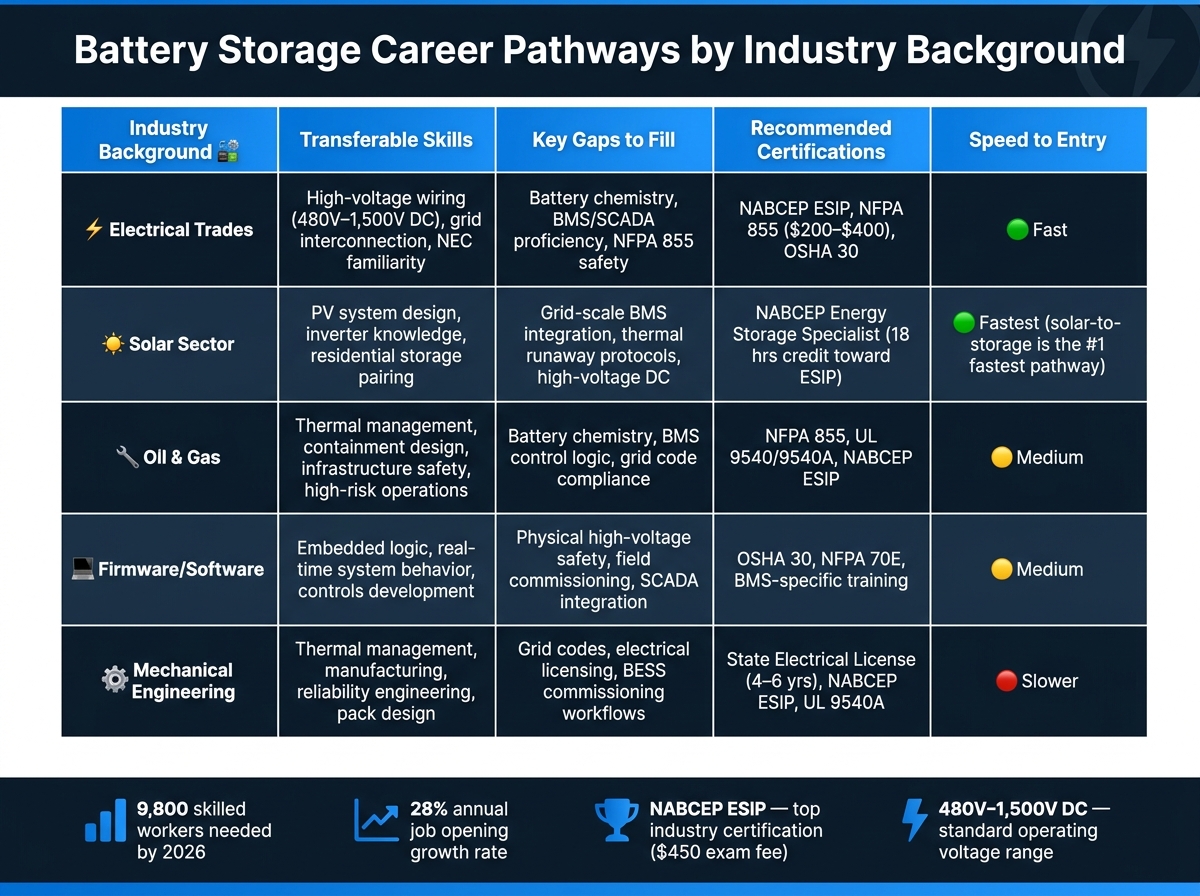
Battery Storage Career Pathways: Skills, Gaps & Certifications by Industry Background
If you’re coming from skilled trades or the energy sector, chances are you already have many of the skills needed for battery storage. This field draws heavily from electrical, construction, oil & gas, and solar industries. The key is identifying where your experience fits and addressing any gaps.
Pathways from Electrical and Construction Trades
Electricians are in a prime position to transition into battery storage. Skills like working with high-voltage systems (480V to 1,500V DC), grid interconnections, and modifying service panels directly align with utility-scale BESS (Battery Energy Storage Systems) installation and commissioning. Plus, familiarity with the National Electrical Code (NEC) is often a baseline requirement, giving licensed electricians a strong starting point.
For construction workers, experience in site infrastructure, conduit installation, or operating heavy equipment is highly relevant – especially for large-scale BESS projects where physical buildout is a major focus. To advance quickly, gaining NFPA 855 competency is key. This training, typically costing $200 to $400, is increasingly required by Authorities Having Jurisdiction (AHJs) for permits on commercial and utility-scale storage projects.
Moving from Oil & Gas or Solar Sectors
If you’re coming from oil & gas, your expertise in high-risk operations is a major asset. Skills like thermal management, containment design, and infrastructure safety protocols are directly applicable to large-scale BESS containment and fire prevention – areas where skilled workers are in demand.
"Technicians who understand NFPA 855 fire protection requirements, containment systems, and thermal runaway mitigation are in short supply and command a significant premium." – BuildStackHub
For solar installers, the transition is even more straightforward. Many residential storage systems are paired with solar PV, so your knowledge of inverters and system design applies directly. In fact, the solar-to-storage pathway is currently the fastest route into the battery field. Earning the NABCEP Energy Storage Specialist credential can help bridge the gap between solar-focused work and more technical storage roles.
Mapping Existing Skills to Battery Storage Requirements
The key to transitioning into battery storage is showing how your current skills align with the industry’s needs. Many career-changers have the expertise but struggle to connect it to battery-specific outcomes. Brent Conway of Protingent explains:
"Battery employers want to see how your work applies to energy storage outcomes: reducing thermal risk, improving test rigor, strengthening controls behavior, shortening debug cycles, improving reliability, or supporting scale-up."
Here’s a look at how various industry backgrounds align with battery storage needs:
| Industry Background | Transferable Skills | Application in Battery Storage |
|---|---|---|
| Electrical Trades | High-voltage wiring, grid interconnection | BESS installation and utility-scale commissioning |
| Solar Sector | PV system design, inverter knowledge | Residential and commercial storage pairing |
| Oil & Gas | Infrastructure safety, thermal management | Large-scale BESS containment and fire prevention |
| Firmware/Software | Embedded logic, real-time behavior | BMS (Battery Management System) development |
| Mechanical Engineering | Thermal management, manufacturing, reliability | Battery pack design and structural integrity |
When updating your resume, avoid vague phrases like "supported infrastructure projects." Instead, focus on battery-relevant outcomes. For example, say "managed thermal containment systems" or "worked with safety-critical electrical infrastructure." This approach makes it clear how your experience translates to energy storage.
Using Digital Platforms to Connect Workers with Battery Storage Jobs
Once training closes the skills gap, the next step is helping workers connect with employers quickly and efficiently.
The Workforce Deployment Problem in Energy Storage
After gaining the necessary skills for battery storage jobs, the real challenge lies in finding the right employers without delay. Many battery storage projects operate under tight schedules due to utility contracts and tax credit deadlines. When a project owner needs a commissioning crew, they need it immediately. Any staffing delays can lead to costly liquidated damages and lost revenue.
While training programs address skill and certification gaps, the next critical hurdle is ensuring fast, efficient worker deployment. The issue? Finding workers who combine general electrical or construction experience with specialized ESS credentials – like NFPA 70E, high-voltage DC expertise, or BESS commissioning certifications – within the same geographic area is no easy task. Traditional hiring processes often rely on manual checks and slow verification methods. As ABLEMKR points out:
"Traditional temp agencies often lack understanding of technical requirements like TWIC cards, ISNetworld pre-qualification, or industry-specific safety training."
This challenge is especially pronounced in utility-scale projects located in rural areas or along transmission corridors. Local labor pools are often too small, and flying in workers from distant locations can be both time-consuming and expensive.
How ABLEMKR Supports Energy Storage Workforces

ABLEMKR is a workforce deployment platform designed for industries with high demand and high risk, such as utilities and energy infrastructure. Its mobile-first approach connects pre-vetted workers to job sites based on certifications, safety training, availability, and location – a perfect fit for battery storage employers.
Workers create detailed profiles showcasing their trade expertise, experience, and certifications like OSHA 10/30, NFPA 70E, and other battery-specific qualifications. Employers, in turn, post project requirements, including certifications, locations, schedules, and start dates. The platform’s matching engine filters for workers who meet all criteria – ensuring they’re nearby, available, and fully certified before stepping onto a site.
Through the ABLEMKR app, workers can instantly update their safety credentials, complete e-learning modules, and sign site-specific acknowledgments. This ensures compliance before they arrive on-site, eliminating first-day administrative delays – a crucial advantage when pre-commissioning timelines are tight.
This streamlined process ensures that workforce mobilization happens quickly and without compliance issues.
Benefits for Workers and Employers
For workers looking to break into battery storage, visibility can be a major obstacle. Digital platforms like ABLEMKR not only help bridge the hiring gap but also make it easier to showcase new skills and certifications. For example, you might have completed training in BESS installation or earned a new safety certification, but without connections to ESS developers or EPCs, those qualifications might go unnoticed. ABLEMKR allows workers to highlight both their foundational trade experience and their newly acquired battery-specific training to employers actively hiring for energy projects across the country.
For employers, the platform offers real-time compliance tracking. Workers’ certifications and onboarding progress are continuously updated in their profiles. Rules like "current NFPA 70E training required" or "OSHA 30 completed within the last five years" can be enforced before deployment, reducing the risk of sending non-compliant workers to high-energy sites. Additionally, integrated payroll workflows and real-time crew status updates allow project managers, safety teams, and finance departments to stay aligned. For workers, this means on-time payments are guaranteed, eliminating the financial uncertainty often associated with project-based work during career transitions.
Conclusion: Building a Skilled Battery Storage Workforce
The growing demand for battery storage solutions is outpacing the supply of qualified workers. To bridge this gap, the industry needs a focused approach to training and hiring.
For workers, earning certifications and gaining hands-on experience are essential steps toward filling critical roles. Whether your background is in electrical contracting, construction, oil and gas, or solar, these skills offer a solid starting point. The challenge lies in identifying and addressing specific gaps, such as safety credentials, energy storage system (ESS) expertise, or commissioning experience. Regional apprenticeships, community college programs, and manufacturer-led training can help close these gaps effectively.
Employers also play a key role. Building partnerships for training, hiring workers during their career transitions, and using tools to verify credentials instantly can prevent costly project delays. Digital platforms like ABLEMKR are already making this process smoother. By connecting certified workers to projects quickly, with full compliance transparency, these platforms benefit both workers seeking well-paying jobs and project managers aiming to assemble qualified teams without administrative hurdles.
The energy transition depends on having skilled workers on-site with the right credentials. Achieving this requires a collaborative effort between workers, employers, and the systems that connect them. Deliberate action today will ensure the workforce is ready for tomorrow’s challenges.
FAQs
What skills should I learn first to break into battery storage?
To kick off a career in battery storage, begin by developing a strong base in electrical fundamentals and earning safety certifications. This means understanding electrical theory, reading wiring diagrams, and working with control circuits. It’s also a good idea to get an OSHA 10-hour or 30-hour construction safety card, as many job sites require it.
From there, focus on battery-specific skills. Learn about system architecture, high-voltage equipment, and battery management systems (BMS). Hands-on experience is key, so becoming proficient with tools like multimeters will make you stand out.
Do I need an electrical license to work on BESS projects?
Yes, an electrical license is usually necessary for Battery Energy Storage System (BESS) projects. For grid-tied and commercial installations, licensed electricians are required to ensure compliance with codes like NEC Article 706. Even residential projects often call for licensed professionals, especially for tasks like upgrading service panels or handling utility notifications. In certain regions, specific licenses – such as a C-10 license – are mandatory to legally perform installation and electrical work.
How can ABLEMKR help me find battery storage jobs faster?
ABLEMKR’s mobile-first platform makes it easier to find battery storage jobs by matching your profile with projects that fit your certifications, training, availability, and location. To increase your chances of being found by contractors, keep your profile up to date with your electrical and safety credentials.
The app sends real-time notifications about job opportunities that match your qualifications. This way, you can quickly access high-paying jobs and manage your schedule – all directly within the app.


