
The rapid growth of electric vehicles (EVs) in the U.S. – with sales quadrupling since 2021 – has created a critical need for skilled workers in battery recycling. By 2030, 1.2 million EV batteries will require recycling annually, rising to 14 million by 2040. This demand is driving job creation in a field focused on recovering valuable materials like lithium, cobalt, and nickel, reducing reliance on foreign resources. However, transitioning into these roles isn’t simple. Workers must acquire specialized skills in high-voltage safety, battery chemistry, and hazardous material handling, while facing challenges like safety risks and a lack of widespread training programs.
To address these gaps, federal initiatives like the Battery Workforce Initiative and partnerships with organizations such as ISRI are rolling out training and certification programs. These include hands-on technical courses, high-voltage safety certifications, and apprenticeships aligned with national standards. Platforms like ABLEMKR are helping connect certified workers with employers, streamlining the hiring process and ensuring safety compliance. As the industry grows, these efforts aim to equip workers with the expertise needed to meet the recycling demand while offering stable, well-paying career opportunities.
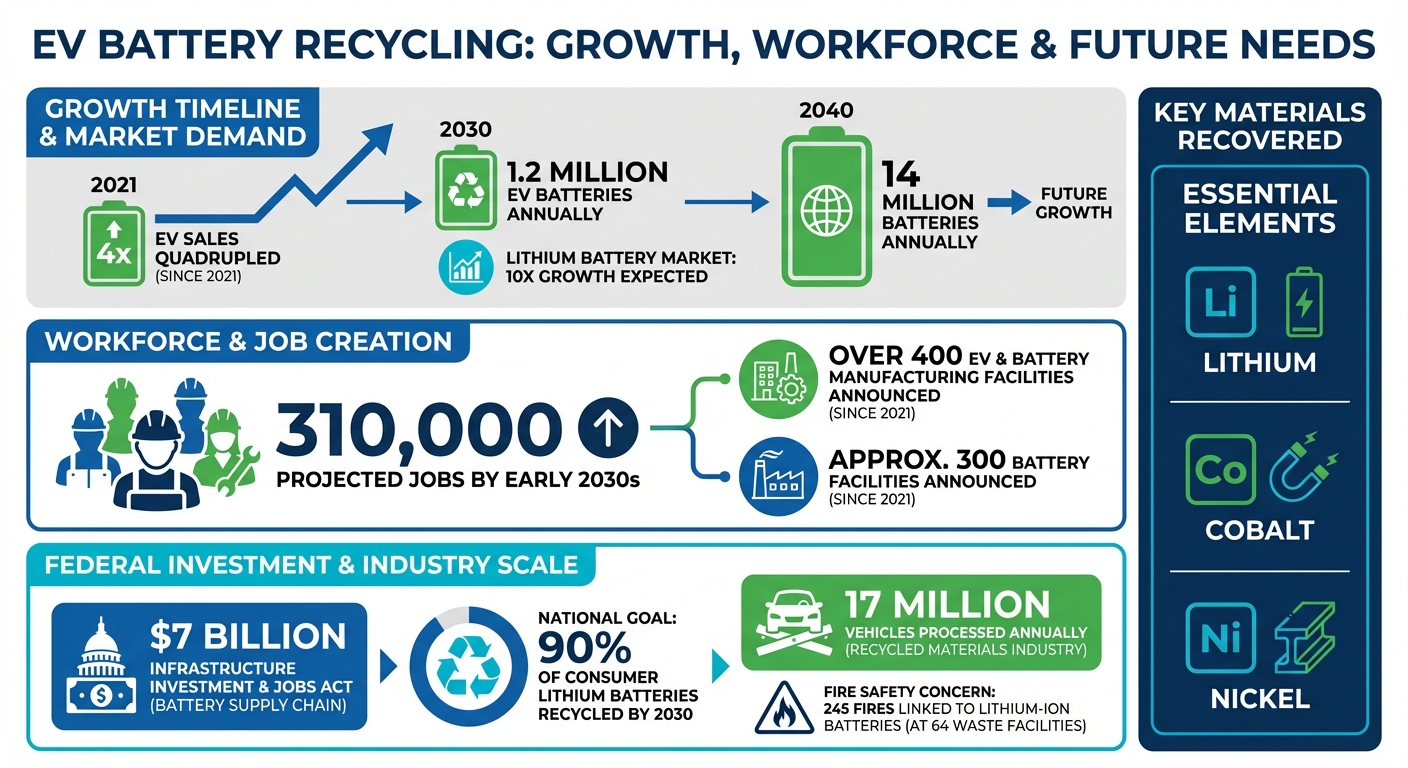
EV Battery Recycling Industry Growth and Workforce Statistics 2021-2040
Supercharged Jobs
Challenges Workers Face When Entering EV Battery Recycling
The rapid growth of the EV battery recycling industry brings with it a host of challenges for workers looking to enter the field. Despite the sector’s expansion, transitioning into these roles isn’t straightforward. The work requires specialized skills, involves significant safety risks, and suffers from a lack of accessible training programs. Even experienced workers from other industries face hurdles in adapting to the technical and operational demands of battery recycling. Let’s take a closer look at these challenges, starting with the steep learning curve in technical knowledge.
Technical Knowledge Gaps in Battery Handling
Recycling EV batteries requires a skill set that differs greatly from traditional automotive or energy-related work. Workers need to be familiar with high-voltage DC systems, understand the intricacies of various battery chemistries (like lithium, cobalt, and nickel), and navigate the complexities of disassembly – whether manual or automated. For many, especially those coming from fields like construction or oil and gas, these electrochemical hazards and advanced technologies, such as AI-driven sorting processes, are entirely new territory.
The market for lithium batteries is expected to grow tenfold by 2030. This explosive growth means that workers must quickly adapt to evolving technologies, including handling newer, low-cobalt battery formats that require different protocols. These technical demands only add to the safety risks workers must manage in this line of work.
Safety Hazards in Battery Recycling Work
The safety risks in battery recycling are significant and often life-threatening. One of the most serious dangers is thermal runaway events, which can lead to fires or explosions. Workers also face high-voltage electrocution risks when disassembling large-format batteries, along with potential exposure to toxic chemicals that can cause immediate harm or long-term health problems.
In March 2024, EXPOST Technology Inc., based in San Diego, CA, received $8 million in Department of Energy funding to develop a mobile system designed to mitigate these risks. Their system integrates zero-emission shredding and electrolyte extraction, aiming to neutralize electrochemical hazards before batteries are transported. This funding highlights the urgency of addressing the risks associated with current manual processes. Robin Wiener, President of ISRI, emphasized the importance of safety improvements:
"Developing this program was important not only for our employees, but also for first responders and the communities around us".
While physical dangers are a pressing concern, the lack of widespread training programs adds another layer of difficulty for workers entering the field.
Shortage of Accessible Training Programs
For workers eager to transition into EV battery recycling, the lack of training opportunities is a major roadblock. National Guideline Standards for battery-related apprenticeships were only introduced in March 2024, and it will take time for standardized training programs to fully roll out. Many federal resources and apprenticeship initiatives are still in the early stages.
Geographic limitations further complicate access to training. For example, ISRI partnered with the Energy Security Agency in 2024 to create a three-level safety training program, but the hands-on technical course is currently offered only in Piqua, Ohio. Workers who cannot travel to such locations are left with online training options, which lack the hands-on experience necessary for safe battery handling. Meanwhile, the recycled materials industry processes approximately 17 million vehicles annually, but the infrastructure to train workers specifically for EV battery recycling lags far behind the growing demand.
To build a skilled workforce capable of meeting the industry’s needs, targeted training and certification programs will be critical in overcoming these challenges.
Training Programs and Certifications for Battery Recycling Jobs
Workers looking to enter the field of EV battery recycling now have access to a variety of training programs and certifications aimed at equipping them with the necessary skills. The U.S. government has committed nearly $7 billion through the Infrastructure Investment and Jobs Act to bolster the domestic battery supply chain, including recycling efforts. These initiatives address the technical and safety challenges of the industry, offering clear pathways for workers to transition into this expanding sector.
Government and Industry Training Programs
One of the standout federal initiatives is the Battery Workforce Challenge (BWC), launched by the U.S. Department of Energy. This program establishes Regional Workforce Training hubs that focus on reskilling and upskilling workers for roles in battery manufacturing and recycling. These hubs are a collaborative effort involving manufacturers, vocational schools, and local labor departments, working together to bridge critical skill gaps. Since 2021, approximately 300 battery facilities have been announced across the U.S., creating a pressing need for skilled workers.
In March 2024, the Department of Energy (DOE) and Department of Labor introduced the Battery Workforce Initiative (BWI) in Lansing, Michigan. This program rolled out the first-ever DOL-certified National Guideline Standards for registered apprenticeships tailored to battery machine operators. U.S. Secretary of Energy Jennifer M. Granholm emphasized its significance, stating:
"The Battery Workforce Initiative is part of our whole-of-government approach to revitalize industry and rebuild our economy from the bottom up and the middle out, providing American workers with good paying forward looking careers".
Another critical program is the ISRI/ESA High Voltage Training, developed by the Institute of Scrap Recycling Industries (ISRI) and the Energy Security Agency. This program offers three levels of safety education: online safety training, in-person technical courses, and management-level onsite battery handling. The hands-on technical training, held in Piqua, Ohio, focuses on high-voltage battery handling. Dalen Zartman, CEO of the Energy Security Agency, explained:
"This training content features a partnership between the world’s foremost experts in this space. ISRI has helped facilitate the partnership to develop knowledge that has a direct impact on safe handling of EV batteries with deterring thermal events as the goal".
These programs, combined with clear certification paths, provide workers with essential skills for safe and efficient battery recycling.
Required Certifications for Battery Recycling Work
To handle the unique challenges of battery recycling, workers must obtain specific certifications. The ISRI High Voltage Electric Vehicle Technology Training certification begins with an online Level 1 safety course. This certification is a prerequisite for the Level 2 in-person training, which emphasizes hands-on battery handling techniques. For management-level professionals, Level 3 training focuses on overseeing onsite battery operations.
The National Guideline Standards for Registered Apprenticeships offer another critical certification pathway, providing nationally recognized credentials for battery machine operators. These standards ensure workers gain qualifications that are accepted by employers nationwide.
Additionally, workers must complete training in hazardous materials handling and adhere to the 2024 International Fire Code (Section 320) for lithium-ion storage. The Department of Transportation’s "Check the Box" initiative also provides essential guidance for the safe shipping of hazardous materials. This is especially important considering that a study of 64 waste facilities identified 245 fires linked to lithium-ion or lithium metal batteries.
Learning Through On-the-Job Training
While certifications are vital, practical, hands-on experience plays an equally important role in preparing workers for the demands of battery recycling. Registered apprenticeships aligned with the BWI National Guideline Standards allow workers to gain real-world experience while earning national credentials.
Regional Workforce Training hubs, launched in the summer of 2024, connect transitioning workers with localized training opportunities. These hubs form partnerships with companies, unions, and community colleges, offering access to advanced technologies like AI-powered sorting systems and robotic dismantling equipment.
In March 2024, the DOE awarded MOLG Inc. $5.1 million to deploy five robotic "microfactories" in Chantilly, Virginia. These facilities automate the dismantling of end-of-life laptop batteries at half the cost of traditional methods. They also serve as training grounds, allowing workers to gain hands-on experience with cutting-edge battery disassembly technology.
sbb-itb-aa28329
How ABLEMKR Connects Workers to EV Battery Recycling Jobs

As the demand for EV battery recycling ramps up across the U.S., connecting skilled workers with employers is becoming increasingly important. Handling high-voltage systems and hazardous materials requires specialized training, and that’s where ABLEMKR steps in. Their mobile-first platform bridges the gap between qualified laborers and recycling facilities, ensuring that workers meet the necessary technical and safety standards. By verifying certifications and safety training, ABLEMKR ensures that only the right personnel are deployed, making workforce placement more efficient.
Matching Workers to Jobs Based on Certifications
ABLEMKR’s platform takes a tailored approach to matching workers with jobs by verifying their certifications, safety training, and even location. For example, the platform confirms certifications like ISRI qualifications and tracks workers who have completed Level 1 online safety training or Level 2 hands-on technical handling. This ensures that workers are placed in roles that align with their expertise. Additionally, the platform identifies workers trained to handle high-voltage systems up to 900V and those equipped with specialized personal protective gear, such as high-voltage gloves.
Faster Hiring and Compliance Management for Employers
For employers, ABLEMKR simplifies the hiring process and ensures compliance with safety regulations. Tight deadlines often require assembling skilled teams quickly, and ABLEMKR delivers real-time insights into worker certifications and compliance status. Employers can confirm that workers meet DOL-certified National Guideline Standards for apprenticeships, ensuring that battery machine operators have undergone standardized training. The platform also includes compliance tracking to maintain safety standards and integrates payroll workflows to reduce administrative tasks. This allows employers to focus on their core operations without getting bogged down by logistics.
Providing Workers with Flexible, Well-Paid Opportunities
For workers, ABLEMKR opens doors to specialized roles in battery recycling, such as mechanical disassembly, chemical process operations, and materials science for quality assurance. Given the high-voltage nature of battery packs and the handling of hazardous materials, these roles come with competitive pay. Workers transitioning from traditional automotive manufacturing can find stability in the clean energy sector, contributing to broader industrial goals. Through the mobile app, workers can search for jobs based on their availability and location, enjoy flexible schedules, and rely on guaranteed on-time payments.
Measuring Success in EV Battery Recycling Career Transitions
As the EV battery recycling industry continues to grow, it’s crucial to evaluate how effectively workers transition into this field. Measuring success involves tracking job placement rates, wage growth, and job retention. In March 2024, the U.S. Department of Energy (DOE) and Department of Labor introduced the Battery Workforce Initiative’s National Guideline Standards for registered apprenticeships. These collaboratively developed standards provide a framework for assessing workers’ safety and technical expertise.
With these benchmarks, it’s now possible to gauge the success of career transitions using specific performance indicators.
Monitoring Job Placement After Training
One of the clearest ways to measure success is by tracking how many trained workers secure roles in battery recycling. The Battery Workforce Challenge Program uses a cloud-based Career-Connected Learning management system to monitor job opportunities across North America for various worker groups. Regional Workforce Training hubs collaborate with local labor departments, training institutions, and battery manufacturers to ensure workers transition into high-demand roles. Since 2021, over 400 EV and battery manufacturing facilities have been announced in the U.S., making placement rates a key indicator of whether training programs are meeting industry needs. Beyond initial job placement, long-term factors like wage growth and job retention provide a deeper measure of success.
Assessing Pay Increases and Job Retention
Career advancement can also be evaluated through wage growth and sustained employment. The Battery Workforce Initiative tracks how vocational and transitional workers move into higher-paying, stable roles within the battery supply chain. Bob Galyen, Chief Technology Officer at NAATBatt, highlighted the importance of training, stating:
"training is the key to a successful battery industry".
In addition to job placement, it’s essential to monitor whether workers stay in their roles for at least 12 to 24 months while achieving wage increases. Workers who develop specialized skills – such as operating advanced machinery with 95% accuracy in sorting batteries by chemistry or using systems that cut disassembly costs by 50% – often earn higher wages due to their expertise.
Using Data to Improve Training Programs
Employment outcomes also play a key role in refining training programs. For example, in July 2024, the DOE awarded the New York City Department of Sanitation $2,150,000 for a project involving 200 mobile collection events aimed at recovering significant quantities of batteries. This data-driven approach demonstrates how metrics can guide program design. Similarly, MOLG Inc. received $5,157,122 in DOE funding to deploy five robotic "microfactories" for dismantling laptop batteries. Their goals include cutting disassembly costs by 50% and improving speed by 50% using new "Design for Disassembly" software. Evaluating outcomes in these high-tech roles helps identify gaps in training for AI and automation, allowing programs to adapt and better prepare workers for advanced technologies and rigorous safety standards.
Conclusion
The EV battery recycling industry stands at a crossroads, presenting both challenges and opportunities. With projections estimating the creation of 310,000 jobs by the early 2030s, this sector demands a workforce skilled in high-voltage systems and intricate chemical processes – skills that are essential for tackling the technical and safety risks involved, such as thermal events and exposure to toxic materials.
To address these hurdles, standardized training and apprenticeship programs are laying the groundwork for a competent workforce. For example, the Battery Workforce Initiative’s National Guideline Standards, introduced in March 2024, provide a structured pathway for workers to earn credentials in areas like battery machine operation and recycling processes. These efforts not only prepare individuals for immediate roles but also set the stage for sustained career growth in this rapidly evolving field.
Platforms like ABLEMKR are playing a pivotal role in accelerating workforce readiness. By matching pre-vetted workers with battery recycling employers based on certifications, safety training, and location, these platforms help connect skilled professionals to high-demand roles. Workers with expertise in hazardous material handling or automated disassembly are quickly placed in well-paying jobs, while employers benefit from streamlined compliance and efficient crew mobilization. This approach not only fills critical positions but also strengthens the nation’s push toward energy independence.
Beyond job placement, workforce development in battery recycling serves a larger purpose – securing America’s energy future. By training workers to recover key minerals like lithium, cobalt, and nickel domestically, the U.S. reduces its reliance on foreign supply chains. This effort aligns with the national goal of recycling 90% of consumer lithium batteries by 2030, creating a win-win for environmental goals and economic growth.
Collaboration among government bodies, educational institutions, and industry leaders is essential to keep training programs relevant and accessible. With over 400 EV and battery manufacturing facilities announced since 2021, the demand for skilled recycling workers is only set to grow. Investing in workforce development today ensures a robust and sustainable energy future for the nation.
FAQs
What skills do workers need for EV battery recycling jobs?
EV battery recycling involves navigating a complex blend of technical know-how, safety protocols, and regulatory requirements. Workers need to be proficient in handling high-voltage EV systems, safely deactivating battery packs, and adhering to fire-suppression and hazardous material handling guidelines. Using personal protective equipment correctly is a non-negotiable part of the job.
Beyond safety, the role demands expertise in material identification and disassembly. This includes separating lithium-ion components and recovering valuable metals with precision to avoid damage. A strong understanding of compliance standards – like OSHA and EPA regulations – is equally important, along with maintaining meticulous documentation to ensure traceability throughout the process.
Given these challenges, structured training and certifications are becoming essential for workers in this field. Platforms such as ABLEMKR are stepping in to connect certified, pre-vetted professionals with EV battery recycling projects. These platforms not only prioritize safety and efficiency but also help workers enhance their skills and stay aligned with industry standards.
What federal programs support training for EV battery recycling jobs?
Federal programs are stepping up to build a skilled workforce in EV battery recycling, focusing on training and certifications to meet the industry’s growing needs. The Department of Energy (DOE) and Department of Labor (DOL) have launched the Battery Workforce Initiative, which introduces apprenticeship guidelines and certifications tailored to roles such as battery-machine operators and recyclers. These efforts are being rolled out through partnerships with community colleges, unions, and industry leaders, offering workers a clear path to enter the field.
On top of that, legislation like the Bipartisan Infrastructure Law (BIL) and the Infrastructure Investment and Jobs Act (IIJA) is funneling billions into battery manufacturing and recycling projects. A portion of this funding is specifically set aside for training programs, safety courses, and apprenticeship stipends. Another significant contribution comes from the Battery and Critical Mineral Recycling Program, which allocates $125 million to support research and workforce training. These initiatives ensure workers gain the necessary skills and safety credentials to thrive in this rapidly expanding sector. Together, they’re creating a strong foundation for careers in EV battery recycling.
What safety risks should workers be aware of in EV battery recycling?
Recycling EV batteries presents a set of safety challenges that demand meticulous care. One of the primary concerns is the risk of electrical shock. High-voltage battery packs, which often retain charges between 300–800 volts even after a vehicle is retired, can be dangerous if not properly de-energized and isolated. Following strict procedures is essential to avoid serious accidents.
Another critical risk is thermal runaway. This occurs when damaged or mishandled battery cells overheat, potentially leading to fires or explosions. The situation becomes even more hazardous due to the flammable chemicals in the electrolyte, which can release toxic gases when ignited, increasing the danger of inhalation-related injuries.
Additionally, workers must contend with mechanical and ergonomic hazards. The substantial size and weight of battery modules can cause injuries such as cuts, crushing, or muscle strain if not handled correctly. To mitigate these risks, comprehensive safety training, proper protective gear, and strict adherence to handling protocols are absolutely necessary.


