
The energy sector is changing fast, and leaders must keep up. With 14 million new energy jobs expected by 2030 and growing demand for skills in areas like Battery Energy Storage Systems (BESS) and smart grids, many leaders face a critical skills gap. Almost half of executives report challenges in reskilling employees for digital and data-driven roles.
Key takeaways:
- Leadership Skills Needed: Strong project management, technical knowledge, and communication are vital for managing complex energy projects.
- Certifications: Credentials like PMP, CEM, and OSHA safety certifications validate expertise and improve project outcomes.
- Training ROI: Leadership training boosts efficiency, reduces costs, and increases productivity, offering up to $4.15 ROI for every $1 spent.
- Tools for Workforce Management: Platforms like ABLEMKR streamline worker deployment, compliance tracking, and project monitoring for better results.
Energy leaders who invest in continuous learning and workforce tools will be better prepared to handle the challenges of the energy transition.
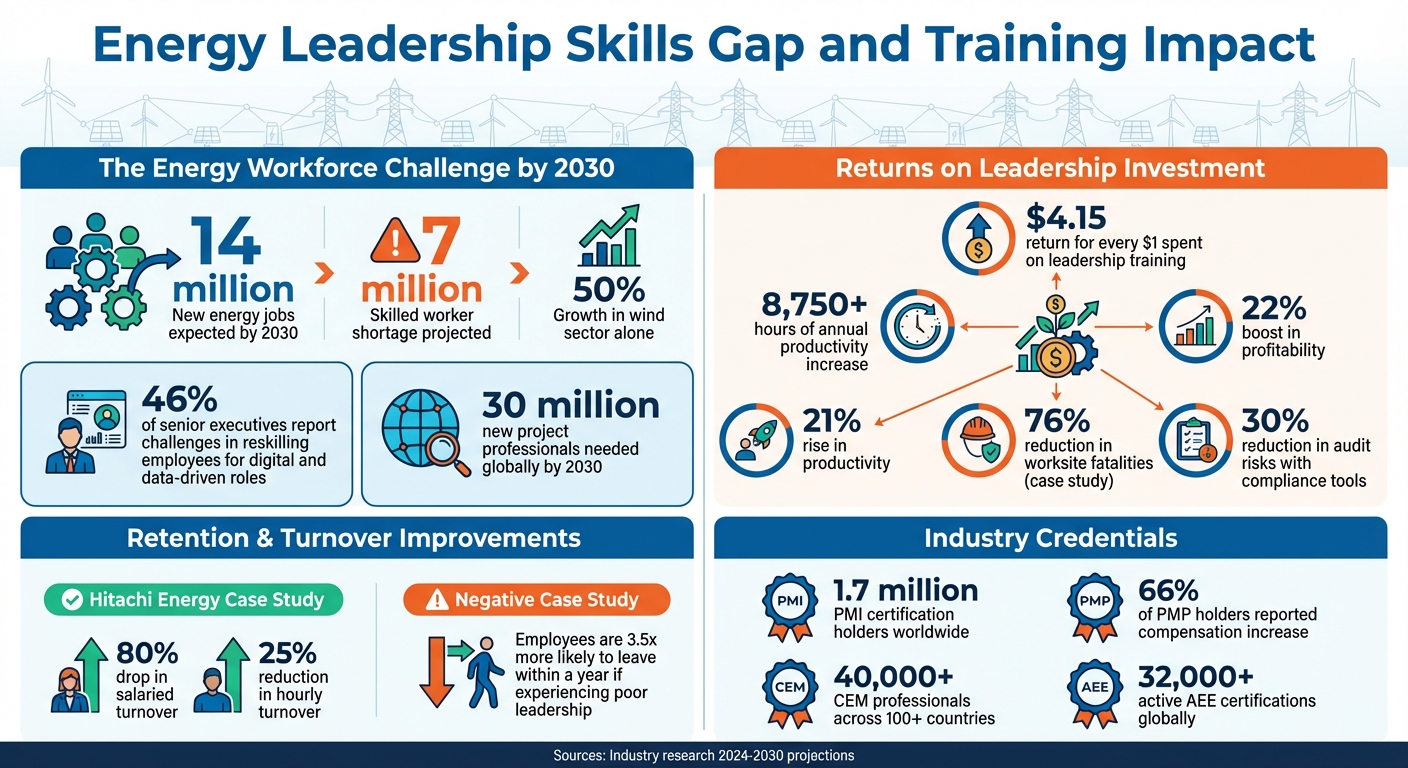
Energy Sector Skills Gap and Leadership Training ROI Statistics
Core Leadership Skills for Energy Projects
Project Management and Planning
Energy infrastructure projects require a mix of meticulous planning, careful budgeting, and thorough risk assessment. Leaders in this field must juggle immediate project execution with a broader, long-term strategic perspective, all while managing cross-functional teams effectively. These skills become even more critical when dealing with complex projects that combine multiple technologies, each with its own timeline and resource demands.
A strong grasp of systems thinking is also essential. Understanding how various project components influence one another allows leaders to make smarter decisions. Structured decision-making, paired with input from diverse team members, ensures well-rounded strategies.
This level of planning naturally ties into the technical expertise needed to guide energy projects successfully.
Technical Knowledge and Industry Experience
Even as soft skills gain prominence, technical expertise remains a cornerstone of leadership in the energy sector. The industry is shifting from relying solely on traditional experience-based models to more flexible, skills-based approaches that accommodate emerging technologies. This shift means leaders must not only understand older systems but also stay informed about advancements like smart grids, data analytics, and Battery Energy Storage Systems (BESS).
Dr. Yanos Michopoulos from the Energy Institute highlights the importance of technical credibility in building trust:
Communication is not what we say, but what others hear.
By speaking their teams’ technical language, leaders can bridge the gap between engineering challenges and actionable solutions. While they don’t need to be experts in every field, maintaining a mindset of continuous learning is crucial.
This technical foundation directly supports better communication and more effective team leadership.
Communication and Team Leadership
Strong communication skills are essential for driving successful projects and enhancing organizational performance. Miscommunication in the workplace is costly, with companies losing millions annually as a result. In energy projects, where teams often span multiple disciplines and work remotely, leaders must excel in both verbal and digital communication.
For senior leaders, emotional intelligence often outweighs technical know-how. This involves recognizing team members’ emotions, fostering strong relationships, and creating an environment where individuals feel safe to voice concerns. Russell Dubner, Chief Communications Officer at BCG, underlines the importance of a structured approach:
a systematized way of thinking that gives leaders a framework of how to excel in a high-intensity environment.
This framework involves managing energy across four dimensions – physical, emotional, mental, and spiritual.
Leaders also need to tailor their communication to suit different audiences. For example, executives require concise updates focused on budgets and compliance, while facility managers need detailed operational insights. The goal is to ensure all updates are both clear and actionable.
sbb-itb-aa28329
Training Energy Leaders: Inside the CES Graduate Fellowship
Industry Certifications for Energy Leaders
Certifications play a key role in establishing expertise and credibility, especially in the energy sector, where leaders must deliver efficient, cost-effective projects. These credentials confirm a professional’s ability to achieve tangible results, such as cutting costs and reducing emissions. With a projected need for 30 million new project professionals globally by 2030, the demand for certified energy leaders is growing rapidly. These certifications not only validate leadership skills but also ensure effective management of energy projects in a modern context.
Project Management Professional (PMP)
The PMP certification is often regarded as the gold standard in project management. It demonstrates a leader’s ability to oversee people, processes, and priorities throughout a project’s lifecycle. With over 1.7 million PMI certification holders worldwide, this credential is essential for handling complex energy infrastructure projects. In fact, 66% of PMP holders reported an increase in total compensation, including salary and bonuses, within the past year.
To pursue this certification, candidates generally need 3–5 years of professional experience. For those specializing in large-scale infrastructure, PMI offers tailored credentials like the PMI Construction Professional (PMI-CP). For energy leaders looking to deepen their expertise in energy-specific project management, the Certified Energy Manager (CEM) certification is another strong option.
Certified Energy Manager (CEM)
The CEM certification equips professionals with the tools to meet sustainability goals while maintaining cost efficiency. According to the AEE Center:
"The CEM is the industry’s most respected certification, empowering professionals like you to cost-effectively progress on sustainability goals, and help organizations become more cost competitive".
Since its introduction in 1981, more than 40,000 professionals across 100+ countries have earned the CEM credential. This certification covers 14 key areas, including HVAC optimization, lighting systems, energy storage, and decarbonization strategies. It also trains leaders to conduct energy audits and apply Measurement & Verification (M&V) techniques to identify cost-saving opportunities and reduce expenses.
The practical impact of the CEM is evident. For example, the U.S. Navy requires its Energy Managers to hold a CEM certification, allowing new managers up to one year to earn it. Similarly, Virginia Executive Order 48 mandates that energy managers in state agencies with energy costs exceeding $1 million must be CEM-certified. Additionally, the City of Philadelphia requires large non-residential buildings to employ a "qualified tune-up specialist", defined as a certified energy manager or professional engineer, to enhance building efficiency.
Training costs are $2,100.00 for AEE members and $2,345.00 for non-members, with participants earning 3.3 Continuing Education Units (CEU) upon completion. Applications should be submitted 3–4 weeks before training begins.
OSHA Safety Certifications
Safety is a top priority in the energy sector, and OSHA certifications ensure compliance with strict safety standards. These credentials are essential for leaders in high-risk environments, where adhering to safety protocols is critical for protecting workers on infrastructure projects. OSHA certifications are often required for roles in facility management and energy auditing.
The Association of Energy Engineers (AEE) reflects the industry’s focus on safety, with over 32,000 active certifications globally. For professionals who lack the necessary experience for full certification, an "In-Training" designation allows them to begin building their credentials while gaining practical experience. Most AEE certifications also require completion of an approved training program to establish a solid knowledge base. To maintain these certifications, professionals must earn approved professional development credits.
Online Courses for Energy Project Management
Online courses provide a flexible way to gain the skills needed for managing complex energy projects. These programs cover essential areas such as project planning, budgeting, safety compliance, and team coordination. With the energy sector undergoing constant change, professionals need training that not only fits into their busy schedules but also equips them with practical skills they can apply immediately. These courses, building on certifications and leadership training, focus on offering actionable strategies to tackle modern energy project challenges.
In addition to traditional certifications and leadership programs, online courses play a critical role in developing well-rounded expertise for energy infrastructure projects.
Construction and Energy Project Management Courses
The Association of Energy Engineers (AEE) offers an online program specifically designed for energy professionals: "Project Management for Energy Engineers and Energy Managers." This two-day intensive course is tailored for those overseeing large-scale infrastructure projects with budgets exceeding $0.5 million. Led by Bobby Rauf, PE, CEM – a seasoned expert with over 30 years of industry experience – the course guides participants through the entire project lifecycle, from initial planning to commissioning and closure.
According to AEE Education, participants gain insights that are:
"seldom covered in textbooks and are often only acquired through experience."
The curriculum includes project mapping, contract essentials, safety considerations, and hands-on training with widely used project management software. Upon completion, participants earn 0.8 Continuing Education Units (CEU). The next session is set for May 18–19, 2026, with early bird pricing available until May 11, 2026. Costs are as follows:
- Members: $775.00 (early) / $875.00 (regular)
- Non-members: $825.00 (early) / $925.00 (regular)
The course is accessible on smartphones, tablets, and computers with a high-speed internet connection.
Technology and Data Analytics Courses
In today’s energy sector, data analytics and technology play a central role in decision-making. Several top universities offer highly rated online courses, including:
- University at Buffalo: Energy Production, Distribution & Safety specialization
- University of Colorado Boulder: Renewable Energy Specialization
- Duke University: Electric Industry Operations and Markets
These courses consistently receive ratings above 4.7, reflecting their quality and relevance. They integrate OSHA standards into broader safety protocols while addressing environmental regulations and workforce strategies for energy projects.
Additionally, the Project Management Institute (PMI) offers training that focuses on managing AI-driven projects. Their courses explore the use of Disciplined Agile tools to adapt workflows for the fast-changing energy landscape. This training helps leaders incorporate artificial intelligence and data analytics into their project management practices, addressing the growing intersection of AI, climate, and energy.
Many of these platforms offer flexible options, including 7-day free trials, financial aid, or subscription-based access, making them accessible to a wide range of learners.
Using ABLEMKR for Workforce Management
After completing advanced leadership training and certifications, the next step for energy leaders is finding practical tools to manage their workforce effectively. This is where ABLEMKR steps in. Designed as a mobile-first platform, ABLEMKR connects skilled workers to critical energy projects, bridging the gap between leadership skills and hands-on execution. It’s built to meet the demands of modern energy operations.
Fast Workforce Deployment with ABLEMKR
With features like geo-location matching and pre-vetted worker profiles, ABLEMKR can deploy the right personnel in just a few hours. For instance, a utility company in Texas successfully mobilized certified crews to repair a wind farm within 24 hours, avoiding delays that traditional hiring methods might have caused. The platform’s vetting process includes customized interviews to ensure workers meet specific project requirements before arriving on-site.
Energy leaders operating across U.S. energy corridors – from the Permian Basin to Midwest utility projects – can quickly mobilize teams for urgent needs like pipeline repairs or unexpected shutdowns. ABLEMKR’s flexible options, including trial, flex, and direct placement models, allow managers to scale their workforce efficiently without getting bogged down by administrative hurdles.
Tracking Compliance and Safety Standards
ABLEMKR simplifies compliance management by automating the tracking of certifications such as OSHA safety training and other industry-specific qualifications. Its dashboards let energy leaders monitor worker certifications in real time, flagging any upcoming expirations. For example, during a pipeline project in the Permian Basin, an operator used ABLEMKR to maintain 100% compliance by integrating it with payroll and compliance systems. This proactive approach not only ensured adherence to federal standards but also helped the company avoid over $100,000 in potential fines.
The platform eliminates the need for manual spreadsheets, easing the administrative workload for HR teams and project managers. In fact, analytics from ABLEMKR show that companies using its compliance tools can reduce audit risks by 30%. This streamlined approach directly supports project efficiency by keeping teams focused on execution rather than paperwork.
Real-Time Workforce Tracking
The ABLEMKR mobile app provides live updates on worker location, status, and task progress through geo-fenced attendance and detailed dashboards. During a major infrastructure project in the Midwest, project leaders used these tools to monitor crew utilization, improving on-site productivity by 25%. The app tracks key metrics like attendance rates, task completion, and compliance scores, all accessible from any device.
This real-time data helps managers spot potential delays before they become major issues. For instance, one utilities project reduced overtime costs by 15% by identifying inefficiencies in shift scheduling. The app also allows leaders to communicate directly with workers, view profiles and ratings, and make on-the-fly adjustments to deployments as conditions change. One extractives company expanding into energy transition projects used ABLEMKR’s real-time tracking tools to complete projects 20% faster, thanks to full visibility over their vetted and trackable workforce. These tools not only enhance productivity but also contribute to significant cost savings for energy projects.
Measuring Returns on Leadership Training
Better Project Efficiency and Lower Costs
To gauge the effectiveness of leadership training, start by comparing performance metrics from before and after the training. Collect baseline data like project completion rates, cycle times, and error rates, then measure these same metrics post-training. For example, a global building materials company reported a 76% reduction in worksite fatalities after introducing leadership development programs centered on safety culture.
Energy companies can also track savings through metrics like reduced rework, fewer compliance violations, and quicker project delivery times. When leaders improve their communication and decision-making skills, projects tend to experience fewer delays and stay closer to budget. Additionally, you can calculate the financial impact of retaining employees by multiplying the number of employees retained (post-training versus pre-training) by 50% of their average annual salary. These cost savings directly contribute to better workforce productivity.
Higher Workforce Productivity
Well-trained leaders significantly influence team performance. Research shows employees are 3.5 times more likely to leave within a year if they experience poor leadership interpersonal skills. For instance, Hitachi Energy saw an 80% drop in salaried turnover and a 25% reduction in hourly turnover after implementing targeted leadership training.
You can track productivity improvements using indicators like revenue per employee, individual output, or the balance between strategic and administrative tasks. Leadership training has been shown to generate productivity increases of over 8,750 hours annually. In energy infrastructure projects, this translates to faster mobilization, better resource allocation, and improved on-site efficiency. Companies that monitor leadership performance through key metrics have reported a 22% boost in profitability and a 21% rise in productivity. These improvements set the stage for sustained growth.
Long-Term Business Growth
The long-term benefits of leadership training become evident as organizations build a pipeline of capable managers ready to handle complex projects. For every dollar invested in leadership training, businesses can see a return of up to $4.15. This ROI includes both direct outcomes – like reduced turnover and increased productivity – and indirect benefits, such as enhanced safety records, stronger compliance, and a better reputation.
To evaluate the long-term impact, conduct reviews at 6, 12, and 24 months after the training ends. Focus on metrics like internal promotion rates, leadership bench strength, and the organization’s ability to manage larger or more complex projects. Use the following formula to calculate ROI: [(Total Benefits – Training Costs) / Training Costs] × 100. Energy companies that align their training programs with specific business objectives – such as financial margin growth, regulatory compliance, or ESG goals – often achieve the most impressive ROI.
Conclusion
By 2030, the world will face a shortage of 7 million skilled workers, even as 14 million new energy jobs are expected to emerge. The wind sector alone is projected to grow by 50%. This stark gap highlights the urgent need to equip energy leaders with the skills required to navigate this shift.
Leadership training plays a key role in boosting efficiency, reducing costs, and improving safety. The move toward skills-based workforce models allows companies to assess development needs more effectively. It also enables them to calculate mobility scores, creating a shared framework for talent management across the organization. As Suzanne Courtney, Associate Partner of Talent Solutions at Aon, explains:
Potential is a key aspect of skills-based workforces – not the potential to lead, but more the potential to learn, unlearn, adapt, and keep up with constantly changing learning and business landscape.
A strong foundation in digital fluency is critical to achieving these goals. With renewable energy capacity expected to grow by 2,400 gigawatts between 2022 and 2027, leaders must embrace digital, data-driven operations. However, 46% of senior executives admit they face difficulties in retraining their workforce for this transformation. Simon Virley, Vice Chair and U.K. Head of Energy and Natural Resources at KPMG, underscores this point:
Technology has a massive part to play in the energy transition, so it’s got to be part of the reskilling as well.
Overcoming these challenges requires more than just training programs. Strategic talent management is essential. This includes mapping current skills, employing "buy, build, or borrow" strategies for workforce development, and standardizing training credentials across the industry. Companies that foster workforce agility – through mentorship, knowledge-sharing platforms, and digital tools – will be better prepared to tackle infrastructure demands and cultivate leaders capable of driving the energy transition forward.
FAQs
Which leadership skills matter most for energy infrastructure projects?
Effective leadership in energy infrastructure projects demands a combination of technical know-how and people-focused skills. Leaders need emotional intelligence to handle emotions effectively and encourage collaboration within teams. Strong interpersonal skills are crucial for clear and productive communication with a wide range of stakeholders. Making unbiased decisions is also key to ensuring fairness and balanced outcomes. On top of that, modern communication abilities and strategic thinking are vital for navigating shifts in the industry and staying aligned with changing regulations and market dynamics.
How do I choose between PMP, CEM, and OSHA certifications?
When deciding on certifications for energy and infrastructure projects, it’s crucial to align your choice with your career objectives:
- PMP (Project Management Professional): Ideal for those aiming to excel in project leadership and management, particularly in construction and energy infrastructure sectors.
- CEM (Certified Energy Manager): Best suited for professionals focusing on energy efficiency and sustainability.
- OSHA certifications (like the OSHA 30-Hour): Essential for safety training and ensuring compliance on job sites.
Each certification serves a unique purpose, so consider your specific goals and the skills you want to develop when making your choice.
How can I measure the ROI of leadership training on real projects?
To measure the ROI of leadership training, tie the outcomes of the training directly to critical business metrics. Look at areas like revenue growth, better project performance, or improved operational efficiency to showcase measurable results.
For example, if the training is aimed at enhancing decision-making skills, track how those improved decisions impact project timelines or cost savings. If the goal is to boost team productivity, monitor metrics like output per employee or reduced downtime.
The key is to ensure that your evaluation aligns closely with your specific project objectives. This way, you’ll gain insights that are not only clear but also actionable, helping you demonstrate the real value of the training.


