
If I had to sum it up in one line: union apprenticeships usually offer more structure, steadier pay steps, and stronger benefits, while non-union apprenticeships often offer faster entry and more employer-to-employer flexibility.
If you’re choosing between the two, I’d focus on six things right away:
- Who runs the program
- How hard it is to get in
- Training hours and jobsite records
- Pay progression
- Benefits
- How easy it is to move between jobs
Here’s the short version:
- Union programs are often run by joint union-employer committees and usually follow a set path over 3 to 5 years
- Non-union programs are often run by one employer or contractor group, so rules can differ a lot
- Registered apprenticeships usually require 144 classroom hours and about 2,000 on-the-job hours per year
- Union pay often starts around 40% to 55% of journeyman pay and moves up on a fixed schedule
- Union workers often get richer health and pension plans, sometimes adding $20 to $30+ per hour on top of base pay
- Non-union entry can be faster, sometimes within days or weeks
- Union-backed programs posted 56% completion rates in one comparison, versus 46% for employer-only programs
- From 2019 to 2022, union-based programs trained 70% of construction apprentices
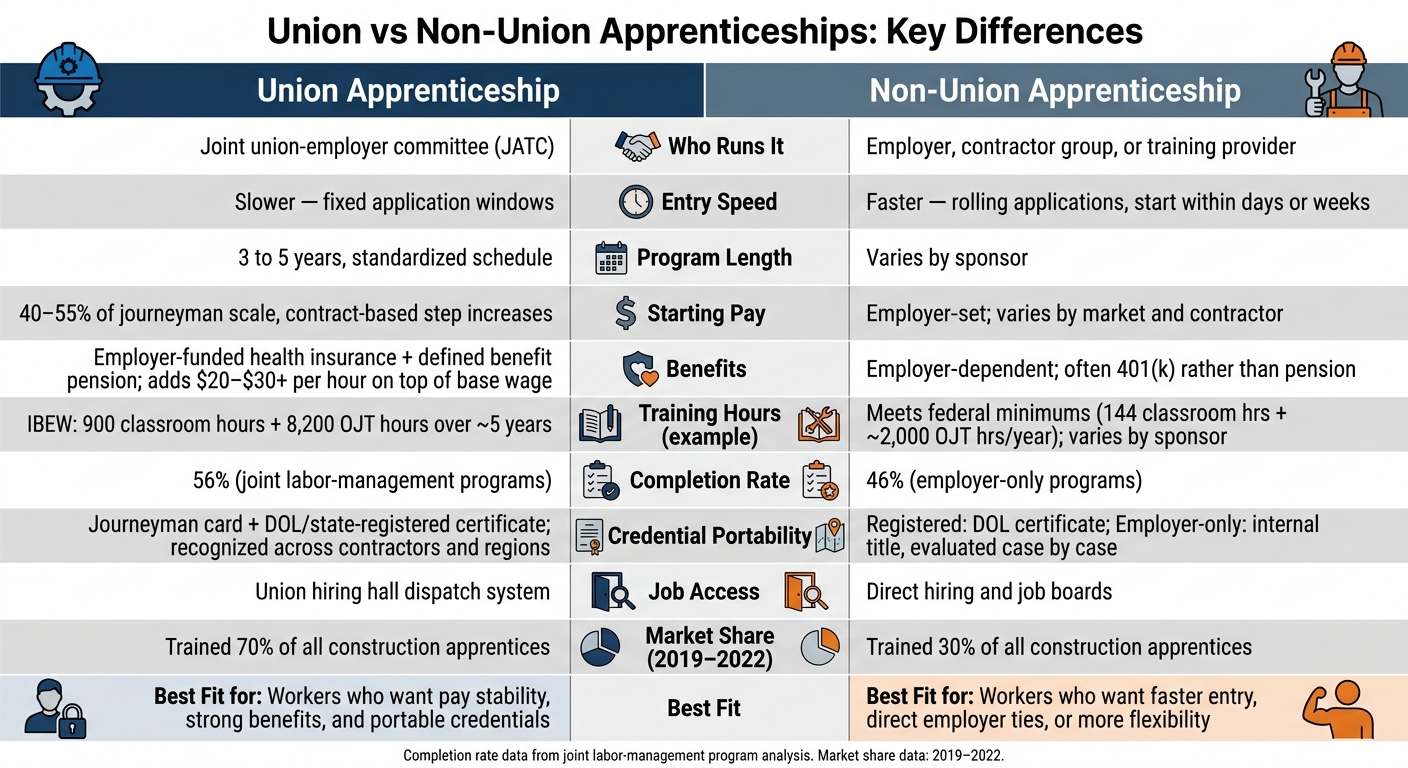
Union vs Non-Union Apprenticeships: Side-by-Side Comparison
Quick Comparison
| Factor | Union Apprenticeship | Non-Union Apprenticeship |
|---|---|---|
| Program control | Joint union-employer committee | Employer, contractor group, or training provider |
| Entry speed | Often slower, set application periods | Often faster, rolling hiring |
| Training format | More standardized | Varies by sponsor |
| Pay steps | Set by contract | Set by employer |
| Benefits | Health coverage + pension are more common | Depends on employer |
| Credential carry-over | Often stronger across contractors | Depends on registration and employer records |
| Job access | Referral hall dispatch | Direct hire, job boards |
| Best fit | Workers who want pay and benefit stability | Workers who want faster entry or direct employer ties |
To me, the main takeaway is simple: neither path is automatically better. Union is often the better fit if you want a clear pay ladder, stronger benefits, and credentials that travel well. Non-union can make more sense if you want to start sooner, work directly for one company, or take a less formal path into the trade.
That’s the lens I’d use for the rest of the article.
sbb-itb-aa28329
How Union and Non-Union Apprenticeship Programs Are Organized
Union Program Structure and Entry Rules
Union apprenticeship programs in construction and energy trades usually run through Joint Apprenticeship and Training Committees (JATCs). These committees include equal representation from the union and signatory employers. They approve the curriculum, oversee instructors, review apprentice performance, and coordinate job placements. In the U.S., major trade unions sponsor these programs.
Funding usually comes from jointly managed training trust funds. Those funds are paid for through employer contributions set in collective bargaining agreements. Apprentices are then dispatched through the union hall to signatory employers based on project needs and program rules.
Getting in is formal and often competitive. Most union programs require applicants to be at least 18 years old and to have a high school diploma or GED. Many also want high school algebra or a placement test that covers math and reading. The selection process often includes:
- An aptitude or trade-specific exam
- A structured interview
- A fixed application window
Once accepted, apprentices move forward on a set multi-year schedule, usually 3 to 5 years.
After acceptance, the next big split is how programs divide classroom instruction and jobsite training.
Non-Union Program Structure and Entry Rules
Non-union programs work differently. They are usually employer-directed, which means contractors, trade associations, and training providers can run them. Oversight stays with the sponsor instead of a joint labor-management committee, so hiring, advancement, and job assignments are handled internally.
Entry is often faster. Many non-union sponsors use the same basic requirements: age 18, high school diploma or GED, drug test, and physical ability to do the work. But they may skip algebra or a standardized aptitude exam unless the trade calls for it. In many cases, people can apply year-round and start within days or weeks after being hired.
The trade-off is less consistency from one program to another. One sponsor might run a fully registered, multi-year apprenticeship. Another might offer only sponsor-tracked on-the-job training.
| Feature | Union (JATC-Managed) | Non-Union (Employer/Association-Led) |
|---|---|---|
| Who runs it | Joint labor-management committee | Employer, contractor group, or training provider |
| Funding source | Training trust funds (employer contributions) | Employer budgets, tuition, or public grants |
| Application process | Fixed windows, aptitude tests, committee interviews | Rolling applications, employer interviews |
| Advancement criteria | Standardized hours + classroom benchmarks | Varies by sponsor; may be evaluation-based |
| Registration status | Registered with state or federal agency | Varies – registered or sponsor-tracked only |
Next: how classroom instruction, jobsite learning, and completion requirements differ.
Training Hours, Jobsite Learning, and Credentials
Classroom Instruction and Safety Training
Training hours and credential rules show how much structure each path has.
Registered apprenticeships usually require at least 144 classroom hours and about 2,000 OJT hours per year. Union programs often go past those minimums. For instance, an IBEW inside wireman apprenticeship includes 900 classroom hours and 8,200 OJT hours over about five years.
Non-union registered apprenticeships have to meet those same federal minimums. But employer-only programs can look very different on the ground. Some follow a similar setup. Others lean more on short, employer-specific instruction and jobsite learning.
Safety training often follows that same split. Union programs usually build in OSHA 10 or OSHA 30, along with trade-specific modules such as fall protection, lockout/tagout, confined space entry, and arc flash. They also tend to connect that training to the exact tasks and equipment workers use on the job. Non-union programs vary more. Some offer similar safety instruction, while others handle most of it during onboarding and don’t revisit it much after that. In some jurisdictions, including New York City, Nevada, Massachusetts, Philadelphia, and Connecticut, OSHA 10 or OSHA 30 is required by law for certain jobsites.
On-the-Job Training and Completion Credentials
Hour tracking is where the split becomes easiest to see. Union apprentices log hours by task category, and supervisors verify each entry before the apprentice can move ahead in the program. Non-union tracking ranges from detailed logs in registered programs to informal supervisor reviews in employer-only programs. That kind of flexibility can work well when a company takes training seriously. But when a worker moves to a new contractor, it can also leave room for doubt about what that worker has actually done.
Classroom hours matter, but OJT records often decide advancement.
This is where credential portability starts to matter in a practical way. Finishing a union apprenticeship usually leads to a journeyman card plus a DOL or state-registered certificate of completion. Those credentials are widely recognized across contractors and regions within that trade. Non-union workers in registered programs can earn that same federal certificate. Workers trained only through company-defined programs, though, may leave with internal titles or employer-issued certificates that don’t carry the same outside recognition.
That difference matters most when workers move between contractors and project sites. For workers changing projects, portable credentials can speed up hiring. ABLEMKR supports that portability by matching pre-vetted workers with documented certifications and safety training to mission-critical projects, while giving employers real-time visibility into worker status.
| Credential Type | Union Apprenticeship | Non-Union Registered | Employer-Only Program |
|---|---|---|---|
| Completion credential | Journeyman card + DOL/state-registered certificate | DOL/state-registered certificate | Internal title or employer certificate |
| OJT records | Standardized hour-and-task logs, JATC-reviewed | Varies by sponsor | Often informal or supervisor-based |
| Safety credentials | OSHA 10/30 + trade-specific modules | Varies; may include OSHA credentials and similar modules | Onboarding-focused; less systematic |
| Portability | Recognized across contractors and regions within the trade | Recognized where registered | Evaluated case by case by new employers |
Pay, Benefits, and Job Access
Wages, Raises, and Training Costs
After training is in place, pay is usually where the difference becomes easiest to see. This is where the split between union and non-union paths shows up most clearly.
Union apprentices usually start at a set share of the local journeyman wage under the collective bargaining agreement. In many programs, that starting point is about 40–55% of journeyman scale, with pay increases every 1,000–2,000 hours. Most apprentices hit full journeyman rate in four to five years. Because those increases are written into the contract, the schedule is clear from the start. You know when the next bump is coming and how much it will be.
Non-union pay works differently. It depends on the employer. Some large open-shop contractors run structured apprenticeship programs with set pay steps, but those rules come from company policy, not an industry-wide system. Starting wages can still be strong, and some employers use sign-on bonuses or merit-based raises to bring in and keep good workers. On Davis-Bacon jobs, both union and non-union contractors usually have to meet the posted wage and fringe package for each classification, which can shrink the pay gap on those jobs.
Training costs can also look very different. Union apprentices often pay little or no tuition. Non-union costs depend on the sponsor. Some employers cover the full cost, while others may have apprentices pay up front for certifications or safety training, or repay those costs through payroll deduction.
Benefits, Hiring Channels, and Work Stability
Hourly pay is only one part of the picture. Benefits can change the math in a big way.
Union benefit packages often include employer-funded health insurance and defined benefit pension plans. In many locals, employer payments into health and pension funds add $20–$30+ per hour on top of base wage. Federal labor data reviews keep pointing in the same direction: union construction workers tend to earn about 20–30% more in total compensation than non-union workers once health and pension benefits are counted. Those benefit packages can also help crews stick together over longer jobs, which matters when contractors want less turnover in the middle of a project.
Non-union employers build their own benefit plans. Bigger contractors may offer health insurance and a 401(k) with a company match. Smaller firms may offer less beyond the legal minimum. And when retirement plans are offered, they are more often defined contribution plans instead of guaranteed pensions.
Job access follows two different models. Union workers usually go through a hiring hall, which is a referral system. Contractors ask for workers by classification, and the hall sends out qualified workers who are available. When one project wraps up, union apprentices usually go back to the out-of-work list and wait for the next dispatch.
Non-union apprentices usually get work through direct hiring or job boards. That can give workers more freedom to choose where they apply, but it also means they carry more of the job-search burden when work slows down. For shutdowns and repairs, ABLEMKR can match pre-vetted workers to open roles by certification, safety training, availability, and location.
| Union Apprenticeship | Non-Union Apprenticeship | |
|---|---|---|
| Starting pay | About 40–55% of journeyman scale | Employer-set; varies by market and contractor |
| Raise schedule | Automatic, contract-based step increases | Employer policy; may be merit-based or ad hoc |
| Health & retirement | Negotiated health coverage + defined benefit pension | Employer-dependent; often 401(k) rather than pension |
| Training costs | Typically little or no tuition | Varies; worker may pay for some courses or credentials |
| Job placement | Hiring hall dispatch system | Direct hiring and job boards |
Which Path Fits Your Goals and What Employers Should Know
Best Fit for Workers
After looking at structure, training, pay, and dispatch, the next step is simple: which path lines up with what you want from the job? For most workers, that comes down to pay stability, benefits, how fast they can get in, and how far the path can take them over time.
If you want predictable pay progression, health coverage, and pension contributions, a union apprenticeship is usually the steadier option. In construction, joint labor-management programs started at about $19/hour and exited at roughly $38/hour, with completion rates of 56% versus 46% in employer-only programs. That matters. It gives workers a clearer pay ladder and credentials that can travel more easily when they switch contractors or move to a new region.
If you care more about flexibility, direct relationships with one employer, and faster entry into certain roles, a non-union path may make more sense. Pay can vary more, and there may be more room to work out hours or project selection directly with the company. Someone who performs well can also move up fast inside that business. The flip side is pretty clear: raises, benefits, and job stability are often less predictable.
For employers, those same differences shape hiring speed, compliance needs, and how steady a crew feels from one project to the next.
Best Fit for Employers and Final Takeaways
For employers, the right choice depends on the kind of job in front of you. Some projects are all about speed. Others are all about paperwork, labor rules, and making sure the crew is ready on day one.
Large infrastructure, public works, and federally funded jobs often require verified apprenticeship status and certified payroll compliance. On those sites, union pipelines can supply workers who are easier to clear for access and payroll. On fast-moving or remote energy work – pipeline repairs, mine development, or utility shutdowns – the focus often shifts to speed and compliance documentation. ABLEMKR matches pre-vetted workers to open roles by certification, safety training, availability, and location, with compliance tracking built in.
Taken together, the pattern is pretty straightforward: match the apprenticeship model to the work. Neither route wins in every case. Union programs tend to produce steadier wage outcomes and stronger completion results. Non-union programs can work well when employers put real structure behind training and advancement. Union-based programs trained 70% of all construction apprentices from 2019 to 2022, and one analysis projected a shortage of roughly 450,000 skilled construction workers by 2027. That’s a big gap, and it means the industry needs both paths working well.
| Decision Factor | Lean Union | Lean Non-Union |
|---|---|---|
| Wage predictability | Contract-based step increases | Employer-set, may be merit-based |
| Benefits depth | Defined pension and health coverage | Benefits vary by employer |
| Credential portability | Recognized across union locals and often across states | Employer-dependent recognition |
| Project type fit | Public works, prevailing wage, large industrial | Private commercial, niche energy, smaller jobs |
| Hiring speed | Hall dispatch; strong in high-union regions | Direct hire; faster in lightly unionized markets |
| Training consistency | Standardized by joint apprenticeship committees | Varies by employer; strong at large firms |
FAQs
Which apprenticeship path is better for beginners?
If you’re just getting started, the right path comes down to your experience and the support you have around you.
For many people, pre-apprenticeship programs are the best place to begin. They help you build core skills, learn safety basics, and get ready before stepping into a formal trade program.
Once you’re ready for deeper, hands-on training, Registered Apprenticeships offer a clear earn-while-you-learn route. You get structured training, work toward nationally recognized credentials, and build a path toward long-term career growth.
Can I switch from non-union to union later?
Yes. You can move from non-union to union work later, but you may need to meet different certification and registration requirements.
Union job sites often ask for things like:
- proof of apprenticeship status
- journeyman cards
- registration with state agencies
- current, documented safety and trade-specific certifications
ABLEMKR can help by tracking compliance and verifying credentials for different project requirements.
How do I know if a program is registered?
Check whether the apprenticeship is overseen by the U.S. Department of Labor or a recognized State Apprenticeship Agency. These agencies keep records of registered, compliant programs.
Employers and project managers should also document an apprentice’s registration status for labor regulation and prevailing wage compliance. ABLEMKR helps manage compliance documentation, including apprenticeship records and worker certifications.


