
Union status does not decide worker status. In the U.S., the main question is simple: does the person work like an employee, or like a separate business?
If I had to boil this down fast, here’s the answer:
- Union workers are usually W-2 employees
- Independent contractors are usually paid on Form 1099-NEC
- A label alone does not decide the case
- Control, supervision, tools, schedule, and pay matter most
- State ABC tests can make contractor status much harder to defend
- Misclassification can mean unpaid overtime, tax issues, and workers’ comp gaps
On many job sites, the warning signs are easy to spot. If a foreman sets the hours, assigns daily tasks, enforces safety meetings, and the worker uses company equipment, that setup often points to employee status. By contrast, a contractor usually runs a separate business, invoices for work, brings more of their own equipment, and controls how the job gets done.
Under the Fair Labor Standards Act, most employees must get time-and-a-half after 40 hours in a workweek. That’s one reason classification disputes can get expensive fast.
Quick Comparison
| Point | Union Labor | Independent Contractor |
|---|---|---|
| Tax form | W-2 | 1099-NEC |
| Who controls the work | Employer | Worker’s business |
| Pay setup | Hourly or CBA wage scale | Bid, unit rate, milestone, or lump sum |
| Tools/equipment | Mostly employer-provided | Mostly business-owned or rented |
| Overtime | Often yes | Not required by wage law |
| Business risk | Low | Higher profit-or-loss risk |
If you’re hiring, managing, or doing site work, I’d look first at control, crew direction, and pay structure. Those three points usually tell you more than the contract title does.
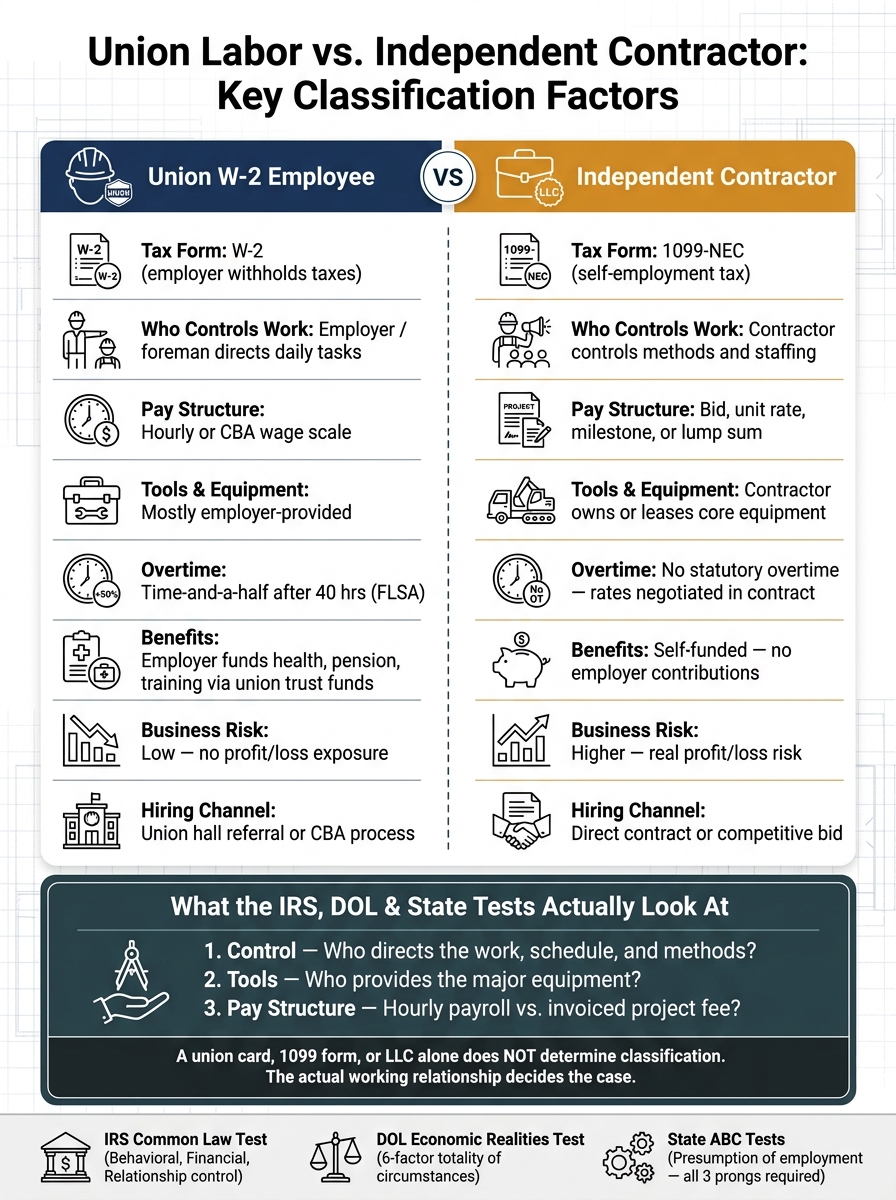
Union Labor vs Independent Contractor: Key Classification Factors
How to Properly Classify Employees and Independent Contractors
sbb-itb-aa28329
Union Labor vs. Independent Contractor Status: A Direct Comparison
Once you have the basic framework, the next issue is pretty simple: who controls the work, and who takes the business risk?
How Union Employment Is Typically Structured
In a standard U.S. construction or energy union setup, the worker is a W-2 employee. The collective bargaining agreement sets pay by trade classification, such as laborer, journeyman electrician, pipefitter, welder, ironworker, or foreman. It also often sets pay by experience level, like apprentice versus journeyman.
Base pay is only part of the picture. The employer also makes required contributions to union trust funds for health insurance, pension, annuity, and training for each hour worked. The CBA usually spells out shift schedules, start times, break rules, and overtime premiums too. Union foremen are also W-2 employees. They run crews, assign tasks, and enforce safety rules under the employer’s authority.
How a Legitimate Contractor Arrangement Is Typically Structured
A real independent contractor runs a separate business. That usually means an LLC, S-corp, or sole proprietorship with its own EIN, licenses, and insurance. Instead of going on payroll, the contractor works under a direct contract with a general contractor, subcontractor, or asset operator and gets paid by invoice.
Payment is usually tied to milestones, unit pricing, or a lump-sum bid for a defined scope of work. No taxes are withheld. The contractor is usually paid on Form 1099-NEC and handles estimated taxes and self-employment taxes on their own.
The key is actual independence. A contractor supplies major tools and equipment, can work for more than one client, decides how to staff the job, and chooses how to sequence the work. They also take on real profit-or-loss risk based on how well they perform the job. If they run a crew, that crew answers to them, not to the hiring company’s foreman.
Where the Two Models Overlap in Practice
This is where people get tripped up. On the job site, both setups can look almost the same. A union welder and a contractor welder might do the same work on the same pipeline project, wear the same PPE, follow the same safety rules, and work the same shifts.
But the legal difference sits under the surface. It comes down to how the relationship is set up and who controls the details.
| Factor | Union W-2 Employee | Independent Contractor |
|---|---|---|
| Hiring channel | Union hall referral or CBA process | Direct contract or competitive bid |
| Tax forms | W-2; employer withholds taxes | 1099-NEC; self-employment tax |
| Benefits | Employer-funded health, pension, and training contributions through union trust funds | Self-funded; no employer contributions |
| Overtime eligibility | FLSA time-and-a-half after 40 hours in a workweek; the CBA may add daily OT or other premiums | No statutory overtime; rates negotiated in the contract |
| Tools and equipment | Employer provides major equipment; worker brings personal trade tools | Contractor owns or leases significant equipment and factors it into pricing |
| Control over work | Employer directs daily tasks, schedule, and methods | Contractor controls methods and staffing and is evaluated on results |
Union membership, 1099 paperwork, and LLC status do not decide classification by themselves. What matters next is the actual working relationship: does it look like employment, or does it look like an independent business? That’s what the IRS, DOL, and state tests look at next.
Key Legal Tests Used in the United States
Three U.S. tests shape worker classification. Each one looks, in its own way, at who controls the work and how the work is carried out.
| Test | Primary Focus | Why It Matters in Construction and Energy |
|---|---|---|
| IRS Common Law Test | Right to control behavior, finances, and the business relationship | Employer control over schedule, supervision, and tools often points to employee status. |
| DOL Economic Realities Test (FLSA) | Economic dependence vs. true business independence | Workers integrated into core field operations with little investment or profit control are more likely to be employees |
| State ABC Tests | Presumption of employment unless all three prongs are met | Performing core construction or energy work under company direction makes contractor status much harder to defend |
On construction and energy sites, these tests usually come up in three practical areas: site control, crew direction, and pay structure.
IRS Common Law Test and Right-to-Control Factors

The IRS test is often the clearest place to start on a job site. It sorts the analysis into three buckets: work control, financial control, and business relationship.
Work control looks at who decides how the job gets done. That includes task order, required training, shift schedules, and safety rules. Financial control looks at who provides tools and equipment, whether the worker can make a profit or take a loss on the job, and whether that worker markets services to other clients. Business relationship looks at written contracts, benefits such as health insurance and pension contributions, and whether the work sits at the center of the company’s regular operations.
On a union crew during a refinery turnaround or a commercial build, most of these factors usually point to employee status. The foreman assigns the day’s work. The company sets the shifts. The employer supplies the heavy equipment. That’s a strong sign of employment. Contractor status is much harder to support unless the worker’s business controls the methods, staffing, and schedule.
DOL Economic Realities Test Under the FLSA
The DOL’s economic realities test uses a six-factor, totality-of-the-circumstances approach. Put simply, it asks whether the worker is economically dependent on the hiring company or actually operating an independent business.
The six factors are:
- opportunity for profit or loss
- investment
- degree of permanence
- nature and degree of control
- whether the work is part of the company’s core work
- whether specialized skills are used with real business initiative
In construction and oil-and-gas field work, the core-work factor often carries a lot of weight. A laborer working on a pipeline repair site for weeks or months, under the company’s safety system and chain of command, is doing the company’s core work. Still, no single factor decides the case on its own. The DOL looks at all six together.
State ABC Tests and Construction-Specific Presumptions
State ABC tests are stricter and often decide the issue fast. They start with a presumption of employment, and the hiring company has to prove all three prongs before treating someone as an independent contractor.
- Prong A: The worker must be free from control in practice, not just in the contract.
- Prong B: The work must fall outside the company’s usual business.
- Prong C: The worker must run an existing independent business.
States like Massachusetts, New Jersey, California, and New York use ABC-style tests with extra force in construction. When a worker is doing the company’s core trade, Prong B is often the hardest one to satisfy.
Where Classification Problems Show Up on Real Job Sites
On construction and energy job sites, misclassification tends to show up in a few plain, practical places: who controls the site, who directs the crew, and how the worker gets paid. You can usually spot the issue by looking at three day-to-day decisions: access, supervision, and pay. When site rules, crew control, and payment method clash with claimed contractor status, that’s where problems start.
Site Control: Access, Safety Rules, and Daily Work Methods
A company-issued badge, a fixed start time, and mandatory toolbox talks run by the site superintendent all start to point toward employee status, even on a short-term industrial project.
Short-term work doesn’t change the test. Control does. If the company sets the hours, tells people how the work must be done, provides the heavy equipment, and disciplines workers for missing safety meetings, those facts add up fast.
A true contractor setup looks different. Access is set by contract, not by punching a clock. The worker, or the worker’s business, controls the tools and work methods. The job is defined by the result, not by day-to-day instruction.
Crew Direction: Foremen, Superintendents, and Work Assignments
When a superintendent or foreman gives out the day’s assignments – rebar, lift, or framing work – and also handles on-site discipline like write-ups, suspension, or removal for safety violations, the setup starts to look like employment.
A real independent contractor works differently on the same site. They show up with their own crew, handle their own staffing, and deal with site management mostly on coordination. Their scope is tied to an outcome – deliver X linear feet of installed pipe by a set date – not to daily direction from the foreman.
Pay Structure: Union Scales, Hourly Payroll, Day Rates, and Lump-Sum Bids
A flat day rate, by itself, does not turn someone into an independent contractor. If that worker is still under company control, follows company schedules, and does the company’s core work, they likely count as an employee and may be owed overtime under the FLSA no matter how the pay is framed.
The table below lines up common field situations with the signals they tend to send:
| Field Scenario | Likely Employee Indicator | Likely Contractor Indicator |
|---|---|---|
| Reporting time | Fixed hours; absences require approval | Worker chooses hours within an agreed access window; deliverables drive the schedule |
| Site access | Company badge; site sign-in | Access set by contract; vendor presence tracked, not clocked |
| Safety meetings | Mandatory toolbox talks; discipline for skipping them | Follows site rules; runs an internal safety process for the crew |
| Tools and equipment | Company-owned tools and equipment; little capital at risk | Worker’s business owns or rents core equipment; bears maintenance and cost risk |
| Daily work direction | Foreman assigns tasks and methods each shift | Worker receives a defined scope; controls methods and sequencing independently |
| Pay structure | Hourly pay, overtime, W-2 | Per-project or per-unit fee; invoiced under a business name; profit/loss risk |
| Business presence | No separate registration, licensing, or advertising; single client | Registered business with licenses, insurance, and multiple clients |
In the field, these cases usually come back to a few facts: who controls the work, who brings the tools, who runs the crew, and whether the worker serves other clients. Those details often decide whether someone looks like an employee or a real contractor.
Conclusion: How to Cut Misclassification Risk in Construction and Energy
Union status and contractor status deal with two different issues. One is about collective bargaining. The other is about legal classification. And when companies get this wrong, the label on the paperwork won’t save them. What matters is the actual working relationship.
On the ground, that usually comes down to three things: control, direction, and pay. The biggest warning signs tend to be site control, crew direction, and pay practices that look like employee treatment. When those facts pile up, misclassification can lead to expensive back-wage liability.
That’s why paperwork alone isn’t enough. The contract matters, sure. But documentation and payroll systems matter just as much. Workforce platforms like ABLEMKR can help support compliant deployment by recording W-2 or 1099 status, certifications, supervision, payroll, and compliance records before mobilization.
Key Takeaways for Employers and Project Managers
Use the same classification tests before mobilizing crews every time. A union card, a subcontractor agreement, or a 1099 form does not settle the issue. Classification needs to match the facts: who controls the work, how the crew is supervised, how pay is set up, and which state’s rules apply.
Many states use ABC tests that assume employee status unless the company can clearly prove otherwise. So a classification that works in one state may fail in another. That’s where companies get tripped up.
A simple pre-mobilization process can help:
- Build a checklist before workers arrive on site
- Train supervisors on what can create an employee relationship
- Use workforce systems that keep classification records current across job sites
Key Takeaways for Workers
Watch how you’re treated on site, not just what the contract says. If you’re paid on a 1099, but a company foreman gives you daily assignments, sets your schedule, and has you use company tools, that gap deserves a closer look.
Misclassification can cost workers overtime pay, access to benefits, and workers’ compensation coverage. If you’re in a union, your steward or business agent is a direct resource. Keep copies of pay stubs, contracts, and schedules. If a dispute comes up, those records can make a big difference.
FAQs
Can a union worker ever be a 1099 contractor?
Yes – possibly. Union status by itself does not decide whether someone can be a 1099 contractor.
What matters is the actual working relationship: how much control the company has, how much financial independence the worker has, and the full nature of the relationship. If the company controls how, when, and where the work gets done, that worker is probably an employee, no matter their union status.
What matters most in a misclassification case?
What matters most is the actual working relationship – not job titles, labels, or even a signed independent contractor agreement.
Courts and regulators look at control and economic reality. In plain English, they want to see how the work relationship functions day to day.
That includes things like:
- who directs the work
- who provides the tools and equipment
- who takes on financial risk
- whether the work is a core part of the business
- whether the paperwork shows true independence
A contract can help. But it won’t outweigh the facts if the relationship looks like employment in practice.
Does an LLC automatically make me a contractor?
No. Forming an LLC or getting an EIN does not automatically make you an independent contractor.
Federal and state agencies look at the actual working relationship. They look at things like the hiring company’s control over your work, your financial independence, and whether your work sits at the core of that company’s business. In plain English, the paperwork matters less than how the job works day to day.
So even if you have an LLC, an EIN, or a contract that calls you an independent contractor, that alone doesn’t settle it.


