
If you want the short answer: underwater wet welding is harder to control, more crack-prone, and tougher to inspect than surface welding. Surface welding avoids depth pressure and murky water, but it still faces rain, wind, dirt, fumes, and runoff.
Here’s the core takeaway in plain English:
- Underwater wet welding deals with high pressure, low visibility, water movement, and very fast cooling
- That fast cooling can leave the heat-affected zone with hard, brittle microstructures
- Wet welding also brings more hydrogen into the weld, which increases crack risk
- Dry habitat welding cuts many of those problems and can get closer to surface weld quality
- Surface welding is easier to see and control, but weather and surface contamination still hurt weld quality
- Pollution risk changes by setting: air and stormwater on land, water and sediment underwater
- Corrosion is a problem in both cases, but the drivers differ
A few numbers make the gap clear:
- Underwater wet welding cooling time often falls between 1 and 6 seconds
- Diffusible hydrogen with ferritic electrodes can hit 30–100 ml/100 g underwater, versus a 15 ml/100 g limit for dry welding
- Reported hardness reached 195.37 Hv10 in marine welds, compared with 153.60 Hv10 on land
- Localized HAZ corrosion reached about 250 µm after 18 months in Baltic Sea exposure
- In marine atmospheric testing, localized corrosion reached about 390 µm after 720 hours
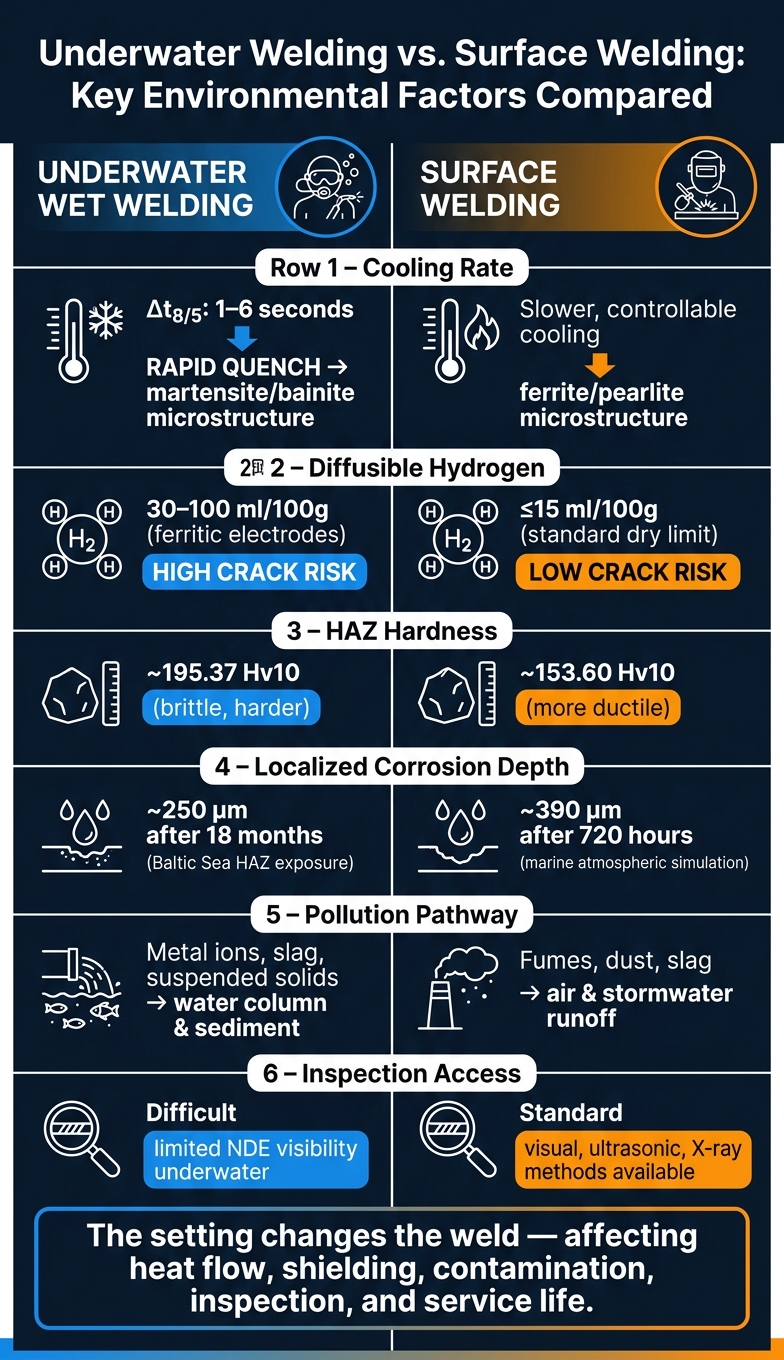
Underwater Welding vs. Surface Welding: Key Environmental Factors Compared
Underwater Welding VS Welding On Land | WHICH IS BEST
sbb-itb-aa28329
Quick Comparison
| Factor | Underwater Wet Welding | Surface Welding |
|---|---|---|
| Work setting | In water at depth | In air |
| Arc control | Lower due to pressure, currents, bubbles | Higher in stable conditions |
| Visibility | Often poor | Usually clear |
| Cooling | Very fast | Slower, easier to control |
| Crack risk | High from hydrogen and hard HAZ | Lower if dry and preheated as needed |
| Main contamination path | Water column and sediment | Air, dust, runoff |
| Inspection | More limited | More standard access |
| Corrosion exposure | Seawater/freshwater attack, HAZ issues | Humidity, salt air, industrial exposure |
So when I look at underwater welding vs. surface welding, the main difference is simple: the setting changes the weld. It changes heat flow, shielding, contamination, inspection, and how long the joint may last.
Underwater Welding: Environmental Factors Below the Surface
As welding engineer Uwe W. Aschemeier puts it:
"Wet welding is completed in an environment that is hostile to both the weld and the welding process."
That line gets right to the point. Underwater welding has to deal with four main problems: pressure, water movement, low visibility, and very fast cooling.
Pressure, Water Movement, and Low Visibility
As depth goes up, hydrostatic pressure gets higher. That pressure shrinks droplets and makes the arc less stable. It also changes gas solubility, which increases the risk of porosity and can shift weld chemistry.
Without any barrier between the arc and the water, the process is much less stable than welding in air.
Currents and swells make electrode control more difficult too. Higher flow velocities can narrow the weld bead and increase the chance of defects such as pores and cracking. On top of that, turbidity and rising bubbles block the welder’s view, so watching the arc and checking the weld in the moment becomes far less reliable.
Those conditions don’t just affect the weld. They also affect the water around it.
Pollution Risks in Marine and Freshwater Settings
In wet welding, the arc breaks apart the surrounding water into hydrogen and oxygen. Slag, metal particles, and iron oxides can move into the water column or settle into nearby sediment right away.
Big repair jobs can add another layer of disturbance. During the Stena Line pier renovation in Kiel, divers removed 3,200 cubic feet of mud, silt, and scrap. They also pressure-washed 32,000 square feet of steel at 4,650 psi. That kind of prep work stirs up sediment, releases oxidation byproducts into the water, and shortens the time available for the repair itself.
Material Degradation Underwater
One of the biggest structural issues is how fast the weld cools underwater. The critical cooling time (Δt8/5) in underwater wet welding usually falls between 1 and 6 seconds. That’s only a small slice of the cooling time seen in air. The result is a rapid quench that promotes martensite and bainite in the heat-affected zone (HAZ), leaving behind hard and brittle microstructures.
You can see that difference in hardness data. In marine-environment welds, hardness can reach 195.37 Hv10, compared with 153.60 Hv10 for land-based welds.
Hydrogen makes the situation worse. When the arc dissociates water, hydrogen floods the weld zone. Ferritic electrodes can produce diffusible hydrogen levels of 30–100 ml/100 g, which is far above the 15 ml/100 g limit used for dry welding. Austenitic stainless or nickel-based electrodes lower hydrogen to 5–25 ml/100 g, but that fix comes with a tradeoff: those electrodes can trigger galvanic corrosion with structural steel unless epoxy coatings or ICCP are in place.
Field data shows how serious that can get. In the Baltic Sea, localized HAZ corrosion reached about 250 µm after 18 months of exposure. To reduce these risks, teams use dry habitat welding, tighter AWS D3.6M inspection rules, and steel with CE ≤ 0.40%.
Surface welding has its own set of jobsite pressures, but it doesn’t have to fight these underwater conditions.
Surface Welding: Environmental Factors in Air and Field Conditions
Surface welding gets rid of hydrostatic pressure and poor visibility, which is a big relief compared with underwater work. But that doesn’t mean the job gets easy. The risk simply moves. Instead of pressure and murky water, you’re dealing with weather, dirt on the workpiece, and site runoff. Those factors can affect arc stability, cooling rate, weld soundness, and how well the joint holds up against corrosion over time.
Weather, Contaminants, and Arc Stability
Wind and rain are two of the biggest problems on outdoor jobs. AWS D1.1 prohibits welding or thermal cutting on wet surfaces or in the rain. That rule isn’t just about convenience. Moisture speeds up cooling, and that can increase the risk of discontinuities and hydrogen cracking. Before welding starts, remove mill scale, oil, rust, and coating residue so the arc stays steady and the weld metal isn’t fighting hidden contamination.
Air Emissions, Dust, and Runoff
Outdoor welding also leaves a mark beyond the joint itself. Surface welding produces fumes and dust, and on exposed sites, grinding debris and wash water can move contaminants into soil and storm drains. In the field, that can turn a small cleanup issue into a much bigger site-control problem.
Material Degradation in Topside Conditions
Topside exposure can be rough on welded steel, especially in humid, salty, or industrial air. Chlorides and moisture can break down oxide layers and lead to galvanic corrosion and pitting at the weld interface. In simulated marine atmospheric tests, localized corrosion depth reached about 390 µm after 720 hours. That helps explain why exposed steel often still depends on barrier coatings and Impressed Current Cathodic Protection (ICCP) where appropriate.
Underwater Welding vs. Surface Welding: Side-by-Side Comparison
Underwater and surface welding part ways in three big areas: control, contamination, and how the weld holds up over time.
Operating Conditions and Weld Control
Underwater wet welding is tougher to control. Pressure, movement, and fast cooling in water can throw off the arc and speed up hardening in the heat-affected zone, or HAZ. Put the two side by side, and the gap is easy to see.
| Feature | Surface Welding | Underwater Wet Welding |
|---|---|---|
| Medium | Air / shielding gas | Water (marine or freshwater) |
| Pressure | Atmospheric (1 atm) | Ambient pressure, increasing with depth |
| Visibility | Generally high | Often low – silt, currents, and bubbles |
| Cooling Rate | Slower, more controllable | Rapid (Δt8/5: 1–6 sec) |
| Shielding Stability | High (gas or flux) | Low; water movement disrupts shielding |
| Access | Low to moderate | High – requires commercial diving support |
| Inspection Limits | Standard visual and NDE methods | Difficult NDE due to visibility and access |
On land, welders usually get a steadier setup. Underwater, the job can feel like trying to write neatly while someone shakes the table. Low visibility, shifting currents, and bubble interference all make precision harder.
Pollution Pathways and Footprint
That same split shows up in pollution too. With surface welding, the main concern is what goes into the air or washes off through runoff. Underwater welding shifts the problem into the water and sediment.
| Pathway | Surface Welding | Underwater Welding |
|---|---|---|
| Primary pollutants | Fumes, dust, slag, CO₂ | Metal ions, slag, suspended solids |
| Dispersion medium | Air and stormwater | Water column and sediment |
| Exposure risk | Respiratory exposure for workers and nearby personnel | Aquatic life and marine ecosystems |
| Typical controls | Ventilation, enclosures, runoff barriers | Silt curtains, specialized diving suits |
In plain terms, the mess doesn’t disappear. It just moves through a different medium, and that changes who or what takes the hit.
Corrosion, Cracking, and Service Life
Underwater welds also deal with a much higher risk of cracking and faster corrosion in the HAZ. Ferritic stick electrodes used in wet conditions produce 30–100 ml/100g of diffusible hydrogen. That’s far above the 15 ml/100g limit for dry welding, and it pushes hydrogen-induced cracking in brittle HAZ microstructures.
| Risk Factor | Surface Welding | Underwater Wet Welding |
|---|---|---|
| Hydrogen cracking risk | Low if kept dry and properly preheated | Very high – water dissociation in the arc |
| Diffusible hydrogen | ≤15 ml/100g (standard limit) | 30–100 ml/100g with ferritic electrodes |
| Microstructure | Ferrite / pearlite (standard) | Martensite / bainite – brittle |
| Hardness (marine env.) | ~153.6 Hv10 | ~195.37 Hv10 |
| Corrosion driver | Atmospheric oxidation and humidity | Galvanic cells, pitting, HAZ attack |
| Inspection difficulty | Standard visual, ultrasonic, and X-ray methods | Difficult – limited NDE access underwater |
That hardness jump points to more brittleness in underwater welds. And that, in turn, shapes the whole job: when you need dive teams, how strict inspection needs to be, and why repair planning usually has to be more cautious.
Project Planning: Matching Skills to Job Conditions
Job conditions shape who you can hire and when they can work. As the site gets tougher, the list of people who can do the job safely gets smaller.
Training, Compliance, and Crew Selection
Topside welding skills don’t usually carry over underwater without extra training. Underwater wet welding follows EN ISO 15618-1 and AWS D3.6M, while surface welding often falls under AWS D1.1 or ASME Section IX. That’s why diving credentials, corrosion awareness, and hyperbaric safety play such a big part in hiring.
For urgent marine and energy projects, ABLEMKR helps mobilize pre-vetted workers based on certification, safety training, availability, and location.
Key Takeaways for Employers and Workers
Once you account for the site conditions, staffing becomes the next big control point. The main difference comes down to where risk piles up. Underwater welding puts more pressure on rapid cooling, hydrogen cracking, contamination, and limited inspection. Surface welding puts more pressure on weather, emissions, and runoff.
Job success in either setting depends on three things lining up:
- The welding method
- The pollution and corrosion controls
- The qualifications of the crew
When those pieces don’t match the job, the environmental factors covered throughout this article stop being manageable risks and start turning into liabilities.
FAQs
Why does underwater wet welding cool so fast?
Underwater wet welding cools fast because the electrode, workpiece, and arc sit directly in the surrounding water. That water works like a heat sink, pulling heat away through strong convection.
With no barrier to shield or insulate the weld zone, the water creates a quenching effect. In plain terms, the weld loses heat almost as soon as it forms, so cooling can be 10 to 15 times faster than in dry, topside welding.
When is dry habitat welding the better choice?
Dry habitat welding is the better option when a project needs weld quality that’s close to what you’d get at the surface.
It works by sealing off the weld area inside a hyperbaric chamber. That setup helps limit the fast cooling, hydrogen-induced cracking, and high material hardness that often show up in wet welding. The trade-off is cost and setup. Dry habitat welding needs more equipment and a more involved operation.
Still, when structural integrity matters and performance standards are strict, this is usually the go-to choice.
Which inspection methods work best underwater?
Underwater weld inspections usually depend on diver-led checks to assess damage and overall structural condition. When visibility is poor, divers carry out specialized in-water surveys to look for cavitation, erosion, or corrosion.
If material verification is needed, divers can retrieve steel samples for lab analysis to confirm weldability standards.


