
If you want to weld underwater in the U.S., one card is not enough. In most cases, employers want 5 separate credential types before they clear you for work: commercial diver certification, AWS Certified Welder (CW), AWS D3.6M qualification, a dive physical, and CPR/first aid plus site safety training.
Here’s the short version: underwater welding is part diving, part welding, and part job-site clearance. That means you need proof that you can dive, pass weld tests, handle pressure exposure, and meet safety rules. You also need to keep some items current, with renewal cycles that can range from annual refreshers to every 5 years.
If I had to sum up the article in one quick checklist, it would be this:
- Commercial diver certification: shows you’re trained for work diving, not recreational scuba
- AWS Certified Welder (CW): shows you can pass a recognized weld test, often D1.1 or 6G
- AWS D3.6M qualification: shows you can weld under the exact underwater procedure used on the job
- Dive physical: shows you’re medically cleared for pressure and underwater work
- CPR/first aid and safety training: shows you can meet emergency and site access rules
The big point: these are not substitutes for each other. Employers usually treat them as a stack, where each document covers a different part of the job.
Quick Comparison
| Credential | What it proves | Typical role in hiring | Common renewal timing |
|---|---|---|---|
| Commercial Diver Certification | You can do job-site diving work | First screen | Varies by school/employer |
| AWS Certified Welder (CW) | You can pass a welding test | Welding proof | Test/record based |
| AWS D3.6M Qualification | You can weld underwater to the required procedure | Project-specific check | Tied to job/procedure |
| Dive Physical | You’re medically fit to dive | Medical clearance | Varies by employer/project |
| CPR/First Aid + Safety Training | You can meet emergency and site rules | Final clearance items | 1 to 5 years, depending on the card |
So if you’re asking, “What certifications do I need to become an underwater welder in the U.S.?” this article’s answer is simple: you need all five parts in place, not just welding skill alone.
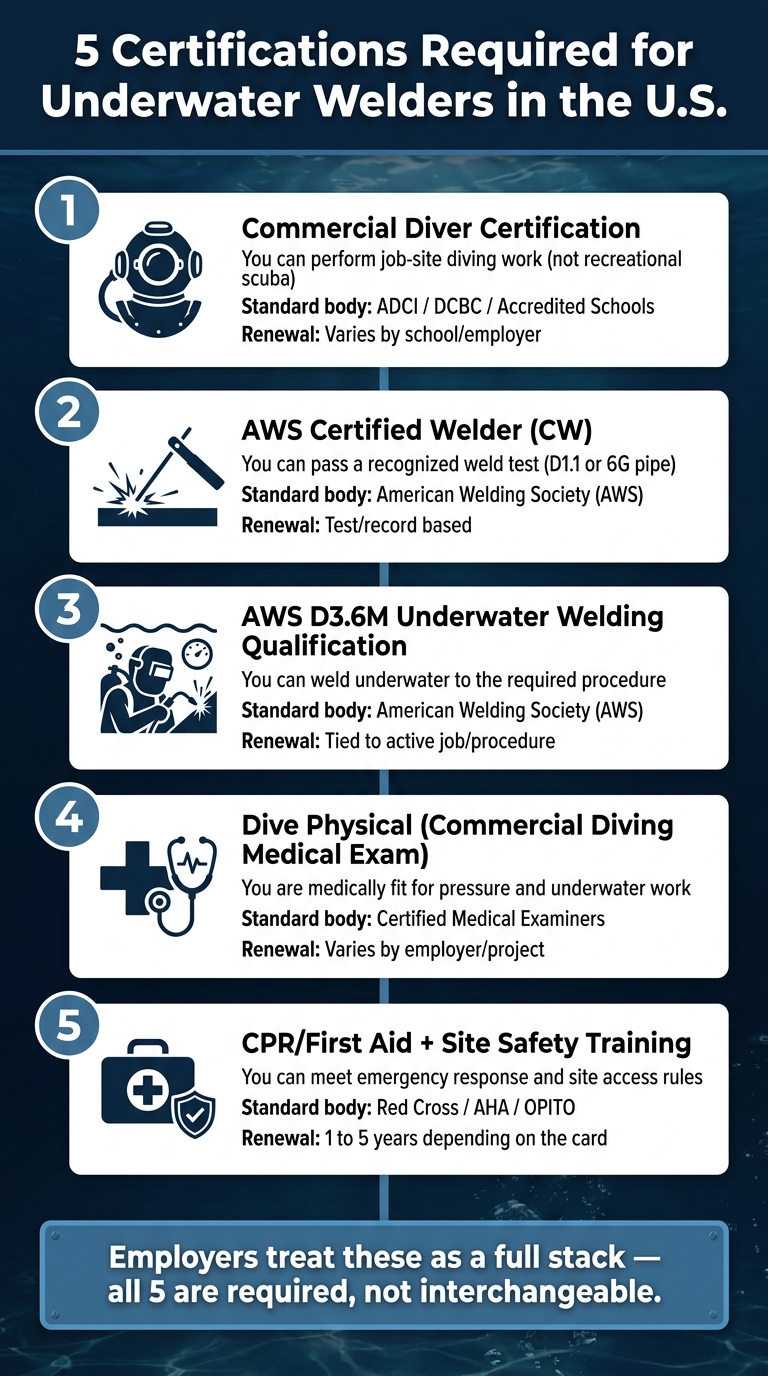
5 Certifications Required for Underwater Welders in the U.S.
What Certifications Do You Need to Become a Commercial Diver or Underwater Welder
sbb-itb-aa28329
What U.S. Employers Expect Before You Weld Underwater
U.S. employers want a full stack of credentials before they let anyone weld underwater. And no, welding skill alone won’t cut it.
Most employers look for four things: diving ability, welding ability, medical fitness, and emergency readiness. Each one answers a basic hiring question:
- Can you dive?
- Can you weld?
- Can you work safely?
- Can you handle the physical strain of the job?
That’s why the paperwork usually falls into five credential types.
"Welding safety certificates count only if they document OSHA-aligned hazard training; weld tests prove skill." – ABLEMKR
In practice, the usual stack includes commercial diving credentials, an AWS welding qualification, a dive physical, and CPR/first aid plus site safety training. One credential does not replace another. U.S. employers treat each item as its own checkbox, not as a tradeoff.
The list below breaks each requirement into one credential type.
1. Commercial Diver Certification
Commercial diver certification is the first credential U.S. employers look for when hiring underwater welders. It covers the industrial diving skills needed for underwater work, including OSHA rules, rigging, and winch operations.
A recreational scuba card doesn’t count here. Commercial diving training is built for jobsite hazards and heavy equipment. That’s a completely different bar from recreational open-water training.
This certification is the diving base for underwater welding jobs in offshore oil and gas, inland infrastructure, and marine construction. Once you have this diving credential, employers usually look next at welding qualification.
2. AWS Certified Welder (CW)
The AWS Certified Welder (CW) is a welding credential tied to the trade itself. It shows that you can pass a recognized weld test. Put simply, it proves you can make the welds employers expect to see.
In the U.S., employers often want passing results on AWS D1.1 structural weld tests or 6G pipe tests.
That’s why CW is only one part of the hiring stack. Employers use CW as proof of welding skill, while safety training deals with job-site hazards. CW is the welding proof many employers want before they move you toward underwater-specific qualification.
3. AWS D3.6M Underwater Welding Qualification
After workers show general welding skill, they need underwater-specific qualification under AWS D3.6M.
AWS D3.6M is a code-based qualification linked to specific procedures. In plain English, it connects performance tests to the exact procedure and job conditions the welder will face. It’s not enough to be a good welder in general. The worker has to prove they can handle the specific underwater welding procedure the job calls for.
That’s why employers use AWS D3.6M as a direct way to check whether a welder can do the exact underwater work required on the project. In the U.S., it’s the standard employers apply on offshore oil and gas and marine infrastructure projects.
The qualification also has to match the procedure and the project itself. So records shouldn’t float around as a generic credential. They should stay tied to the active job and the procedure being used.
That technical proof only matters once the diver also clears the medical and safety checks employers require.
4. Commercial Diving Medical Exam (Dive Physical)
After welding qualification, the next step is medical clearance. A commercial diving medical exam, often called a dive physical, clears a welder for underwater work before deployment to a job site.
The exam looks at a few core systems that matter underwater:
- Cardiovascular function
- Respiratory function
- Ear and sinus health
- Neurological function
Employers use the dive physical to document that medical clearance is in place. Renewal timing depends on the employer and the needs of the project.
5. CPR/First Aid and Job-Site Safety Training
Once medical clearance is done, safety cards are often the last step before you can go out on a job. Medical clearance shows you’re fit to dive. Safety training deals with the risks of the site you’re about to work on.
CPR and first aid certification is a common requirement on commercial diving job sites. On remote sites, that matters even more. Crews need divers who can respond to trauma, bleeding, hypothermia, and AED use. Most cards stay valid for 2 to 3 years, though annual refreshers are often recommended.
After CPR and first aid, offshore and industrial work usually adds site-specific training. Offshore jobs often require BOSIET (Basic Offshore Safety Induction and Emergency Training). That training covers helicopter escape, sea survival, and firefighting. BOSIET usually runs on a 4-year cycle.
Oil and gas roles often require H2S Awareness training. This covers how to detect and respond to toxic hydrogen sulfide gas. OSHA requires annual refreshers.
A TWIC (Transportation Worker Identification Credential) gives access to ports and vessels for many offshore jobs. It’s a federal ID issued by the TSA after a background check, and it’s valid for 5 years.
For tank, ballast, and vessel work, confined space entry training is mandatory. It covers the hazards that come with enclosed underwater areas.
Here’s a side-by-side look at the most common safety credentials:
| Credential | Primary Focus | Renewal |
|---|---|---|
| CPR/First Aid | Emergency medical response | Every 2–3 years |
| BOSIET/HUET | Offshore survival and helicopter escape | Every 4 years |
| TWIC | U.S. port and vessel security access | Every 5 years |
| H2S Awareness | Toxic gas detection and response | Annual |
| Confined Space Entry | Enclosed area hazard safety | Site-dependent |
The comparison below shows how these credentials differ from the core diving and welding requirements.
Side-by-Side Look at the 5 Credential Types
These credentials usually don’t stand on their own. In most cases, employers stack them together before they let someone take on underwater work. The table below shows where each one sits in the hiring stack.
| Credential | Primary Purpose | Typical Standard Body | Hiring Level | Typical Use |
|---|---|---|---|---|
| Commercial Diver Certification | Verifies underwater operational safety | ADCI / DCBC / Accredited Schools | Baseline | Subsea construction and inspection |
| AWS Certified Welder (CW) | Verifies surface welding proficiency | American Welding Society (AWS) | Baseline | Surface welding that supports underwater work |
| AWS D3.6M Underwater Welding Qualification | Sets the quality standard for wet and dry underwater welds | American Welding Society (AWS) | Advanced | Structural repairs and offshore rigs |
| Dive Physical (Medical Exam) | Verifies fitness for diving and pressure exposure | Certified Medical Examiners | Baseline | Required for diving work |
| CPR/First Aid / Safety Training | Verifies emergency response readiness | Red Cross / AHA / OPITO | Baseline | All job sites and offshore platforms |
The next section shows how employers combine these credentials on real U.S. job sites.
How These Certifications Work Together on U.S. Job Sites
These credentials work as a clearance stack, not a set of separate badges.
On U.S. job sites, employers check the full stack before they send someone out. They look at the whole file at once:
- Weld tests show skill
- Safety records show hazard training
- Medical clearance shows fitness
That’s what turns separate credentials into job-site clearance.
And that stack helps employers clear the right diver-welder for the right job.
Conclusion
These five credentials act as a single hiring filter. In the U.S., underwater welding doesn’t come down to just one card or certificate. Employers want the full set before they clear anyone for work.
Taken together, they cover the main areas that matter on the job: diving, welding, medical fitness, and site safety. That means commercial diver certification, AWS Certified Welder (CW), AWS D3.6M underwater welding qualification, a commercial diving medical exam (dive physical), and CPR/first aid plus site safety training.
Build them in sequence, because employers review them as a package. For U.S. underwater welding jobs, they expect the complete set before you can get on site and start work.
FAQs
Which certification should I get first?
Start with baseline safety certifications. An OSHA 10-hour or 30-hour Construction Safety card is often the first one to get because many industrial and energy job sites require it before you can even step on site.
Next, add First Aid/CPR. Then move into trade-specific credentials, such as NCCER certifications, or role-based safety training like H2S awareness or confined space entry, depending on what the project calls for.
Can I get hired with scuba certification alone?
No. For underwater welding jobs, most employers want more than scuba certification by itself.
These roles are usually linked to safety training, proof that you can actually weld, and other site-specific safety or access certifications, not just diving credentials.
How often do underwater welding certifications expire?
It depends on the credential.
Offshore safety certifications like BOSIET and HUET are often valid for four years. In most cases, you’ll need refresher training before that window closes.
Other requirements follow different timelines:
- HAZWOPER and CPR/First Aid often renew every year
- Medical certifications may stay valid for two to five years
The safest move is simple: check the renewal date with your training provider or project manager.


