
Wind energy technicians are in high demand, with jobs projected to grow by 60% between 2023 and 2033. These professionals maintain and repair wind turbines, which can involve working at heights of over 260 feet and handling complex electrical, mechanical, and hydraulic systems. To succeed in this field, certifications are a must for safety and technical expertise, including:
- OSHA 10/30: Covers workplace safety standards.
- GWO Basic Safety Training (BST): Focuses on wind-specific hazards like working at heights, fire awareness, and first aid.
- GWO Basic Technical Training (BTT): Covers turbine maintenance skills (mechanical, electrical, hydraulic).
- NCCER Certification: Provides hands-on training for turbine troubleshooting and maintenance.
- NFPA WTT-I: Validates electrical safety and troubleshooting skills.
Advanced training, such as ANSI/ACP standards and specialized modules in electrical systems, hydraulics, and mechanical maintenance, can lead to higher-paying roles. Platforms like ABLEMKR streamline hiring by matching technicians with verified credentials to job opportunities, ensuring compliance and efficiency.
To thrive as a wind energy technician, maintaining certifications like GWO BST (renewable every 24 months) and pursuing advanced credentials is key. With competitive salaries and growing opportunities, this career offers a promising path in the renewable energy sector.
The NFPA Wind Technician Certification Standardizes Wind Safety
sbb-itb-aa28329
Required Safety and Technical Certifications
Getting into the wind energy field requires specific safety and technical certifications. These credentials prove you’re prepared to handle the unique challenges of working on wind turbines, like climbing tall towers while managing heavy equipment. Below, we’ll break down the key certifications you’ll need to succeed as a wind technician.
OSHA certifications ensure you’re familiar with federal workplace safety standards. The Global Wind Organization (GWO) training focuses on wind-specific hazards, such as working at heights and dealing with turbine fires. Meanwhile, NCCER certification equips you with the technical know-how for troubleshooting and maintaining turbine systems. Together, these certifications prepare you for the physical and technical demands of the job.
For GWO training, all records must be uploaded to the WINDA database (winda.globalwindsafety.org), which assigns you a unique WINDA ID. Employers looking to hire field staff use this ID to verify your qualifications. Registration is free and should be completed before you start any GWO training. As of 2026, the WINDA system has tracked over 190,000 trained workers across 55 countries.
Let’s dive into the details of OSHA, GWO, and NCCER certifications and their roles in the wind energy industry.
OSHA 10 and OSHA 30 Certifications
OSHA certifications provide foundational knowledge of federal workplace safety laws that apply to various industrial settings. OSHA 10 covers general construction safety, while OSHA 30 offers a deeper dive into topics like hazard recognition, personal protective equipment (PPE), machinery guarding, and hazard communication.
Programs like the 40-week certificate at Pinnacle Career Institute include OSHA 30 training to ensure students meet industrial safety standards before entering the field. While these certifications don’t expire, it’s wise to take periodic refreshers to stay updated on the latest regulations. However, since OSHA training is broad, additional wind-specific safety training is essential for this field.
Global Wind Organization (GWO) Basic Safety Training (BST) and Basic Technical Training (BTT)
GWO training is a must-have for anyone entering the wind energy industry. It’s split into two categories: Basic Safety Training (BST), which focuses on emergency response and on-site hazards, and Basic Technical Training (BTT), which hones turbine maintenance skills.
Basic Safety Training (BST) emphasizes hands-on learning through scenario-based exercises. It covers four main areas: Working at Heights, Manual Handling, First Aid, and Fire Awareness. If you’re planning to work offshore, you’ll also need to complete the Sea Survival module. BST certifications are valid for 24 months, and technicians are encouraged to schedule refresher training around the 22-month mark to avoid lapses.
Basic Technical Training (BTT) focuses on the technical skills needed for turbine maintenance. It covers mechanical, electrical, and hydraulic systems, along with newer modules like Bolt Tightening and Hazardous Energies under the V11 standard. Unlike BST, BTT certifications don’t expire. Recent updates have streamlined the combined Mechanical and Electrical modules into a 16-hour (two-day) course. This standardized training approach has added efficiency, giving GWO-trained technicians up to six additional workdays per year compared to those trained outside the GWO framework. With over 600 certified training centers worldwide, finding one near you is relatively easy.
NCCER Wind Turbine Training Certification
To build on safety and wind-specific training, the National Center for Construction Education and Research (NCCER) offers wind turbine–focused certifications. These programs prepare technicians for hands-on tasks like maintenance and troubleshooting. The curriculum covers turbine components, electrical systems, mechanical operations, and diagnostic techniques, giving you the skills to independently handle turbine issues.
NCCER certification is widely respected by employers and complements GWO training by diving deeper into the technical side of turbine operations. Many community colleges and technical schools offer NCCER-accredited programs, though costs vary. For instance, Minnesota West’s Wind Energy Technology program costs about $3,370 per semester. The training emphasizes real-world scenarios and prepares students for the physical demands of tower work.
Advanced Certifications and Specialized Training
Once you’ve earned basic safety and technical certifications, advanced credentials can take your skills to the next level, opening doors to specialized roles in the wind energy industry. These certifications, like the ANSI/ACP 5000-2-2022 standard, along with focused training in electrical, hydraulic, and mechanical systems, prepare you for higher responsibility and technical challenges. Programs such as the Qualified Electrical Worker (QEW) and ACP micro-credentials also validate specific skills for high-risk tasks, helping you advance your career.
ANSI/ACP 5000-2-2022 Minimum Standard for Entry-Level Technicians
The ANSI/ACP 5000-2-2022 standard is a game-changer in wind energy training. It sets clear benchmarks for entry-level technicians by outlining the essential skills and learning objectives required in the field. Whether your training is conducted internally or through a third-party provider, this standard ensures consistency and eliminates unnecessary overlap.
When choosing a training program, make sure it offers a formal "Certification" with testing and validation, rather than just a "Certificate of Completion" that only confirms attendance. The standard also acknowledges that entry-level technicians will work under the supervision of a Qualified Electrical Worker. By meeting these competency requirements, you’ll be well-prepared for advanced technical training in areas like electrical systems, hydraulics, and mechanical maintenance.
Specialized Training in Electrical Systems, Hydraulics, and Mechanical Maintenance
Once you’ve mastered the basics, specialized training modules can help you handle more complex technical challenges. These modules build on your foundational knowledge and focus on critical areas:
- Electrical Systems Training: Covers essential concepts like AC/DC theory, three-phase systems, circuit breakers, and power distribution. You’ll also gain hands-on experience with tools like multimeters, clamp-on ammeters, and phase rotation testers. This training is especially relevant for roles like Wind Technician II, which often require two to three years of field experience.
- Hydraulic Training: Focuses on understanding system components, pump operations, and fluid dynamics. You’ll learn how to safely operate hydraulic equipment, which is crucial for tasks like securing turbine components.
- Mechanical Training: Includes torque theory, bearing maintenance (plain, ball, and roller), and lubrication systems. These skills are essential for identifying failures and replacing key components.
Specialized courses often combine these modules, providing hands-on skill verification to prepare you for advanced roles like Wind Technician II. Federal regulations, such as 29 CFR 1910.269(a)(2)(viii), require employers to ensure that employees demonstrate proficiency in their work practices before completing training. Employers increasingly use micro-credentials to track and verify these specialized skills.
National Fire Protection Association (NFPA) Wind Turbine Technician Level 1 (WTT-I)
The NFPA WTT-I certification is designed to validate your ability to handle essential wind turbine tasks, with a strong emphasis on electrical safety. It’s ideal for those with at least six months of field experience or those who have completed relevant training. This certification confirms your skills in troubleshooting, lockout/tagout procedures, and basic energy testing – critical for working safely with high-voltage equipment.
The certification exam includes 60 multiple-choice questions and takes two hours to complete. The initial application fee is $245, with retesting and recertification fees of $199 and $180, respectively. Before applying, ensure you meet the eligibility criteria, which include either six months of work experience or completing a course aligned with the NFPA exam blueprint. The certification emphasizes NFPA 70E (Standard for Electrical Safety in the Workplace), equipping you for both high- and low-voltage tasks.
With wind technician jobs projected to grow by 60% between 2023 and 2033, advanced credentials like the NFPA WTT-I can help you secure roles such as Troubleshooting Technician, Lockout/Tagout Specialist, or Wind Farm Support Specialist.
Entry-Level vs. Advanced Credentials Comparison
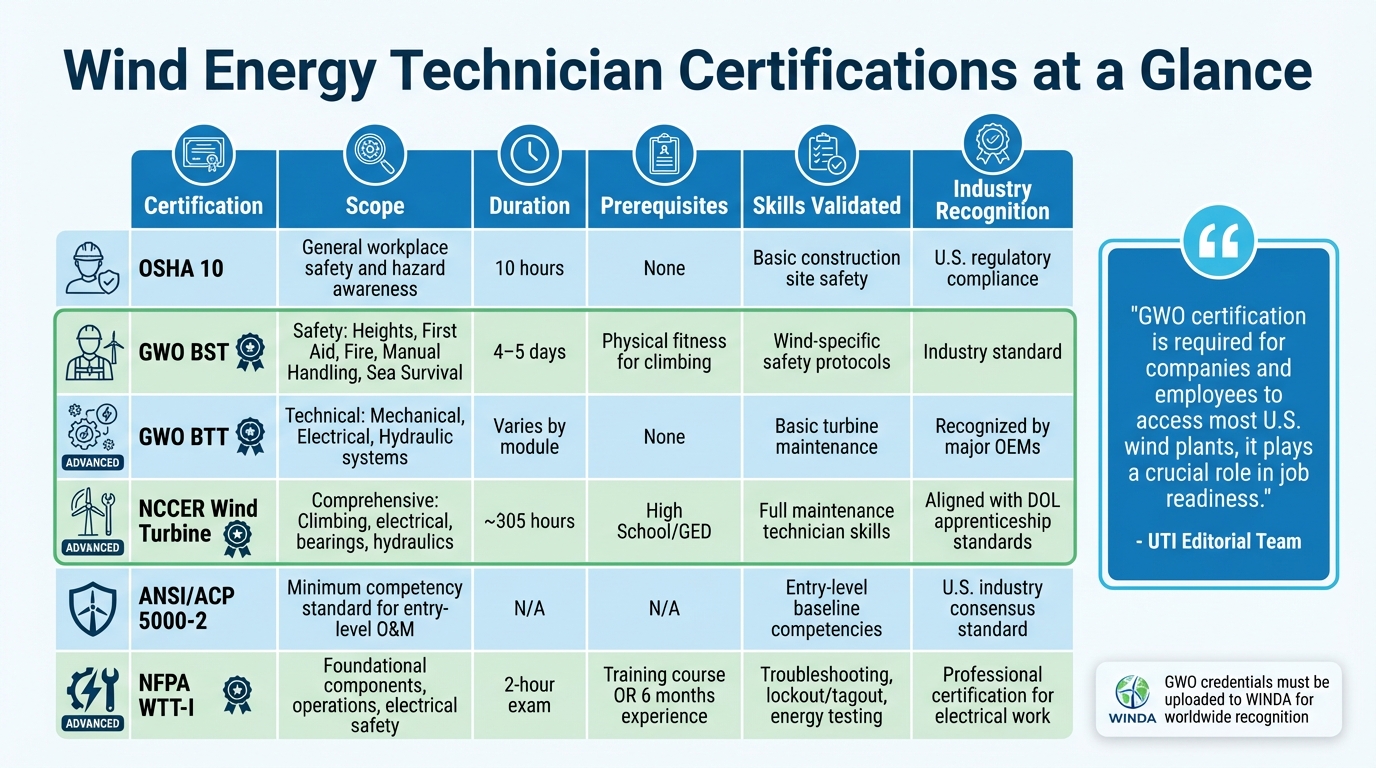
Wind Energy Technician Certifications Comparison Guide
This section breaks down the differences between entry-level and advanced certifications to help shape your career path. Entry-level credentials focus on essential safety practices and basic technical skills, such as climbing, fire safety, and system upkeep. On the other hand, advanced certifications dive into specialized areas like Advanced Rescue Training (ART), which involves evacuating personnel from nacelles or blades, and Enhanced First Aid (EFA), which prepares you to manage injuries in remote locations.
The requirements for these certifications differ significantly. For entry-level roles, you’ll typically need a high school diploma or GED and the physical ability to work at heights. Advanced certifications often require foundational credentials – such as GWO Basic Safety Training (BST) – and relevant field experience. For example, the NFPA WTT-I certification requires either a training course or six months of work experience. Most GWO certifications, regardless of level, are valid for 24 months and require periodic refresher training to stay current.
When it comes to pay, entry-level technicians earn an average of $22.61 per hour, while those with 10–19 years of experience average $28.56 per hour. The median annual salary for these roles is $61,770. Advanced certifications often pave the way to higher-paying, specialized positions.
Credentials Comparison Table
Here’s a quick overview of some key certifications:
| Certification | Scope | Duration | Prerequisites | Skills Validated | Industry Recognition |
|---|---|---|---|---|---|
| OSHA 10 | General workplace safety and hazard awareness | 10 hours | None | Basic construction site safety | U.S. regulatory compliance |
| GWO BST | Safety: Heights, First Aid, Fire, Manual Handling, Sea Survival | 4–5 days | Physical fitness for climbing | Wind-specific safety protocols | Industry standard |
| GWO BTT | Technical: Mechanical, Electrical, Hydraulic systems | Varies by module | None | Basic turbine maintenance | Recognized by major OEMs |
| NCCER Wind Turbine | Comprehensive: Climbing, electrical, bearings, hydraulics | ~305 hours | High School/GED | Full maintenance technician skills | Aligned with DOL apprenticeship standards |
| ANSI/ACP 5000-2 | Minimum competency standard for entry-level O&M | N/A | N/A | Entry-level baseline competencies | U.S. industry consensus standard |
| NFPA WTT-I | Foundational components, operations, electrical safety | 2-hour exam | Training course OR 6 months experience | Troubleshooting, lockout/tagout, energy testing | Professional certification for electrical work |
"GWO certification is required for companies and employees to access most U.S. wind plants, it plays a crucial role in job readiness." – UTI Editorial Team
Additionally, uploading GWO credentials to WINDA ensures they are recognized worldwide.
Using ABLEMKR for Credential-Based Hiring in Wind Energy
As technical training evolves, workforce deployment in wind energy needs to keep up. Technician roles in this sector are expected to grow by 45% between 2022 and 2032, making efficient hiring solutions more important than ever. ABLEMKR’s mobile-first platform simplifies this process by connecting pre-vetted technicians to wind energy projects based on verified credentials, safety training, availability, and location.
Wind energy employers need technicians with expertise in mechanical and electrical systems – gearboxes, generators, hydraulic systems, and high-voltage electrical systems are just a few examples. ABLEMKR ensures that only technicians with verified certifications, like GWO BST, OSHA 30, or NFPA WTT-I, are assigned to projects. By verifying these qualifications upfront, the platform eliminates delays in site access, saving time and reducing frustration.
Beyond credential verification, ABLEMKR empowers technicians with flexible job opportunities. The platform sends real-time job notifications tailored to each technician’s certifications – whether they’re entry-level or advanced. With guaranteed on-time payments and W2 employment status, technicians enjoy job security while retaining the freedom to choose assignments that align with their skills and availability.
For employers, ABLEMKR’s real-time updates boost operational efficiency. They gain instant visibility into worker status and compliance tracking, making it easier to mobilize crews for urgent turbine shutdowns, scheduled maintenance, or emergency repairs. With certifications already verified and payroll streamlined, employers can focus on keeping operations running smoothly.
Conclusion
The path for wind energy technicians today is well-defined. GWO Basic Safety Training (BST) serves as the baseline requirement for accessing most wind project sites, while OSHA 10 or OSHA 30 certifications ensure compliance with U.S. workplace safety standards. As Maersk Training aptly puts it:
"GWO training is not only a qualification but also the essential first step for most wind jobs".
The outlook for this career is promising. With the industry growing steadily, there is a projected need for nearly 2,000 new technicians annually. Competitive wages further highlight the importance of obtaining the right certifications, making strategic planning around credentials a must for aspiring and current technicians.
To stay ahead, technicians should maintain their GWO certifications by completing 24-month refreshers tracked in the WINDA database. Adding advanced qualifications like ART or Enhanced First Aid can open doors to leadership roles. For those aiming for specialized positions, certifications such as GWO Basic Technical Training (BTT) or NFPA WTT-I are valuable additions to their skillset. Verified credentials are the key to unlocking these opportunities.
Platforms like ABLEMKR play a crucial role by linking technicians with opportunities that align with their qualifications. As technicians earn new certifications – whether it’s offshore Sea Survival training or expertise in electrical systems – they gain immediate access to projects requiring those specific skills through real-time matching.
Global certification standards and digital verification systems are empowering technicians to build long-term careers in the rapidly expanding wind energy sector in the U.S.
FAQs
Which certifications do I need first to get hired as a wind turbine technician?
To kick off your career as a wind turbine technician, focus on earning key certifications such as the Wind Turbine Technician Certification, the OSHA Safety Certificate, and the First Aid, CPR, and AED Instructor Certification. These qualifications highlight your technical abilities and safety knowledge, both of which are highly valued by employers in this field.
How do I get a WINDA ID and keep my GWO BST from expiring?
To obtain a WINDA ID, you need to register on the WINDA database by filling out the delegate registration form. Once you have your WINDA ID, make sure to share it with your training provider before attending any GWO courses.
If you want to keep your GWO Basic Safety Training (BST) certification active, you must complete refresher courses every two years before your certification expires. Your training provider will update your records in the WINDA system to ensure your certification stays current.
Which advanced credential should I pursue to move into higher-paying wind tech roles?
To move into higher-paying positions in wind energy, obtaining advanced certifications can make a significant difference. For example, the GWO Advanced Rescue Training (ART) is highly regarded for demonstrating safety and technical proficiency. Additionally, certifications like Control of Hazardous Energies or Crane and Hoist credentials showcase specialized expertise. These qualifications not only sharpen your skills and improve safety practices but also highlight your commitment to professional growth – qualities that employers look for in senior, better-paying roles in the industry.


