
Solar hiring is still hard in 2026, and the fix is not “post more jobs.” If I were staffing a solar crew today, I’d start with a simple system: plan headcount by project phase, hire through the right channels, screen for safety and field skill, set pay clearly, and keep workers on site with solid onboarding and steady schedules.
Here’s the short version:
- Demand is still high: 53 GW of solar projects saw delays in 2024, partly because crews were short.
- The worker gap is still there: the U.S. needs about 53,000 more solar workers by late 2026.
- Hiring is still tough: 86% of solar employers say open roles are hard to fill.
- Utility-scale and commercial jobs need different hiring plans: travel, housing, crew size, and role mix can change a lot.
- Bad screening is expensive: OSHA cards alone are not enough; I’d check field skill, safety judgment, references, and work status before making an offer.
- Pay has to be clear upfront: solar PV installers earn a national median of $24.93/hour, and remote utility-scale jobs often need $35–$65/day per diem on top.
- Retention starts before day one: late paperwork, unclear schedules, and pay mistakes often lead to no-shows and early exits.
If you want a simple way to think about it, solar installer recruitment comes down to five steps:
- Plan labor by phase
- Source workers in the right places
- Screen for safety, skill, and reliability
- Make clear pay offers
- Run onboarding and retention the same way every time
That’s the core of this guide. It lays out how I’d hire for U.S. solar projects in 2026 without wasting time, overhiring, or losing good workers after the first few weeks.
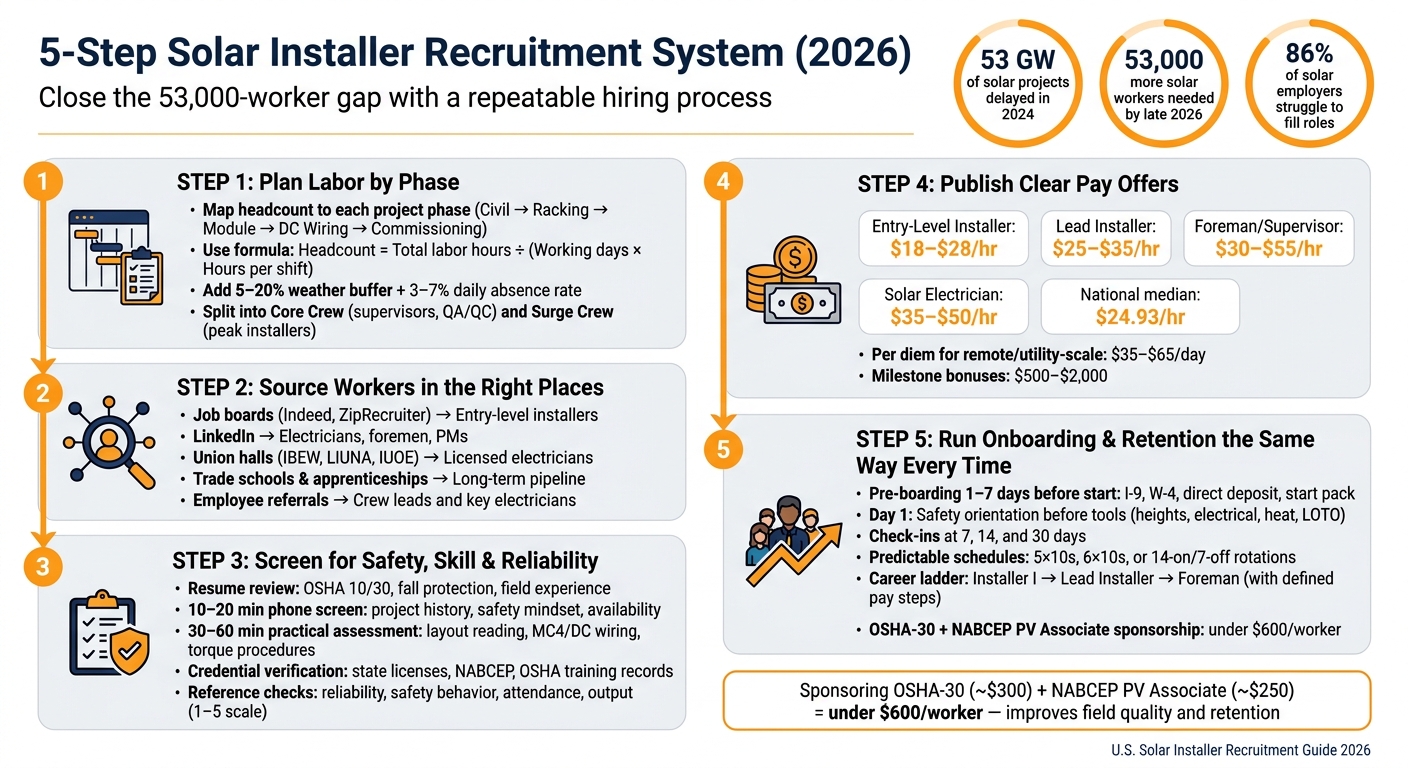
5-Step Solar Installer Recruitment System (2026)
1. Define staffing needs before you start recruiting
Build your staffing plan around the project schedule, each phase of work, and the actual site conditions. Start with the schedule first. Then match labor to each phase instead of hiring based on gut feel.
The table below shows common phases, the main roles tied to each one, and the headcount you’ll usually see on utility-scale and large commercial sites.
| Project Phase | Core Roles | Typical Headcount |
|---|---|---|
| Preconstruction | Project manager, site superintendent, survey or layout lead | Small team |
| Civil / Groundwork | 1–2 site superintendents, 2–4 equipment operators, 4–10 general laborers, 1 survey or layout lead | 8–17 |
| Racking & Structural | 1 general foreman, 2–4 foremen or lead installers, 12–40 installers, 1–2 quality/safety representatives | 16–47 |
| Module Installation | 1 general foreman, 2–4 foremen or lead installers, 12–40 installers, 1–2 quality/safety representatives | 16–47 |
| DC Wiring | 1 electrical foreman, 2–6 electricians, 4–12 electrical helpers | 7–19 |
| AC / Inverter Work | 1–2 senior electricians, 1 commissioning or controls technician, small support crew | 3–6 |
| Commissioning | 1 commissioning lead, 1–3 technicians | 2–4 |
| O&M | 1 site manager, 1–3 technicians | 2–4 |
Set skill, certification, and availability requirements
For each role, define the minimum credentials, field skills, and availability before you write the job post. That keeps hiring tight and cuts down on weak applicants.
| Role | OSHA | Fall Protection | NABCEP | State Electrician License | Availability |
|---|---|---|---|---|---|
| Entry-Level Installer | OSHA 10 | Required | Not required | Not required | Preferred for travel-heavy sites |
| Experienced Installer | OSHA 10 | Required | PV Associate preferred | Not required | Often required |
| Electrician | OSHA 30 | Required | PV Installation Professional preferred | Required (journeyman or master) | Often required |
| Foreman / Superintendent | OSHA 30 | Competent person status | Preferred | Varies by state | Required |
Be plain about the hands-on skills that matter. That includes basic tool use, reading work instructions, lining up racking with care, torqueing to manufacturer specs, basic DC stringing, and leading a crew.
For travel-heavy utility-scale work, say exactly what the job is. Is it local-only or travel-based? What’s the rotation pattern? Are per diem, lodging, and travel reimbursement included? Put that in the job profile from the start.
Peak phases also tend to bring overtime and weekend work. Candidates should know that upfront, not after they show up on site.
Estimate labor hours and hiring timing
Work from labor hours, not instinct. Start with a task-level productivity rate. For example, if past data shows 80 modules installed per installer per day on similar terrain, and your project has 80,000 modules, that equals 1,000 installer-days, or 10,000 installer-hours at 10-hour shifts.
Headcount = Total labor hours ÷ (Working days × Hours per shift)
At 100 working days and 10-hour shifts, that 10,000-hour estimate means you need 10 installers. Use the same approach for racking crews, electricians, and commissioning technicians, each with their own productivity marks.
Then build in buffers. Add 5–20% for weather based on the region, a 3–7% daily absence rate, and a rework allowance tied to past defect rates.
It also helps to split the workforce into two groups: your core crew and your surge crew. Core roles like site supervisors, general foremen, QA/QC leads, and key electricians stay on through most of the project. They carry the site’s safety habits and quality bar. Surge workers handle peak racking and installation, then roll off when that phase wraps up.
With roles, timing, and headcount mapped out, sourcing gets a lot more focused.
sbb-itb-aa28329
2. Find solar installers through the right U.S. channels
With roles, headcount, and timing locked in, the next step is simple: go where the right workers already are. Section 1 defined the crew. This section covers where to find it.
Use job boards, trade schools, apprenticeships, unions, and referrals
No single channel works for every hire. The mix should match the role, the market, and how fast you need people on site.
Indeed and ZipRecruiter can drive a lot of applicants fast. That makes them a good fit for entry-level installers, though you’ll usually need more screening to sort through the volume. LinkedIn tends to work better for electricians, foremen, and site supervisors, where licenses, certifications, and past project size matter more than sheer applicant count.
Trade schools and community colleges can supply candidates who already have basic PV knowledge and jobsite safety training. Registered apprenticeship programs with DOL-approved guidelines build a longer-term path toward journeyman or licensed electrician status. They won’t solve an urgent labor gap overnight, but they often lead to stronger retention.
For licensed electricians and seasoned electrical foremen, union halls can be the fastest steady route on projects covered by collective bargaining agreements. Common partners include IBEW for electricians, LIUNA for construction craft laborers, and IUOE for operating engineers. Pay and fringe costs are higher, but the credentials are usually more dependable.
Employee referrals often bring in the best-fit hires, especially for foremen and crew leads. Put structure around the program with clear bonus amounts and eligibility rules. Referred workers often stay longer and get up to speed faster.
| Channel | Speed to Fill | Typical Cost | Fit | Best For |
|---|---|---|---|---|
| Job boards | High | Medium | Variable | Entry-level installers |
| Medium | Medium–High | Strong | Electricians, foremen, PMs | |
| Trade schools / community colleges | Medium | Low–Medium | Solid baseline | Junior installers, career changers |
| Apprenticeships | Medium–Long | Medium | High, strong retention | Long-term electrician pipeline |
| Union halls | High (once signatory) | High | High credential reliability | Licensed electricians, foremen |
| Referrals | Medium | Low–Medium | Very high fit | Crew leads, key electricians |
Adjust sourcing by region and project location
The utility-scale vs. commercial split from the introduction shapes sourcing by region in a very direct way. California has the largest solar workforce, at about 78,982 jobs, along with a strong union footprint, higher prevailing wages, and deep community college networks. In that market, union halls and local trade school ties often work well. Texas, by contrast, is a major utility-scale growth market and is mostly non-union, so job boards, referrals, and labor platforms built for travel-based solar crews often do better. Florida’s growth in commercial rooftop and distributed solar makes local installers and electricians with heat-safety knowledge and hurricane-resistant construction experience more attractive. North Carolina has major utility-scale activity and solid installer networks, but many projects sit in rural areas, which means you may need to source from a broader geography.
The biggest split is between remote utility-scale sites and metro commercial rooftop jobs. Remote sites in places like West Texas or the California desert often don’t have enough local skilled labor. In those cases, recruit across several states and aim at travel-based solar crews. The job post should spell out travel pay, per diem rates, employer-provided or reimbursed lodging, and the work rotation, such as 14 days on / 7 days off. For metro commercial work, local labor pools are usually the better play, with job ads focused on short commutes, steady nearby work, and more predictable schedules.
After sourcing, move qualified candidates into one workflow for screening and onboarding.
Use workforce technology to speed deployment and compliance
If you’re staffing across several sites, workforce software can keep the whole pipeline in one place. ABLEMKR matches pre-vetted workers to job sites based on certifications, safety training records, availability, and geo-location. It also tracks credentials such as NABCEP PV Associate, OSHA 10/30, and Fall Protection against role requirements, and handles worker onboarding – I-9, W-4, direct deposit, and safety acknowledgments – from a mobile device before day one.
Used the right way, workforce tech helps tie the channels together. You can feed the funnel through job boards, trade schools, apprenticeships, and unions, then keep a bench of proven workers ready to move when the next site opens.
Once candidates are in the funnel, screen for safety, skill, and work authorization.
3. Screen, qualify, and select reliable solar field workers
Once candidates are in your funnel, screen hard for role fit, safety, and reliability. One interview format won’t tell you who can actually do the job. Plenty of people look fine on paper and then fall apart when you ask about site work, safety calls, or travel. Start with a strict screen, then use interview time on people who already match the role.
Review applications and confirm role fit early
Field hiring is tight, so screening should focus on fit, not volume. Apply role-based criteria at the resume stage before you book interviews.
Installers: documented solar or related construction work, torque wrench and crimper familiarity, rooftop or ground-mount experience, OSHA 10, fall protection, and readiness to travel.
Electricians: journeyman or master license, DC wiring, combiner boxes, inverters, and AC tie-in, single-line diagrams, and OSHA 30 preferred.
Foremen: crew leadership for 8–20+ workers, daily production targets, JSAs, site logs, and communication with superintendents or PMs.
Run a 10–20 minute phone screen. Ask about the candidate’s last two projects, how they think about safety, earliest start date, willingness to travel, and pay expectations. If project history is vague, safety judgment feels weak, or availability is too rigid, cut them at this stage.
Test technical skill, safety judgment, and leadership ability
Keep practical assessments to 30–60 minutes and tie them to work the person would actually do on site.
For installers, a layout reading exercise works well. Have them read a string or table drawing and identify module counts. Pair that with a tabletop MC4 connector and DC wiring walkthrough. You’ll get a fast read on whether they’re ready. Add a torque procedure question and a short photo review where they spot defects like misaligned modules or bad clamp placement.
For electricians, ask them to walk through a single-line diagram, explain a lockout/tagout process for an inverter shutdown, and describe the high-level commissioning sequence for a commercial PV system.
For foremen, skip the wiring test. Give them a crew allocation problem with a weather delay or equipment failure and see how they protect safety while keeping production moving. Then role-play a schedule slip with a superintendent and score them on clarity, accountability, and communication.
Don’t lean on OSHA cards alone. Ask behavioral questions that show what the candidate does when conditions turn unsafe. You want clear examples of hazard recognition, escalation, and corrective action. If someone shrugs this off or gives fuzzy answers, that’s a red flag – especially for electricians and foremen working near energized equipment.
Verify credentials, references, and work authorization
Run final checks before any offer goes out. NABCEP does not replace OSHA training records. Clients often want dated fall-protection and electrical-safety records for each crew member, so verify both on their own.
Check references the same way every time. Talk to supervisors from the last three to five years and ask direct questions about:
- attendance patterns
- daily output compared to peers
- how the person handled a safety incident
- whether the supervisor would rehire them
Use a simple 1–5 scale for reliability, safety, attendance, and quality. Take verbatim notes. If a reference hesitates on rehire, pay attention.
The table below shows which checks apply at each stage by role:
| Pipeline Step | Installers | Electricians | Foremen |
|---|---|---|---|
| Application review | Solar/construction experience; tool familiarity; OSHA 10 | Solar electrical experience; DC/AC work; state license | Crew leadership history; JSA writing; supervisor roles |
| Phone screen | Project history; safety mindset; availability; pay | Project history; code/safety focus; availability; pay | Leadership approach; safety ownership; logistics; pay |
| Technical/safety assessment | Layout reading; MC4/DC basics; torque and quality checks | Single-line diagrams; lockout/tagout; commissioning basics | Crew coordination scenarios; productivity planning; communication role-play |
| Credential verification | OSHA 10; fall-protection training | State electrical license; OSHA 30; NABCEP (if required) | OSHA 30 (preferred); documented supervisory experience |
| Right-to-work & background | Form I-9; background/drug test if site-required | Form I-9; background/drug test if site-required | Form I-9; background/drug test if site-required |
| Reference checks | Reliability; safety behavior; attendance; output | Code compliance; safety; documentation quality | Safety leadership; crew performance; stakeholder communication |
| Final offer | Role, rate, schedule, site assignment | Role, rate, schedule, site assignment | Role, rate, leadership scope, site assignment |
For multi-state operations, ABLEMKR can centralize verified certifications, licenses, and compliance checks before deployment. Once candidates clear these checks, move straight into pay, onboarding, and start-date confirmation.
4. Build pay plans, onboarding, and retention systems that keep crews on site
After screening, three things shape whether workers stay: pay, onboarding, and retention. The offer gets people to say yes. Onboarding gets them to the job site. Retention is what keeps them there.
Set pay bands and total compensation for each role
Base pay is only one part of the offer. According to U.S. Bureau of Labor Statistics data, the national median for solar PV installers is $24.93/hour ($51,860/year). Utility-scale work usually pays more than commercial rooftop work because crews deal with remote sites, heavier equipment, and longer shifts.
Use the ranges below as a starting point, then adjust for region, labor market, union rules, and budget.
| Role | Commercial Rooftop | Utility-Scale |
|---|---|---|
| Entry-Level Installer | $18–$25/hr | $20–$28/hr |
| Lead Installer | $25–$32/hr | $27–$35/hr |
| Foreman / Supervisor | $30–$40/hr | $38–$55/hr |
| Solar Electrician (Journeyman) | $35–$50/hr | $36–$48/hr |
What moves fill rate, though, is the full package. For utility-scale travel jobs, add per diem of $35–$65/day for meals and incidentals. Be upfront about weekly hours too. Peak construction often runs 50 to 60 hours per week, and that matters because some workers want overtime and will opt in for those bigger checks.
You can also use milestone bonuses of $500–$2,000 for phase completion or end-of-project attendance, with the amount tied to role and project length. Even simple extras, like access to health insurance and paid safety training, can help your offer stand out in a tight labor market.
Build a clear onboarding flow from pre-boarding to day-one safety orientation
A lot of onboarding problems start before day one. If workers don’t get clear instructions, PPE details, or paperwork handled in time, no-shows go up fast.
Start one to seven days before the start date. Collect I-9 verification, W-4, direct deposit details, emergency contacts, and any needed certifications. Then send a written start pack with the site address, start time, schedule, PPE rules, pay rate, overtime policy, and the day-one contact.
Day one should begin with safety orientation before anyone touches tools. Go over site-specific hazards like working at heights, electrical exposure, and heat. Cover emergency procedures, lockout/tagout, and incident reporting. Issue PPE and tools, make sure workers know how replacements work, and explain the reporting chain: foreman, site superintendent, and safety officer. After that, move into hands-on training for racking, module handling, torque specs, and wiring under direct supervision.
ABLEMKR can centralize this pre-boarding and onboarding workflow by collecting certifications, running compliance checks, managing payroll setup, and giving supervisors real-time visibility into which crew members are cleared for specific tasks before they ever reach the site. For multi-site utility-scale operations, that kind of centralized record-keeping can cut manual onboarding time by several days and reduce pay errors that drive early attrition.
Short check-ins at the 7-, 14-, and 30-day marks help catch issues before they turn into turnover. Use the 30-day review to document safety, attendance, and work quality. It also gives you a clean handoff from onboarding into retention.
Keep strong workers with predictable schedules, fair pay, and clear advancement paths
Once onboarding is in good shape, retention comes down to a few plain issues: pay accuracy, schedule stability, communication, and advancement. Workers leave when pay is late, schedules swing all over the place, managers go quiet, or the next step is a mystery. Fix those four problems and retention usually gets better.
Accurate, on-time pay is non-negotiable. Spell out the pay schedule clearly, whether that’s weekly or biweekly. Give workers pay stubs that show base pay, overtime, per diem, and bonuses in a clean breakdown. Integrated payroll workflows help cut overtime and per diem mistakes, which means fewer payroll headaches and fewer people walking off over pay disputes.
Scheduling matters just as much. Set shift patterns like 5×10s or 6×10s and stick to them. On remote utility-scale projects, rotation schedules such as 14 days on / 7 days off give workers room to plan family time, and that directly lowers mid-project attrition. If weather or equipment throws the schedule off, say so fast and say it clearly.
Advancement is another big piece. The table below shows the gap between a plain hourly setup and a package built to keep good people.
| Element | Basic Hourly Employment | Retention-Focused Package |
|---|---|---|
| Base pay | Market rate, no structure | Defined pay bands with entry, mid, and max rates |
| Overtime | Paid per law, not communicated upfront | Expected hours disclosed at offer; OT treated as an earning opportunity |
| Per diem / travel | None or inconsistent | $35–$65/day for remote sites; paid travel days for mobilization |
| Bonuses | None | Milestone bonuses ($500–$2,000); attendance recognition |
| Benefits | None | Health insurance access; paid safety training |
| Schedule | Variable, last-minute changes | Predictable shifts; rotation options for remote work |
| Advancement | Informal or invisible | Defined path: Installer I → Lead → Foreman, with criteria and pay steps |
| Payroll accuracy | Manual, error-prone | Integrated workflows; transparent pay stubs |
Make advancement criteria clear during onboarding, not buried in some HR file nobody reads. If workers know what it takes to move from Installer I to Lead Installer, and from Lead to Foreman, they’re more likely to show up, build skills, and stay through the next project cycle.
Tie promotions to clear markers like tenure, safety record, ability to read plans, and crew coordination on the ground. Add a modest pay bump at each step, and you get a career ladder that costs less than hiring the same roles over and over.
Conclusion: A repeatable process for solar installer recruitment
The U.S. solar industry needs about 53,000 more workers by late 2026 to hit installation targets. That gap won’t close by pushing harder on hiring. It closes when companies use the same hiring system across projects, regions, and seasons.
That’s the core idea here: don’t reinvent the process every time. The five steps in this guide work best as one connected system, not as separate tasks. Plan by phase, source through more than one channel, screen for safety and fit, publish clear pay, and standardize onboarding and retention. Each step supports the next, with one goal in mind: keep your best people through project completion and move them into the next job with a clear path forward.
Once that system is running, three details carry a lot of weight:
- Sponsoring OSHA-30 (~$300 per person) and a NABCEP PV Associate credential (~$250 per person) costs under $600 per worker and can improve field quality and retention.
- Publishing full pay ranges in job posts cuts down offer friction and brings in candidates who are serious about the role.
- 30-day check-ins help spot problems before they turn into turnover.
Key points to carry into your next hiring cycle
The employers most likely to staff utility-scale and commercial solar projects on time treat workforce planning as a steady operation, not a scramble before a start date. In practice, that means keeping a live roster of pre-vetted workers, tracking certifications and availability between projects, and reviewing hiring metrics after each cycle so the process gets tighter over time.
The pressure is real. 86% of solar employers report difficulty filling open roles, and 27% of utility-scale installation employers say hiring is very difficult. The teams that get past those numbers usually aren’t doing one magic thing. They’re running a tighter process from planning through retention. That’s the edge in solar installer recruitment right now.
FAQs
How many solar installers should I hire for each project phase?
The number of solar installers changes with the phase of the project. A utility-scale or commercial build doesn’t need the same crew from start to finish, and that shift can be pretty dramatic.
During development, teams are usually small and specialized, with about 5 to 20 full-time employees. Engineering and design often call for dozens of team members. Then comes construction, where labor demand can jump fast and reach hundreds of workers for mechanical installation.
Once the system is up and running, staffing drops off again. Operations and maintenance usually need only a few technicians per megawatt.
What should I include in a solar installer job offer?
Be transparent. Spell out the day-to-day work, the credentials you want to see, and what the pay looks like.
That means covering things like:
- Daily responsibilities: what the person will handle each day, who they work with, and what success looks like on the job
- Required credentials: certifications such as OSHA 10, OSHA 30, or NABCEP, plus any license, training, or field experience needed
- Pay details: include a clear salary range in U.S. dollars, and if the role includes commission, bonuses, or other incentive pay, say so plainly
You should also explain how the job is set up. Is it on-site, hybrid, or remote? How much travel is part of the role? If employees are on the road, note whether you offer housing stipends, per diem, mileage reimbursement, or a company vehicle.
Career path matters too. Let people know whether the role can grow into lead, manager, or specialist positions. And don’t skip benefits. Call out items like:
- Professional development and paid training
- Health programs and medical coverage
- Flexible scheduling or other work-life support
The goal is simple: give candidates the full picture so they can tell, fast, whether the role fits their skills, goals, and day-to-day life.
How can I reduce no-shows and early turnover?
Focus on payroll accuracy, clear onboarding, and early social integration. If the first paycheck is wrong, trust can take a hit fast. Make sure workers are paid on time and paid correctly, no matter where they’re assigned.
You can also speed up onboarding by collecting documents and verifying certifications before day one. On large projects, cohort onboarding works well. It also helps to assign a buddy or mentor and give realistic job previews, so people know what the role actually looks like before they start.


