
- The Problem: The world needs 38.2 million renewable energy jobs by 2030, but 75% of employers struggle to find qualified workers. High turnover, remote project locations, and specialized skills are key obstacles.
- The Solution: Companies can improve recruitment by:
- Building a strong employer brand that highlights sustainability and career growth.
- Writing clear, detailed job descriptions with specific skills and certifications.
- Using technology to speed up hiring and track recruitment metrics.
- Retention Strategies: Efficient onboarding, transparent pay, and clear career paths help keep workers engaged.
- Tech Tools: Platforms like ABLEMKR simplify hiring by pre-verifying worker credentials, automating compliance checks, and enabling rapid deployment for urgent projects.
Key Takeaway:
To meet the demand for renewable energy workers, companies must streamline hiring, invest in worker development, and align with candidates’ values. This approach ensures projects stay on track and attract top talent.
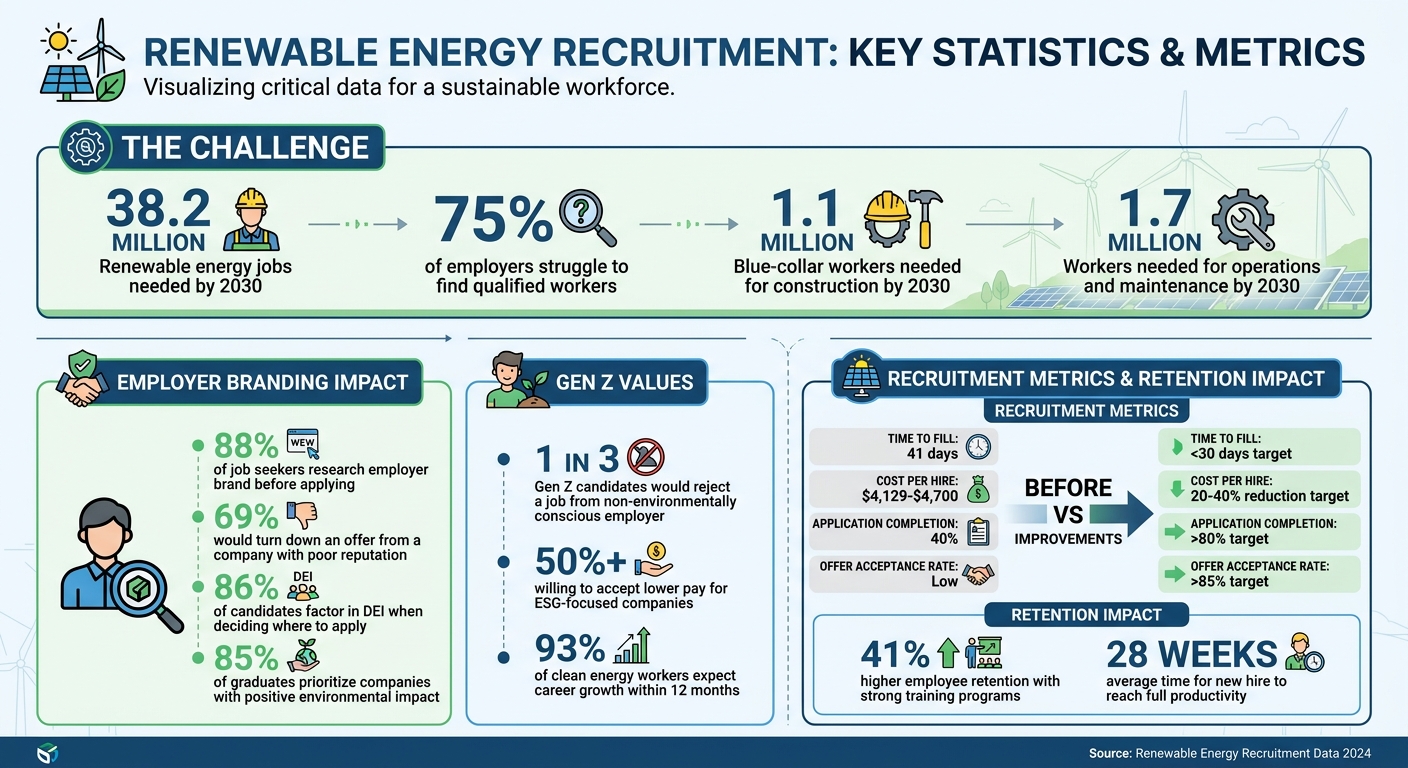
Renewable Energy Recruitment Statistics and Key Metrics 2030
Recruiting Students and Employees into an Inclusive Clean Energy Transition
sbb-itb-aa28329
Building Your Employer Brand for Renewable Energy
Your employer brand sets you apart in a competitive industry, especially when 75% of renewable energy companies report hiring difficulties. The stats don’t lie: 88% of job seekers research a company’s employer brand before applying, 69% would turn down an offer from a company with a poor reputation, and 85% of graduates prioritize working for companies with a positive environmental impact.
In renewable energy, values matter deeply. For example, 1 in 3 Gen Z candidates would reject a job offer from an employer that isn’t environmentally conscious, and over half are even willing to accept lower pay to work for a company that prioritizes ESG (Environmental, Social, and Governance) concerns. As Asim Hafeez, Owner and Operator at Empower Energy Solutions, explains:
Gen Z cares about sustainability in the workplace because they have knowledge that previous generations didn’t have… they see the side effects, environmental issues are a lot more pressing for them.
To build a strong employer brand, you need to go beyond words. Show candidates that your company genuinely aligns with their values. This means taking real environmental action, offering clear career growth opportunities, and fostering a workplace where diverse talent feels valued and included.
Showcasing Environmental Commitment and Career Paths
Forget vague mission statements – Gen Z candidates, who are highly digitally aware, can easily spot greenwashing. Instead, share specific actions your company has taken to meet ESG goals. For instance, in 2022, Piper Maddox, a clean energy recruitment firm, launched a sustainability initiative that included planting trees, saving thousands of air miles, and preserving ice through strategic partnerships.
Sustainability should also be woven into your Employee Value Proposition (EVP). Deepali Vyas, CEO of Fearless+, emphasizes:
Incorporating sustainability initiatives into the EVP can help to attract candidates who are looking for a workplace that aligns with their values.
Leverage platforms like LinkedIn, Instagram, and your career page to showcase your green initiatives. For remote or field-based roles, highlight programs like renewable energy–powered data centers, Earth Day sponsorships, or community-focused philanthropy.
Beyond environmental efforts, career development is a key concern for candidates. Many worry about limited advancement opportunities in the renewable energy sector. Address this by clearly outlining how each role contributes to the energy transition and what long-term growth looks like. Companies with strong training programs enjoy 41% higher employee retention. Share real examples of employee career paths on your website or social media, and consider creating video testimonials where team members discuss their professional growth. You could also establish employee-led "green teams" to encourage leadership development while supporting sustainability goals.
While environmental commitment and career growth are essential, building a diverse and inclusive workplace is equally critical.
Creating a Diverse and Welcoming Workplace
Diversity isn’t just a moral imperative – it’s a business necessity. With a talent shortage in renewable energy, limiting your applicant pool isn’t an option. In fact, 86% of candidates factor in a company’s approach to DEI (Diversity, Equity, and Inclusion) when deciding where to apply.
Start by auditing your hiring practices. Remove gendered language from job descriptions, anonymize CVs during the initial screening process, and standardize interview questions with fixed scoring systems. Ensure your recruitment process is accessible to individuals with visual, hearing, or mobility impairments.
Skills-based hiring can also be a game-changer in this emerging field. Instead of relying solely on traditional qualifications, use technical assessments to identify capable candidates who may lack formal education. Offer apprenticeships or specialized training programs to help individuals from non-traditional backgrounds enter the industry. On your website and social channels, highlight your commitment to equal opportunity by featuring diverse team members at work. This signals to potential applicants that your company values inclusivity and offers real opportunities for growth.
Writing Job Descriptions for Renewable Energy Positions
A job description is more than just a list of responsibilities – it’s your first interaction with potential hires. With the renewable energy sector projected to need 38.2 million jobs by 2030, attracting the right talent starts with clear, precise postings. Vague descriptions can turn away qualified candidates, leaving critical roles unfilled.
This fast-paced industry lacks standardized training programs across the board. That’s why specificity is key. Use targeted titles like "Solar Energy Project Manager" or "Wind Turbine Technician" to draw candidates with the right expertise. This approach helps ensure that applicants with the necessary qualifications and skills apply, reducing mismatched applications and addressing workforce challenges.
Your job descriptions should also reflect your company’s ESG (Environmental, Social, and Governance) framework. Demonstrate your commitment by showcasing concrete examples of environmental initiatives or community programs. This transparency builds trust with candidates who often research company values before applying. Once you’ve set the stage, focus on the skills, certifications, and benefits that resonate with professionals in renewable energy.
Specifying Required Skills and Certifications
Certifications are a great way to show that your company values quality and professionalism. Be explicit about the credentials needed for each role. For example:
- Certified Energy Manager (CEM) for leadership roles
- Certified Renewable Energy Professional (REP) for technical positions
- LEED AP for sustainable building projects
- PMP for overseeing projects
- Certified Energy Auditor (CEA) for conservation roles
- Certified Demand-Side Management Professional (CDSM) for utility planning
In addition to certifications, outline the technical skills required. Key competencies might include energy auditing, carbon footprint analysis, energy procurement, demand-side management, or sustainable project management. Avoid vague terms like "experience in renewable energy." Instead, specify: "5 years of experience in solar panel installation."
Clearly list daily responsibilities. For instance, rather than saying "Oversee installation", describe it as "Manage solar panel installations, including scheduling subcontractors and performing quality control inspections." This level of detail helps candidates understand what the job entails and whether they’re a good fit.
Given the variability in training programs, consider adopting skills-based hiring practices. Focus on assessing competencies rather than relying solely on formal education. This approach can help you identify candidates with hands-on expertise who might otherwise be overlooked.
Lastly, don’t forget to provide a transparent breakdown of compensation and work arrangements.
Describing Compensation and Work Arrangements
A strong employer brand isn’t just about clear job expectations – it’s also about offering competitive and transparent compensation. Be upfront about salary ranges, commission structures, benefits, and career progression opportunities. Ashley Pitt, a Renewable Energy Recruitment Specialist, highlights:
88% of job seekers consider an organization’s employer brand before applying for a role.
Use market research to ensure your compensation is competitive. With many states now requiring pay transparency, being honest about salary expectations can set you apart and build trust with candidates.
Renewable energy jobs often involve remote locations, which can be a challenge for recruitment. Address this directly by detailing work arrangements, travel requirements, and any support you offer for remote assignments. Highlight benefits like flexible schedules, remote work options for planning roles, or rotation schedules that balance on-site work with time off. For field roles, mention perks such as company vehicles, travel allowances, or housing stipends.
Career advancement is another critical area to address. Lay out potential growth paths, such as moving from junior technician to senior technician to site supervisor. With the rapid expansion of renewable energy jobs, unclear career trajectories can be a concern. Emphasize training programs or apprenticeships that help employees grow, especially as the industry evolves. Companies that invest in training see 41% higher employee retention rates, making it a worthwhile focus.
Finally, include benefits that matter to renewable energy professionals. Highlight offerings like health programs, continuing education stipends, professional development budgets, and flexible working hours. These perks can make your job description stand out to top talent in the field.
Using Technology to Speed Up Hiring
Manual hiring processes can slow down renewable energy projects when time is of the essence. Whether it’s staffing a solar installation or handling an emergency turbine repair, waiting weeks to find the right personnel isn’t feasible.
Technology platforms are changing the game by automating tasks like candidate screening, certification checks, and compliance tracking. Some platforms can evaluate candidates in as little as 24–48 hours. In fact, agencies have successfully filled critical renewable energy roles in under a week – after months of traditional searching.
The rise of Managed Service Provider (MSP) models is also transforming workforce management in the renewable energy sector. For instance, Worley shared how their MSP model has been a game-changer:
Their MSP model has streamlined our recruitment process, giving us access to a vetted network of specialist agencies, real-time visibility into hiring metrics, and full compliance with IR35 and other regulatory requirements.
ABLEMKR’s specialized platform builds on this momentum, offering a tailored solution for the unique staffing needs of renewable energy projects.
How ABLEMKR Helps Hire for Renewable Energy Projects
ABLEMKR’s platform is designed to tackle the specific challenges of staffing renewable energy projects across the U.S. Its mobile-first technology connects pre-vetted workers to job sites based on certifications, safety training, availability, and location – essential for large-scale solar farms, wind projects, or energy storage installations.
The platform simplifies hiring with pre-verified worker profiles. Certifications, such as electrical licenses or OSHA training, are confirmed before workers are added. The automated system matches workers to jobs by considering technical qualifications, location, and schedules – handling tasks that are often cumbersome with manual processes.
Compliance is seamlessly integrated. ABLEMKR tracks certifications, safety training expirations, and site-specific requirements, ensuring no delays occur due to outdated credentials or missing paperwork. For projects spanning multiple states, this feature is invaluable, offering real-time updates on worker readiness so employers know who’s eligible and when.
Payroll is another area where ABLEMKR shines. The platform includes built-in payroll workflows, ensuring on-time payments for workers. This not only boosts worker retention but also frees employers from administrative burdens, allowing them to focus on completing projects.
Deploying Workers Fast for Urgent Projects
Thanks to technology, renewable energy projects can now respond more effectively to urgent needs. Tight deadlines, which often deter workers from the sector, are more manageable. For example, a sudden transformer failure at a solar farm or a planned maintenance shutdown demands immediate action. ABLEMKR’s geo-location feature identifies qualified workers near the site, cutting travel time and costs.
While typical hiring timelines range from 1–3 weeks, urgent situations can be addressed much faster. In some cases, onboarding consultants can be completed in just 1–3 days, enabling workers to start almost immediately.
Imagine a utility company discovering a critical wind turbine issue late Friday afternoon. With ABLEMKR, certified technicians can be identified within hours, their credentials verified digitally, and deployment coordinated – all through the platform’s mobile app. This speed ensures projects stay on track and minimizes expensive downtime.
Real-time tracking adds another layer of efficiency. Project managers can monitor every step, from assignment acceptance to worker arrival at the job site. This transparency is especially valuable for complex tasks involving multiple trades – such as electricians, roofers, and systems technicians – who need to work in sync to meet deadlines.
Onboarding and Keeping Renewable Energy Workers
Speeding up productivity and ensuring long-term retention are key to cutting project costs and avoiding delays. The renewable energy sector faces unique challenges: jobs are spread across various locations, compliance requirements are complex, and workers are drawn to roles that align with their passion for environmental impact. With 93% of clean energy workers expecting career growth within 12 months, keeping employees engaged depends heavily on providing growth opportunities and aligning with their values.
Efficient Onboarding Procedures
Getting workers ready to hit the ground running is critical. Delays in onboarding – like slow paperwork processing – can lead candidates to accept competing offers. To avoid this, make sure all equipment, system access, and safety documentation are ready before day one.
Platforms like ABLEMKR simplify the process by automating documentation collection. For renewable energy projects that span multiple states, this means verifying OSHA certifications, electrical licenses, and site-specific safety requirements in real time. Workers can upload their credentials via a mobile app, and employers receive instant confirmation of readiness. This eliminates the back-and-forth of emails and phone calls, speeding up the onboarding process.
Another crucial factor? Payroll accuracy. A mistake on a worker’s first paycheck can immediately destroy trust and push them to leave. ABLEMKR’s integrated payroll workflows ensure payments are accurate and on time, no matter where workers are stationed. For employees rotating between solar farms or wind sites across states, reliable pay builds confidence in their employer.
For large-scale projects, like solar installations requiring multiple trades, cohort-based onboarding works especially well. Group sessions create immediate peer connections, reducing feelings of isolation and fostering long-term retention. Pairing new hires with experienced workers as "buddies" can also make a big difference. These mentors answer questions, explain site-specific protocols, and help new workers settle in faster – all of which reduces early turnover.
Once onboarding is streamlined, the focus shifts to strategies that ensure workers stay engaged and committed over time.
Improving Worker Retention Over Time
Keeping skilled workers isn’t just about onboarding – it’s about creating clear career paths and investing in their development. Retention is critical for maintaining a high-quality workforce, meeting project deadlines, and keeping costs under control. With the industry needing an estimated 1.1 million more blue-collar workers for construction and 1.7 million for operations and maintenance by 2030, competition for talent is fierce. Companies that prioritize their workforce will stand out.
Offer technical career paths for workers who want to grow their expertise without moving into management. For instance, a solar installer might advance from technician to lead installer to systems specialist, with each step offering higher pay and more responsibilities. For workers who grow tired of constant travel to remote sites, create pathways from fieldwork to office roles. For example, experienced electricians or turbine technicians might transition into project coordination or operations, using their hands-on experience in less physically demanding roles.
Investing in advanced certifications and training is another way to show commitment to your workforce. Workers value employers who support their growth, and 86% of graduates believe it’s crucial for their employer to have a positive environmental impact. As one industry expert put it: "If you don’t provide that growth, someone else will".
Finally, connect workers’ efforts to tangible results. Share metrics like how much carbon a completed solar farm offsets or how many homes a wind project powers. Regular updates on milestones – like megawatts installed or emissions avoided – help workers see the real-world impact of their efforts. These measurable achievements give workers a sense of pride and reinforce their connection to the mission of renewable energy.
Tracking Recruitment Performance Metrics
When it comes to fine-tuning every step of the hiring process, keeping an eye on the right metrics is a must. In fact, 82% of companies say data plays a key role in their talent acquisition strategies. These numbers tell you where things are working – and where they’re falling apart. This is especially critical in renewable energy, where tight deadlines and a limited pool of skilled workers make hiring a high-stakes game.
Important Recruitment Metrics to Monitor
One of the first metrics to track is Time to Fill, which measures how many days pass between posting a job and getting an offer accepted. For engineering roles, the global average is 29 days. But in renewable energy, things often move faster. For example, if wind turbine technician roles in one area are filled in 20 days, but solar electrician positions in another take 45 days, it’s a clear sign of where you need to speed things up.
Next is Quality of Hire, which evaluates how well new hires perform in their first year. Instead of relying on gut instinct, use data like performance reviews, safety records, and productivity stats. Similarly, First-Year Attrition – when employees leave within 12 months – can signal a disconnect between what candidates expect and the reality of the job. Considering it takes an average of 28 weeks for a new hire to reach full productivity, losing them early can be a huge setback.
Cost per Hire is another key metric. This is the total cost of recruitment divided by the number of hires. Industry averages range from $4,129 to $4,700. If your costs are much higher, it’s worth investigating which parts of your hiring process are driving up expenses. For instance, traditional headhunters can take 20–30% of a new hire’s first-year salary.
Don’t overlook the Offer Acceptance Rate either. If candidates are rejecting your offers, it might be due to slow hiring processes or compensation packages that don’t stack up against competitors.
Lastly, keep tabs on Source of Hire to figure out which channels – like LinkedIn, niche job boards, or employee referrals – are bringing in the best talent. Tools like Google Analytics can track how applications turn into hires, helping you focus your budget on the channels that actually work.
These metrics aren’t just numbers – they’re the foundation for spotting areas to improve and measuring progress.
Before and After Recruitment Metrics Comparison
To see how far you’ve come, start by setting a baseline. Record your current performance for each metric, then track changes after implementing new strategies. This helps you calculate ROI and justify further investment in tools or process updates. Here’s an example of how baseline and target metrics might look:
| Metric | Baseline (Before Improvements) | Target Result (After Improvements) | Method for Improvement |
|---|---|---|---|
| Time to Fill | 41 days | <30 days | AI-powered resume screening and automated scheduling |
| Cost per Hire | $4,129–$4,700 | Reduced by 20–40% | Shift from headhunters to internal referral programs |
| Application Completion Rate | 40% | >80% | Simplified, mobile-friendly forms with "save for later" options |
| First-Year Turnover | High (due to poor fit) | <10% | Realistic job previews and stronger alignment with company mission |
| Offer Acceptance Rate | Low (losing to oil & gas) | >85% | Competitive total rewards packages and equity offerings |
Platforms like ABLEMKR make tracking these metrics easier. Its integrated dashboard gives you a real-time look at how long each hiring stage takes – from the initial application to deployment. If you notice a two-week delay between resume reviews and interviews, for example, automated scheduling tools can help close that gap. The platform also tracks worker compliance and productivity, so you can see how quickly new hires are getting up to speed.
"Without tracking relevant recruiting metrics, your organization is potentially missing out on hiring top talent and risks staying behind the competition." – Erik van Vulpen, Founder and Dean, AIHR
Conclusion
Recruiting in the renewable energy sector goes far beyond simply filling open roles – it’s about shaping the workforce that will drive the clean energy movement forward. With global Net Zero targets requiring the creation of 38.2 million renewable energy jobs by 2030, having a structured and efficient recruitment strategy is critical to meeting deadlines and advancing decarbonization efforts.
The industry faces unique challenges: evolving technology demands ongoing upskilling, training programs lack standardization, and remote project locations make attracting talent more difficult. Technology-driven recruitment solutions are stepping in to tackle these issues. Tools like skills-based assessments help evaluate real-world competencies, digital platforms provide data to benchmark pay, and bias-reducing technologies expand access to diverse talent pools.
Platforms such as ABLEMKR are leading the charge with tailored solutions. Their mobile-first platform connects pre-vetted workers to renewable energy projects based on certifications, safety credentials, availability, and location. This allows for rapid crew mobilization, whether it’s for an urgent wind turbine repair or a planned solar panel installation. Features like real-time worker tracking, compliance integration, and automated payroll simplify the process, removing traditional bottlenecks. For workers, this means access to flexible, well-paying opportunities with guaranteed timely payments. For employers, it means faster project completion and a stronger position in the energy transition.
It’s also worth noting that 88% of job seekers research a company’s brand before applying. Your recruitment strategy isn’t just a hiring tool – it’s a reflection of your commitment to clean energy. By combining a strong employer brand, clear job postings, seamless onboarding, and the right technology, you’re not just hiring efficiently – you’re building a team that stays and ensures long-term success. The renewable energy sector is advancing rapidly, and your approach to recruitment needs to match its pace.
FAQs
What roles are hardest to fill in renewable energy?
The toughest positions to fill in the renewable energy industry are specialized technical roles, including electricians, PV (photovoltaic) installers, heavy equipment operators, and project managers. These jobs demand advanced skills and extensive training, making it difficult to find qualified candidates. On top of that, the increasing complexity of renewable systems – like smart inverters and battery integration – has driven up the need for highly skilled workers, further amplifying the talent gap in the sector.
How do I make field roles in remote sites more attractive?
To draw skilled professionals to remote roles in the renewable energy sector, prioritize offering competitive salaries, flexible work schedules, and assistance with obtaining certifications. Make sure to showcase clear paths for career advancement, prioritize safety and regulatory compliance, and equip workers with real-time tools for tasks like invoicing and tracking. Highlight the perks of contributing to the growing green economy, and use platforms that simplify onboarding and deployment to make these positions more attractive.
Which hiring metrics should I track first?
Focusing on metrics that offer quick insights into workforce readiness and project progress is essential. Some key indicators to monitor include:
- Skilled Workers Hired vs. Projected Needs: Measure how well hiring aligns with workforce demands.
- Certification and Safety Training Completion Rates: Ensure employees are properly trained and certified for their roles.
- Time-to-Fill for Critical Roles: Track how long it takes to hire for positions like wind turbine technicians, where delays can impact timelines.
Beyond these, it’s also important to keep an eye on onboarding time, retention rates, and compliance with safety standards. These metrics help confirm that your workforce is well-prepared to meet tight deadlines and industry demands.


