
Here’s the short answer: most U.S. workers do not need an OSHA 10 or OSHA 30 card under federal OSHA law, but some states, cities, and public contracts do require it. If I were checking a worker for a job today, 07/12/2026, I’d look at five things first: the OSHA plan, the project type, the worker’s role, any local/public contract rule, and the card date.
In plain English:
- Federal OSHA does not require OSHA 10 or OSHA 30 for most jobs
- OSHA 10 is usually for workers
- OSHA 30 is usually for supervisors
- Some places turn that into a legal rule, especially on public works
- State plans matter because rules can change by state
- Local rules matter too, such as New York City, Miami-Dade County, and Philadelphia
- OSHA cards do not expire federally, but many jobs still want training done within the last 3 to 5 years
- Providers keep class records for 5 years, so lost-card issues can become a problem later
A few places stand out right away:
- Nevada: OSHA 10 for construction workers and OSHA 30 for supervisors, usually within 15 days of hire
- New York State: OSHA 10 on some public works at $250,000+
- New York City: many larger sites need a 40-hour Site Safety Training package
- Massachusetts: OSHA 10 on public works starting at $10,000
- Connecticut: OSHA 10 on public building work at $100,000+
- New Hampshire: OSHA 10 before work on some state-funded public jobs at $100,000+
- Missouri: OSHA 10 or a state-approved equivalent for on-site public works workers
- Georgia, Texas, and much of private-sector Illinois: no statewide OSHA card law; rules often come from the contract or employer
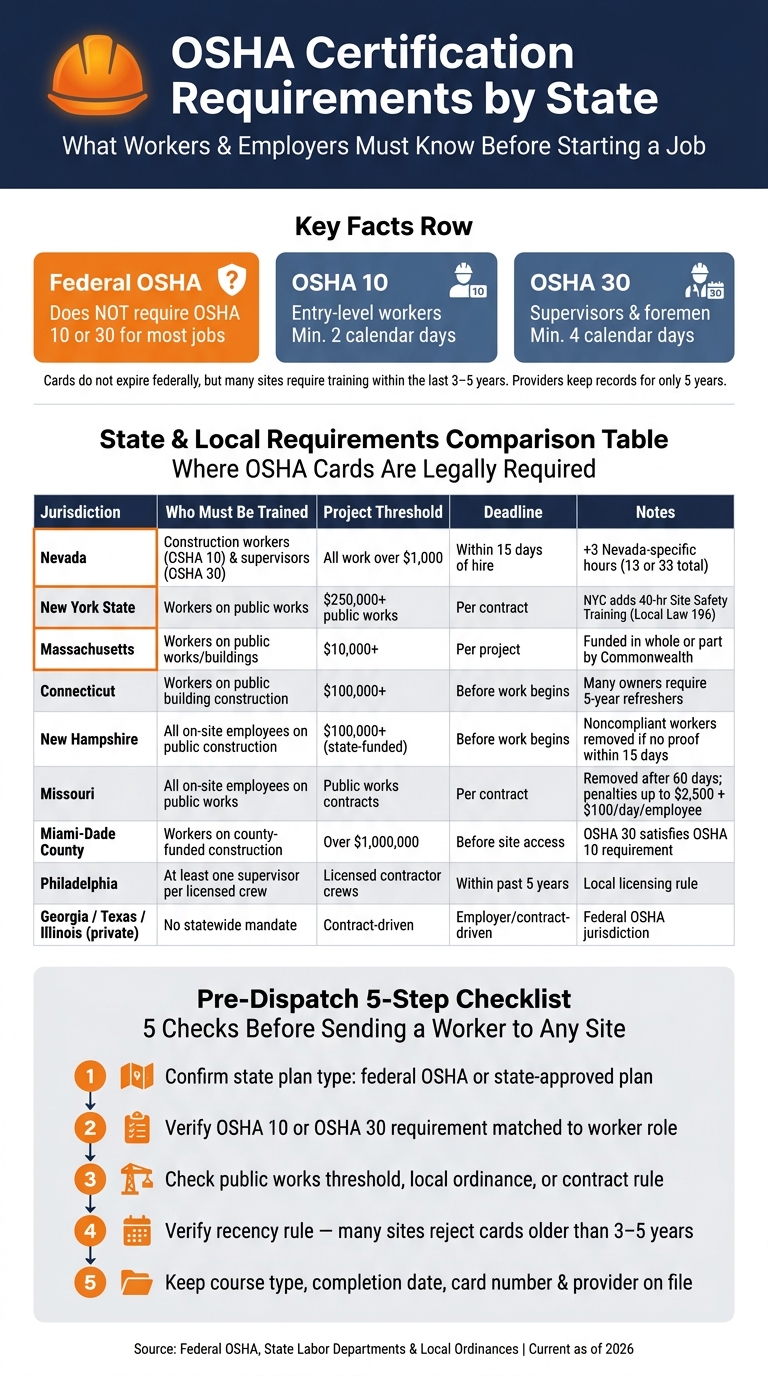
OSHA Certification Requirements by State: Quick Reference Guide
Is OSHA Federal or State? The Answer Depends on Where You Work
sbb-itb-aa28329
Quick Comparison
| Place | Rule Type | Who It Hits | Trigger |
|---|---|---|---|
| Nevada | State law | Construction workers and supervisors | Most construction work over $1,000 |
| New York State | State public works rule | Covered workers/some supervisors | Public works at $250,000+ |
| New York City | Local rule | Workers on many larger sites | Site Safety Plan-covered work |
| Massachusetts | State public works rule | Workers on covered public projects | $10,000+ |
| Connecticut | State public building rule | Construction workers | $100,000+ |
| New Hampshire | State-funded public work rule | On-site employees | $100,000+ |
| Missouri | State public works rule | On-site employees | Public works contracts |
| Miami-Dade County | Local rule | County-funded construction workers | Over $1,000,000 |
| Philadelphia | Local rule | At least one supervisor on licensed crews | Local licensing rule |
| Georgia | No statewide card law | Contract-driven | Varies by job |
| Illinois | No private-sector statewide card law | Contract-driven | Varies by job |
| Texas | No statewide card law | Contract-driven | Varies by job |
Bottom line: I would not treat “OSHA certification” as a license. It usually just means an OSHA Outreach card, and that card is only one part of jobsite compliance. You still need to match the right training track – Construction or General Industry – and check state, local, and contract rules before sending anyone to work.
Federal OSHA Training Rules: The Baseline Before Checking State Requirements
Federal OSHA does not require every worker to carry an OSHA 10 or OSHA 30 card. But employers still have to provide the hazard-specific training required under the OSHA standard that applies to the job. That baseline matters, because state rules often build on top of it.
When OSHA 10 vs. OSHA 30 Is Typically Required
OSHA 10 is meant for entry-level workers. OSHA 30 is usually for supervisors, foremen, and safety leads.
Here’s the key point: Federal OSHA does not require either card for general employment. In most cases, the card requirement comes from state law, contract language, or site rules. Nevada is one clear example. The state requires OSHA 10 for construction workers and OSHA 30 for supervisors within 15 days of hire. The next section shows where states turn those common expectations into legal rules.
Choosing the Right Training Track: Construction, General Industry, and Related Sectors
Pick the training track based on the work being done, not the company’s label. A business might call itself an energy company, utility contractor, or plant operator. That doesn’t decide the track. The job itself does.
| Work Type | Correct Track | Governing Standard |
|---|---|---|
| Building construction, bridges, highways, heavy civil | Construction | 29 CFR 1926 |
| Utility line installation, trenching, new pipeline construction | Construction | 29 CFR 1926 |
| New well pads, compressor stations, pipeline builds | Construction | 29 CFR 1926 |
| Plant/facility maintenance, manufacturing, warehousing | General Industry | 29 CFR 1910 |
| Terminal operations, midstream facilities, ongoing production | General Industry | 29 CFR 1910 |
When the work is mixed or not crystal clear, Construction is usually the safer default. Why? Because it covers higher-risk tasks such as scaffolding, excavation, and steel erection.
Accepted Training Formats and Proof of Completion
OSHA Outreach training can be delivered in a classroom, by live video, or through authorized online training from OSHA-authorized providers. OSHA 10 takes at least two calendar days, and OSHA 30 takes at least four.
After finishing the course, workers get a federal Department of Labor (DOL) wallet card. Before accepting that card, employers should check a few things:
- The industry track matches the job
- The provider is still authorized
- The course date meets any state or site recency rule
A General Industry card does not match a construction job. It’s that simple.
It also helps to keep verified card images and trainer details in one system. That way, dispatchers can confirm compliance before a worker is assigned to a site. Once the format and card check out, the next step is looking at each state’s rules.
OSHA Certification Requirements: All 50 States
How to Read Each State Entry
Each state entry uses the same format, which makes side-by-side checks much easier.
Here’s what each field means:
- Plan Type – Whether the state runs its own OSHA-approved program or stays under federal OSHA
- Coverage/Sectors – Which workers the rule applies to
- Required Training – Whether the rule calls for OSHA 10, OSHA 30, or a state-approved equivalent, and whether that rule comes from a statute, regulation, or contract language
- Project Threshold – The project value or project type that triggers the rule
- Completion Deadline – When the training has to be done
- Renewal Interval – Whether the state requires recertification or just employer retraining
- Notable State or Local Rules – Extra requirements, like NYC Local Law 196 or state-specific course content
Use those fields to answer a simple jobsite question: can this worker start now, or do they need training first?
Selected State and Local Rules
Most OSHA 10 and OSHA 30 requirements don’t come straight from statewide law. They usually show up in public contracts, local ordinances, or licensing rules. The entries here focus on places where OSHA card rules move beyond a common jobsite policy and become an actual legal requirement.
Nevada is one of the clearest examples. The state requires OSHA 10 for construction workers and OSHA 30 for supervisors within 15 days of hire. It also adds 3 hours of Nevada-specific content, which brings the totals to 13 hours or 33 hours. If an employer doesn’t follow the rule, the noncompliant worker must be suspended or terminated.
New York State requires OSHA 10 for workers on public works contracts advertised at $250,000 or more. New York City goes further. Under Local Law 196, workers on many large construction and demolition sites covered by a Site Safety Plan must complete a 40-hour Site Safety Training package.
A few other places have direct OSHA 10 or OSHA 30 rules worth flagging.
Massachusetts requires OSHA 10 for workers on public works and public building projects funded in whole or in part by the Commonwealth. The threshold starts at $10,000.
Connecticut requires OSHA 10 on public building construction contracts of $100,000 or more. On top of that, many owners and agencies expect workers to retrain every 5 years.
New Hampshire requires all on-site employees to complete OSHA 10 before they begin work on public construction projects costing $100,000 or more when those projects are funded in whole or in part by state funds. If a worker shows up without it, they must provide proof of completion within 15 days or be removed.
Missouri takes a strict approach through the Construction Safety Training Act. All on-site employees on public works contracts must complete OSHA 10 or a comparable state-approved program. Workers who still haven’t met the rule after 60 days must be removed, and penalties can reach $2,500 plus $100 per calendar day per employee.
At the local level, Miami-Dade County requires workers on county-funded construction contracts over $1,000,000 to complete a 10-Hour Construction Course. An OSHA 30 Construction card also satisfies that OSHA 10 rule.
Philadelphia uses a narrower local rule. Licensed contractor crews must have at least one supervisory employee who completed OSHA 30 within the past 5 years.
By contrast, Georgia, Texas, and most private-sector construction in Illinois do not have statewide OSHA card mandates. In those places, training rules usually come from the employer, the owner, or the contract itself.
Selected State and Local Requirements
Statewide rules and local rules are split out below so you can check the right source fast.
| Jurisdiction | Who Must Be Trained | Project Threshold | Completion Deadline | Renewal / Notes |
|---|---|---|---|---|
| Nevada | Construction workers; supervisory employees | All work over $1,000 | Within 15 days of hire | No formal expiration; Nevada adds 3 state-specific hours, for 13 or 33 total hours |
| New York State | Workers on covered public works; supervisors on certain contracts | Public works advertised at $250,000 or more | As required by the contract | NYC Local Law 196 adds a 40-hour Site Safety Training package for many large sites |
| Massachusetts | Workers on public works and public building projects | $10,000 and up | Per project requirements | Public works/public buildings funded in whole or in part by the Commonwealth |
| Connecticut | Workers on public building construction | $100,000 and up | Before work begins | Many owners expect 5-year refreshers |
| New Hampshire | All on-site employees on covered public construction projects | $100,000 and up, funded in whole or in part by state funds | Before beginning work; noncompliant workers must provide proof of completion within 15 days or be removed | Exempt roles exist under the statute |
| Missouri | All on-site employees on public works contracts | Public works contracts | Per contract | Noncompliant workers are removed after 60 days; penalties can reach $2,500 plus $100 per calendar day per employee |
| Miami-Dade County (local) | Workers on county-funded construction contracts | Over $1,000,000 | Before site access | OSHA 30 Construction satisfies the OSHA 10 requirement |
| Philadelphia (local) | At least one supervisory employee on licensed contractor crews | Licensed contractor crews | OSHA 30 must be completed within the past 5 years | Local rule |
| Georgia | No statewide mandate; contract-driven | No statewide mandate | Employer- or contract-driven | Federal OSHA jurisdiction |
| Illinois | No statewide mandate for private-sector workers; contract-driven | No private-sector statewide mandate | Employer- or contract-driven | Federal OSHA jurisdiction for private construction |
| Texas | No statewide mandate; contract-driven | No statewide mandate | Employer- or contract-driven | Federal OSHA jurisdiction |
Renewal, Recordkeeping, and Multi-State Compliance
When OSHA Cards Expire and When Retraining Is Required
Once you confirm the rule in a given state, the next step is simple: make sure the card still meets the job’s timing rules.
At the federal level, OSHA Outreach cards do not expire. An OSHA 10 or OSHA 30 card serves as proof that the worker completed the course. But there’s a catch. OSHA does not keep the class records. Authorized providers keep them for five years, and once that period ends, replacement cards can’t be issued.
That’s where state and project rules start to matter. Public work often adds its own recency standard. Some public works jobs require OSHA 10 Construction to have been completed within the last five years. On top of that, many owners and general contractors set internal rules that call for refresher or supplemental training every 3 to 5 years. Before you send anyone to a site, read the bid or solicitation language closely for any recency requirement.
What Employers Should Keep on File
Good records make inspections and jobsite audits a lot less painful. Even when a rule doesn’t strictly require a record, it still makes sense to keep one.
At a minimum, keep:
- OSHA 10/30 cards
- Training dates
- The name of the authorized trainer or provider
It also helps to keep refresher course logs and toolbox talk records with the date, topics covered, trainer, and attendees. For workers assigned to state-funded or municipal contracts, connect each worker to the exact project and document any site-specific orientation completed before site access. If retraining happens after a near miss or a recordable incident, track that in a separate log.
For multi-state crews, put everything in one digital system and keep it for at least five years, or longer if another rule says so. That kind of setup cuts down on last-minute issues when workers move from one state to another.
Using ABLEMKR to Track Worker Credentials Across States

For mobile crews, manual tracking can fall apart fast. A worker cleared for one state’s public project may still need a different document set or a more recent training record in another place.
ABLEMKR is built for that kind of problem. ABLEMKR matches pre-vetted workers to job sites based on certifications, safety training, availability, and location. Employers also get built-in compliance tracking tied to integrated payroll workflows, which helps teams confirm worker readiness before dispatch. That check can help crews get moving faster for shutdowns and remote repairs.
Conclusion: What to Check Before Sending a Worker to Any Job Site
Before dispatch, confirm which rule set applies and whether the site calls for OSHA 10 or OSHA 30. A quick check up front can save a lot of trouble once the crew is on the road.
Use these five checks before you release a worker to a site:
- Confirm whether the state operates under federal OSHA or an OSHA-approved state plan.
- Verify whether the project requires OSHA 10 or OSHA 30, and match it to the worker’s role.
- Check whether a public works threshold, local ordinance, or contract rule triggers training.
- Verify any recency rule; many sites reject cards older than 3 to 5 years.
- Keep the course type, completion date, card number, and provider on file.
Missing documentation during a site audit or OSHA inspection can delay deployment.
These five steps should be a standard gate in every mobilization workflow, not something you deal with after a crew is already en route.
FAQs
Do I need OSHA 10 or OSHA 30?
OSHA 10 is meant for entry-level workers, including laborers and apprentices. It covers basic job site safety, such as hazard recognition and personal protective equipment.
OSHA 30 is aimed at supervisors, foremen, and safety managers. It goes deeper into safety rules, risk management, and compliance.
The right course depends on your role. In some cases, employers or local jurisdictions require one of these courses for site access.
Which OSHA training track fits my job?
It mostly comes down to your job.
The OSHA 10-hour course is meant for entry-level workers. It covers the basics, like hazard recognition, proper PPE use, and worker rights.
The OSHA 30-hour course is geared toward supervisors, forepersons, and safety professionals. It goes deeper and fits people who oversee crews or handle jobsite safety.
Both courses come in industry-specific versions, such as construction or general industry. On top of that, you may need task-specific training for certain duties, like operating equipment or working in confined spaces.
Can an old OSHA card still be accepted?
Yes. Federal OSHA 10- and 30-hour cards do not have an official expiration date, so an older card may still be accepted.
That said, local rules, employers, or project owners may ask for refresher training every three to five years. If a card is older or seems unusual, verify it through the issuing trainer or the OTI Education Center.


