
Wind turbine maintenance is high-risk work, and the basics are simple: stop falls, isolate power, control entry, and plan rescue before the job starts.
If I had to sum up the full article in a few lines, it would be this: technicians often work 121 to 328 feet up, OSHA fall rules can apply at 4 feet and above, and remote sites add delays when someone gets hurt. That means safe work depends on four things: current training, task-specific clearance, site checks before work, and clear records after the job.
Here’s the short version:
- Train the crew first. GWO BST and BTT help prepare workers, but electrical work, LOTO, and confined space entry need separate clearance.
- Use the main controls every time. That means 100% tie-off, zero-energy verification, and entry controls for towers, hubs, and nacelles.
- Check conditions before work starts. Weather, ice, overspeed, vibration, fire risk, and rescue delays can all change the plan.
- Treat preventive maintenance as a safety step. Brake checks, blade checks, grounding checks, and thermal scans can help catch problems early.
- Practice emergencies. Crews need drill-based plans for fire, medical events at height, storms, and electrical incidents.
- Track everything. Training dates, permits, JHAs, LOTO logs, inspections, and drill records all need to be current and easy to verify.
A simple way to think about it:
| Focus area | What matters most |
|---|---|
| Worker readiness | Current training, medical fitness, task clearance |
| Fall safety | Harness checks, ladder systems, SRLs, tie-off |
| Energy control | LOTO, stored-energy release, zero-voltage test |
| Entry safety | Air monitoring, attendants, rescue setup |
| Site risk | Weather, ice, fire, overspeed, communication |
| Records | Permits, logs, inspections, drill history |
If a crew is not trained, locked out, tied off, and rescue-ready, the job should not start.
Below, I’ll walk through the article’s main points in plain English so you can see what safe wind turbine maintenance looks like in practice.
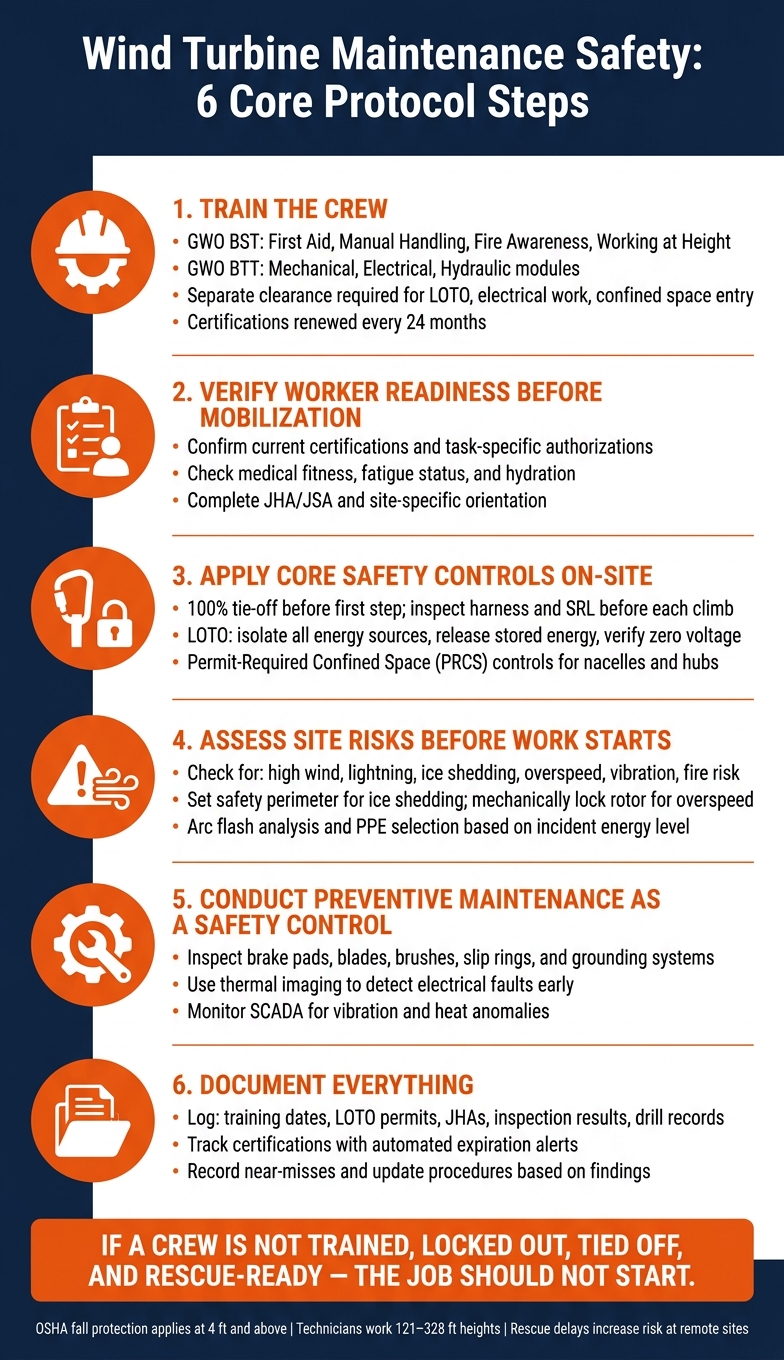
Wind Turbine Maintenance Safety: 6-Step Protocol Checklist
Inside Wind Turbine Safety Training | Iain Tindall
sbb-itb-aa28329
Training, Certification, and Worker Readiness
Once you identify the hazards, the next step is making sure each worker is cleared for the job. Written rules matter, but they only work when the crew can carry them out safely in the field. In wind turbine maintenance, that means training, certification, and fitness all need to be in place.
Core Technician Training: Heights, First Aid, Fire, and Manual Handling
GWO Basic Safety Training (BST) is the starting point for wind technicians. It covers First Aid, Manual Handling, Fire Awareness, Working at Height, and Sea Survival for offshore crews. GWO BST also includes hands-on rescue drills, and certifications usually need refresher training every 24 months to keep workers current. Worker readiness also includes medical fitness, fatigue control, and hydration, especially for remote climbs.
For technical tasks, GWO Basic Technical Training (BTT) gives workers basic instruction in mechanical, electrical, hydraulic, bolt tightening, and installation modules. It is meant to prepare technicians for supervised work and company-specific training.
Task-Specific Authorization for Electrical Work, LOTO, and Confined Spaces
Core training alone does not clear someone for electrical work, LOTO, or confined-space entry.
Electrical work on wind turbines falls under NFPA 70E and OSHA 1910.269. These rules require arc flash hazard analysis and PPE chosen based on incident energy levels. Only a qualified person with documented training and authorization should perform or supervise this work. Lockout/Tagout (LOTO) authorization under OSHA 1910.147 must also be documented separately in the authorization log. For confined space entry into nacelles or hubs, technicians need Permit-Required Confined Space (PRCS) authorization under OSHA 1910.146, along with air monitoring and a designated attendant.
Before dispatch, workers should complete a JHA/JSA and a site-specific orientation. That review should cover weather, fatigue, hydration, rescue plans, communication readiness, and turbine-specific hazards like high wind, ice shedding, fire, and overspeed.
How ABLEMKR Helps Verify Certifications and Crew Readiness Before Mobilization

ABLEMKR verifies certifications, availability, and location before mobilization, giving employers real-time visibility into crew readiness. That check should happen before crews move into climb, electrical, and entry procedures.
Use the checklist below to confirm crew readiness before mobilization:
| Training Category | Standard/Module | Typical Renewal Interval | Documentation Tracked |
|---|---|---|---|
| Core Safety | GWO BST (First Aid, Manual Handling, Fire Awareness, Working at Height, Sea Survival) | 24 months | GWO WINDA ID, Certificate of Completion |
| Technical Competency | GWO BTT (Mechanical, Electrical, Hydraulic, Bolt Tightening, Installation) | Initial training | Module records, supervised task logs |
| Electrical Safety | NFPA 70E / OSHA 1910.269 | Varies; often 3 years | Arc flash training records, Qualified Person authorization |
| Hazardous Energy (LOTO) | OSHA 1910.147 / 1910.269(d) | Annual review | Authorization log, LOTO permit records |
| Confined Space | OSHA 1910.146 (PRCS) | Annual / task-specific | Entry permits, atmospheric testing logs |
Dispatch only after every applicable certification, permit, and training record is current. Once readiness is confirmed, the next move is putting the main maintenance controls to work on site.
Core Safety Protocols for Routine and Corrective Maintenance
With the crew ready to go, the work shifts to the job site. At that point, safety comes down to handling the hazards most likely to cause severe injuries. Routine inspections and corrective repairs don’t look exactly the same, but three controls keep showing up as the make-or-break factor: fall protection, electrical isolation, and confined space control.
Fall Protection and Safe Tower Climbing Procedures
OSHA 1910.28(b) requires a Personal Fall Arrest System (PFAS) or ladder safety system on any fixed ladder over 24 feet. Start with 100% tie-off before the first step off the ground. And before anyone clips in, check that anchor points are rated for the task.
Before each climb, inspect the full-body harness for stitching damage, D-ring wear, and readable labels. Check the self-retracting lifeline (SRL) too. It should retract smoothly and lock when tested. Climb-assist systems can cut fatigue on long climbs, which sounds great on paper and feels even better halfway up a tower, but they do not replace fall protection. Set the assist force to the climber’s weight so it doesn’t get in the way of the vertical lifeline.
Use the right setup for the area where the work happens:
| Location | Primary System | Key Equipment |
|---|---|---|
| Tower Ladder | Climbing Ladder Fall Arrest System (CLFAS) | Rail or cable, carrier sleeve (shuttle), front D-ring harness |
| Nacelle Top | Class 2 SRLs (Leading Edge) | Reinforced lifeline, energy absorber, dorsal D-ring |
| Hub/Nacelle Interior | Work Positioning / Fall Restraint | Side D-rings, short positioning lanyards, anchor points |
Work stops at once during lightning, extreme wind, ice buildup, or poor visibility. Once fall protection is in place, the next step is simple: control energy before hands-on work starts.
Electrical Isolation, Lockout/Tagout, and Arc Flash Controls
"Electricity is one of the most dangerous parts of wind turbine work." – Texas Department of Insurance
The lockout process follows a clear order: identify all energy sources, isolate them, release stored energy, and then apply a personal lock and tag. After that, verify zero energy by trying the controls or testing voltage.
When technicians work near electrical parts, they must wear flame-resistant (FR) clothing and rubber gloves. Any live troubleshooting work also calls for insulated tools and voltage-rated mats.
| Electrical Task | Required Controls | PPE & Tools |
|---|---|---|
| System Repair | LOTO (Lockout/Tagout) | Personalized padlocks, tags, circuit tester |
| Circuit Testing | Verification of zero energy | Multimeter, arc flash face shield, FR clothing |
| Nacelle Mechanical/Hydraulic Work | Mechanical and hydraulic isolation | Rotor locks, hydraulic bleed-off valves, rubber gloves |
| Live Troubleshooting | Safe boundaries and limited access | Insulated tools, rubber gloves, voltage-rated mats |
This isn’t the place to cut corners. A quick check that gets skipped can turn into a major incident fast. Once energy is under control, the next check is the space itself.
Confined Space Entry and Safe Movement Inside Towers and Nacelles
A nacelle or hub may qualify as a Permit-Required Confined Space (PRCS) under OSHA 1910.146. If it does, entry requires continuous atmospheric monitoring, forced ventilation when needed, a designated attendant outside the space, and a documented rescue plan before entry begins.
Communication is part of that control, not an extra step. Set dedicated radio channels, agree on check-in intervals, and confirm emergency signals before entry. The attendant must stay in contact the whole time and follow the site rescue plan.
| Confined Space Risk | Mitigation Measure |
|---|---|
| Atmospheric Hazards | Continuous air monitoring and forced ventilation |
| Entrapment / Pinch Points | Mechanical isolation and LOTO of rotor and yaw systems, blade locking pins |
| Communication Failure | Dedicated attendant, assigned radio channel, and timed check-ins |
| Emergency Rescue | Pre-rigged descent devices and practiced rescue drills |
Inside towers and nacelles, small habits matter. Use tool tethers and toe-boards to stop dropped objects. Keep two points of contact when moving through tight spaces.
These controls feed straight into the pre-job risk assessment and emergency plan.
Risk Assessment, Preventive Maintenance, and Emergency Response
These controls only hold up when crews plan for changing conditions, keep key systems in working order, and practice rescue steps before the job starts.
Pre-Job Risk Assessment and Site-Specific Safe Work Planning
A pre-job risk assessment should line up the LOTO plan with every electrical, mechanical, and stored-energy source on the turbine. The Site Safety Supervisor or a designated technician should complete and sign the safety checklist. That checklist needs to cover wind, thunderstorms, ice shedding, fire, overspeed, vibration, and unusual noise.
Those aren’t box-checking items. Each one can change the job plan on the spot. Ice shedding means setting and enforcing a safety perimeter around the turbine base. An overspeed condition means the rotor must be mechanically locked before nacelle entry is even considered. The checklist should also include fall-protection inspection.
Arc flash analysis belongs in the electrical part of the assessment, and PPE should be chosen based on the incident energy level at each work point. After LOTO, authorized employees should verify zero voltage and test the controls before work begins.
This checklist ties straight back to the hazards already covered: falls, electrical isolation, confined space entry, and rescue delays at remote sites. Once the job plan is in place, the next step is keeping the turbine from breaking down in the first place.
Preventive Maintenance as a Safety Control, Not Just a Reliability Task
Preventive maintenance is a reliability task, but it’s also a major safety control. Skip scheduled maintenance, and planned work can turn into higher-risk emergency repair work fast.
A structured preventive program should focus first on the components most likely to create dangerous conditions if they fail. Brushes and slip rings are high-wear parts, and if they’re neglected, they can arc. Brake pad thickness and emergency stop function should be checked on a set schedule, not only after something starts sounding off. Blade inspections can spot chips, cracks, leading-edge erosion, and fastener torque loss before they become structural problems.
Thermal imaging and grounding checks are useful for finding electrical faults before they escalate. SCADA condition monitoring gives operators a steady view of vibration and heat, which helps flag changes before they become failures.
When preventive checks are up to date, emergency response tends to be simpler and needed less often.
Emergency Rescue, Evacuation, and Incident Drills
The plan should cover high wind speeds, thunderstorms, ice shedding, fire, turbine overspeed, high vibrations, and unusual noise. It also needs to spell out the exact steps, assigned roles, and equipment for each response.
Drills matter because emergencies rarely play out the way people expect. A nacelle fire is not the same as a medical event at height, and each one calls for a crew that has already practiced the response. Communication chains should be confirmed before entry, not made up in the middle of a bad situation.
| Emergency Scenario | Required Response Steps | Key Equipment | Drill Frequency |
|---|---|---|---|
| High Wind / Severe Weather | Immediate shutdown; evacuate tower if wind limits are exceeded or thunderstorms develop | Remote software stop; anemometer monitoring | Quarterly |
| Nacelle Fire | Emergency stop; fire suppression; evacuate via descent system | Fire extinguishers; emergency descent device | Semi-annually |
| Medical Event at Height | Initiate rescue-from-height protocol; contact emergency chain | Rescue harness; descent devices; first aid kit | Semi-annually |
| Overspeed Condition | Engage emergency brakes; apply mechanical rotor lock | Brake system; main disconnect switch | Annually |
| Electrical Incident | LOTO verification; arc flash PPE; medical assessment | NFPA 70E-compliant PPE; voltage testers | Annually |
Every maintenance and emergency action should be logged with the date, crew, findings, and corrective action. Those records feed the compliance tracking process.
Compliance Tracking and Building a Safer Wind Maintenance Program
Tracking Training Status, Inspections, and Maintenance Records Across Crews
Once controls are in place, the last step is proving people followed them. Every safety action in this guide needs a record. If it isn’t documented, it can’t be confirmed in an audit.
Keep certification expirations, task authorizations, and audit trails in one digital system. A central system gives you one source of truth for certifications, authorizations, and expiration dates. Paper files and spreadsheets tend to fall apart when crews work across many sites. Toolbox talk logs should also be part of the record set, especially when crews review fatigue and dropped object prevention before the shift starts.
ABLEMKR gives employers real-time visibility into credentials, onboarding, and mobilization status before deployment. Its mobile-first platform tracks worker certifications, authorizations, and compliance records in one place – supporting audit trails and pre-mobilization readiness for wind operators managing rotating crews across remote U.S. sites.
Track the records that show each control was completed.
| Compliance Item | Documentation Requirement | Monitoring Method |
|---|---|---|
| Training & Certifications | Current certificates, authorizations, and renewal dates | Digital database with automated expiration alerts |
| PPE & Fall Protection | Pre-use inspection logs for harnesses, lanyards, and anchor points | Digital checklists with photo verification |
| Risk Assessment | Site-specific JHA/JSA, Permits to Work, and Approved Written Procedures (AWPs) | Pre-shift digital submission before site access |
| Energy Isolation | LOTO logs, zero-voltage test results, isolation point photos | Step-by-step digital workflow with mandatory sign-offs |
| Asset Maintenance | Turbine maintenance records with date, time, personnel, findings, and corrective actions | Turbine-specific digital maintenance records |
| Incidents & Near-Misses | Near-miss reports and incident follow-up actions | Centralized reporting database with follow-up tasks |
| Emergency Response | Drill logs, attendance records, and corrective actions | Scheduled drill logs with participation records |
Compliance also means learning from small failures before they turn into incidents. A near-miss only helps if someone reviews it, spots patterns, and updates the procedure. That feedback loop is what turns reporting into prevention.
Key Takeaways for Employers, Project Managers, and Technicians
A safer wind maintenance program doesn’t come from one control alone. It comes from layering skilled workers, task-specific protocols, and clean documentation. The core requirements are:
- Verify GWO training, LOTO authorizations, and task-specific certifications before mobilization.
- Use fall protection, LOTO, confined space controls, and task-specific procedures every time.
- Treat preventive maintenance as a safety control.
- Document JHAs, inspections, incidents, and rescue drills in audit-ready records.
Wind turbine maintenance will always carry real risk. The job is to make sure every person on the crew is trained, every control is in place, and every action is documented well enough to prove it.
FAQs
Who is qualified to perform wind turbine maintenance?
Wind turbine maintenance should be handled by people who have the right training, hands-on skills, and verified ability for the job. These workers are often called wind turbine technicians, or windtechs.
When the work involves electrical systems, the job must be done by a Qualified Electrical Worker (QEW). That means someone with proven skill in safety procedures, including work in high-voltage settings.
ABLEMKR helps companies keep track of certifications, safety training, and worker deployment.
When should turbine maintenance work be stopped?
Stop work at once if conditions turn unsafe, such as when thunderstorms are moving in. Lower crane booms and clear workers from the area.
This job involves dangerous heights and complex machinery, so any team member has the authority to stop operations if something feels off. Work also must not continue until all energy sources are isolated and confirmed through Lockout/Tagout procedures.
What records should crews keep for compliance?
Crews should keep clear, up-to-date records for electrical work. That includes updated electrical installation drawings, current training certifications, and worker qualification records that show:
- who is certified
- what each person is allowed to do
- when each credential expires
They should also keep maintenance and safety records in good order. This includes signed work orders, approved written procedures, permits to work, and key and lock management documentation.


