
Battery Energy Storage Systems (BESS) are critical for balancing power grids, especially with the rise of renewable energy. However, they come with unique safety risks, including thermal runaway, toxic gas emissions, and high-voltage electrical hazards. Proper safety training is essential for workers and first responders to manage these dangers effectively.
Key Takeaways:
- Thermal runaway can cause fires lasting days, as seen in incidents like the 2024 Gateway Energy Storage Facility fire.
- Toxic gases such as hydrogen fluoride and carbon monoxide pose health risks during fires, requiring isolation zones and protective gear.
- Electrical hazards include arc flash and stranded energy, making specialized training vital.
- Standards like NFPA 855 (2026 update), UL 9540A, and OSHA regulations form the basis of safety protocols.
- Training covers electrical safety, thermal risk management, and physical safety, with hands-on simulations, certification programs, and collaboration with first responders.
Safety training ensures compliance with regulations, reduces risks during installation and operation, and prepares teams for emergencies. Digital tools now streamline training and certification tracking, improving workforce readiness for this rapidly evolving industry.
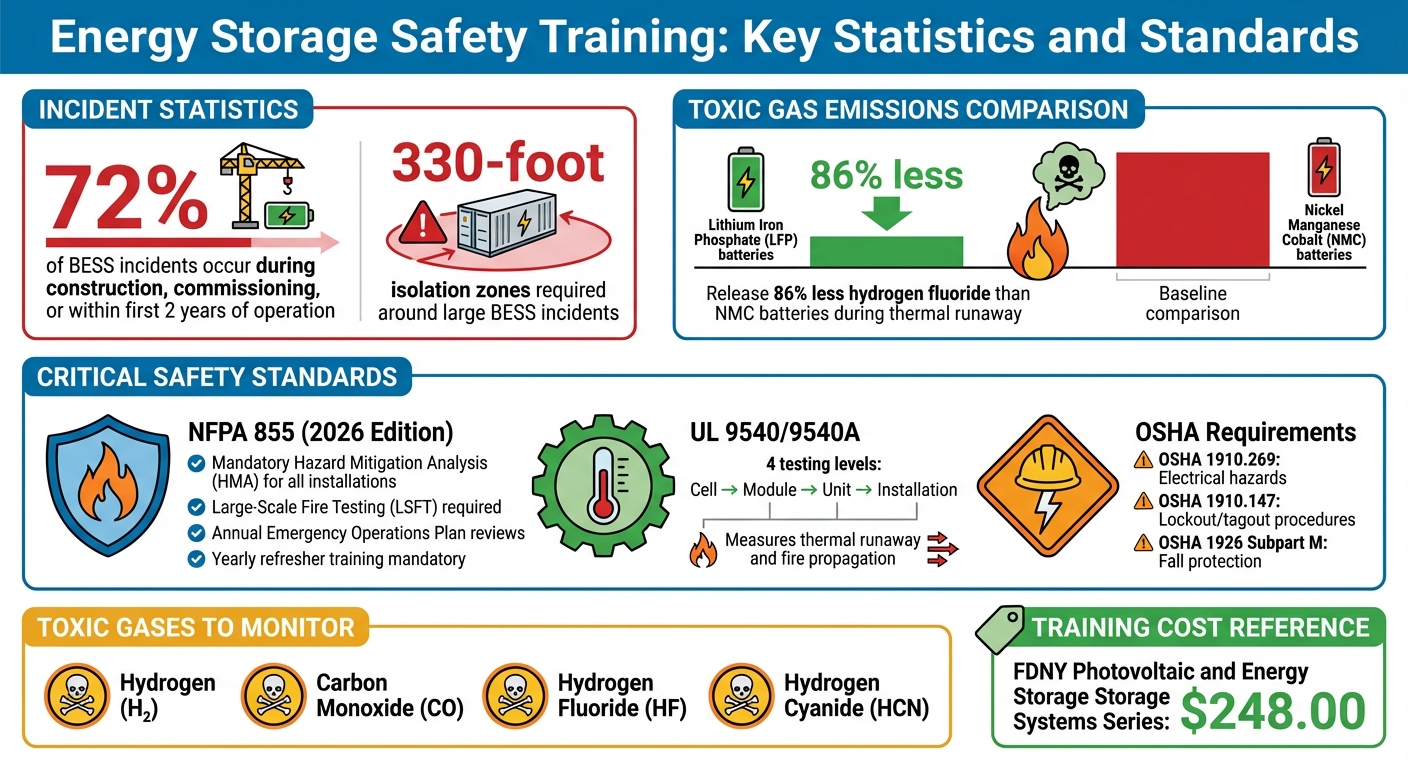
Energy Storage Safety Statistics and Key Standards Overview
Battery Energy Storage Safety: From Cells to Systems
sbb-itb-aa28329
Safety Standards for Energy Storage Systems
Energy storage safety training is built around strict standards and regulations that outline both the knowledge workers need and the responsibilities of employers to ensure their safety. These standards have evolved quickly, spurred by high-profile incidents that revealed gaps in safety measures. Key frameworks like NFPA 855, UL certifications, and OSHA requirements are central to the safe operation of battery energy storage systems (BESS).
NFPA 855: Fire and Explosion Safety

The 2026 edition of NFPA 855 brings major updates to fire safety protocols for energy storage systems. One of the biggest changes is the mandatory Hazard Mitigation Analysis (HMA) for all BESS installations, eliminating exemptions based on system size. This requires training programs to include site-specific hazard evaluations, addressing risks like thermal runaway, gas generation, and deflagration.
Another key update is the requirement for Large-Scale Fire Testing (LSFT), which must be combined with UL 9540A data to ensure the safety of entire systems, not just individual components. Workers need to understand how full installations behave under severe conditions, such as during thermal runaway. In addition, the standard now mandates integrating deflagration venting with explosion prevention measures outlined in NFPA 69.
"The 2026 edition introduces the most significant changes yet: mandatory Hazard Mitigation Analysis for virtually all installations, explicit Large-Scale Fire Testing requirements, and a clear message that explosion prevention can no longer rely on venting alone." – Wattality Engineering
Training under NFPA 855 focuses on equipping workers with the skills to identify and manage BESS-specific hazards. This includes using multi-gas detection systems (for H₂, CO, HF) to catch early signs of thermal runaway. Emergency Operations Plans must be reviewed annually, and all personnel are required to undergo yearly refresher training. Local fire departments must also be informed of training schedules.
UL 9540 and UL 9540A: System-Level Safety

UL 9540 provides a safety certification for entire energy storage systems, while UL 9540A focuses on thermal runaway and fire propagation across four levels: cell, module, unit, and installation.
"UL 9540A is the only fire and explosion testing method that will be referenced in the 2026 edition of NFPA 855." – UL Solutions
The data from UL 9540A testing – such as gas composition, heat release rates, and fire spread behavior – plays a critical role in shaping worker safety training and emergency response plans. For instance, testing has shown that Lithium Iron Phosphate (LFP) batteries release about 86% less hydrogen fluoride than Nickel Manganese Cobalt (NMC) batteries during thermal runaway, highlighting the importance of understanding battery chemistry-specific risks. While UL 9540A testing can be expensive, its insights are vital for creating thorough training programs.
OSHA Standards and Worker Safety
OSHA regulations are essential for protecting workers involved in the construction, maintenance, and operation of energy storage systems. Three key standards apply directly to BESS:
- OSHA 1910.269: Focuses on electrical hazards in power generation and distribution, including high-voltage battery systems.
- OSHA 1910.147: Establishes lockout/tagout (LOTO) procedures to control hazardous energy during battery installation and maintenance. This is crucial since batteries can remain dangerous even after being disconnected.
- OSHA 1926 Subpart M: Addresses fall protection requirements, especially important for utility-scale or rooftop energy storage installations.
These standards are crucial because most BESS incidents – 72% – occur during construction, commissioning, or within the first two years of operation. For example, the 2019 explosion at the McMicken facility in Arizona, which injured four firefighters, led to stricter OSHA-aligned emergency protocols and mandatory deflagration venting. Training programs must focus on these high-risk phases, ensuring workers can identify and mitigate hazards during installation and early operations.
With these safety standards as the groundwork, we’ll next look at the specific training components designed to address these risks.
What Energy Storage Safety Training Covers
Energy storage safety training equips workers to handle the specific risks associated with battery energy storage systems (BESS). These systems present unique challenges because they cannot usually be completely de-energized, unlike traditional power facilities. Training focuses on three key areas: electrical safety, thermal and fire risk management, and physical safety protocols. Each area addresses the distinct hazards of working with BESS.
Electrical Safety and Lockout/Tagout Procedures
Electrical safety training for BESS revolves around Qualified Electrical Worker (QEW) programs, which are designed to enhance workers’ knowledge and skills for operating in energized environments. BESS systems remain energized even during maintenance, making traditional lockout/tagout (LOTO) procedures more complex and requiring specialized approaches.
Workers are trained to use the Battery Management System (BMS) to monitor key electrical parameters, such as over-voltage or current imbalances, which could signal potential issues. The training also explains the differences between AC-coupled and DC-coupled systems, as each presents unique hazard profiles depending on how they connect to the grid. Before operating any BESS, staff must complete this training, with annual refresher courses required to maintain safety standards.
While electrical safety protocols help prevent overloads and short circuits, managing heat and fire risks demands a completely different set of skills.
Thermal and Fire Risk Management
Thermal safety training focuses on identifying and responding to thermal runaway events. Workers learn to use the BMS to track individual cell temperatures and voltages, which can indicate overheating. For fire response, the training emphasizes a controlled burn strategy – allowing a fire to burn out while consuming flammable gases to reduce explosion risks and prevent reignition. Instead of directly extinguishing the fire, responders use water to protect nearby enclosures and structures from the flames.
Emergency procedures include creating 330-foot isolation zones around large BESS incidents, ensuring personnel stay upwind and uphill to avoid exposure to toxic gases. Full personal protective equipment (PPE), including Self-Contained Breathing Apparatus (SCBA), is required to guard against harmful emissions like hydrogen fluoride, hydrogen cyanide, and carbon monoxide. Air monitoring during these events focuses on detecting these specific gases, while ventilation systems are used to minimize flammable gas accumulation.
Fall Protection and Physical Safety
Physical safety training addresses the risks of mechanical damage, which can lead to thermal runaway. Workers are taught to avoid actions like dropping batteries, improper handling that causes punctures, or exposing units to excessive vibration – all of which can damage internal components and trigger short circuits.
"Mechanical Damage: Dropping the battery, punctures from improper handling, or excessive vibration can damage the delicate internal structures… causing an internal short circuit." – Bob Wu, Solar Engineer, Anern
The training also covers maintaining proper clearance around batteries and inverters to ensure airflow and prevent overheating. Workers are instructed to protect systems from high humidity, which can lead to condensation, corrosion, and electrical faults. Regular visual inspections for swelling, bulging, or corrosion are critical to spotting early signs of system failure.
Hands-On Training Methods
Hands-on training makes safety standards practical, helping workers apply protocols from NFPA 855, UL 9540A, and OSHA in real-world scenarios. For battery energy storage systems (BESS), which often can’t be fully de-energized, workers need realistic practice that mirrors what they’ll face on the job site. This type of training ensures they’re ready to handle the unique challenges of these systems.
Simulation-Based Training
Interactive training tools, like online modules and video programs, provide an accessible starting point for workers new to energy storage. For example, NFPA offers online courses covering battery basics, hazards, and emergency response in an engaging, interactive format. The FDNY also provides a Photovoltaic and Energy Storage Systems Series for $248.00, which focuses on installation, maintenance, and inspection.
On-site familiarization takes training a step further. This hands-on approach gives workers and first responders a detailed look at specific facilities. For instance, the FDNY-Con Edison collaboration created videos that guide personnel through the layout and risks of individual battery storage sites. Between 2022 and 2024, Fluence conducted dozens of first responder training sessions. These sessions focused on emergency scenarios, teaching participants to identify alarm types and maintain safe distances during thermal events.
"Annual training sessions are essential to getting first responders familiar with battery storage technology and preparing them for emergency response scenarios." – Fluence
Training also emphasizes transitioning from automated safety systems to manual responses. Workers practice using thermal imagers to detect temperature changes in overheated batteries, a critical skill for identifying thermal runaway risks before ignition. These drills help personnel interpret alarms and act quickly when needed.
Structured mentorship programs offer another layer of skill-building, ensuring workers gain deeper expertise.
Mentorship and Certification Programs
Certification programs validate that workers have the skills to safely handle BESS installations and operations. Certified installers help prevent common mistakes, such as improper wiring or inadequate ventilation, which can lead to serious safety hazards. The American Clean Power (ACP) organization offers Qualified Electrical Worker (QEW) program guidelines tailored to the unique challenges of BESS operations and maintenance.
"Battery Energy Storage Systems (BESS) are unique in that they cannot typically be fully de-energized and there are so many tasks to be performed by so few technicians, often without the specializations found in traditional generation facilities." – American Clean Power (ACP)
Certification courses cover topics like electrical theory, failure modes, incident response, and emergency preparedness. These programs are becoming increasingly critical as regulations tighten. For instance, UL 9540 certification is often a prerequisite for permitting and utility interconnection in North America. Workers trained through these programs learn to manage specific hazards like thermal runaway, toxic gas release, and "stranded energy", a persistent shock hazard even after a fire.
Mentorship programs built around the Incident Command System (ICS) also play a key role. They prepare trained leaders to coordinate responses, manage internal teams, and communicate with external first responders during emergencies. This leadership becomes even more important as aging battery systems behave less predictably over time.
Training with First Responders
In addition to technician training, joint exercises with first responders are crucial for comprehensive emergency preparedness. Collaborating with local fire departments ensures everyone involved has a clear understanding of safety protocols and roles during emergencies. California Senate Bill 38, signed in October 2023, now requires battery storage owners to develop emergency response plans in coordination with local agencies.
These joint sessions familiarize first responders with site-specific equipment and failure risks. Facility operators should invite local fire departments for site tours, providing digital schematics and hazard data to establish clear response protocols. Such exercises also clarify decision-making authority among key personnel, emergency responders, and utility operators.
"Clarity in roles and responsibilities ensures a swift and efficient response, minimizing downtime and potential risks during an emergency." – Fluence
Regular refresher sessions are just as important. They help account for staff turnover and keep everyone updated on changes to site conditions or operations.
Using Technology for Safety Compliance
Technology has become a game-changer in managing safety compliance and workforce coordination, complementing essential hands-on training.
When it comes to energy storage, safety compliance involves keeping track of certifications, training records, and worker qualifications across an entire site. Regulatory codes mandate initial and annual refresher training for both staff and emergency responders. Additionally, the local Authority Having Jurisdiction (AHJ) requires detailed documentation and certification records before granting operational approval. As the American Clean Power Association notes:
"Before operation, facility staff and emergency responders must be trained in safety procedures and are required to be given annual refresher training".
Digital compliance logs simplify this process by replacing manual paperwork. They ensure that worker certifications and training records are easily accessible during AHJ inspections. For non-residential battery systems exceeding 50 kWh (tested under UL 9540A), having precise and up-to-date documentation is critical.
Tracking Training Compliance and Certifications
Modern workforce platforms offer real-time tracking of worker certifications, ensuring that only qualified personnel handle battery energy storage systems. ABLEMKR‘s platform, for instance, keeps digital records of safety training, allowing employers to confirm that workers have completed key courses – such as electrical safety, thermal runaway response, and lockout/tagout protocols – before they even step on-site. The system’s compliance tracking automatically flags certifications nearing expiration, preventing the risks and delays associated with lapsed credentials.
This real-time access to training records also streamlines coordination with local fire departments and emergency responders, ensuring all regulatory requirements are met. By removing the guesswork and manual effort, digital tools not only maintain compliance but also enable faster and safer staffing decisions.
On-Demand Staffing for Energy Storage Projects
Energy storage projects often demand quick crew mobilization, whether for planned installations, emergency repairs, or unexpected shutdowns. ABLEMKR’s mobile-first platform connects prequalified workers to job sites using geo-matching technology, factoring in their certifications, availability, and location. This is especially useful for utility-scale battery systems, which can operate continuously for over 20 years and require specialized maintenance throughout their lifespan.
The platform’s automated job-matching system takes into account critical credentials, such as QEW and thermal runaway training, ensuring that workers are notified of opportunities suited to their expertise. Additionally, integrated payroll workflows and guaranteed on-time payments help reduce administrative headaches, making operations smoother and more efficient.
Conclusion
Energy storage systems come with risks that go beyond traditional electrical work. Hazards like thermal runaway, toxic gas emissions, and fires that are difficult to extinguish make them uniquely challenging. Recent incidents in Arizona and California highlight the seriousness of these dangers.
Safety training isn’t just a recommendation – it’s a requirement. NFPA 855 mandates annual refresher courses for both facility staff and emergency responders. These courses cover critical safety measures, including strategies for controlled burns, managing contaminated water runoff, and maintaining 330-foot isolation zones, as outlined in NFPA 855 and UL 9540 standards.
Adhering to standards such as NFPA 855, UL 9540, and OSHA regulations is key to safeguarding workers and the public. As Creative Safety Supply points out:
"Emergency planning and training must be provided by the ESS owner so operations, maintenance, and emergency responders can address any potential hazards in a safe manner."
This multi-faceted approach to safety is crucial in today’s energy storage landscape. Digital tools also play a big role in improving workforce preparedness. For example, ABLEMKR’s platform enables real-time tracking of certifications and matches workers with verified training – covering areas like electrical safety, thermal runaway response, and lockout/tagout protocols – to the projects where they’re needed most. This not only reduces compliance risks but also speeds up the process of getting teams ready for action.
FAQs
What should a BESS Hazard Mitigation Analysis include?
A Battery Energy Storage System (BESS) Hazard Mitigation Analysis needs to assess primary failure consequences, mitigative barriers, and fault conditions. It should also factor in applicable codes, standards, and built-in safety features, alongside strategies for preventing incidents and managing responses. This approach helps thoroughly identify and address potential risks tied to energy storage systems.
How can you tell when thermal runaway is starting?
Thermal runaway typically starts with noticeable warning signs, including excessive heat, cell swelling or deformation, voltage fluctuations, sudden temperature spikes, or even unusual odors coming from battery packs. These red flags can be detected effectively with the help of proper monitoring systems. Catching these signs early is crucial to maintaining safety.
What training do first responders need for BESS fires?
First responders need focused training to handle Battery Energy Storage System (BESS) incidents, especially those involving lithium-ion batteries. This training should cover critical hazards such as fires, explosions, exposure to toxic chemicals, and electrical shocks. Key areas of instruction include understanding the risks of thermal runaway, using gas monitoring equipment, applying proper ventilation methods, and interpreting safety data sheets effectively. Additionally, knowledge of NFPA 855 standards and local safety regulations is crucial for responding safely and efficiently to BESS-related emergencies.


