
The U.S. faces a major challenge in retrofitting buildings for renewable energy: a lack of skilled workers. Despite federal investments and the potential for 1.3 million new jobs by 2030, 83% of energy efficiency employers struggle to find qualified workers. Key skill gaps include:
- Technical knowledge: Workers lack math skills for calculating electrical loads and expertise in areas like solar panel installation, high-efficiency HVAC systems, and insulation.
- Building science: Limited understanding of energy flow, moisture management, and air movement hampers effective retrofitting.
- System integration: Heat pump installations require overlapping skills from HVAC and plumbing, but training programs still treat these trades separately.
Outdated training programs, a retiring workforce, and slow STEM education growth worsen the problem. Solutions include modernizing training, creating short-term bootcamps, and using digital platforms to connect certified workers with projects. Without addressing these gaps, the U.S. risks falling short of its 2050 net-zero goals.
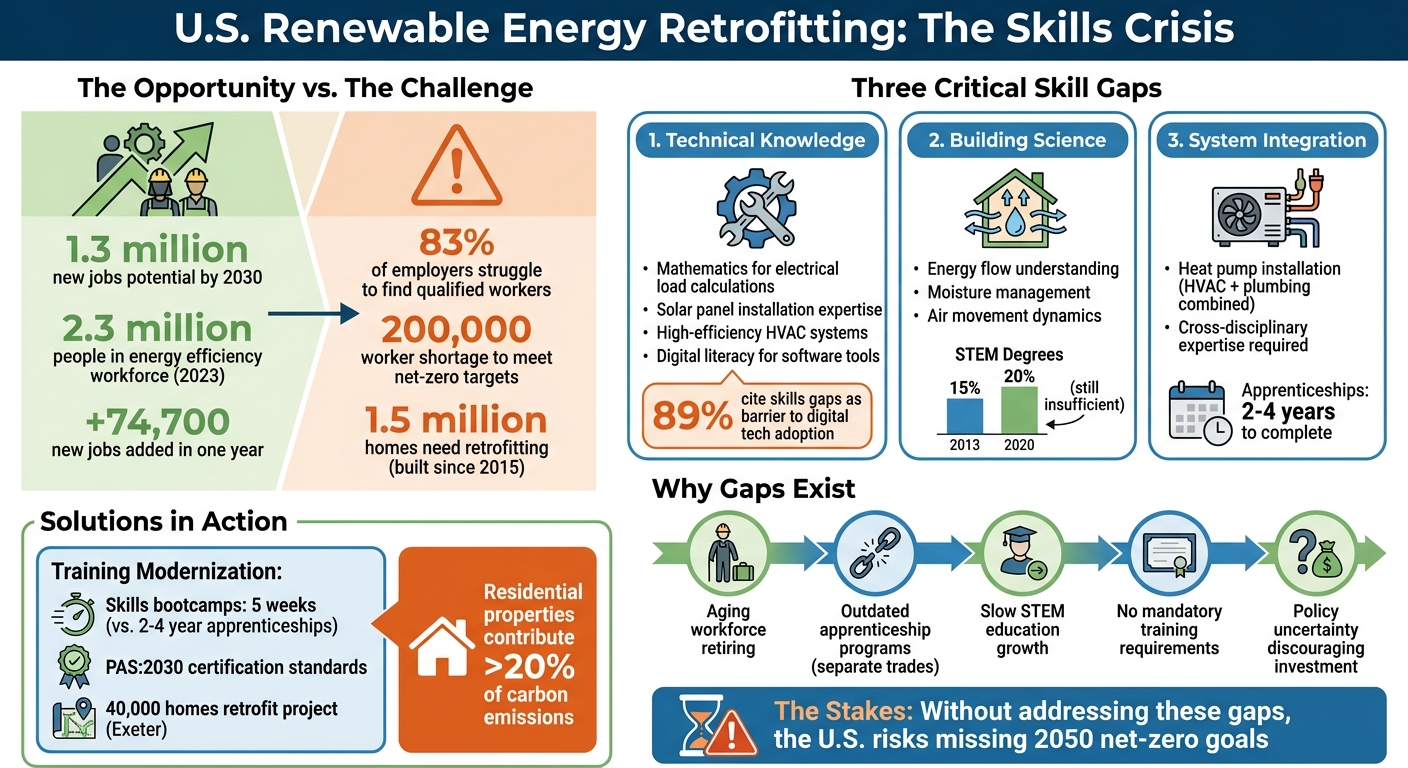
Renewable Energy Retrofitting Skills Gap Statistics and Workforce Challenges
EP218 Breaking Down Silos: The Path to Better Retrofit Training with Ben Hildebrandt (May 2025)
sbb-itb-aa28329
Skills Shortages in Renewable Energy Retrofitting
The renewable energy retrofitting industry is grappling with a shortage of skilled workers, which threatens to slow down progress on large-scale projects. Despite the energy efficiency workforce expanding to 2.3 million people in 2023 – adding 74,700 new jobs in just a year – training programs have struggled to keep up with the rapid growth. This gap has left many workers unprepared for the technical challenges of modern retrofitting.
Technical Knowledge Deficiencies
One of the most pressing issues is the lack of essential technical skills. Many workers in the field lack the mathematical knowledge needed for tasks like calculating electrical loads or converting units – skills that are critical for renewable energy installations.
"Mathematics is particularly important, as being able to calculate electrical loads or convert units is essential for primary energy efficiency occupations." – International Energy Agency
In addition to basic math skills, there’s a significant shortage of expertise in specialized areas like solar panel installation, high-efficiency HVAC systems, and insulation techniques. Digital literacy is another barrier, as many workers struggle with the software tools used for calculations, data management, and system optimization. Certified energy auditors and building inspectors, who are essential for operating advanced diagnostic tools, are also in short supply.
A deeper understanding of building science is another critical gap that needs to be addressed.
Moisture Management and Building Physics
A lack of knowledge about building physics – covering areas like energy flow, air movement, and moisture dynamics – further limits the workforce’s ability to effectively use new technologies. This issue is closely tied to inadequate STEM education. While the percentage of STEM degrees awarded in the U.S. increased from 15% in 2013 to nearly 20% in 2020, the International Energy Agency has noted that this growth still falls short of what’s needed to meet the energy sector’s demands.
In response to these challenges, Exeter College in South-west England launched new training programs in March 2025 under the leadership of Luke Moss. These programs aim to upskill workers to meet PAS:2030 quality standards for retrofitting 40,000 homes. The curriculum focuses heavily on building physics and moisture management – key areas where many workers currently lack expertise.
Renewable Energy System Integration
The integration of renewable energy technologies presents another layer of complexity. Retrofitting projects often require knowledge that bridges traditionally separate disciplines. For instance, installing heat pump water heaters and hydronic heat pumps demands combined expertise from HVAC/R and plumbing professionals – two fields that have historically operated independently.
"Understanding heat pump water heaters and hydronic heat pumps requires a combination of knowledge and experience from two traditionally separate roles – HVAC/R and plumbing." – International Energy Agency
Standardized training materials for these emerging technologies are still lacking, making it difficult for workers to demonstrate their competence. Contractors also face challenges when using design tools that simplify the integration of renewable systems into existing buildings. To address this, the Pacific Northwest National Laboratory (PNNL) began developing centralized training materials in February 2025, focusing specifically on heat pump technologies to create a more uniform knowledge base across the residential decarbonization sector.
Why Training Gaps Exist
The shortage of skilled workers in renewable energy retrofitting stems from systemic issues that have persisted over time. In 2023, a striking 83% of energy efficiency employers in the U.S. reported difficulties in hiring, highlighting how current training systems fail to meet the growing demand. Let’s break down the key reasons behind these training gaps and their impact on workforce readiness.
Aging Workforce and Lack of New Entrants
The renewable energy retrofitting sector is grappling with a dual problem: experienced professionals are retiring, and not enough younger workers are stepping up to fill their shoes. This imbalance amplifies the existing shortfall in technical and integration skills. Apprenticeships for roles like electricians and HVAC installers often take two to four years to complete, further delaying the entry of new talent. Compounding this is the slow growth in STEM education; while STEM degree conferrals in the U.S. increased from 15% in 2013 to just under 20% in 2020, the International Energy Agency points out that this is still far from sufficient to meet the booming demand for energy efficiency roles.
This educational gap leaves many potential workers without the essential knowledge needed for complex retrofitting tasks, such as calculating electrical loads or understanding the physics of building structures. The result? A workforce unprepared to tackle the nuances of modern retrofitting projects.
Outdated Apprenticeships and Training Programs
Traditional training programs are largely focused on conventional construction methods and fail to address the cross-disciplinary skills required for modern retrofitting. For example, technologies like heat pump water heaters demand a blend of HVAC/R and plumbing expertise – yet most apprenticeships still treat these trades as separate silos. This outdated approach leaves workers ill-equipped for renewable energy installations, making it clear that training programs need a major overhaul.
"Without the involvement of employers, there is a risk of workers investing in training without a clear pathway into employment." – International Energy Agency
Another challenge is the absence of mandatory training requirements for professionals working on retrofit projects. Small and medium-sized enterprises (SMEs), in particular, often lack the awareness or financial motivation to invest in upskilling their employees. This results in workers missing the certifications needed for modern energy projects. Alarmingly, 89% of energy professionals cite skills gaps as the main barrier to adopting digital technologies in the sector. Yet, most apprenticeships fail to incorporate training on specialized software for energy modeling or fault detection.
Slow Integration of Retrofit-Specific Curricula
The way retrofitting skills are taught also poses a challenge. Instead of being treated as core competencies, these skills are often tacked onto existing programs as afterthoughts. This piecemeal approach has slowed the development of a workforce capable of addressing the unique demands of retrofitting older buildings. Unlike new construction, retrofitting requires tailored solutions that consider a building’s age, condition, and original construction techniques.
Policy uncertainty has only made things worse. Frequent shifts in government priorities discourage long-term investment in training programs. For instance, it’s estimated that 1.5 million homes built since 2015 will already need retrofitting to meet net-zero goals due to earlier gaps in carbon policy.
"Our training provision is directly shaped by the priorities of our valued stakeholders… We’ve designed entirely new courses, including our insulation programmes, tailored for the existing workforce requiring upskilling to meet PAS:2030 standards." – Luke Moss, Skills and Employer Project Manager, Exeter College
Adding to the complexity is the diversity of housing stock. Buildings vary widely in age and construction methods, making it nearly impossible to design a universal training curriculum. Despite this, many programs still attempt a one-size-fits-all approach, leaving workers unprepared for the unique challenges they’ll encounter on job sites.
How to Address Training Gaps
Tackling the skills gap in renewable energy retrofitting demands swift action on multiple levels. With an estimated shortage of 200,000 workers needed to meet net-zero targets, traditional methods alone won’t suffice. This workforce deficit poses a serious threat to the U.S.’s ability to meet its climate goals, despite substantial federal investment. Here’s a look at current efforts and what still needs to be done.
Modernizing Training Programs
To close the skills gap, training programs must incorporate retrofit expertise directly into construction education. For example, in March 2025, Exeter College collaborated with the Green Skills Advisory Panel (GSAP) and NOCN Group to create new insulation and renewable technology courses. These programs aimed to upskill workers to meet PAS:2030 standards for a project retrofitting 40,000 homes in Exeter. By involving industry stakeholders, the curriculum was tailored to meet real-world needs instead of relying on outdated approaches.
Skills bootcamps have emerged as a faster alternative to traditional apprenticeships. In late 2024, construction firm Durkan teamed up with Build East, L&Q housing association, and contractors Bauder and London Felt to run a five-week roofing and retrofit bootcamp. This initiative offered hands-on training and led directly to job placements in specialized roles.
"Skills bootcamps provide onsite, targeted training with tight timescales. They also open up opportunities for career progression and an offer of wage certainty." – Kevin O’Connor, Head of Social Value Delivery at Durkan
However, financial barriers often prevent experienced workers from participating in unpaid training programs. Kevin O’Connor suggested a potential solution:
"If there was, for example, government funding to cover these wages for the duration of each bootcamp, then this relatively inexpensive four- to five-week investment would quickly and efficiently open up a rich vein of talent to the retrofit industry." – Kevin O’Connor, Head of Social Value Delivery at Durkan
This wage support concept could make it easier for seasoned workers to transition into retrofit roles, leveraging their existing construction knowledge. Once curricula are updated, the next challenge is ensuring that trained workers can quickly find employment.
Using Digital Platforms for Workforce Matching
Modern training programs need to be paired with efficient job-matching systems. Once workers complete training and earn certifications, they need streamlined pathways to employment. Traditional hiring methods often struggle to connect certified workers with the right projects, especially in specialized fields like retrofitting. Digital workforce platforms solve this problem by automating the matching process based on certifications, availability, and location.
For instance, ABLEMKR’s mobile-first platform connects pre-vetted workers with renewable energy retrofitting projects across the U.S. Employers benefit from real-time compliance tracking for standards like PAS:2030, while workers gain access to well-paying opportunities without the hassle of conventional job searches. By bridging the gap between training and employment, these platforms ensure that investments in workforce development translate into immediate results.
Centralized Training and Certification Systems
Regional coordination hubs have become critical for aligning training with industry demands. The Green Skills Advisory Panel (GSAP) model, initially piloted in Exeter, has expanded to other regions in England and Wales. These panels use skills surveys and stakeholder meetings to design curricula that reflect current project requirements.
Centralized systems also help maintain consistency and quality across the workforce. For government-backed retrofitting projects, requiring specific certifications ensures that installations meet regulatory standards. This is especially important given that residential properties contribute over 20% of carbon emissions, and around 1.5 million homes built since 2015 will need retrofitting to meet net-zero goals.
The goal is to create scalable, repeatable training models.
"Skills bootcamps develop good-quality entry-level learners specifically and quickly to meet the needs of the retrofit sector and understand its primary principles, such as quality of installation and regulatory compliance." – Kevin O’Connor, Head of Social Value Delivery at Durkan
Conclusion
The renewable energy retrofitting industry in the U.S. is grappling with a serious skills gap that could derail efforts to meet critical climate targets. With around 1.5 million homes built since 2015 already needing retrofits to align with net-zero goals, the urgency to address this challenge cannot be overstated. Poor training not only wastes valuable resources but also risks compromising building safety and occupant health.
To tackle this shortfall, a comprehensive approach is essential. One key step is embedding retrofit skills into standard construction education, ensuring these competencies are part of the core curriculum rather than optional add-ons. Additionally, regional collaboration, such as the Green Skills Advisory Panel in Exeter, helps align training programs with the actual needs of ongoing projects. Digital workforce platforms also play a vital role by matching certified professionals with retrofitting opportunities efficiently.
Luke Moss from Exeter College highlighted the importance of stakeholder engagement: "Our training provision is directly shaped by the priorities of our valued stakeholders". This collaborative model, paired with advanced workforce deployment tools, offers a scalable solution to the workforce shortage. Platforms like ABLEMKR exemplify this approach by connecting qualified workers to renewable energy retrofitting projects while ensuring compliance with standards like PAS:2030. By integrating training and deployment, such technologies ensure that investments in workforce development directly result in high-quality installations, paving the way for a more effective energy transition.
FAQs
What retrofit skills are most in demand right now?
The skills most sought after for retrofitting projects include HVAC installation, energy efficiency upgrades, and specialized trades such as solar electricians, energy inspectors, welders, and HVAC technicians. These professionals play a key role in advancing net-zero emission targets while helping to fill workforce gaps in the building and energy industries.
Why do heat pump projects require both HVAC and plumbing training?
Heat pump projects demand expertise in both HVAC and plumbing because these systems combine heating, ventilation, and air conditioning with plumbing elements like refrigerant lines and water connections. Having the right training is key to ensuring proper installation, efficient operation, and overall safety.
How can ABLEMKR help connect certified retrofit workers to projects faster?
ABLEMKR simplifies the process of connecting certified retrofit workers with projects through its mobile-first platform. By matching pre-screened workers based on their certifications, safety training, availability, and location, the platform ensures projects can quickly access the skilled labor they need. This efficient system helps employers mobilize qualified workers promptly, keeping projects on schedule.


