
Workplace safety in the energy sector isn’t just a box to check – it’s about saving lives and avoiding costly mistakes. With fatality rates in oil and gas extraction over double the national average and OSHA fines reaching up to $156,259 for violations, proper safety training is non-negotiable. Here’s what you need to know:
- Key Risks: High-pressure systems, hazardous chemicals, and electrical dangers like arc flashes.
- Regulations: OSHA and NFPA 70E standards require specific training for tasks like lockout/tagout (LOTO) and electrical safety.
- Training Methods: Combine classroom learning, hands-on practice, and simulations (e.g., VR) to prepare workers for hazards.
- Compliance Gaps: Regularly assess training programs and worker skills to address weaknesses.
- Cultural Shift: Build a safety-first mindset with toolbox talks, peer-led committees, and open reporting systems.
- Documentation: Keep detailed training records and use tools like ABLEMKR to track compliance.
Bottom line: Safety training isn’t just about meeting legal requirements – it’s about protecting workers, avoiding shutdowns, and maintaining operational success.
Safety First: OSHA‘s Impact on the Energy Sector
sbb-itb-aa28329
Regulatory Requirements for Energy Safety Training
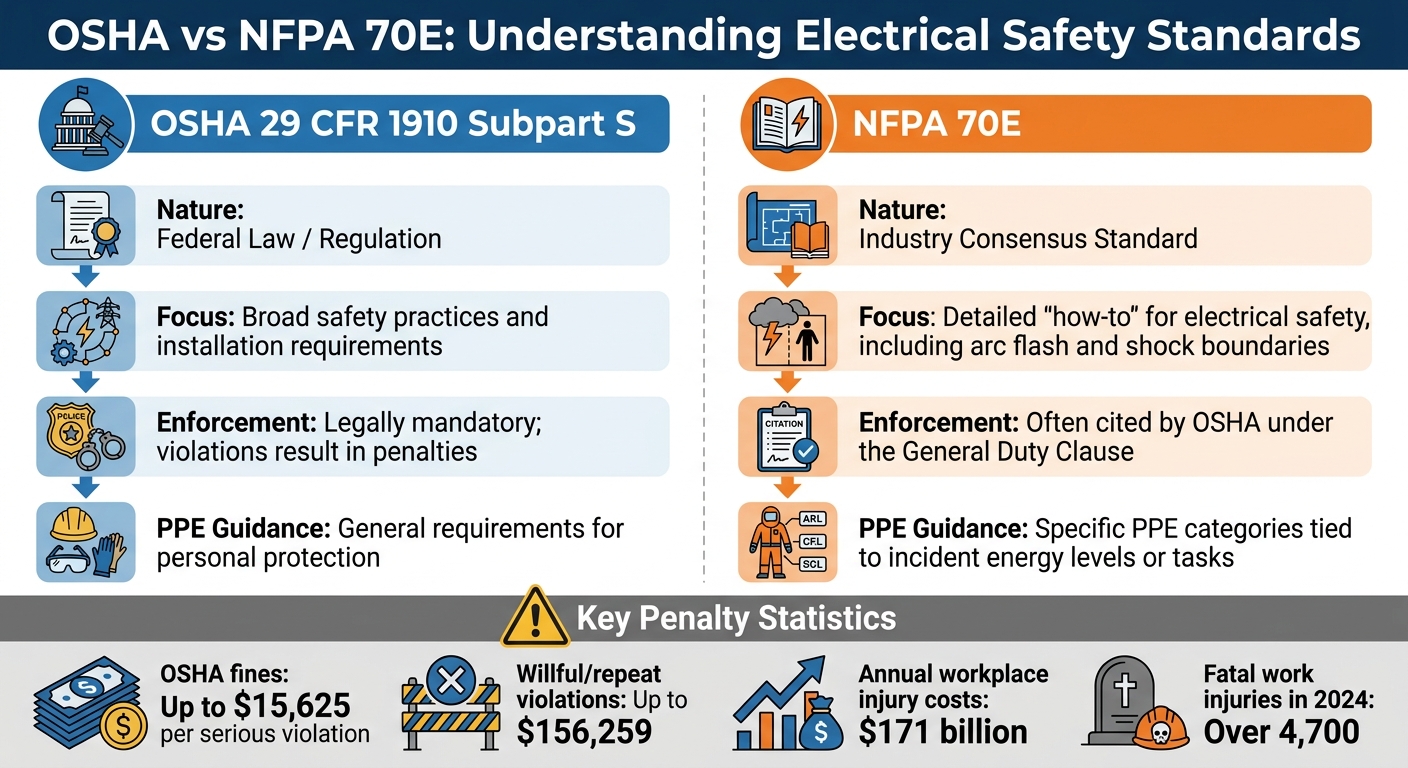
OSHA vs NFPA 70E Electrical Safety Standards Comparison
OSHA and NFPA 70E Standards
Energy employers must comply with two key regulatory frameworks: OSHA regulations and NFPA 70E standards. Together, these guide the development of effective safety training programs.
OSHA 29 CFR 1910.332 requires training for employees who may encounter electric shock risks. This regulation differentiates between "qualified" workers – those who work directly on energized parts – and others who need basic awareness. Training for all workers includes identifying energized components, understanding nominal voltage levels, and maintaining safe clearances. This applies to any work involving circuits operating at 50 volts or more relative to ground.
OSHA 29 CFR 1910.147, commonly known as the Lockout/Tagout (LOTO) standard, mandates procedures to isolate machinery and prevent hazardous energy releases during maintenance. Other important standards include 1910.119 for managing processes with highly hazardous chemicals, 1910.146 for confined spaces requiring permits, and 1910.333 for electrical work practices.
NFPA 70E complements OSHA by offering detailed guidance on protecting workers from electrical hazards like arc flashes and shocks. While OSHA establishes the legal baseline, NFPA 70E provides specifics, such as personal protective equipment (PPE) categories based on incident energy levels. OSHA often references NFPA 70E when issuing citations under the General Duty Clause (Section 5(a)).
| Feature | OSHA 29 CFR 1910 Subpart S | NFPA 70E |
|---|---|---|
| Nature | Federal Law / Regulation | Industry Consensus Standard |
| Focus | Broad safety practices and installation requirements | Detailed "how-to" for electrical safety, including arc flash and shock boundaries |
| Enforcement | Legally mandatory; violations result in penalties | Often cited by OSHA under the General Duty Clause |
| PPE Guidance | General requirements for personal protection | Specific PPE categories tied to incident energy levels or tasks |
OSHA allows training to be delivered through classroom instruction, on-the-job experience, or a combination of both. The depth of training depends on the worker’s exposure to risk. Training must occur before employees face hazards, when job roles change, when new hazards emerge, or when an incident reveals a gap in knowledge. Importantly, training must be provided in a language and literacy level that employees can understand. OSHA has penalized companies for failing to offer multilingual training when necessary.
These standards not only ensure legal compliance but also promote practical, scenario-based training that prepares workers for real-world challenges.
Penalties for Non-Compliance
Failing to meet safety training requirements can result in serious financial and operational consequences. OSHA fines can reach up to $15,625 per serious violation and as much as $156,259 for willful or repeat offenses. Beyond fines, workplace injuries and fatalities have far-reaching costs. In 2024, over 4,700 fatal work injuries were recorded in the U.S., with workplace injuries collectively costing an estimated $171 billion annually.
Non-compliance can also lead to unplanned shutdowns, emergency responses, and lengthy investigations, all of which disrupt operations. Reputational damage is another risk, potentially making it harder to attract skilled workers, secure contracts, or maintain licenses. In 2020, approximately 2,380 workers narrowly avoided electrical injuries due to luck rather than proper safety practices – a clear indication that some employers are falling short of their responsibilities.
Certain high-risk occupations face stricter requirements. OSHA Table S-4 highlights roles like electricians, welders, blue-collar supervisors, mechanics, and riggers as being at greater risk. For these workers, electrical safety training isn’t optional – it’s a legal mandate designed to protect both individuals and organizations from devastating outcomes.
Assessing Workplace Hazards and Training Needs
Conducting a Job Safety Analysis
To effectively assess workplace hazards, break each job into smaller steps, identify potential risks like arc flash, electrical shock, or stored energy, and consider possible failures along with the safeguards needed to prevent them.
As Aaron Gelb, Partner at Conn Maciel Carey, points out:
"What I find in a lot of instances is a disconnect between what senior leadership thinks is going on and what is actually getting done in the warehouse, on the shop floor, or out at a job site".
This highlights the importance of involving employees who work directly with equipment, as they often recognize hazards that might not be apparent from written procedures alone.
Each Job Safety Analysis (JSA) should align with OSHA’s specific requirements. For example, refer to 29 CFR 1910.147 when addressing lockout/tagout procedures, using machine-specific documentation to ensure compliance. Additionally, reviewing incident reports and near-miss data can reveal recurring hazards and areas where training may be lacking. This data-driven approach ensures resources are directed where they’re needed most. For instance, OSHA-accredited lockout/tagout training is estimated to prevent approximately 50,000 accidents annually.
Once hazards are identified, evaluate current training programs to uncover and address any gaps in employee competency.
Evaluating Training Gaps
After mapping out workplace hazards, the next critical step is identifying training gaps that could leave workers unprepared. Start by reviewing certifications, attendance logs, and assessment scores. Ensure employees in high-risk roles, such as electricians, welders, and riggers, hold the necessary certifications for their positions.
However, certifications alone don’t guarantee competency. Real-world skills should be verified through direct observations and worker interviews. OSHA inspectors often focus on the gap between documented training and actual on-the-job performance during their evaluations.
To keep training relevant, avoid waiting for an annual audit. Instead, review procedures on a rolling 12-month basis. As Aaron Gelb advises:
"Every procedure must be reviewed on a rolling 12-month basis. You don’t want to wait 11 months before starting a review and find yourself asking, ‘How do we fix this?’".
This approach ensures training remains up-to-date as equipment, processes, and regulations evolve. Updating hazard analyses regularly also helps identify when training reassessments are needed.
Stay informed about regulatory changes from organizations like OSHA, EPA, and NFPA. When new standards are introduced or existing ones are revised, promptly evaluate how these changes impact your training requirements. Schedule refresher sessions as needed to ensure compliance and maintain worker safety.
Implementing Energy Safety Training Programs
Key Training Topics for Energy Workers
Once hazards are identified and gaps are analyzed, the next step is creating targeted safety training programs. These programs need to be tailored to specific roles. For example:
- Authorized employees: Responsible for performing lockout/tagout (LOTO) procedures, they must fully understand how to confirm zero-energy states and choose the right personal protective equipment (PPE) for various hazards. Their training should also include arc flash prevention as outlined in NFPA 70E and the difference between energized and de-energized work.
- Affected employees: These workers need to grasp the purpose of LOTO procedures, recognize when they are in effect, and understand the importance of never tampering with locks or tags.
- Other employees: A basic awareness of LOTO devices and restart prohibitions is sufficient for this group. However, in facilities using tagout-only systems, training must emphasize that tags are warnings, not physical restraints.
Generic training won’t cut it when it comes to OSHA standards. Programs must include machine-specific procedures that detail the exact steps for shutting down and isolating equipment. This specificity is crucial, especially considering that OSHA listed its lockout/tagout standard as the 5th most cited violation in fiscal year 2024. A total of 2,443 citations were issued, with penalties for willful violations reaching as high as $165,514.
These tailored training topics create a solid foundation for practical, scenario-based exercises that reinforce safe practices.
Using Practical Scenarios for Training
Tailoring training topics is only half the battle. Practical scenarios are essential for turning theoretical knowledge into actionable skills. Effective training combines classroom learning with hands-on experience. For example, authorized workers should practice machine-specific shutdown and isolation procedures in real-world scenarios before being certified. This hands-on approach builds muscle memory and can reveal issues that a written test might miss.
Virtual reality (VR) simulations are another powerful tool. They allow workers to practice high-risk procedures in a completely safe environment. A study from Central Washington University found that 100% of participants felt VR safety training improved their understanding of safety protocols. Emergency response drills are equally important, simulating incidents like natural gas leaks, arc flashes, or oxygen displacement in confined spaces. These drills teach workers who to contact, how to evacuate safely, and basic first aid until professional responders arrive.
Annual inspections also offer a chance for one-on-one coaching with authorized employees. Supervisors can use these inspections to review procedures, correct mistakes, and reinforce proper techniques. A blended learning approach works well here, combining short digital lessons (5–10 minutes) for theory with on-the-job skill checks to ensure workers apply what they’ve learned.
Training isn’t a one-and-done deal. Retraining is necessary whenever job roles change, new equipment is introduced, or inspections reveal gaps in knowledge.
Building a Safety-First Workplace Culture
While technical training programs address specific risks, creating a workplace where safety is a shared value requires more than just instruction. It’s about fostering a culture where everyone feels personally responsible for safety. A safety-first culture thrives when every individual, from entry-level employees to senior management, is actively engaged. Leadership plays a pivotal role here – when managers prioritize safety, allocate resources, and hold themselves accountable, they set a powerful example that resonates throughout the organization.
Encouraging Employee Participation in Safety Programs
To truly embed safety into the workplace, employees need to feel heard and involved. One way to achieve this is by forming peer-led safety committees. These groups can pair experienced team members with newer employees to mentor them and conduct peer observations. This type of collaboration encourages workers to model safe behaviors and reinforces these habits daily. Small group discussions also create a space for sharing best practices and identifying potential risks as a team.
"The learning process should have proper lines of communication and promote a safety culture where it is acceptable to speak up about concerns." – Claire Griffin, Veriforce
Another key element is establishing a blame-free reporting system. Employees should feel confident reporting near-misses or unsafe conditions without fear of retaliation. These reports act as early warning signs, helping to identify risks before they escalate into incidents. Recognizing employees who take the initiative to report hazards, mentor others, or suggest safety improvements can further encourage participation. When workers see their concerns are taken seriously and lead to tangible changes, safety becomes a shared responsibility rather than an obligation.
These strategies lay the groundwork for making safety an integral part of daily operations.
Embedding Safety into Daily Operations
Safety isn’t something that should only be addressed during annual training sessions – it needs to be part of the everyday workflow. Daily pre-job briefings, often referred to as "toolbox talks", are an effective way to focus on specific hazards related to the day’s tasks. These quick sessions allow teams to review essential safety protocols without disrupting productivity.
For higher-risk tasks, such as confined space entry or energy isolation, a permit-to-work system can add an extra layer of safety. This system requires formal approval before starting work, ensuring supervisors verify that all necessary precautions are in place. Combining these formal processes with informal feedback mechanisms allows workers to address unsafe practices immediately. This approach integrates safety into every shift, making it a natural and ongoing part of operations.
Documenting and Tracking Compliance
Building on your hands-on training, keeping thorough documentation and tracking compliance are critical to strengthening your safety program. Without proper records of training, companies risk fines, heightened liability, or even operational shutdowns – especially in high-risk energy sectors. Written documentation acts as both a legal safeguard and a practical guide, showing regulators and insurance auditors that your team is trained and your safety measures are up to date.
Developing Written Safety Protocols
Start by drafting Standard Operating Procedures (SOPs) for high-risk tasks. These should include detailed lockout/tagout (LOTO) procedures, outlining steps for managing energy controls, tagout systems, and the proper handling of energy-isolating devices. Additionally, implement formal written programs for areas like respiratory protection, hearing conservation (for workers exposed to noise levels of 85 decibels or higher), and confined space entry.
If creating these documents from scratch feels overwhelming, you’re not alone. Many state agencies, such as the Texas Department of Insurance, offer free templates for LOTO, confined spaces, and excavation protocols. These templates can be tailored to fit your specific operations.
Keep in mind that safety protocols aren’t static. Regularly review and update them to account for changes in job roles, equipment, or regulations. Periodic inspections should also be scheduled to ensure that written procedures align with on-site conditions. For convenience, consider storing these documents on digital platforms, making them easily accessible in the field.
While written protocols establish the groundwork, tracking systems ensure compliance remains consistent over time.
Using ABLEMKR for Compliance Tracking

Relying on paper-based systems can lead to lost records and limited visibility into worker qualifications. ABLEMKR tackles these challenges by integrating compliance tracking directly into workforce management. The platform offers real-time updates on worker certifications, training statuses, and credential expiration dates, making it easy to assign pre-qualified workers to job sites based on their current credentials.
Whether you’re mobilizing a crew for an urgent pipeline repair or a planned maintenance project, ABLEMKR’s mobile-first system ensures that only certified and compliant workers are dispatched. The platform allows instant verification of worker qualifications – covering everything from OSHA 10-hour cards to LOTO certification and confined space training. This eliminates the need for manual checks of physical documents and provides audit-ready records for your entire workforce.
Conclusion
Training workers for energy safety compliance is about more than following regulations – it’s about protecting lives in one of the riskiest industries. For context, the fatality rate in oil and gas extraction stands at 8.9 per 100,000 workers, significantly higher than the 3.6 rate across all industries. As Doug Parker, former Assistant Secretary of Labor for OSHA, put it:
"Safety training is not just about compliance – it is about ensuring every worker goes home safe at the end of the day. Employers who invest in comprehensive training programs see fewer injuries and fatalities".
To meet safety standards, align operations with OSHA 29 CFR 1910 and NFPA 70E guidelines, verify worker skills through hands-on evaluations, and keep well-organized, audit-ready documentation. Process Safety Management standards also call for formal compliance audits at least once every three years.
Creating a safety-first culture means going beyond just checking boxes. Workers should feel confident in identifying hazards and using stop-work authority when conditions are unsafe. Regular toolbox talks and job hazard analyses can foster an environment where safety becomes second nature.
Incorporating these practices also sets the stage for using technology to simplify compliance. Digital platforms like ABLEMKR can replace outdated paper systems, offering real-time tracking of worker certifications, automated renewal alerts, and audit-ready documentation. Whether handling urgent pipeline repairs or planned maintenance, instant access to credentials – such as OSHA 10-hour cards or confined space training – ensures the right workers are always in the right place, fully prepared.
FAQs
How do I decide who is “qualified” vs. “unqualified” for electrical work?
A worker is considered qualified when they have completed documented training, gained relevant on-the-job experience, and proven they have the skills needed for the job. According to OSHA standards (1910.332 and 1910.333), proper training is mandatory for anyone working near or directly on electrical equipment. If a worker lacks these qualifications or the required documentation, they should be classified as unqualified. It’s the employer’s responsibility to ensure all workers meet OSHA’s standards and hold the necessary certifications or skills to safely handle electrical tasks.
What’s the fastest way to create machine-specific LOTO training for each asset?
To create effective machine-specific Lockout/Tagout (LOTO) training, focus on crafting detailed procedures for isolating every energy source connected to each machine. Here’s how to get started:
- Identify all energy sources: This includes electrical, mechanical, hydraulic, and any other potential energy types tied to the equipment.
- Develop precise lockout/tagout procedures: Create step-by-step instructions tailored to each machine, covering how to safely isolate and control its energy sources.
- Integrate these procedures into training modules: Equip workers with the knowledge to apply these procedures correctly, ensuring their safety on the job.
By following these steps, you align with OSHA standards while promoting safer work environments.
How often should we retrain workers, and what triggers retraining?
Workers generally need refresher training every three years to keep up with current safety procedures. However, retraining might also be necessary when there are updates to operating procedures or safety regulations, or if an employee demonstrates gaps in understanding or compliance. In high-risk fields like oil and gas, OSHA standards and industry norms often call for more frequent retraining to address specific hazards or regulatory changes.


