
Fire safety training is essential for industries with high fire risks, like energy and extractives. OSHA requires employers to ensure workers are trained to identify hazards, respond effectively, and follow safety protocols. Here’s a quick guide to creating a fire safety training program:
- Identify Risks: Assess fire hazards specific to your facility, like flammable liquids or confined spaces.
- Know Regulations: Familiarize yourself with OSHA standards (e.g., 29 CFR 1910.38, 1910.119) and industry guidelines.
- Tailor Training: Customize training based on roles – general workers, Fire Watch personnel, or Emergency Response Teams.
- Use Effective Methods: Combine hands-on training, VR simulations, and multimedia tools for better retention.
- Track Progress: Document all training sessions and certifications to meet OSHA’s record-keeping requirements.
- Conduct Drills: Run regular fire drills to ensure teams are prepared for emergencies.
Proper training not only ensures compliance but also protects lives and property. By following these steps, you can create a safer workplace and meet regulatory standards.
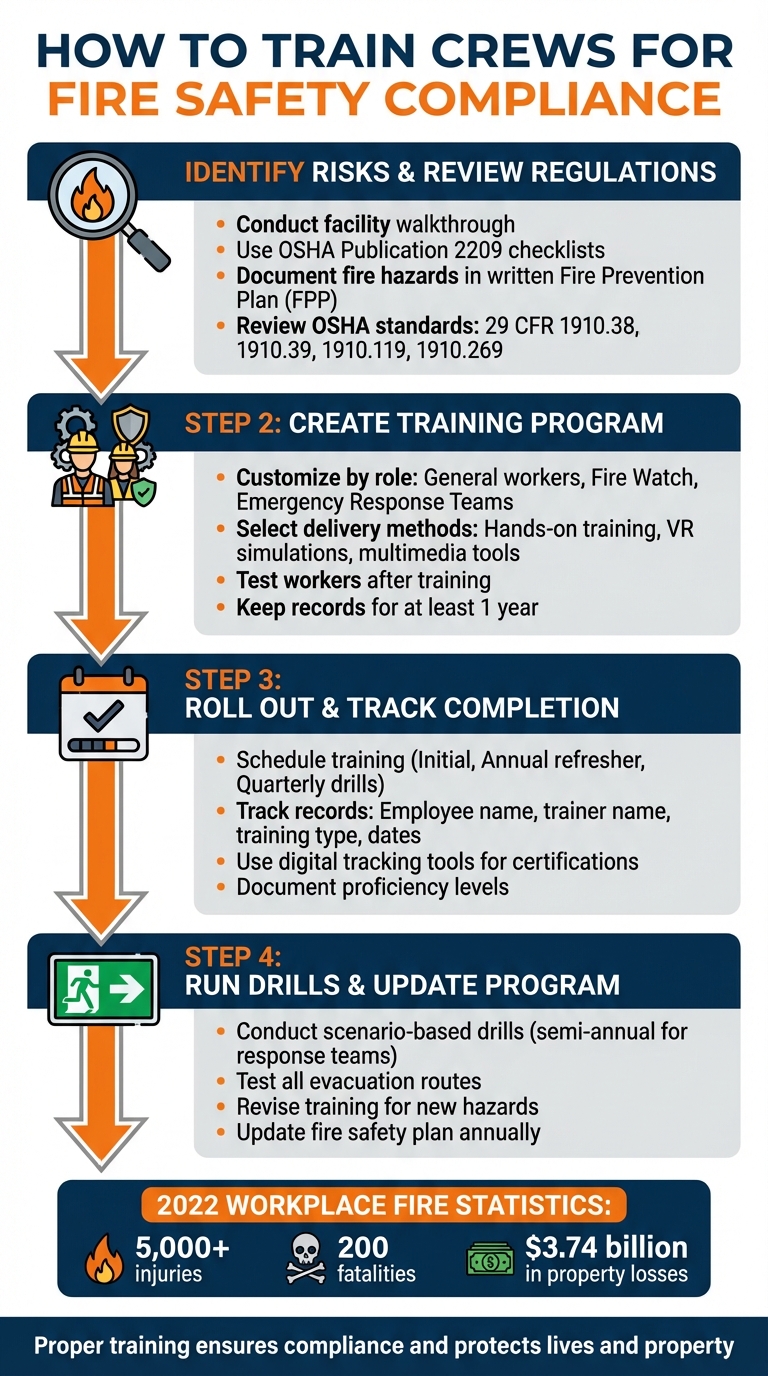
4-Step Fire Safety Compliance Training Process for Energy Industry
Fire Ptotection Safety Training Course – Module 8 | OSHA 30 Hour Construction Study Guide
Step 1: Identify Fire Risks and Review Regulations
Before diving into training, pinpoint potential fire hazards in your facility. Start by conducting a thorough walkthrough, taking note of key risks in areas like petroleum refining, electric power generation, and hazardous gas storage. Don’t overlook process-specific dangers such as electric arc furnace steelmaking, spray finishing with flammable materials, and operations like welding, cutting, or brazing.
To guide your assessment, use the OSHA Publication 2209 checklists to identify workplace hazards. Pay attention to combustible dust, flammable liquids, and compressed gases like acetylene. Evaluate the layout and physical conditions of spaces where hot work occurs, and carefully assess confined spaces where fire risks may be heightened.
Document Fire Hazards at Your Facility
OSHA mandates a written Fire Prevention Plan (FPP) to catalog major fire hazards, proper handling and storage methods for hazardous materials, and ignition sources along with their control measures. While companies with 10 or fewer employees can communicate this plan orally, most energy facilities will need a formal, written document. The plan should also specify the fire protection equipment needed for each hazard and identify the employees (or their roles) responsible for maintaining ignition control systems.
Include procedures for managing flammable and combustible waste accumulation, and outline maintenance routines for heat-producing equipment safeguards. This documented hazard list will form the backbone of your compliance and safety strategy.
Review OSHA and Industry Standards
Once hazards are documented, match them to the applicable regulations. For example, 29 CFR 1910.269 addresses fire safety in Electric Power Generation, Transmission, and Distribution, while 29 CFR 1910.119 focuses on Process Safety Management for facilities handling highly hazardous chemicals, such as refineries. Key fire safety requirements are outlined in 29 CFR 1910.38 (Emergency Action Plans) and 29 CFR 1910.39 (Fire Prevention Plans).
Here’s how some OSHA standards align with specific hazards:
| OSHA Standard | Industry/Hazard Focus | Relevance to Energy Facilities |
|---|---|---|
| 29 CFR 1910.269 | Electric Power Generation, Transmission, and Distribution | Core safety standard for power plants and grid operations |
| 29 CFR 1910.106 | Flammable Liquids | Governs storage and handling of fuels and solvents |
| 29 CFR 1910.119 | Process Safety Management (PSM) | Essential for refineries and chemical processing facilities |
| 29 CFR 1910.252 | Welding, Cutting, and Brazing | Sets fire prevention rules for "hot work" activities |
Be sure to check if your state’s OSHA plan imposes stricter requirements. For energy-specific operations, consult the OSHA Technical Manual (OTM), particularly the sections on "Petroleum Refining Processes", to identify sector-specific risks and mitigation strategies. Even if no specific OSHA standard applies to a hazard, the General Duty Clause (Section 5(a)) obligates you to protect workers from recognized dangers. In such cases, you can refer to consensus standards from the National Fire Protection Association (NFPA) to address these risks.
Step 2: Create Your Fire Safety Training Program
Now that you’ve identified hazards and reviewed relevant regulations, it’s time to develop a fire safety training program tailored to specific roles. A one-size-fits-all approach won’t cut it. General workers should be trained to recognize alarm signals and know evacuation routes, while those in specialized roles need more in-depth knowledge. For example, "Fire Watch" personnel who monitor welding or cutting operations must understand fire behavior, fire classifications, and how to oversee hot work areas. Meanwhile, "Incipient Firefighters", tasked with handling small fires, benefit from hands-on training with extinguishers and hose lines.
In high-risk environments like refineries or power plants, you might need Emergency Response Teams (ERT) trained in advanced skills such as incident command, chemical spill handling, and confined space rescue. Leadership roles, like Fire Wardens or Marshals, require training in hazard identification, conducting inspections, and leading evacuations during emergencies. By customizing training scenarios, you ensure each role practices responding to its unique challenges.
Customize Training by Job Role
Start by defining the specific responsibilities of each role during a fire emergency. Every worker should understand alarm systems and evacuation procedures as a baseline. Beyond that, those expected to operate fire extinguishers need to learn about extinguishing agents, the risks of handling small fires, and how to use both fixed and portable fire protection systems.
Fire Watch personnel require even more specialized training. They need to grasp fire behavior, understand which extinguishing agents work for different fire types, select the right personal protective equipment, and familiarize themselves with the unique hazards of the areas they monitor. As OSHA’s Shipyard Employment eTool explains, “Effective training allows workers to recognize, respond and provide corrective action as well as understand and retain the training information”.
For designated fire response teams, training should be rigorous and ongoing. This includes quarterly reviews of written procedures, live fire exercises, and semi-annual drills. Drills should take place across all shifts, including nighttime operations in low-light conditions.
Once roles and responsibilities are clear, the next step is selecting the best training methods.
Select Your Training Delivery Methods
Choose training methods that reinforce key actions under realistic conditions. Hands-on, live fire training is especially effective for Fire Watch personnel and response teams, as it allows them to operate equipment under real-world pressure. For general safety training and diverse crews, multimedia tools like videos, signage, and pictographs are great for reinforcing critical information, especially when dealing with varying literacy levels or language barriers.
Emerging technologies have also revolutionized fire safety training. For instance, in 2024, Program-Ace developed a cutting-edge Emergency Evacuation Simulator for a U.S.-based construction company. This 3D simulation replicated the job site, enabling employees to practice evacuation procedures in a virtual environment. Gamified features and data tracking helped monitor progress and response times, preparing workers to navigate complex structures during emergencies.
Virtual Reality (VR) simulations are another powerful tool, allowing workers to rehearse high-risk scenarios like oil refinery fires or chemical leaks without physical danger. Similarly, Augmented Reality (AR) can overlay digital fire hazards onto the actual workplace, providing realistic practice with real extinguishers.
"Retention improves when training involves realistic simulations. For example, practicing fire extinguisher use in a virtual environment enables employees to internalize the steps, making it second nature in real scenarios." – Program-Ace
Whatever method you choose, make sure it aligns with the specific hazards of your site. After training sessions, conduct testing to confirm workers have absorbed the material, and keep detailed training records – including the employee’s name, trainer’s name, type of training, and dates – for at least one year.
Step 3: Roll Out Training and Track Completion
Start your fire safety training program without disrupting daily operations. This means carefully planning sessions to fit around various shifts, keeping detailed records of each training event, and ensuring compliance with OSHA standards. Poor planning can hurt productivity, and incomplete records could lead to penalties during audits.
Set Up Your Training Schedule
Plan your training dates well in advance and share them on the company calendar. For larger teams or multiple shifts, consider semi-annual or staggered sessions to ensure everyone is covered without bringing work to a halt.
Using portable fire simulators for on-site training can save time and make the process more efficient. Schedule these drills during quieter periods to minimize their impact on productivity.
Additional sessions are crucial when onboarding new employees, updating facility layouts, or introducing new hazards. For instance, if new equipment is added or production spaces are reconfigured, schedule refresher training immediately instead of waiting for the usual annual cycle. Short monthly sessions, led by maintenance staff, can also be a practical way to keep fire safety top of mind without requiring lengthy interruptions.
| Training Type | Recommended Frequency | Key Requirements/Notes |
|---|---|---|
| Initial Training | Upon hire | Covers hazard identification, evacuation routes, and extinguisher basics |
| Refresher Training | Annually | Updates on protocols; required for fire watch by OSHA |
| Emergency Drills | Quarterly to Semi-annually | Focus on evacuation practice and response times |
| Specialized Training | As needed | Necessary for new equipment or hazards |
| Fire Response Team | Quarterly | Training on written operating procedures |
Once your schedule is set, ensure every session is properly documented and tracked.
Track Training Records and Certifications
OSHA requires detailed records for all training sessions. These records must include the employee’s name, the trainer’s name, the type of training provided, and the date(s) it occurred. Keep these records for at least one year to ensure they’re available for audits. OSHA auditors may request these documents at any time, so they need to be easily accessible.
"The employer must keep records that demonstrate that employees have been trained…" – OSHA Standard 1915.508
Testing employees after training helps confirm they’ve retained the information. For roles like Fire Watch personnel or response teams, document their proficiency levels. Keep supporting materials like agendas, presentation slides, and sign-in sheets to strengthen your compliance documentation.
To make this process easier, consider using digital tracking tools. These platforms can help organize schedules, send automated reminders, and monitor certifications in real time. A digital system simplifies record-keeping and ensures your fire safety program stays on track.
sbb-itb-aa28329
Step 4: Run Fire Drills and Update Your Program
Training sessions alone don’t cut it – practical drills are where preparation turns into action. Regularly running these drills and updating your program ensures your team is ready for real emergencies. OSHA has specific requirements for drill frequency, and failing to meet them can result in citations during inspections. This makes realistic, scenario-based drills a must.
Conduct Scenario-Based Fire Drills
Your drills should reflect the actual conditions your workers might face. If your workplace includes low-light areas or confined spaces, practice in those environments to prepare workers for high-pressure situations. Fire response teams should participate in drills twice a year, while all employees should complete at least one evacuation drill annually. During these drills, test every evacuation route – blocked exits during a real emergency could force workers to find alternate paths.
For hands-on training, use near-expiration fire extinguishers to practice without wasting new ones. However, avoid smoke-generating devices that could create unsafe conditions during training. Make sure your drills cover all emergency alerts, from system discharge alarms to evacuation signals. The insights you gain from these exercises should guide immediate updates to your safety protocols.
Revise Training for New Hazards and Regulations
Drills often reveal gaps in knowledge or preparedness, which means retraining needs to happen quickly. Fire safety training isn’t a one-and-done deal – it should evolve as your operations, equipment, or facility layouts change. Don’t rely solely on annual reviews; retraining is essential anytime workers’ skills fall short or new hazards emerge.
Stay informed about regulatory deadlines to avoid compliance issues. For example, by July 4, 2025, firefighting foams containing PFOA will be banned in certain areas and must be treated as hazardous waste. Check with equipment manufacturers to confirm whether your fire extinguishers contain restricted substances like PFAS or PFOA. Review and update your fire safety plan at least once a year to account for new risks or changes in operations. Keep all training records for at least one year, and ensure any external fire response teams have the latest version of your plan.
Using Workforce Platforms to Manage Compliance
Fire safety training is a critical part of ensuring compliance, and keeping track of worker credentials can be a daunting task. When managing employees across multiple sites, relying on paper records or trying to track expiring certifications can lead to confusion and delays. Workforce platforms simplify this process by centralizing compliance data, offering instant access to information about worker qualifications. This centralized approach not only makes compliance management more efficient but also enables quick deployment of qualified personnel.
Deploy Trained Workers with ABLEMKR

OSHA identifies untrained subcontractors and temporary workers as potential fire protection risks. This concern becomes even more urgent during emergency scenarios, like shutdowns or remote pipeline repairs, where teams need to be mobilized quickly. ABLEMKR tackles this issue by pre-vetting workers against fire safety certifications, such as NFPA 1403-2002 standards, before they even arrive on-site.
The platform pairs workers with projects based on their certifications, safety training, and location. For example, if you need fire watch personnel for a last-minute job, ABLEMKR ensures their credentials are already verified. OSHA mandates that fire watch personnel must complete training before being assigned to duty. By verifying certifications in advance, the platform eliminates delays and ensures compliance. Additionally, it confirms that training was delivered in a language the worker understands, aligning with OSHA’s language requirements.
Monitor Certifications in Real Time
Keeping credentials up to date isn’t just a best practice – it’s a requirement. OSHA standards specify that training records must include the employee’s name, the trainer’s name, the type of training, and the date. These records must also be readily available for inspection. ABLEMKR’s compliance tracking system provides a centralized hub for these records, sending automated alerts when certifications are nearing expiration. For example, fire response employees require quarterly training updates, while fire watch personnel need annual refreshers. The platform organizes workers by role, making it easier to schedule and manage compliance.
With digital tracking, records stay current and can be accessed instantly. For employers in the energy sector operating under OSHA standard 1910.269 – which focuses specifically on fire safety in electric power generation and distribution – this level of visibility is essential to avoid penalties during inspections.
Conclusion
Fire safety compliance training boils down to four key steps: identifying fire risks and understanding regulations, developing a tailored training program, implementing the training and tracking its completion, and conducting drills while refining the program as needed. These measures not only help meet compliance standards but also play a crucial role in protecting lives and minimizing damage. In 2022 alone, workplace fires and explosions resulted in over 5,000 injuries, 200 fatalities, and $3.74 billion in direct property losses.
"Seconds matter when dealing with a fire; chaos or confusion will only increase the danger. Ideally, responsibilities and reactions will become instinctual through repeated practice".
Training should be role-specific, ensuring every individual knows their responsibilities in an emergency. Regular drills, especially those that simulate real-world challenges like blocked exits or unavailable supervisors, prepare employees to respond instinctively when it truly counts. OSHA mandates quarterly training and semi-annual drills for fire response teams, while fire watch personnel must complete annual refresher courses.
Digital tools, such as ABLEMKR, simplify compliance by verifying and tracking certifications in real time. These platforms ensure that only qualified personnel are available during emergencies, keeping certifications up to date and avoiding delays during inspections.
FAQs
What are the essential OSHA standards for fire safety training?
To maintain fire safety compliance, employers need to prioritize key OSHA standards, especially 29 CFR 1910 Subpart E, which covers exit routes and emergency planning, and Subpart L, focusing on fire protection systems. Essential components include proper training on emergency action plans (1910.38), fire prevention plans (1910.39), and fire extinguishing systems (1910.160). Industries dealing with hazardous materials or grain storage must also follow specific rules, such as process safety management (1910.119) and grain handling (1910.272).
For construction activities, standards like 29 CFR 1926 Subparts C and F provide detailed fire protection and prevention guidelines tailored for job sites. Regularly revisiting these regulations and incorporating them into training programs is critical for meeting compliance requirements and protecting workers in demanding environments.
How can virtual reality improve fire safety training for employees?
Virtual reality (VR) is transforming fire safety training by offering employees a hands-on way to practice essential actions in a controlled, realistic setting. Through VR, high-risk scenarios – like gas leaks, equipment malfunctions, or rapidly spreading fires – are simulated, allowing workers to practice detecting hazards, using fire extinguishers, and executing evacuations, all without putting anyone in harm’s way or interrupting daily operations. This approach not only feels more engaging but also helps employees retain knowledge and develop skills more effectively compared to traditional training methods.
Another advantage of VR is its flexibility. Training sessions can be accessed on demand, cutting down on travel expenses and minimizing downtime, all while meeting compliance standards. Many advanced VR platforms even track performance, identify skill gaps, and provide instant feedback, giving supervisors valuable insights into their team’s readiness. For example, integrating VR modules with workforce systems like ABLEMKR allows employers to assign customized fire safety simulations, track completion rates, and ensure teams are well-prepared to handle emergencies confidently on high-risk job sites.
What are the key steps for creating role-specific fire safety training programs?
When designing fire safety training tailored to specific roles, the first step is to identify the unique fire risks and responsibilities tied to each job. For instance, general employees should be familiar with basic fire safety measures, such as evacuation routes and alarm procedures. On the other hand, fire-watch personnel require in-depth training on how to monitor for fire hazards and report issues promptly. Supervisors have a different focus – they need to understand how to review fire safety plans and ensure all safety protocols are being followed.
Practical, hands-on exercises are essential for effective training. For example, employees can practice using fire extinguishers or participate in fire drills. Make sure the training is accessible to everyone, including workers who speak different languages, by using clear communication methods and translations if necessary.
Lastly, it’s crucial to document all training sessions and keep them updated. As job roles, equipment, or site conditions change, the training materials should evolve too. This ensures not only compliance with safety regulations but also a higher level of preparedness for fire-related emergencies.


