
Energy emergencies like grid blackouts, pipeline failures, and cyberattacks demand well-prepared crews to respond quickly and effectively. Poor training can lead to devastating consequences, as seen in past disasters like the 2010 Deepwater Horizon incident. To ensure readiness, energy operators must:
- Identify risks: Use data like FEMA maps and GIS tools to map hazards specific to each region (e.g., hurricanes, wildfires, cyber threats).
- Define roles: Assign responsibilities using the Incident Command System (ICS) for clear decision-making and coordination.
- Develop training programs: Create a tiered training matrix tailored to roles (e.g., lineworkers, pipeline operators) and regional hazards.
- Run drills: Start with tabletop exercises and progress to full-scale simulations to test skills under realistic conditions.
- Track certifications: Use digital tools to monitor worker qualifications and ensure compliance with agencies like PHMSA and EPA.
- Measure effectiveness: Monitor metrics like response times, error rates, and protocol adherence to continuously improve training.
Investing in structured training, clear role assignments, and regular drills ensures crews are prepared for emergencies, reducing risks and improving response times.
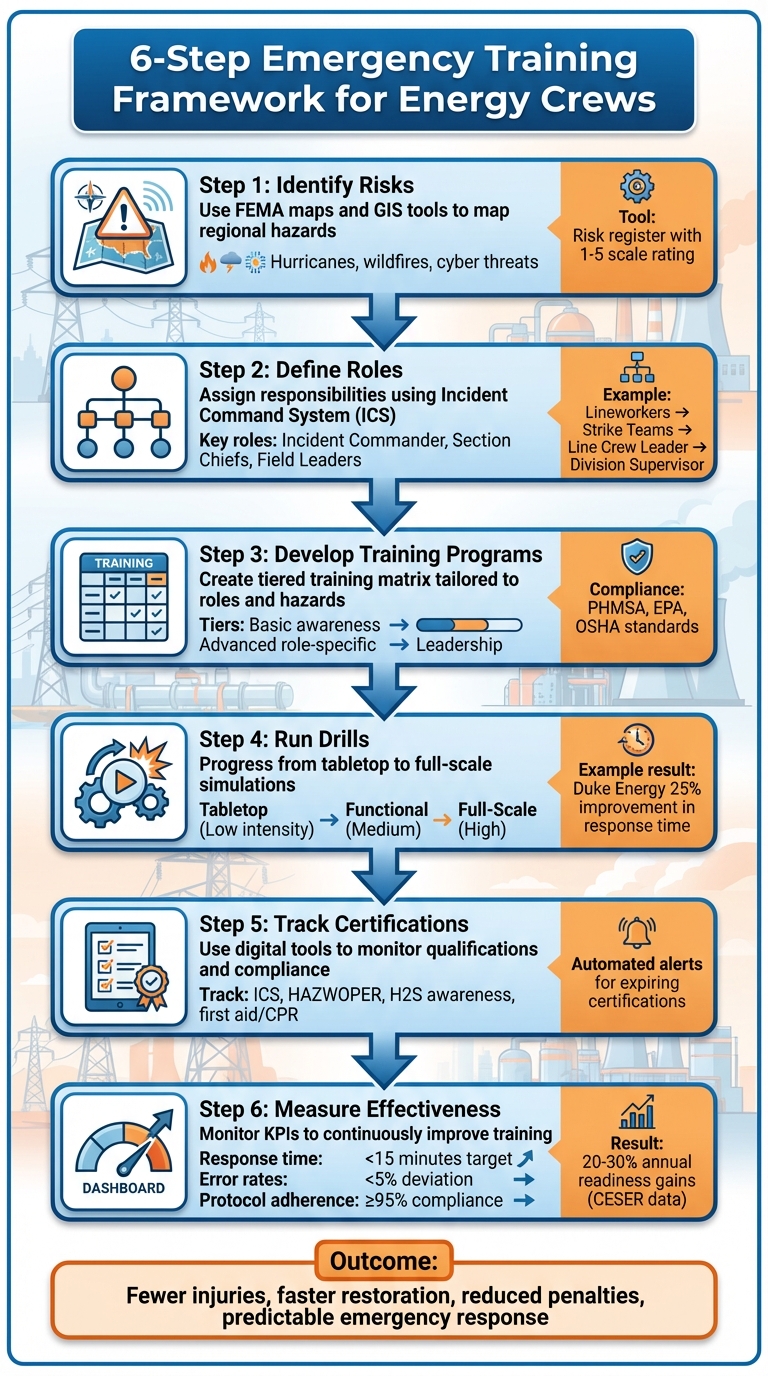
6-Step Emergency Training Framework for Energy Crews
Identifying Emergency Risks and Assigning Crew Roles
Assessing Region-Specific Hazards
Understanding potential threats is the first step in identifying emergencies. Energy operators across the U.S. typically start with an all-hazards approach, narrowing their focus to risks specific to their region. For example, coastal areas often prioritize hurricanes and storm surges, while the western regions brace for wildfires and earthquakes. In the north, winter storms and flooding take precedence. Regardless of location, cyber and physical attacks remain a universal concern.
To prepare, operators develop scenario maps that outline worst-case and likely threats, key assets at risk, activation triggers, operational impacts, and critical interdependencies. A coastal substation in Louisiana facing flooding or a wildfire threatening California transmission lines are examples of risks that might be mapped out.
Integrating historical incident data with resources like FEMA hazard maps, NOAA weather data, and USGS seismic information provides a clearer picture. Overlaying this data with GIS layers of infrastructure allows operators to create a risk register. This register rates each hazard’s likelihood and potential impact on a simple 1–5 scale, making it easier to prioritize and plan.
Once these risks are identified, it’s essential to assign clear roles to handle emergencies effectively.
Assigning Roles Using the Incident Command System
The Incident Command System (ICS) provides a structured framework for assigning roles and decision-making authority. Energy companies often scale ICS based on the situation, using a lean structure for routine outages and expanding to a full system during larger crises.
Key roles like Incident Commander, Section Chiefs, and field leaders should be predefined based on the company’s needs. For instance, a transmission maintenance supervisor might step into the role of Operations Section Chief during a major storm, while a pipeline integrity engineer could serve as a Technical Specialist in Planning.
Field roles are seamlessly integrated into this structure. Lineworkers, for example, operate as part of Strike Teams, reporting to a Line Crew Leader who answers to a Division or Group Supervisor under the Operations Section Chief. Similarly, pipeline field operators act as first responders to leaks by isolating affected areas, conducting air monitoring, and coordinating with local public safety teams, while control room operators handle remote shutdowns, reroute products, and manage regulatory notifications.
To ensure clarity, document these role assignments in ICS organizational charts and playbooks. Regular exercises with state and federal partners can help validate the structure and ensure all team members are familiar with their responsibilities before an emergency arises.
Once roles are defined, it’s time to focus on training.
Developing a Training Matrix by Role
A training matrix connects identified risks to the skills and preparation required for each role. Start by listing key positions – such as lineworker, substation technician, pipeline operator, control room operator, Incident Commander, and Operations Section Chief – and align each with specific competencies. These might include ICS training, hazard-specific courses, equipment operation, and decision-making drills.
For example, pipeline operators might need training in emergency response, hazardous materials handling, and gas monitoring, while Incident Commanders should complete advanced ICS and leadership courses. Companies like Enbridge ensure these training requirements are built into their emergency response plans, with sessions scheduled, completed, and documented. Retraining is also critical when roles change or training sessions are missed.
The training matrix should reflect the actual tasks crews will perform during emergencies. This could include pipeline integrity checks, leak response, substation and distribution isolation, generation plant stabilization, or spill containment. Regional risks further shape training priorities. Coastal teams might focus on hurricane preparation and protecting substations from floods, while western crews emphasize wildfire operations and managing smoke and heat exposure. Liquid pipeline operators may need training on boat handling and deploying booms for waterborne spills, and crews in colder climates should be prepared to operate spill response equipment in freezing conditions.
Lastly, ensure the matrix complies with regulatory standards such as PHMSA, EPA, OSHA, and local requirements. As workforce management becomes more digitized, platforms like ABLEMKR are being adapted from construction to the energy sector. These tools track certifications, safety training, availability, and geo-location in real time, ensuring that only qualified crews are deployed to handle specialized tasks. This not only speeds up response times but also ensures compliance when every second matters.
How Does the Oil and Natural Gas Subsector Prepare for an Emergency?
Building a Tiered Training Program
A tiered training program ensures that every worker has the skills they need to act effectively during an emergency. This approach begins with essential knowledge that applies to everyone and gradually moves into specialized training tailored for specific roles. By starting with core safety principles and advancing to role-specific expertise, this structure helps reduce training gaps and keeps costs under control.
Basic Emergency Awareness for All Workers
Every energy worker needs a strong foundation in emergency procedures. This initial training should include evacuation protocols, such as identifying muster points and conducting roll calls, as well as recognizing alarm systems and their signals – whether for gas leaks, fires, or full-scale evacuations. Workers should also be familiar with basic communication practices, like using two-way radios and standard phrases such as "all clear" or "evacuate now."
The Energy Institute emphasizes the importance of front-line training, including hazard identification, which should be reinforced through regular toolbox talks. For facilities dealing with hazardous materials, the EPA’s Risk Management Program guidelines and the PHMSA Emergency Response Guidebook provide similar training standards for incidents involving transportation.
Advanced Training for Specific Roles
Once workers have mastered the basics, advanced training focuses on the specialized skills required for their specific roles. For example, operations staff managing liquid pipelines need hands-on experience with spill containment, including deploying booms and operating skimmers. Grid restoration crews must be adept at handling switchgear under load conditions, while pipeline field operators require training in valve isolation, air monitoring, and working with local public safety agencies.
The Incident Command System (ICS) serves as an excellent framework for scaling this training. Workers can start with ICS-100 for general knowledge and progress to ICS-400 for leadership roles, with additional modules tailored to regional risks. For instance, Devon Energy trained over 580 personnel in 2024 by integrating NIMS/ICS training with full-scale emergency exercises involving multiple agencies. On the cybersecurity front, programs like CESER’s CyberStrike™ have trained over 1,500 individuals since 2016, offering continuing education credits for professionals in both the electric and oil & gas industries.
After establishing advanced skills, keeping certifications up to date becomes a top priority.
Managing Certifications and Compliance Records
Once core and advanced training is in place, maintaining certifications is essential to ensure emergency readiness. Certifications – such as ICS or hazmat response qualifications – often require renewal every two to three years. Additionally, agencies like the EPA, OSHA, and PHMSA mandate annual reviews of training records and exercises. Program coordinators are responsible for assessing needs, scheduling training sessions, documenting outcomes, and addressing any missed certifications.
Tools like ABLEMKR simplify this process by tracking certifications, safety training, and real-time worker locations, ensuring that qualified personnel can be deployed quickly during emergencies. These platforms also help meet strict regulatory requirements. After-action reports from drills should be used to identify gaps and refine certification requirements, ensuring continuous improvement in emergency preparedness.
Running Drills and Emergency Simulations
Once you’ve established a role-specific training matrix, the next step is turning knowledge into action. Drills and simulations are where theory meets practice, offering teams the chance to test their skills in controlled settings before facing real-world challenges. These exercises start simple and grow more complex over time, helping teams build confidence and refine their abilities.
Starting with Tabletop Exercises and Scaling Up
Tabletop exercises are a great starting point. These are discussion-based sessions that allow teams to walk through scenarios, clarify roles, and identify gaps in procedures – all without needing to deploy resources in the field. For instance, a tabletop drill might simulate a pipeline leak, prompting participants to outline notification protocols, valve isolation steps, and coordination with local fire departments – all from the comfort of a conference room.
Once teams master the basics, functional exercises bring in more realism. These drills simulate events in real time, focusing on the incident command structure and communication systems. They test decision-making under pressure and coordination across departments and external agencies, but still avoid large-scale field mobilizations.
The final step is full-scale field exercises, which test the entire system end-to-end. These involve actual equipment, field crews, mutual-aid partners, and sometimes live props. For example, in June 2024, Duke Energy conducted a full-scale drill in North Carolina simulating a major storm. This exercise involved over 500 personnel and led to a 25% improvement in response time metrics compared to previous drills.
| Exercise Type | Description | Intensity Level | Purpose |
|---|---|---|---|
| Tabletop | Scenario discussion around a table | Low | Test plans, clarify roles |
| Functional | Simulated command post operations | Medium | Practice communication, decision-making |
| Full-Scale | Field deployment with real equipment | High | Test full response capabilities |
This tiered approach ensures teams progress methodically, building on each stage to enhance readiness.
Practicing Decision-Making Under Pressure
Beyond structured exercises, it’s essential to simulate real-world pressures. Emergencies rarely unfold under ideal conditions, so drills should include unexpected challenges like conflicting data, changing weather, or equipment malfunctions to force teams to adapt quickly.
Time compression is another effective tool. For instance, simulating 10 minutes of incident time in just 3 minutes of real time pushes leaders to prioritize safety, system protection, and service continuity without overanalyzing. Adding role-players – such as media representatives or regulators demanding immediate answers – can mirror the external pressures teams will face during actual crises.
Communication drills should use the same tools relied on in emergencies, such as radio channels, SCADA systems, and phone bridges. Introducing complications like failed radio repeaters or network congestion tests backup procedures and ensures critical information flows to all stakeholders without delay.
Reviewing Drills to Identify Gaps
After each drill, conduct a "hot wash" review to capture immediate observations while they’re fresh. Within a few weeks, compile a formal After-Action Report to document strengths, weaknesses, and areas for improvement in plans, training, equipment, and communication.
Each identified gap should lead to a specific action plan with a clear owner, deadline, and resource allocation. For example, if a drill highlights confusion over valve isolation procedures, the next steps might include revising the pipeline isolation checklist and scheduling refresher training for field operators. Organizations that regularly review and act on drill findings have reported a 30% boost in crew readiness and faster response times during actual emergencies.
Track these improvement actions annually and report progress to senior leadership or safety committees. This ensures recurring issues are addressed, not just re-listed in reports. For instance, one oil and gas platform implemented VR simulations, hands-on evacuation drills, and structured debriefings, leading to a 35% reduction in near-miss incidents within six months. This also helped reduce unplanned shutdowns and improved regulatory compliance.
sbb-itb-aa28329
Managing Staffing and Logistics for Emergencies
Effective emergency response isn’t just about training – it’s about having the right people in the right place at the right time. Whether it’s a pipeline rupture, a grid failure, or a refinery accident, every second matters. The ability to quickly mobilize skilled workers can mean the difference between controlling the situation and facing a full-blown crisis. To make this happen, a streamlined system for tracking worker credentials is essential.
Tracking Worker Certifications and Qualifications
Keeping track of worker certifications is non-negotiable. Relying on outdated, manual methods can lead to serious risks. Imagine sending someone to handle hazardous materials without valid HAZWOPER credentials or assigning a worker to a confined space without proper training – it’s a recipe for disaster. A digital system that tracks certifications like OSHA, HAZWOPER, H2S awareness, first aid/CPR, and site-specific qualifications ensures that only qualified personnel are deployed. Automated alerts for expiring certifications add another layer of safety, preventing unqualified staff from being assigned to critical roles.
This kind of system also helps organizations stay proactive. By identifying training needs, scheduling sessions, and tracking completion rates, coordinators can ensure their teams are prepared before an emergency strikes. The result? Fewer qualification gaps and a smoother response when it matters most.
Using Technology to Deploy Crews Faster
Technology can dramatically cut down the time it takes to mobilize crews. Digital platforms, like ABLEMKR’s mobile-first system, make it easy to match workers to job sites based on their certifications, training, availability, and even location. When a pipeline repair or last-minute shutdown demands immediate action, operations teams can quickly filter and dispatch pre-vetted workers with just a few clicks – no more scrambling through spreadsheets or paperwork.
These platforms also provide real-time updates on worker status, payroll integration, and compliance tracking. For workers, it means access to well-paid opportunities with guaranteed on-time payments. This approach aligns with the Department of Energy’s (DOE) focus on rapid deployment through mutual assistance networks. For example, during DOE’s Clear Path exercises, technology-enabled networks successfully deployed certified crews across sectors for post-incident restoration. After-action reports highlighted the value of geo-targeted staffing, showing how tech can improve response efficiency.
Similarly, tools like PHMSA’s TRIPR use interactive scenarios to train responders on the logistics of rapid deployment for incidents like crude oil or ethanol spills. These examples demonstrate how technology isn’t just a convenience – it’s a critical part of modern emergency response.
Maintaining Training and Compliance Documentation
Accurate documentation isn’t just about staying organized – it’s your proof of compliance when regulators or insurers come knocking. A searchable, backed-up system for archiving training records ensures that you meet OSHA, PHMSA, EPA, and state audit requirements.
To stay on top of compliance, map each regulatory requirement to specific training modules and records. For instance, HAZWOPER compliance under 29 CFR 1910.120 requires documented initial training, annual refreshers, and participation in exercises. Similarly, PHMSA’s pipeline emergency response standards demand thorough documentation trails.
When training records are integrated with workforce management systems, credentials are automatically verified during crew assignments. If a worker’s certification has expired, the system blocks them from being assigned until they complete their refresher training. This integration also simplifies after-action reporting, allowing you to quickly generate records showing who responded, their qualifications, and their performance during the incident. By combining meticulous documentation with workforce management, you ensure that every emergency is handled by a prepared, compliant, and efficient team.
Measuring and Improving Training Effectiveness
Building on earlier discussions about drills and role-specific training, consistently measuring performance is key to keeping your crew prepared for any mission. Without tracking progress, it’s impossible to know how effective your training really is. Metrics from drills can highlight team strengths and pinpoint areas needing improvement. The next step is to establish clear benchmarks to evaluate crew readiness and guide enhancements.
Setting Performance Metrics for Crew Readiness
One of the most important metrics to track is response time – from the moment an alert is issued to full crew mobilization. The Department of Energy’s CESER exercise evaluations recommend aiming for under 15 minutes. Other critical metrics include:
- Response Time: Target less than 15 minutes.
- Error Rates: Keep deviations below 5%, based on after-action reports.
- Protocol Adherence: Maintain at least 95% compliance, as measured by simulation scores.
For example, the Clear Path exercise series, conducted by CESER, monitors these metrics before and after training sessions. After-action reports from these annual drills have shown tangible improvements, such as reducing average mobilization times from 30 minutes to 18 minutes and achieving 20–30% annual readiness gains. Using dashboards that integrate drill data – like GPS timestamps for response times, video footage for error analysis, and scored assessments for protocol adherence – provides a real-time snapshot of crew performance. This makes it easier to identify trends and address problem areas.
Once you’ve set these metrics, use them to fine-tune and update your training programs.
Reviewing and Updating Training Programs
Training programs should be reviewed and updated after significant incidents or drills. Conduct after-action reviews within 30 days to document lessons learned and adjust training plans accordingly. For example, following crude oil rail incidents, PHMSA revised its TRIPR training modules by adding interactive scenarios focused on Emergency Response Guidebook protocols. This adjustment led to fewer response errors during subsequent drills.
Annual exercises like the Liberty Eclipse simulations – designed to test both operational technology and cybersecurity teams – offer another example of how training evolves. These simulations incorporate findings from post-exercise reviews to update response strategies, improving resilience against threats like substation cyberattacks. This continuous feedback loop ensures training stays relevant and effective.
Staying Current with Regulatory Standards
As regulations change, training programs must adapt to remain compliant. For instance, NERC EOP standards require biennial reviews with documented proof of drill effectiveness. Similarly, PHMSA guidelines, updated every four years based on incident data, mandate that companies align their training programs within six months of any revisions. Staying on top of updates from organizations like PHMSA and NERC – and conducting quarterly compliance checks – ensures your team is always prepared.
The NASFM’s Pipeline Emergencies program, which aligns with PHMSA standards, has reported impressive results: 40% faster incident resolution and 25% fewer safety violations after implementing updated training. Similarly, CESER exercises demonstrate that compliant crews reduce outage times by 15–20% during simulations compared to non-compliant teams. Keeping up with these standards isn’t just about meeting requirements – it’s about building a team that responds faster, safer, and more effectively when every second counts.
Integrating these practices with tools like ABLEMKR can further streamline your approach. Platforms like this consolidate drill data, certifications, and performance metrics into a single dashboard, enabling energy operators to continuously improve their training programs and maintain top-notch emergency readiness.
Conclusion
Emergency training is non-negotiable for U.S. energy crews. High-risk operations like pipelines, refineries, utilities, and LNG facilities can transform into life-threatening incidents in a matter of minutes if crews aren’t prepared. The Department of Energy’s Office of Cybersecurity, Energy Security, and Emergency Response (CESER) emphasizes the importance of exercises and training as “critical” for ensuring coordinated responses and overall sector resilience. Programs like Clear Path and Liberty Eclipse put crews through the paces with catastrophic, multi-state scenarios, turning plans into actionable, practiced responses through role-based training and realistic drills designed to simulate high-pressure decision-making situations.
The strategy is clear: identify hazards specific to your region, assign well-defined roles using the Incident Command System (ICS), create tiered training plans, conduct regular tabletop and field exercises, and measure performance using clear KPIs. After each exercise, hold after-action reviews to pinpoint successes and failures, update procedures and training materials, and track the resolution of action items. This plan–train–exercise–improve cycle, championed by DOE CESER and industry experts, ensures emergency programs evolve in step with emerging threats and changing regulations. Modern digital systems make this process even more seamless.
Technology has become central to emergency readiness. Quick, precise deployment is critical for stabilizing systems during crises. Tools like ABLEMKR allow energy operators to pair pre-vetted, certified workers with mission-critical tasks based on credentials, training, availability, and location. Whether it’s a last-minute shutdown, remote pipeline repair, or storm-related outage, these platforms ensure the right people are on-site when it matters most. By integrating certification tracking, compliance monitoring, and real-time worker status into a single mobile-first system, these tools bridge the gap between planning and execution.
To get started, take these steps: appoint a training coordinator, select one high-risk scenario, run a tabletop exercise, implement a tracking system, and schedule annual reviews to keep up with evolving standards. The payoff is undeniable – well-trained crews lead to fewer injuries, faster restoration times, reduced outage penalties, and more predictable emergency responses. Investing in comprehensive training and workforce deployment tools isn’t just about meeting compliance requirements – it’s a strategic move to safeguard lives, assets, and operational uptime when every second counts.
FAQs
What steps can energy operators take to ensure their training programs meet regulatory standards?
Energy operators can keep their training programs aligned with regulatory standards by conducting regular audits, maintaining thorough records of all training sessions, and certifying workers according to industry-specific guidelines. Staying updated on changes to federal and state regulations is crucial to ensure ongoing compliance.
Beyond this, integrating real-time emergency drills and leveraging tools designed for workforce deployment can play a key role in preparing workers. These strategies not only help meet compliance requirements but also boost safety and operational preparedness.
What are the essential steps for training energy crews to handle emergencies?
Effective training for energy crews during emergencies requires a well-structured approach. It begins with basic safety and emergency protocol training, ensuring every worker understands the core principles needed to navigate dangerous situations. This foundation is crucial for building a safe and prepared workforce.
Next, workers should complete certification programs that focus on essential skills such as hazard identification, first aid, and fire safety. These certifications not only enhance individual expertise but also ensure compliance with industry standards.
To simulate real-life challenges, incorporate drills and practice scenarios. These exercises test how quickly and effectively crews can respond, while also improving teamwork and decision-making under pressure. Regular refresher courses are equally important to keep everyone aligned with the latest safety updates and to prevent skills from becoming rusty.
For high-risk emergencies like pipeline leaks or electrical failures, it’s vital to offer specialized training. This type of preparation is tailored to the unique responsibilities of each crew member, ensuring they are equipped to handle the specific demands of their roles in critical situations.
How can technology improve the training and readiness of energy emergency crews?
Technology has become a game-changer in boosting the training and preparedness of emergency crews in the energy sector. With tools that provide real-time updates on worker status and simplify processes like hiring and onboarding, teams can be deployed faster and more effectively. Platforms such as ABLEMKR take it a step further by matching workers to emergency tasks based on their certifications, training, and location. This not only cuts down response times but also improves overall coordination.
When the stakes are high, having the right team in the right place makes all the difference. Advanced technology ensures that skilled personnel are sent where they’re needed most, enabling energy companies to handle emergencies effectively while prioritizing safety and meeting compliance requirements.


