
I’d start with one hydropower job posting – not a training catalog. Check its education, experience, and license requirements before paying for classes. Your trade skills may fit the work, but they don’t replace supervised plant training or task approval.
Here’s how I’d compare the four routes:
Quick Comparison
| Your trade | Closest role | Training to check first |
|---|---|---|
| Electrician | Electrical maintenance or controls | Generators, protective relays, PLCs, and switching procedures |
| Millwright | Turbine-mechanical maintenance | Turbine assemblies, vertical-shaft alignment, and plant rigging |
| Mechanic | Plant maintenance | Pumps, hydraulics, controls, and precision measurement; automotive-only backgrounds need more plant training |
| Equipment operator | Apprentice, helper, or site-support work | Plant systems, safety procedures, and supervised repair work |
The time commitment depends on the path. For example, the U.S. Army Corps of Engineers’ Northwestern Division uses a four-year apprenticeship: one year of rotation, then three years in a selected craft.
My rule: <u>keep schooling, licenses, safety training, and plant approval separate</u>. Use classes, apprenticeships, or employer training to fill the gaps – and keep records of your equipment experience and task sign-offs. Course completion alone isn’t permission to work on plant equipment.
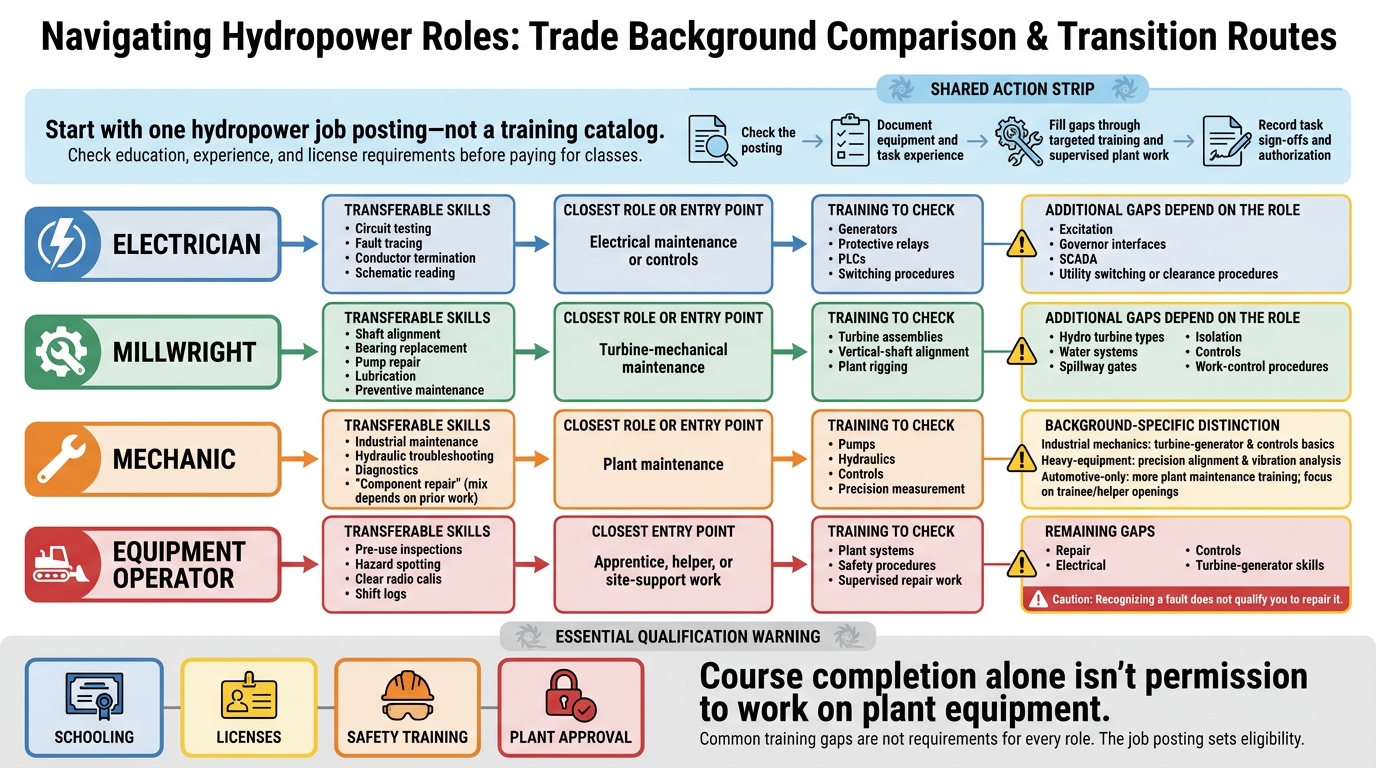
Four Trade Paths to Hydropower Technician Roles
1. From Electrician to Hydropower Technician
Transferable Skills
Your electrical skills carry over directly: circuit testing, fault tracing, conductor termination, and schematic reading all apply to hydropower work. Document your hands-on experience with multimeters, insulation testers, motor starters, and control circuits. The work goes beyond building wiring – hydropower electricians may service motors, generators, transformers, relays, regulators, batteries, and switchyard equipment.
Each electrical background brings something different. Residential work builds wiring basics. Commercial work adds three-phase systems and emergency power. Industrial work adds VFDs, PLCs, and preventive maintenance, while utility work adds switchgear, protective relays, synchronization, and high-voltage systems.
Rather than relying on your job title, name the equipment, voltage ranges, and supervision involved. Training can then close the gap between your electrical experience and plant-specific systems.
Bridge Training
For plant electrical maintenance, focus on generators, excitation systems, transformers, protective relays, medium- and high-voltage switching, and synchronization. For instrumentation and controls (I&C), focus on PLC diagnostics, sensors, calibration, and SCADA. Match training to the posting’s actual tasks before paying for a credential.
DOE identifies an associate degree or recognized technical training in electronics, instrumentation, or a related field as preparation for an I&C technician. Equivalent electrician, mechanical, or industrial experience can also qualify. I&C technicians commonly need 1–3 years of hands-on experience with instrumentation, PLCs, and computer systems, plus 1–3 months of on-the-job training.
Pair coursework with supervised practice in motor-control troubleshooting, insulation testing, and work-order documentation. Electrical safety training should cover OSHA rules, NFPA 70E, arc flash, energized-work limits, grounding, confined spaces, fall protection, and lockout/tagout. Employers may require further qualification before you operate or work on equipment.
Training alone doesn’t meet every hiring requirement. Postings still treat experience, licensing, safety training, and plant authorization as separate checks.
Hiring Requirements
Check required experience, license jurisdiction, safety training, and equipment authorization separately.
Central Nebraska Public Power and Irrigation District required Level I candidates to have one year of vocational or trade-school training in electrical and mechanical maintenance and Level II candidates to have two years plus a Nebraska journeyman-or-higher electrical license.
Compare each requirement with your documented experience and credentials, then ask which gaps you can address after hire. Apply this posting-by-posting check to other trades, too: equipment, experience, and authorization requirements can change even when the plant title stays the same.
sbb-itb-aa28329
Pathway to Apprenticeship – Hydro Power
2. From Millwright to Hydropower Technician
Millwrights enter hydropower through the plant’s mechanical systems. Turbine assemblies have more in common with heavy industrial equipment than with building systems.
Transferable Skills
Shaft alignment, bearing replacement, pump repair, lubrication, and preventive maintenance transfer directly to turbine-generator work. Name the tools you’ve used – dial indicators, micrometers, or laser alignment systems – and document measured clearances and manufacturer tolerances. Hydro employers use these skills on turbine shafts, thrust and guide bearings, couplings, and main-shaft seals.
These skills cover the mechanical core. The next step is learning turbine-specific systems and plant procedures.
Bridge Training
Focus on vertical-shaft alignment, turbine-generator fundamentals, governors, wicket gates, and lube-oil, cooling-water, compressed-air, and hydraulic circuits. Practice reading hydraulic schematics and logging inspection findings, lubricant condition, replaced parts, and test results.
Rigging experience helps with turbine teardown, but powerhouse lifts demand close attention to weight, center of gravity, clearances, and lift plans. Welding and fabrication may also require plant approval or a specific welding qualification.
Classroom completion isn’t proof that you’re ready for plant work. Use supervised plant training to learn turbine assembly, bearing-clearance checks, and return-to-service tasks.
Hiring Requirements
Recent postings show how employers distinguish general mechanical experience from readiness for hydro work:
A July 2026 Enscicon Corporation posting for a journey-level hydroelectric millwright at Rocky Mountain Dam required a journeyman millwright apprenticeship or 4 years of equivalent heavy-industrial experience. Duties included turbine teardown and reassembly, vertical- and horizontal-shaft laser alignment, bearing inspection, and heavy rigging inside turbine pits and generator housings.
Northern California Power Agency’s hydro technician posting requested at least 5 years of mechanical experience, with a state-certified apprenticeship preferred.
Document the equipment you repaired, alignment methods you used, rigging duties you handled, and results you achieved. Use these millwright benchmarks in the comparison ahead to see which gaps are easiest to close across mechanical, electrical, and operator routes.
3. From Mechanic to Hydropower Technician
Mechanics fall between millwrights and operators: the more experience they have with fixed industrial equipment, the easier the move into hydropower.
Transferable Skills
Industrial maintenance and heavy-equipment mechanics are the closest fit. Automotive mechanics have more ground to cover. Industrial mechanics bring experience diagnosing and repairing fixed equipment, while heavy-equipment mechanics bring hydraulic troubleshooting skills. Automotive mechanics bring diagnostic and component-repair skills, but automotive-only experience isn’t the same as hydro plant experience.
Document the equipment type, failure symptoms, tests, measurements, and repair results.
Bridge Training
Training should address each mechanic’s gaps. Industrial mechanics need turbine-generator and controls basics. Heavy-equipment mechanics need precision alignment and vibration analysis. Automotive mechanics need plant maintenance training for pumps, turbines, hydraulics, and controls, along with rigging, hoisting, and piping and instrumentation diagram (P&ID) reading.
All mechanics need plant lockout/tagout, confined-space, and hydraulic stored-energy training. That includes learning how to isolate and release trapped pressure before making repairs.
Hiring Requirements
Idaho Power’s apprenticeship pathway accepted one year of mechanical, maintenance, or construction experience with direct exposure to electrical, generation, power-plant, mechanical systems, hydraulics, or welding.
Experienced industrial mechanics should compare their work records with plant-mechanic requirements. Heavy-equipment mechanics should highlight hydraulic diagnosis skills and identify gaps in fixed-equipment experience. Automotive-only applicants should focus on trainee or helper openings.
Federal hydroelectric mechanic screening focuses on blueprint reading, tool use, assembly and repair, and working with limited supervision.
Equipment operators take a different route, with more emphasis on site support than repair.
4. From Equipment Operator to Hydropower Technician
Equipment operators usually enter hydropower through plant operations and site support, then move into maintenance. The starting point is safe operation, not advanced mechanical work.
Transferable Skills
Pre-use inspections, hazard spotting, clear radio calls, and shift logs all carry over to plant rounds. But recognizing a fault does not qualify you to repair it.
Bridge Training
For operations roles, study gauges, alarms, controls, water systems, and clearance procedures. For maintenance, add precision measurement, bearings, couplings, alignment, pumps, and valves. Supervised assignments should move from inspections and controls to component replacement and post-repair checks, with technician sign-off.
The U.S. Army Corps of Engineers’ Northwestern Division uses a four-year apprenticeship: one year of rotational operation-and-maintenance training, followed by three years completing requirements in a selected craft.
This structure helps trainees learn the plant before choosing a specialty. The training still needs to match the duties in the job posting.
Hiring Requirements
Start with operator apprentice and helper roles, then check each posting’s training and authorization rules. DOE says the usual route is a high school diploma or equivalent, plus extensive apprenticeship or on-the-job training. Some employers prefer related technical education.
Check the actual maintenance duties and required experience in each posting. Keep equipment-operation hours separate from supervised repair records. Crane, forklift, and heavy-equipment qualifications help, but they do not replace plant training or authorization for switching, lockout/tagout, or maintenance.
Compare Training Routes and Skill Gaps
Choose training based on the work you’ll do, not the program title. Compare your trade background with the plant role in five areas: electrical, mechanical, controls, safety, and plant procedures. The gaps below are common, but they aren’t requirements for every role.
| Trade background | Priority training | Practical experience to document | Placement fit | Remaining gaps |
|---|---|---|---|---|
| Electrician | Generators, protection systems, instrumentation, and industrial controls | Record the equipment, voltage range, and supervised testing you’ve worked with. | Best fit for electrical maintenance and controls. | Excitation, governor interfaces, SCADA, and utility switching or clearance procedures |
| Millwright | Turbine-generator assemblies, precision alignment, vibration monitoring, and hydraulics | Record outage work, alignment work, rigging plans, and rotating-equipment troubleshooting. | Closest fit for turbine-mechanical work. | Hydro turbine types, water systems, spillway gates, isolation, controls, and work-control procedures |
| Mechanic | Turbines, governors, vibration analysis, industrial hydraulics, and electrical fundamentals | Document maintenance records, fault diagnosis, parts identification, and safe lifting and shop practices. | Best bridge into industrial maintenance. | Generator auxiliaries, controls, electrical clearances, and plant procedures; a larger gap for those with automotive-only experience |
| Equipment operator | Plant hazards, energy-isolation awareness, rigging, and operations or maintenance fundamentals | Record equipment operation, pre-use inspections, signaling, material handling, and work on active sites. | Best entry point for outage support and site operations. | Repair, electrical, controls, and turbine-generator skills; often the largest technical gap |
Use the table to find your shortest path, then look for coursework or supervised plant training that covers those gaps.
Community-college classes can help with industrial electricity, motor controls, instrumentation, hydraulics, blueprint reading, and PLCs. Compare tuition, fees, tools, and lab access – not just course names. Classes build technical knowledge, but they don’t qualify you to work on a plant’s equipment.
Registered apprenticeships, where available, combine paid work, mentoring, classroom instruction, progressive wages, and a portable credential. Check the sponsor, occupation, and work assignments. Millwright is a recognized apprenticeship occupation, but a trade apprenticeship doesn’t automatically include hydropower training.
Employer trainee programs offer plant-specific assignments. Check entry requirements, supervision, assessments, pay, and whether the credential transfers to other employers. Neither an apprenticeship nor an employer trainee program guarantees a completion date or a job.
Use DOE career guidance for planning only. Its career map broadly groups roles into these bands: entry-level roles at apprentice level or below a two-year postsecondary credential, generally with 1–3 years of experience; mid-level roles at journey or associate level, generally with 3–5 years; and advanced roles at master-craft or bachelor’s level, with 5 or more years. The job posting – not the career band – sets eligibility, including experience, licenses, controls skills, and employer qualifications.
Credentials and Entry Roles in Job Postings
Compare verified eligibility, not transfer speed. This matrix shows reported job requirements and flags missing sources or sources that offer guidance only.
| Trade background | Shortest evidence-supported bridge | Entry role | Minimum credentials | Preferred training | Employer-specific qualifications | Major hiring risk |
|---|---|---|---|---|---|---|
| Electrician | Meet the target level’s electrical-mechanical education requirement | CNPPID Electrical / Mechanical Technician Level I; Level II if qualified | Level I: high school diploma or equivalent, one year of vocational or trade-school education in electrical and mechanical maintenance, and a valid Nebraska driver’s license. Level II: high school diploma or equivalent, two years of vocational or trade-school education in electrical and mechanical maintenance, a valid Nebraska journeyman-or-higher electrical license, and a valid Nebraska driver’s license. | None verified | Electrical and mechanical drawings; hydro equipment maintenance. | Assuming an electrical license replaces the education requirement |
| Millwright | Check education against the target posting | Mechanical maintenance or millwright role | No millwright-specific hydropower posting verified; use the CNPPID Level I baseline only when targeting that role. | None verified | Target-posting requirements not verified | Treating industrial millwright credentials as automatic hydro eligibility |
| Mechanic | Check whether existing schooling meets the posting’s requirements | Maintenance technician or combined electrical/mechanical maintenance role | No mechanic-specific hydropower posting verified; compare against the CNPPID Level I baseline if using that role. | None verified | Target-posting requirements not verified | Assuming repair experience satisfies formal education requirements |
| Equipment operator | No posting-verified minimum bridge established | Apprenticeship track only; not a verified vacancy. | No verified operator-to-hydro posting | None verified | Plant approval for turbines, pumps, valves, gates, controls, and batteries | Assuming equipment operation qualifies someone for plant maintenance or controls |
The source notes below separate reported requirements from guidance and explain what still needs verification.
Verify Hydropower Job Requirements
The CNPPID Electrical / Mechanical Technician source record for Kingsley Dam, Nebraska, has no posting date or direct URL. Its current status is unverified. Check the original notice to confirm the exact Level I wording and Level II license requirement.
Apprenticeship.gov’s Hydroelectric Plant Technicians page provides occupational guidance – not a verified vacancy.
A mechanical job posting from another industry isn’t a hydropower hiring standard. Check the employer and industry before using it as a benchmark.
Separate Industrial Jobs From Hydropower Jobs
Hydro, the aluminum and industrial-products company, posted a millwright role in The Dalles, Oregon with electric motors, hydraulic systems, welding, schematic reading, and NCCER Level 2. Treat it as adjacent-industry evidence, not a hydropower standard.
Also check each credential type separately.
Separate Licenses, Safety Training, and Plant Approval
Driver’s licenses, trade licenses, safety cards, and plant authorization are separate checks. OSHA’s 10-hour and 30-hour Outreach cards are not professional certifications and do not satisfy standard-specific training requirements.
Check confined-space, fall-protection, hazard-communication, and high-voltage requirements separately. Then organize worker records for mobilization and compliance tracking.
Organize Worker Records for Contractor Mobilization
Use ABLEMKR to track certifications, safety records, availability, and location in one worker profile. Keep the issuing body, expiration date, and supporting documents attached.
Conclusion: Match Training to the Plant Role
Match training to the plant role you want. Use the comparison table to find the shortest route. Electricians are best suited to electrical maintenance and controls; millwrights to turbine mechanics; and industrial and heavy-equipment mechanics to diagnostics and hydraulics. Equipment operators have the largest gap to bridge.
Choose one target hydropower job posting before paying for training. Let that posting set the standard; everything else supports it. Check the required credentials, then document the equipment, tasks, troubleshooting methods, and supervision level for each skill.
Fill skill gaps through targeted training and supervised plant work. Record task sign-offs and authorization for core work, including pump inspections, alignment, control troubleshooting, and post-maintenance testing. Focus on proof that you can do the job – not how many courses you’ve taken.
FAQs
Can my trade experience shorten a hydropower apprenticeship?
Yes. If you’ve worked in mechanics, electrical work, or industrial maintenance, employers and training providers often recognize those transferable skills. Your experience may qualify you for employer-led training lasting 3 to 6 months, instead of a formal degree path that takes 1 to 2 years.
Military technical training may also count toward certifications. With prior experience, you may be able to skip entry-level theory and focus on site-specific maintenance.
How can I gain supervised plant experience before getting hired?
Look for apprenticeships or internships that put on-site training first. Many hydropower training providers work with utilities and energy companies, giving you opportunities to observe operations, shadow technicians, and carry out maintenance under supervision.
Pre-apprenticeship programs provide hands-on training in simulated workplace settings, helping connect classroom lessons with field requirements. Look for programs where experienced professionals offer mentoring, practical guidance, and supervision.
Will my hydropower qualifications transfer between employers?
Yes – your hydropower qualifications can transfer between employers, as long as you keep your skills and required safety and compliance credentials current. Training focuses on hands-on mechanical and electrical skills, along with safety procedures such as energy isolation and confined-space work.
Employers typically check core credentials against OSHA-related, NEC-related, and site-specific requirements. Keeping those credentials up to date can make it easier to move between utilities and contractors.


