
Trade deals do not give open access to U.S. jobs. They create limited, short-term entry paths for certain workers, with strict rules on role, purpose, employer, and length of stay.
If I were hiring for a refinery shutdown, mine project, or plant startup, I’d focus on five things right away:
- Entry category: business visitor, TN, H-1B, L-1, or another approved path
- Job scope: whether the worker can visit, supervise, or perform hands-on work
- Time limits: many stays are capped, such as up to 3 years for TN and up to 6 years total for H-1B
- Licensing and site rules: immigration approval alone does not get someone onto a job site
- Employer records: Form I-9, re-verification, expiration tracking, payroll, and subcontractor checks still apply
Here’s the short version:
- Trade agreements help with temporary movement, not general hiring into the U.S. labor market
- They often cover managers, engineers, specialists, service suppliers, and consultants
- Business visitors cannot do site labor
- Workers may still need state licenses, OSHA or MSHA training, union clearance, and site badges
- U.S. wage and safety laws apply to foreign workers just like they do to U.S. workers
A few numbers show why this matters. Construction is projected to need 499,000 more workers in 2026. And under the TN category, engineers made up 41.9% of approvals in 2023, up from 21.5% in 2010. So if you manage staffing in heavy industry, these rules can shape who gets to the site and when.
Quick Comparison
| Topic | What it means | Main limit |
|---|---|---|
| Temporary entry | Short-term cross-border work for a set task | Not open-ended employment |
| Business visitor | Meetings, inspections, contract talks | No productive labor |
| Key personnel | Executives, managers, specialists | Role and stay must fit the rule |
| CSS / IP | Contract-based service work by foreign employees or self-employed workers | Often around 12 months max under deal rules |
| Local labor market access | Hiring into regular U.S. jobs | Usually outside trade-agreement entry rules |
If I had to sum it up in one line, it’s this: trade agreements can help fill short-term skill gaps, but only when immigration status, licensing, labor law, and site access all line up.
sbb-itb-aa28329
Core Terms You Need to Know
Temporary Entry, Mode 4, and Business Visitors
Temporary entry means a foreign national can enter the U.S. for a limited period to carry out a specific business or service task. It does not mean permanent residence or open-ended work permission. The person needs a set purpose, a known end date, and ties to their home country, such as a permanent job there.
Mode 4 – formally the "movement of natural persons" – is the WTO term for this idea under the General Agreement on Trade in Services (GATS). It covers people who cross borders on a temporary basis to supply services, whether they work for themselves or for a foreign company. In plain English, this often comes up when a foreign company sends a specialist to a U.S. project site to deliver a service under contract, like supervising the deployment of specialized equipment.
Business visitors have a narrow lane. They can attend planning meetings, negotiate contracts, or inspect a job site. But they can’t do hands-on labor or take on work that belongs in the local labor market. That line matters. If a company crosses it, the result can be visa denial, entry bans, or penalties. In short, temporary entry is one thing; actual site labor is another.
Key Personnel, Contractual Service Suppliers, and Independent Professionals
Three categories show up again and again: key personnel, contractual service suppliers (CSS), and independent professionals (IP). These labels shape both the visa path and what the worker may do on site.
| Category | Who They Are | Typical Stay Limit | Common Use in Heavy Industry |
|---|---|---|---|
| Key Personnel | Senior managers, executives, or specialists employed by a foreign company | Varies by agreement; often longer stays | Project directors, senior engineers overseeing plant commissioning |
| Contractual Service Suppliers (CSS) | Employees of a foreign firm with no establishment in the U.S. who are sent to fulfill a specific service contract | Often capped at about 12 months, depending on the agreement | Technicians installing or troubleshooting specialized systems |
| Independent Professionals (IP) | Self-employed individuals with a direct service contract in the U.S. | Often capped at about 12 months, depending on the agreement | Specialized consultants for design, engineering oversight, or audits |
Many trade agreements use these three categories beyond business visitors. Under CETA, for example, CSS and IP workers are generally allowed a cumulative stay of up to 12 months within any 24-month period, or for the duration of the contract, whichever is less. Independent professionals usually must hold a university degree or equivalent, plus around six years of relevant experience.
Temporary Movement vs. Access to the Local Labor Market
This is where people often get tripped up. Trade agreements allow limited business mobility for defined categories of skilled workers. They do not give companies a free pass to hire foreign nationals into the U.S. workforce at large.
A simple test helps. If the worker is coming for a specific, time-bound project or contract, stays on a foreign employer’s payroll, and leaves when the assignment ends, that is temporary movement. If the worker is hired onto U.S. payroll to handle ongoing duties alongside domestic employees, that is access to the local labor market.
That split drives a lot of hiring decisions in construction, energy, and mining. Trade-based entry is for specialists. Domestic labor rules apply to ongoing field crews and general site work.
Next, these categories shape how hiring and mobility work on the ground.
How Trade Agreements Shape Hiring and Mobility
Trade agreements affect worker movement in three main ways: entry rules, credential rules, and labor protections. Each one creates a different set of duties for employers. And in practice, knowing which rule applies is often the difference between getting someone on-site fast and getting stuck in delays.
Temporary Entry Chapters and Labor-Mobility Provisions
Temporary entry rules can speed up access for certain project roles. Under agreements like USMCA Chapter 16, defined worker categories can enter without the standard labor-market test. That matters a lot in construction and energy, where a commissioning engineer or technical specialist may need to be on-site in days, not weeks.
Credential-based mobility is a different animal. It does not just speed up border entry for one person at a time. Instead, it focuses on whole professions by cutting licensing barriers. Mutual Recognition Agreements (MRAs) between regulators can recognize licenses or exams across borders. As of June 2023, APEC economies had entered into 217 MRAs for professional qualifications, and about 80% of them covered engineers, architects, surveyors, accountants, and actuaries. Those are core roles in infrastructure and heavy-industry work.
Here’s the practical difference:
| Mechanism | Purpose | Who It Covers | Typical Permit/Cert Rules | Hiring Impact |
|---|---|---|---|---|
| Temporary Entry (Mode 4) | Facilitate short-term business travel and service delivery | Business visitors, intra-company transferees, key personnel | Streamlined visas; typically no local labor-market test | Faster mobilization for management, consultants, and specialists |
| Credential-Based Mobility | Reduce barriers for specific skilled trades and professions | Licensed engineers, architects, surveyors, technical specialists | Requires credential recognition or state-level reciprocity | Fills gaps in specialized roles; still subject to domestic licensing |
| Labor-Rights Provisions | Set minimum labor standards and enforcement tools | All contracted labor, including local, foreign, and migrant workers | No visa category; creates compliance and monitoring obligations | Increases compliance burden and contractor oversight |
Credential Recognition and Occupation-Based Access
Fast entry is only part of the job. The worker still has to qualify for the role once they arrive. Even if a trade agreement recognizes a foreign credential, that does not mean every hurdle on a U.S. job site disappears. State licensing, union rules, site training, and owner access rules can still block deployment.
So the actual process tends to work like a stack of checks. Employers may need to look at:
- trade-agreement entry conditions
- U.S. federal immigration rules
- state licensing
- OSHA or MSHA rules
- union status
- site-access clearances
Miss one layer, and the risk goes up fast.
Hiring Impact for Construction, Energy, Mining, and Heavy Industry
In project-based sectors, these rules shape day-to-day hiring choices. Under USMCA’s TN professional category, engineering has been the top occupation for approved TN visa holders since 2010, climbing from 21.5% of approvals in 2010 to 41.9% in 2023. That lines up with what employers see on the ground: large energy and infrastructure projects often depend on cross-border engineering talent for design, commissioning, and oversight.
For hiring teams, the big change is simple. They need to move from reactive staffing to structured pre-screening. Employers that map common project roles to trade-agreement categories – and keep standard document packages ready for each role – can move qualifying workers much faster. ABLEMKR can store certifications, track expiration dates, and match pre-vetted workers to sites by credential, safety training, and location.
Even when trade rules make entry easier, mobilization still comes down to permits, licensing, and site compliance. Hiring teams still need to clear labor standards, permit rules, and employer checks before a worker can actually start.
Permits, Labor Standards, and Employer Compliance
Once a worker qualifies for a temporary entry path, that doesn’t mean they’re cleared to start work. On a U.S. project site, three things still control deployment: immigration status, labor rules, and the employer’s records.
Work Permits, Stay Limits, and Eligibility Checks
Even if a worker qualifies under a trade-related entry path, U.S. work authorization still controls the job. Every foreign worker needs a valid immigration status that allows employment, and the planned job duties have to match that status.
In construction, energy, mining, and heavy-industry projects, the most common temporary categories are TN for certain Canadian and Mexican professionals under USMCA, H-1B for specialty occupations, and L-1 for intracompany transferees. Each one comes with its own time cap:
- TN workers are usually admitted for up to 3 years per entry
- H-1B workers can stay up to 6 years total
- L-1B specialized-knowledge workers can stay up to 5 years
Any extension still needs the proper immigration process.
That means employers need a clear system for tracking I-94 end dates, petition end dates, and passport expirations. If that tracking slips and work authorization expires in the middle of a project, the result is simple: work stops.
Business visitors have limits too. They can attend meetings or inspect sites, but they cannot perform productive labor.
Those immigration limits draw the outer line. After that, labor law and site compliance take over.
Labor Clauses, Migrant Worker Protections, and Enforcement
USMCA and similar agreements don’t just deal with entry. They also carry labor commitments. USMCA Chapter 23 requires each party to ensure that migrant workers are protected under its labor laws, whether they are nationals or non-nationals, and to maintain fair, equitable, and transparent enforcement proceedings.
On a U.S. job site, that means foreign workers admitted under trade-agreement-facilitated categories get the same wage-and-hour protections as domestic workers. The Fair Labor Standards Act covers minimum wage and overtime, and OSHA governs workplace safety. The Department of Labor’s Wage and Hour Division enforces these rules regardless of a worker’s immigration status. WHD can also investigate contractors and subcontractors for wage, overtime, and recordkeeping violations on federally funded construction and energy projects.
For employers, the message is pretty direct: wage controls, safety rules, and subcontractor oversight matter just as much as immigration status.
U.S. Compliance Items Employers Must Track
Every foreign worker on a U.S. project site should be tied to a clear compliance record. Form I-9 is mandatory for every worker and must be completed within 3 business days of the start date. Employers must retain I-9s for 3 years from the date of hire or 1 year after termination, whichever is later. Missing or deficient I-9s for current employees are treated as ongoing violations until corrected.
| Compliance Item | What Employers Must Do | Key Risk if Missed |
|---|---|---|
| Form I-9 | Complete within 3 business days of hire; retain per federal schedule | ICE audits, civil fines, ongoing violations for current employees |
| E-Verify | Use consistently where required; use only after hire and I-9 completion | Penalties for inconsistent use; prohibited pre-screening of applicants |
| Work-authorization expiration tracking | Monitor I-94 end dates, EADs, and petition end dates; flag expirations well in advance | Workers continuing after status expires; project disruptions |
| Re-verification | Reverify on Form I-9 Section 3 before authorization expires | Late or missing re-verification; discriminatory treatment claims |
| Subcontractor oversight | Require compliant I-9 and wage records; include audit rights in contracts | Wage claims and unauthorized workers on site |
| Document retention | Keep I-9s, payroll records, and related compliance documents per statutory periods | Inability to defend audits; back-pay exposure |
ABLEMKR helps employers track these compliance points. Its employer dashboard gives real-time visibility into worker status and certification validity, so field managers and HR teams can work from the same data when deploying crews to project sites.
Workforce Planning Takeaways and Conclusion
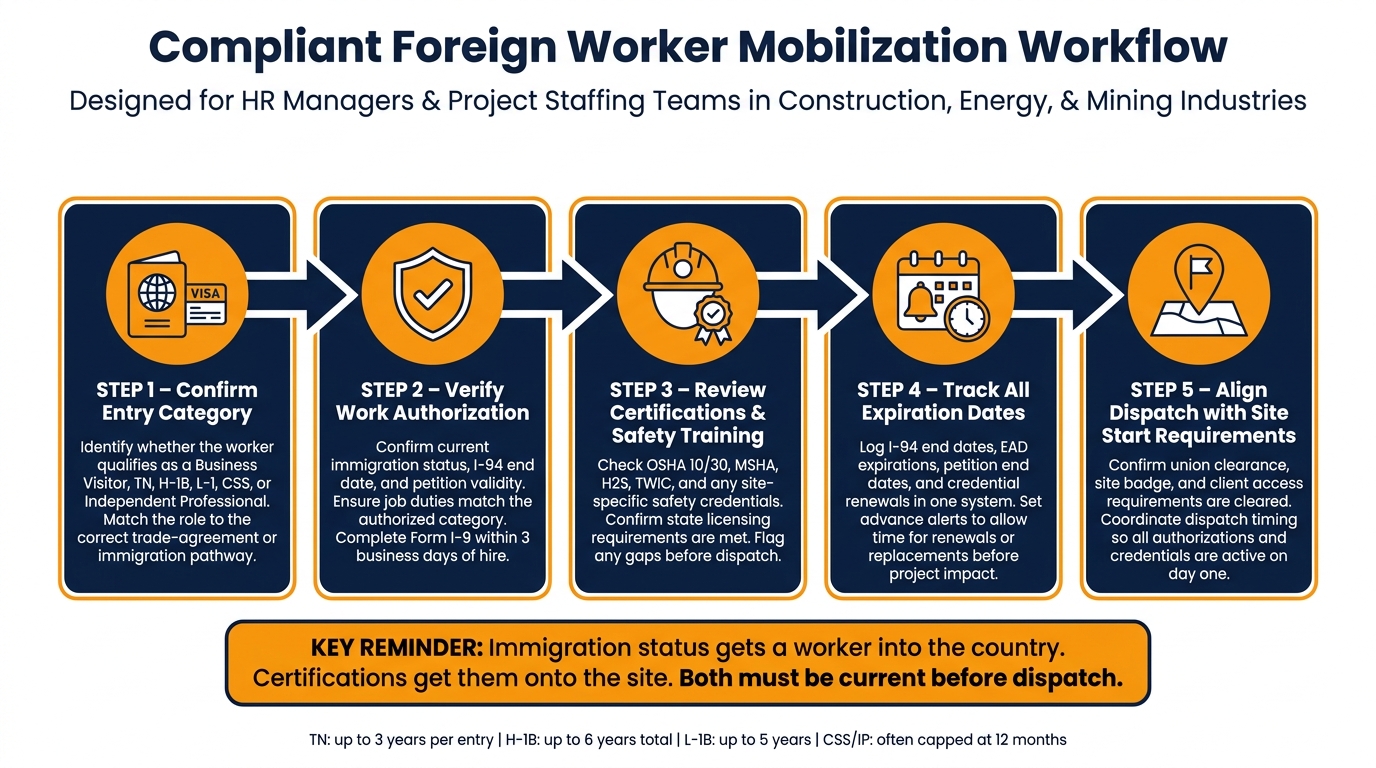
Compliant Foreign Worker Mobilization: Step-by-Step Workflow
Once the legal categories and compliance rules are clear, the last piece is day-to-day execution: getting workers to the jobsite on time without running into a paperwork problem.
A Simple Workflow for Compliant Worker Mobilization
The smartest move is to turn visa, permit, and credential review into one pre-dispatch process. Don’t treat it like cleanup work after crews are already booked. Build it into scheduling from the start.
A practical mobilization flow looks like this: confirm the worker’s entry category, verify current work authorization, review certifications and safety training, track all expiration dates, and align dispatch timing with site start requirements. That sequence matters. A welding supervisor may need a different authorization path than a visiting engineer. And both may still need OSHA training, confined-space permits, or client-specific badging before they can set foot on the job.
Keep permit end dates, credential expirations, and site-access deadlines in one system. If a worker’s authorization runs out in the middle of an assignment, the work stops. That’s the kind of issue that can throw a whole schedule off track. Set alerts well ahead of each cutoff so renewals or replacements can be lined up before the job is affected.
ABLEMKR matches pre-vetted workers to sites by certification, safety training, availability, and location, with real-time status tracking for dispatch and payroll.
On paper, that process sounds simple. In practice, it only works when every deadline and credential is visible before dispatch.
Key Points to Remember
Trade agreements open narrow doors. They do not remove the walls. In day-to-day workforce planning, that means:
- Temporary entry is role-specific and time-limited; it does not grant open labor-market access. A worker admitted under USMCA or a similar framework is authorized for a defined role, sponsor, location, and duration.
- Permits and certifications are separate gatekeepers. Immigration status gets a worker into the country; certifications like TWIC, OSHA 10/30, or H2S training get them onto the site. Both have to be current.
- U.S. labor law applies regardless of entry path. Wage rules, safety obligations, and I-9 requirements don’t pause because a worker entered through a trade-facilitated category.
- Planning from day one reduces delays. Employers that track authorization, credentials, and deadlines from the moment a worker is identified can mobilize faster and avoid last-minute compliance gaps that stall projects.
Foreign-born workers fill a large share of construction and extractive roles, so centralized workforce planning is operational, not optional.
FAQs
How do I know which visa category fits a project role?
Match the visa to your project timeline and labor need. H-2B is the standard temporary option for seasonal or intermittent work, but it comes with annual caps and usually takes five to eight months to process. EB-3 is the usual choice for permanent, full-time roles, though sponsorship often takes three to five years.
The U.S. system includes about 50 visa types, which can get confusing fast. ABLEMKR can help centralize documentation and support proper visa matching.
Can a business visitor do hands-on work on a U.S. site?
Generally, no. In the United States, business visitor status does not permit productive labor or hands-on work at a job site.
Business visitors can attend meetings, consult with business associates, and take part in conferences.
But skilled or manual labor, such as:
- construction
- installation
- heavy equipment operation
requires specific work authorization.
If someone does hands-on work without that authorization, it can create serious compliance risks for both the worker and the employer.
What should employers track before dispatching a foreign worker?
Employers need to confirm every legal and safety box is checked before dispatch. That means tracking:
- visa status and expiration dates
- valid work permits, certifications, and site-specific safety training
- accurate Form I-9 details and, when required, an E-Verify case within 3 business days of the start date
It also helps to keep centralized, audit-ready records that include payroll classification and real-time location tracking. When all of that sits in one place, it’s much easier to cut compliance risk and spot problems before they turn into a headache.


