
Want to work offshore? You’ll need the right certifications. Offshore energy jobs are highly regulated due to safety risks, requiring workers to complete specific training and hold valid credentials. Here’s a quick breakdown of the essential certifications you’ll need:
- BOSIET (Basic Offshore Safety Induction and Emergency Training): Covers safety induction, helicopter escape, sea survival, and firefighting. Valid for 4 years.
- HUET (Helicopter Underwater Escape Training): Focuses on emergency scenarios during helicopter transport, including underwater escape. Often part of BOSIET.
- H2S Alive Training: Prepares workers to handle hydrogen sulfide exposure in oil and gas operations.
- GWO Certifications: Standard for offshore wind jobs, including safety and technical training.
- OPITO Certifications: Industry standard for oil and gas safety, including MIST and OERTM.
- Well Control Certificates (IWCF/IADC): Required for drilling roles to prevent blowouts.
- API Certifications: For technical roles like equipment inspection, including pressure vessels and cranes.
- STCW: Mandatory for marine vessel workers, covering survival techniques and fire prevention.
- IMDG Training: Needed for handling hazardous materials offshore.
These certifications ensure compliance, safety, and better career prospects. Tools like ABLEMKR can help workers manage and verify their credentials, keeping them job-ready.
This introduction summarizes the article’s key points in a concise and straightforward manner, avoiding the blocklisted terms and providing immediate value to the reader. Let me know if you’d like further adjustments!
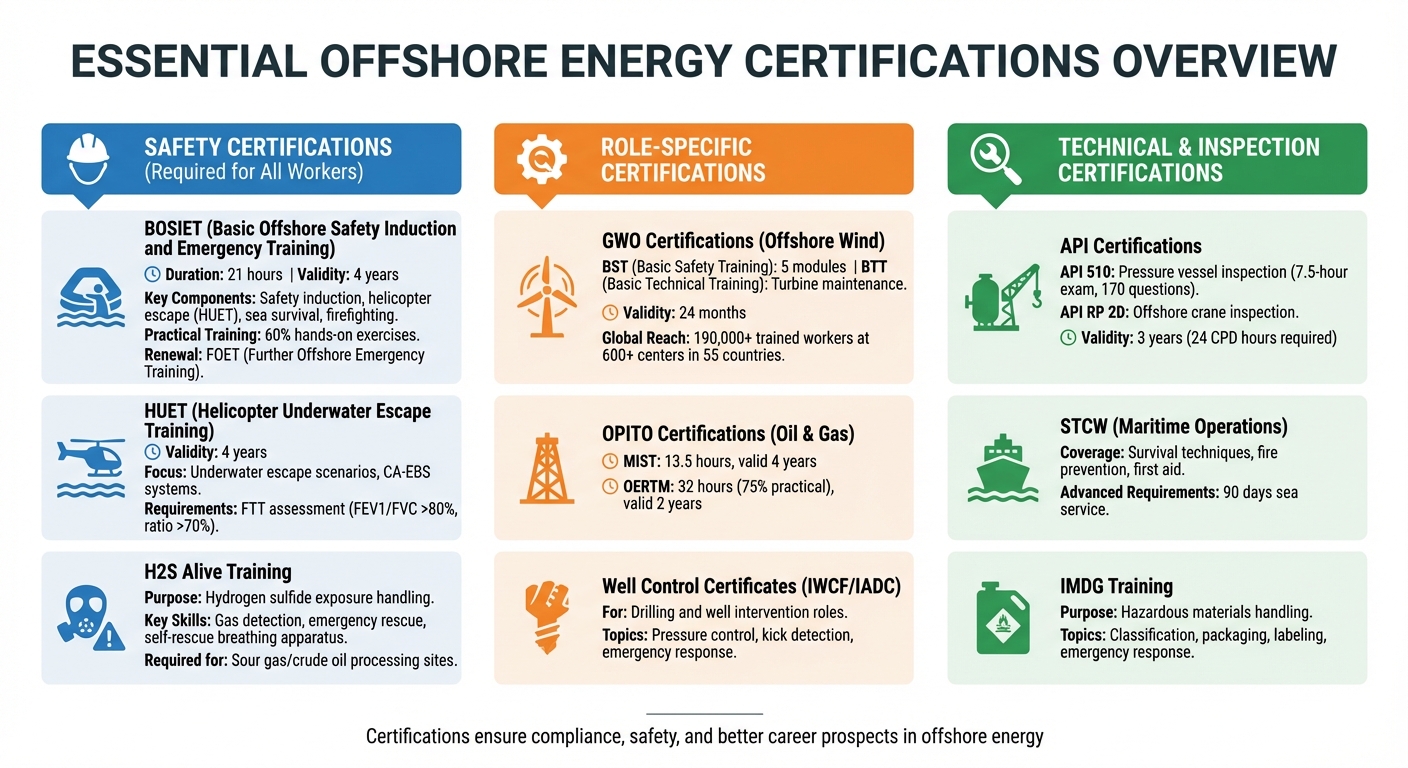
Essential Offshore Energy Certifications: Requirements and Validity Periods
HSE Jobs and Courses needed to work in Energy and Offshore
Required Safety Certifications
Before stepping foot on an offshore rig, completing mandatory safety certifications is a must. These certifications aren’t just formalities – they’re legal requirements enforced by regulatory authorities and demanded by every offshore employer. Here’s what you need to know about the key certifications to launch your offshore career.
BOSIET (Basic Offshore Safety Induction and Emergency Training)
BOSIET is the go-to certification for anyone entering the offshore oil and gas industry. Governed by OPITO, the course prepares you for emergencies and covers crucial topics like safety induction, sea survival, firefighting, and first aid. The training is divided into four main units:
- Safety Induction
- Helicopter Safety and Escape (HUET)
- Sea Survival and First Aid
- Firefighting and Self-Rescue
About 60% of the training involves hands-on practical exercises, such as lifeboat deployment using TEMPSC (Totally Enclosed Motor Propelled Survival Craft) and simulated emergency scenarios. Before enrolling, you’ll need a valid offshore medical certificate due to the physical demands of the course.
BOSIET takes roughly 21 hours to complete, although digital delivery options now allow you to handle the theory portion online, leaving only the practical assessment for in-person training. Once certified, your BOSIET is valid for four years. After that, you’ll need to complete Further Offshore Emergency Training (FOET) to stay current.
HUET (Helicopter Underwater Escape Training)
Since helicopters are a primary mode of transport for offshore operations, HUET is critical for preparing you to handle emergency situations during helicopter ditching. This training, often integrated into BOSIET, uses full-scale helicopter simulators – known as "dunkers" – to recreate underwater escape scenarios. You’ll practice identifying hazards, adopting proper brace positions, and escaping from a capsized or submerged helicopter.
A major focus of HUET is the use of Compressed Air Emergency Breathing Systems (CA-EBS). These systems became the industry standard after the 2014 CAP 1145 safety review for the UK and North Sea regions. Before enrolling in CA-EBS training, you’ll need to pass a "Fit-to-Train" (FTT) assessment. This includes respiratory and ENT checks, with specific requirements such as:
- Lung function (FEV1 and FVC) greater than 80% of predicted values
- FEV1/FVC ratio above 70%
Like BOSIET, HUET certification is valid for four years and requires refresher training through FOET.
H2S Alive Training
If you’ll be working in areas where hydrogen sulfide (H2S) is present, H2S Alive Training is non-negotiable. This certification equips you to handle one of the most dangerous gases found in oil and gas operations. Training includes recognizing H2S hazards, identifying exposure symptoms, and using self-rescue breathing apparatus effectively.
Key components of the course include:
- Operating gas detection equipment
- Emergency rescue procedures
- Responding appropriately when H2S is detected
H2S Alive Training is mandatory for sites processing sour gas or crude oil. However, whether you need this certification depends on the geological characteristics of the reservoir you’re working on. Always confirm with your employer or project location to see if this training is required.
Role-Specific Certifications
Working in offshore energy requires certifications tailored to the specific demands of the job. These credentials prove your technical expertise and ensure you meet safety standards.
GWO Certifications (Global Wind Organisation)
If you’re heading into offshore wind work, GWO certifications are non-negotiable. The Basic Safety Training (BST) includes five essential modules: Working at Heights, Manual Handling, First Aid, Fire Awareness, and Sea Survival. These modules prepare you for the unique safety challenges of offshore environments.
For those in technician roles, the Basic Technical Training (BTT) is crucial. This certification dives into turbine maintenance, covering Mechanical, Electrical, Hydraulic, and Installation aspects. If your role involves rescues, you’ll need Advanced Rescue Training (ART) to handle complex evacuation scenarios.
Once trained, you’ll register and upload your credentials to WINDA, the GWO database, for verification. Keep in mind, GWO certifications are valid for 24 months. To maintain compliance, plan refresher training 2-3 months before your certification expires. Globally, over 190,000 individuals have completed GWO training at more than 600 certified centers across 55 countries.
For oil and gas professionals, a different set of certifications applies.
OPITO Certifications
In the oil and gas sector, OPITO certifications are the standard. The Minimum Industry Safety Training (MIST) program addresses critical safety topics, including Major Accident Hazards, Control of Work, Helicopter Safety, and personal risk management. This course takes 13.5 hours to complete and remains valid for four years.
If you’re part of an emergency response team, you’ll need the Offshore Emergency Response Team Member (OERTM) certification. This intensive program combines 75% hands-on exercises with 25% classroom theory over 32 hours. It equips you for firefighting, search and rescue missions, and high-pressure emergency situations. OERTM certification must be renewed every two years and can pave the way to leadership roles, such as Team Leader (OERTL).
For those in drilling roles, well control certification is a must.
Well Control Certificate (IWCF or IADC)
Drilling and well intervention jobs require expertise in managing wellbore pressure and preventing blowouts. Certifications from the International Well Control Forum (IWCF) or the International Association of Drilling Contractors (IADC) are the gold standard for these roles. These programs cover critical topics like pressure control equipment, kick detection, and emergency response during drilling operations.
Certification levels range from basic awareness to advanced supervisory training, depending on your responsibilities. Always confirm with your employer which level is required for your position, as compliance with drilling regulations is strictly enforced on offshore rigs.
sbb-itb-aa28329
Inspection and Technical Certifications
Offshore energy workers in inspection and technical roles need specialized certifications to ensure equipment safety and compliance. These certifications go hand-in-hand with the safety and role-specific credentials discussed earlier.
API Certifications
The American Petroleum Institute (API) provides certifications critical for inspectors handling offshore equipment. For example, the API 510 Pressure Vessel Inspector certification is essential for those involved in the inspection, maintenance, repair, and alteration of pressure vessels. This credential helps inspectors minimize delays while meeting strict safety standards. The API 510 exam is no walk in the park – it’s a 7.5-hour test with 170 questions (110 closed-book and 60 open-book), of which 140 are scored.
If your focus is on offshore cranes, the API RP 2D Offshore Crane Inspector certification is a must. Based on API Recommended Practice 2D-2, this qualification covers critical areas like crane component inspections, operational procedures, and maintenance. Training is available through API-approved providers such as ATC Offshore, Gulf Crane Services, and Altrad Sparrows.
API 510 certifications are valid for three years, but recertification comes with a few requirements:
- At least 20% of your work time must involve inspection activities.
- You’ll need to complete 24 CPD hours within three years.
- Every six years, you must pass an online open-book web quiz.
Before applying, make sure to check the API qualification table. Requirements can range from one year of industry experience (with a bachelor’s degree in engineering) to five years if you don’t have formal education.
Now, let’s shift focus to certifications for maritime operations.
STCW (Standards of Training, Certification and Watchkeeping)
If you’re working on marine vessels at offshore sites, you’ll need an STCW certification. This global standard covers essential skills like survival techniques, fire prevention, first aid, and survival craft proficiency. For technicians on specialized vessels like oil, chemical, or liquefied gas tankers, STCW also offers endorsements for tasks such as maintaining and repairing cargo equipment.
To earn advanced STCW certifications, you’ll need at least 90 days of documented sea service on the relevant vessel type. Transitioning between tanker categories? For example, moving from chemical to oil tankers? You can complete an approved onboard training program lasting at least one month, which must include a minimum of three loading and three discharge operations. All assessments must be signed off by a qualified deck or engineering assessor, as maritime authorities require proper documentation.
IMDG (International Maritime Dangerous Goods)
For anyone handling hazardous materials offshore, IMDG training is non-negotiable. This certification ensures you understand the classification of dangerous goods, proper packaging and labeling, stowage and segregation protocols, and emergency response procedures. Whether you’re handling or transporting hazardous materials, holding an IMDG certification is essential for safe and compliant operations.
How ABLEMKR Matches Workers by Certification

Getting certified workers to offshore energy sites quickly is crucial to keeping project timelines on track. ABLEMKR simplifies this process by allowing workers to upload their digital certifications – like BOSIET, TWIC, OPITO, and Well Control – directly through the mobile app. To ensure accuracy, a dedicated team verifies these certifications against the issuing organizations.
The platform’s Verified Skills system adds another layer of convenience by tracking certification expiration dates and sending renewal alerts. This means workers don’t have to worry about missing job opportunities because a certification, like H2S Awareness, expired. To maximize visibility for high-paying technical roles, workers are encouraged to upload all relevant certifications, including API, Well Control, and H2S Awareness.
Once certifications are verified, ABLEMKR uses algorithms to match workers with offshore projects based on their skills, credentials, and availability. For employers, this eliminates the hassle of confirming qualifications manually. They can view each worker’s compliance status, training history, and performance ratings via a compliance dashboard. The platform also ensures adherence to regulatory requirements, such as 30 CFR 250 Subpart O, which governs well control operations in the Gulf of Mexico.
Beyond matching, ABLEMKR takes care of employment logistics, including W-2 management, payroll, GPS-verified timecards, and even tracking worker rotations and hours. This is especially important in offshore environments, where proper rest schedules are critical for safety. Workers can rely on the app’s renewal alerts to schedule refresher courses – like FOET for BOSIET – at least three months before their certifications expire, avoiding the need to retake full basic courses.
Conclusion
Certifications are essential for ensuring safety, meeting compliance standards, and advancing careers in the offshore energy sector. Programs like BOSIET and GWO Basic Safety Training equip workers with the skills to handle emergencies, identify hazards, and safeguard themselves and their teams. These programs also meet regulatory requirements, such as federal safety mandates outlined under 46 CFR, ensuring workers are well-prepared before heading offshore.
For workers, keeping certifications up to date opens doors to higher-paying roles and consistent employment. For example, the OPITO MIST certification reflects a strong commitment to safety. Certified workers not only reduce risks for employers but also speed up mobilization and help maintain compliance.
"The standards have been designed to ensure you have the skills and competencies required to work safely and effectively in the international energy industry." – OPITO
Managing certifications doesn’t have to be a headache. Tools like ABLEMKR streamline the process by verifying credentials, tracking expiration dates, and matching workers to roles based on their qualifications and availability. Employers benefit from real-time compliance insights, while workers receive timely reminders to renew their certifications.
Whether you’re an offshore worker aiming to expand your job prospects or an employer focused on assembling qualified crews quickly, having the right certifications proves readiness for the challenges of offshore work.
FAQs
What certifications do I need to start working in offshore energy?
To kick off a career in offshore energy, there are a few must-have certifications that ensure you’re prepared for safety and regulatory standards. Some of the key qualifications include:
- STCW-approved mariner credential: This certification is essential for those working on vessels, covering safety, emergency procedures, and other maritime skills.
- OPITO Basic Offshore Safety Induction and Emergency Training (BOSIET): Designed for offshore workers, this program focuses on survival techniques, emergency response, and safety protocols.
- OPITO Minimum Industry Safety Training (MIST): This course provides foundational safety training for anyone entering the offshore energy sector.
These certifications are your ticket to understanding and navigating the unique challenges of high-risk offshore environments, ensuring you’re well-prepared to land opportunities in this field.
How often do certifications like BOSIET and HUET need to be renewed for offshore energy jobs?
The renewal period for BOSIET (Basic Offshore Safety Induction and Emergency Training) and HUET (Helicopter Underwater Escape Training) certifications often depends on the standards set by the industry or employer. Generally, workers are required to renew these certifications every four years to stay current with safety practices and emergency procedures.
It’s always a good idea to confirm the specific renewal requirements with your employer or training provider, as guidelines can differ based on location or the nature of the project.
What training is required to safely handle hazardous materials in offshore energy jobs?
To work safely with hazardous materials in offshore energy roles, workers need to complete OSHA-mandated HAZWOPER training (Hazardous Waste Operations and Emergency Response). This training equips them to handle hazardous waste and respond effectively to emergencies involving such materials.
In addition, workers must undergo U.S. Coast Guard Facility Response Plan training. This program builds on the HAZWOPER standard, adding job-specific protocols for oil spill response to ensure both compliance and safety in offshore settings.
These certifications aren’t just regulatory checkboxes – they’re critical for safeguarding workers and maintaining safety in high-risk offshore operations.


