
The wind energy sector is booming, but workforce challenges are slowing progress. By 2026, global wind capacity will reach 1,394 GW, requiring 568,800 technicians – a 33% increase since 2021. Temporary staffing is emerging as a solution, helping companies quickly address labor shortages during construction peaks and reduce costs during quieter periods. Offshore wind, with demand up 92%, adds complexity due to specialized skills and higher wages.
Key takeaways:
- Technician demand: 28,400 new hires needed annually (2022–2026).
- Pay trends: Median salary is $62,580/year; offshore roles pay more.
- Staffing benefits: Faster hiring, cost control, and access to specialized skills.
- Technology’s role: AI-driven platforms streamline hiring, verification, and payroll.
Temporary staffing is addressing gaps in a growing, project-driven industry, with technology improving efficiency and flexibility for both employers and workers.
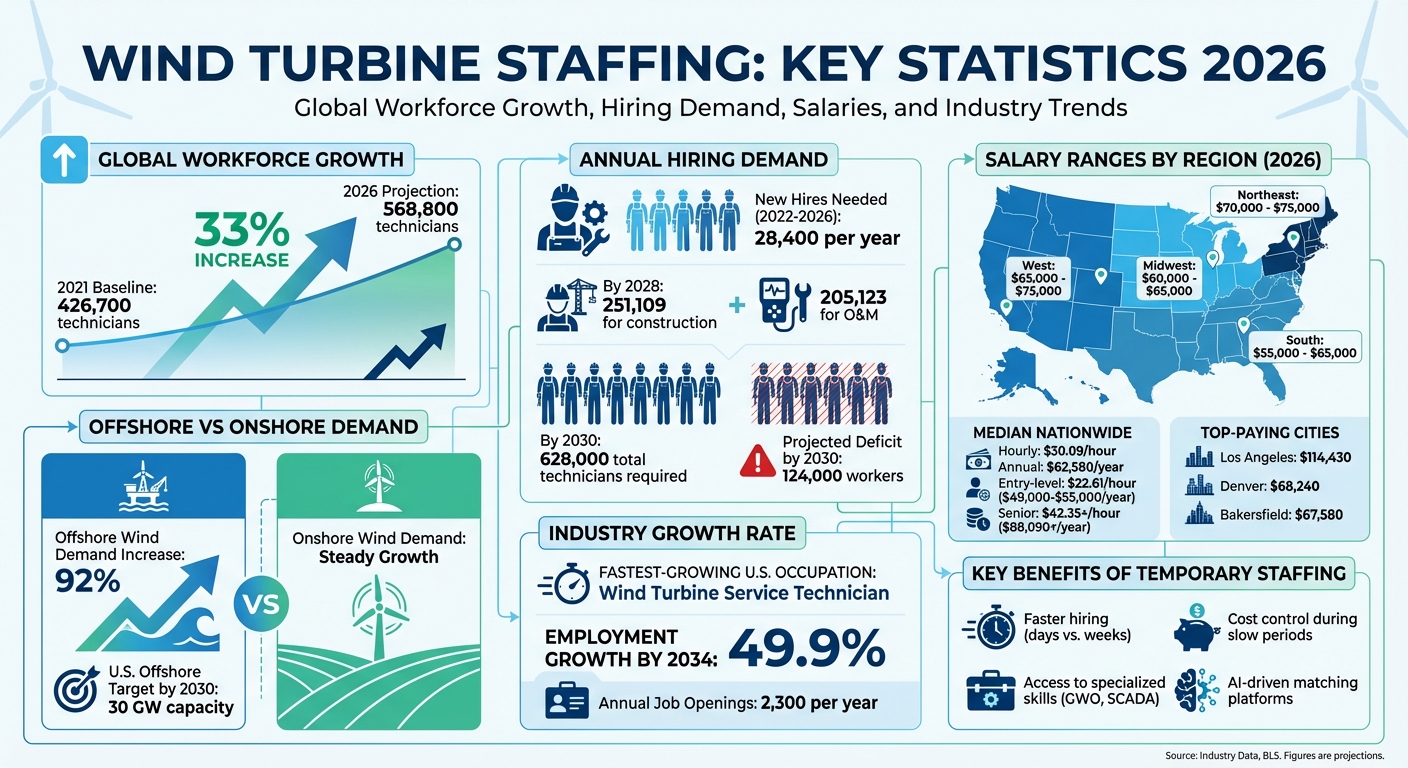
Wind Turbine Technician Workforce Growth and Salary Trends 2026
What’s Driving the Demand for Temporary Staffing
Renewable Energy Growth and Workforce Requirements
The global wind energy sector is gearing up for massive growth, with capacity expected to increase by 86.5% between 2025 and 2030. By the end of the decade, the industry will require around 628,000 technicians to build and maintain wind fleets – a jump from 475,000 in 2025.
One major challenge is the location of these projects. Many wind farms are situated in remote areas, requiring companies to relocate skilled workers to meet project demands.
"Delivering on the potential of wind energy requires building a new workforce for a new era of clean energy. There must be urgent action to address the workforce shortage and scale up installation capability."
- Ben Backwell, CEO of the Global Wind Energy Council
Policy changes are adding to the urgency. Adjusted tax credit timelines have pushed developers to speed up construction to qualify for "safe-harbor" eligibility before mid-2026. These factors make temporary staffing an attractive option for companies needing to scale their workforce quickly.
Why Companies Choose Temporary Staffing
With labor shortages and the project-specific nature of wind energy construction, companies are increasingly relying on temporary staffing solutions. Wind projects demand a flexible workforce. During construction, hundreds of technicians may be required, but ongoing operations and maintenance typically need only a small, specialized team.
"Carrying a massive workforce year-round doesn’t make financial sense in an industry driven by project-based work."
Keeping a large permanent workforce during slower periods can strain resources. Temporary staffing allows companies to align labor costs with project activity – scaling up during construction and scaling down once operations stabilize.
Speed is another critical advantage. Permanent hiring processes can take weeks or even months. In contrast, staffing agencies can provide pre-vetted, certified professionals – such as GWO-certified technicians and rope access specialists – within days.
Filling the Workforce Gap
The wind energy industry faces a notable skills gap. In fact, wind turbine service technician roles are projected to be the fastest-growing occupation in the U.S., with employment expected to rise by 49.9% by 2034.
To address this, staffing firms are increasingly recruiting workers with transferable skills from industries like manufacturing, logistics, and automotive assembly. These professionals often have strong mechanical knowledge and experience with quality control, making them valuable for tasks like turbine component assembly and site logistics – even if they lack direct wind energy experience.
The offshore wind sector presents even greater challenges. It demands not only technical expertise but also maritime safety training. Temporary staffing offers access to this specialized talent pool without the financial burden of long-term hires. This flexibility is especially important for companies facing financial pressures, such as tariffs and shifting policies. For example, Ørsted’s 2025 workforce restructuring highlights the need for adaptable staffing strategies to manage industry changes.
Temporary staffing solutions are proving to be an effective way to bridge the skills gap while maintaining the flexibility needed to navigate the rapidly evolving wind energy landscape.
sbb-itb-aa28329
Where the Jobs Are: High-Demand Regions
Onshore Wind: Midwest and Great Plains
The Midwest and Great Plains are leading the charge in onshore wind employment, with states like Texas, Iowa, and Ohio creating hundreds of job openings in 2026. Much of this demand stems from aging infrastructure that requires regular maintenance. Looking further to 2028, projections show the need for 251,109 technicians for construction and installation, along with another 205,123 for operations and maintenance. States like Kansas and North Dakota, home to sprawling wind farms, often depend on traveling technicians to handle the demands of these remote projects.
The Midwest continues to be a hub for onshore wind energy, offering steady work tied to well-established infrastructure. However, the remote nature of many projects creates challenges, including a lack of nearby training facilities. This makes traveling technicians essential for meeting project deadlines and keeping operations running smoothly.
While onshore wind dominates the central U.S., offshore wind is quickly becoming a focal point along the coasts.
Offshore Wind: Coastal State Opportunities
Offshore wind is transforming job markets along the East and West Coasts, offering unique opportunities distinct from the landlocked Midwest. On the East Coast, states like Massachusetts and New York are experiencing rapid growth as the U.S. pushes toward its 30 GW offshore wind target by 2030. A standout project is Dominion Energy‘s Coastal Virginia Offshore Wind initiative, which will feature 176 turbines generating 2,600 megawatts by 2026. Maryland is also making strides, with MarWind (20 turbines) and Skipjack 1 (10 turbines) expected to wrap up by March 2026. These projects are set to create at least 10,324 direct jobs during their development and operational phases.
Meanwhile, California is emerging as a major player on the West Coast, focusing on deep-water projects to meet ambitious renewable energy goals.
Offshore roles tend to pay more than their onshore counterparts, with average salaries ranging from $70,000 to $75,000 in the Northeast, compared to $60,000 to $65,000 onshore. This pay difference reflects the logistical challenges, travel requirements, and the need for specialized certifications like GWO sea survival. Though offshore projects create fewer total jobs than onshore, they offer specialized, higher-paying roles for technicians ready to work in marine environments.
These trends highlight the importance of temporary staffing in meeting the evolving demands of the wind energy sector.
The Blueprint to Become a Wind Turbine Technician! CTQ Ep // 11
Pay Rates and Compensation in 2026
The rising demand for temporary wind turbine specialists has led to evolving wage structures aimed at attracting top talent. This shift highlights the financial incentives driving temporary staffing in the industry.
Average Pay Rates Across the U.S.
In 2026, wind turbine technicians are earning a median hourly rate of $30.09, which amounts to an annual salary of about $62,580. Entry-level technicians typically earn $22.61 per hour, translating to annual earnings between $49,000 and $55,000. On the higher end, senior technicians with specialized expertise can make more than $42.35 per hour, pushing their annual income above $88,090.
Additional compensation, such as overtime and per diem, can significantly increase earnings. For example, technicians working on remote projects across multiple states often see their annual income rise by tens of thousands of dollars. Lead technicians, in particular, can earn over $90,000 annually when factoring in benefits.
What’s Driving Higher Wages?
A projected 124,000-worker deficit by 2030 has created intense competition for skilled technicians. To attract temporary workers, companies are offering higher hourly wages, signing bonuses, and improved benefits.
Specialized certifications, like GWO modules and SCADA analytics, are now directly linked to higher pay, giving technicians with these qualifications a faster path to career growth. Offshore roles also come with added compensation due to factors like increased risks, marine environment requirements, and demanding travel schedules.
These trends underscore the critical role temporary staffing plays in meeting the workforce demands of this rapidly changing industry.
Regional Pay Comparison
Location significantly impacts pay rates for wind turbine technicians. The Northeast leads the nation, offering salaries between $70,000 and $75,000, driven by offshore projects and higher living costs. California stands out as the highest-paying state, with annual earnings ranging from $84,000 to $94,000. On the other hand, states like Florida and West Virginia fall on the lower end, with salaries between $40,000 and $50,000.
| Region | Typical Salary Range |
|---|---|
| Northeast | $70,000 – $75,000 |
| West | $65,000 – $75,000 |
| Midwest | $60,000 – $65,000 |
| South | $55,000 – $65,000 |
Urban hubs further highlight these differences. For instance, technicians in Los Angeles earn an average of $114,430, while those in Denver and Bakersfield make around $68,240 and $67,580, respectively. These variations reflect not only the cost of living but also the intensity of labor shortages and the complexity of energy projects in specific regions.
How Technology Is Changing Workforce Deployment
The demand for technicians is expected to surge by 50% between 2024 and 2034, translating to around 2,300 new jobs each year. Thanks to advancements in technology, workforce deployment processes have become significantly faster and more efficient. What used to take weeks can now be accomplished in days, thanks to platforms that streamline matching, tracking, and job assignments.
Automated Matching and Worker Verification
Platforms like ABLEMKR are changing the game by leveraging AI-driven algorithms to match pre-vetted technicians with wind energy projects in real time. These systems consider a range of factors, including certifications (like GWO safety training, SCADA analytics skills, and predictive maintenance expertise), worker availability, and geo-location data. This ensures that the right candidates are placed at both onshore and offshore sites without delay.
Automated verification tools further enhance this process by instantly confirming safety credentials via digital badges. This feature drastically reduces onboarding times, ensuring technicians are ready to work as soon as possible. For specialized roles – such as high-voltage tasks, drone inspections, or marine environment-specific jobs – these tools also verify compliance with necessary training and certifications before deployment. Beyond matching, these platforms integrate seamlessly with real-time systems to improve workforce management.
Real-Time Tracking and Payroll Integration
Employers juggling temporary staffing across multiple wind farms now rely on real-time dashboards to stay on top of worker status, location, certifications, and hours worked. This level of visibility is crucial for maintaining compliance and avoiding delays in project timelines, such as commissioning or maintenance schedules.
Payroll integration is another game-changer. These systems ensure technicians are paid promptly and accurately, addressing a common pain point that previously discouraged skilled workers from taking temporary roles. This is particularly valuable when scaling up crews for grid upgrades or managing seasonal demand surges in areas like the Great Plains and Midwest. With over 50% of energy companies citing hiring bottlenecks as a major challenge, these tools help keep projects on track while automating regulatory documentation. The result? Project managers can focus more on operations and less on administrative hurdles.
Flexible Work Opportunities for Technicians
Beyond technical improvements, these platforms give technicians an unprecedented level of flexibility. Through mobile platforms, workers can access a variety of skill-matched opportunities, complete with transparent terms, premium travel pay for offshore roles, and timely payments. Considering clean energy jobs already pay 25% above the U.S. median wage, these platforms make it easier for technicians to find lucrative opportunities without being tied to a specific location.
This flexibility is particularly appealing to the 85% of energy professionals open to new roles for career growth. Technicians can take advantage of peak demand in wind-rich areas and smoothly transition to other projects as needs shift. With the global wind workforce projected to grow from 426,700 technicians in 2021 to 568,800 by 2026 – a 33% jump – these platforms ensure that skilled workers remain engaged and ready to tackle projects across multiple locations.
Conclusion
The temporary staffing market for wind turbine technicians is seeing a major transformation in 2026, fueled by strong annual growth that brings both exciting opportunities and notable challenges. Companies that adopt technology to streamline hiring and deployment will be in the best position to take advantage of these changes.
In the U.S., these challenges vary by region. The Midwest and Great Plains remain the hubs for onshore installations and maintenance, while coastal states are experiencing rapid growth in offshore projects, which often come with higher wages. Technicians have the flexibility to choose projects that suit their skills and lifestyle, making this field increasingly appealing.
Platforms like ABLEMKR are stepping up to address critical industry hurdles. With more than half of energy companies citing hiring difficulties, automated tools that handle certification verification, compliance tracking, and payroll integration have become indispensable. These platforms not only help close the skills gap but also ensure quick crew mobilization, guaranteed payments, and easy access to high-paying jobs. By addressing current obstacles, these technologies are paving the way for future advancements in the sector.
Both employers and workers need to stay ahead of the curve. Companies should focus on scalable staffing solutions that offer real-time insights, while technicians should consider obtaining GWO certifications and developing advanced skills like SCADA analytics and predictive maintenance to stay competitive. According to James Allen of Airswift, 85% of energy professionals are open to exploring new roles for career advancement. This creates a prime opportunity for workers to establish themselves in a growing market.
Globally, the wind energy workforce is projected to reach 569,000 technicians by 2026. Those who adapt to flexible, tech-driven staffing models will be well-equipped to lead the charge in the evolving energy landscape.
FAQs
What certifications help techs get higher-paying temp wind jobs?
Certifications such as GWO Basic Safety Training (BST), First Aid, Manual Handling, Fire Awareness, and Sea Survival can significantly improve earning potential for temporary wind energy jobs, particularly in offshore positions. These credentials highlight critical safety and operational expertise, giving candidates an edge when competing for higher-paying roles.
How do per diem, travel pay, and overtime usually work on temp gigs?
In the world of temporary wind turbine staffing, per diem, travel pay, and overtime play a crucial role in meeting the demands of short-term projects:
- Per diem helps workers cover daily costs, such as meals and lodging, when they’re working away from home.
- Travel pay ensures employees are compensated for the time and expense of getting to remote or regional job sites.
- Overtime provides higher pay rates for hours worked beyond the standard schedule, acknowledging the physically and mentally demanding nature of these roles.
These measures make it easier for workers to manage the unique challenges of short-term assignments.
What should employers check to stay compliant when using temp crews?
Employers must ensure they follow safety regulations, such as OSHA guidelines, to remain compliant. It’s also crucial to verify proper worker classification to sidestep potential penalties. For projects like wind and energy, adhering to industry-specific standards – such as NERC requirements – is essential. Lastly, make sure all necessary registrations and reporting obligations are fulfilled, especially for temporary crews.


