
Offshore oil rigs face major staffing challenges due to workforce shortages and evolving industry demands. Here’s what you need to know:
- Workforce Shortage: The U.S. oil and gas workforce dropped 40% over the last decade, with only 119,000 workers as of August 2025. Rig counts also declined significantly.
- Temporary Staffing Growth: Companies increasingly rely on temporary workers to manage fluctuating market demands without expanding permanent headcounts.
- Rotation Schedules: Common setups include 14/14, 21/21, and 28/28 schedules, balancing work and rest.
- Pay and Benefits: Day rates average $776, with specialized roles earning over $1,200/day. Employers cover housing, meals, and travel.
- Safety Certifications: Workers must complete BOSIET, HUET, and other OPITO-approved training, along with medical exams.
- Digital Solutions: Platforms like ABLEMKR speed up hiring, ensure compliance, and simplify payroll, helping operators avoid delays and fines.
This article explores how temporary staffing solutions, like ABLEMKR, address these challenges by connecting pre-vetted workers with offshore projects faster and more efficiently.
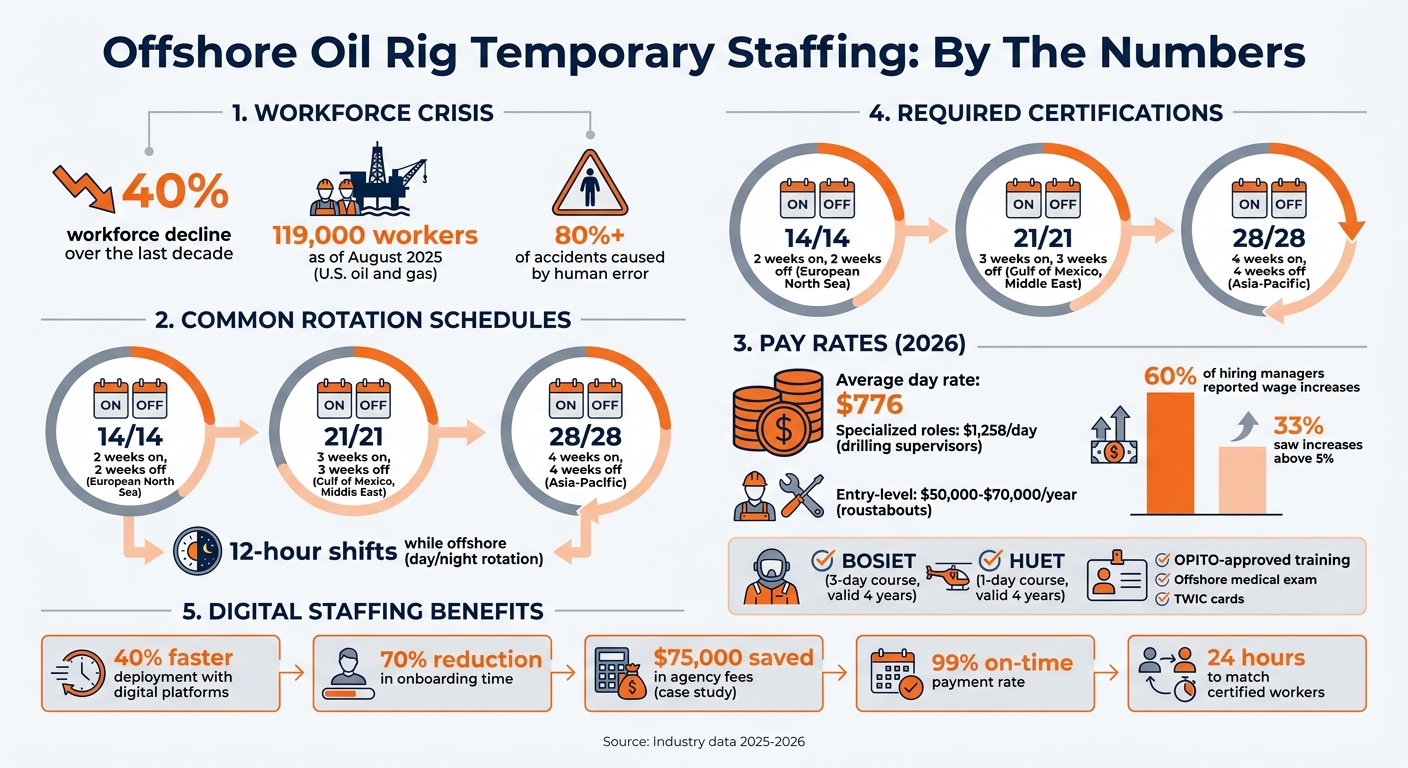
Offshore Oil Rig Temporary Staffing: Key Statistics and Pay Rates 2025-2026
How to Become an Oil Rig Worker | Offshore Jobs for Petroleum Workers | Petroleum Engineering
sbb-itb-aa28329
Typical Rotation Schedules and Work Hours for Temporary Offshore Workers
Offshore operations depend heavily on rotation schedules, which balance continuous platform activity with sufficient rest for workers. These schedules alternate between a set number of consecutive days working offshore and an equal or longer period of leave onshore. As Worldwide Recruitment Solutions (WRS) puts it:
"Rotation schedules denote the ratio of consecutive days worked offshore relative to days of leave onshore. This systematic approach ensures continuous operational capability while providing personnel with structured rest periods."
These rotations are the backbone of work hours, shift patterns, and fatigue management strategies. Common setups include 14/14 (2 weeks on, 2 weeks off), 21/21 (3 weeks on, 3 weeks off), or 28/28 (4 weeks on, 4 weeks off). Regional preferences vary: in the European North Sea, 14/14 schedules are typical, while Gulf of Mexico, Middle East, and Asia-Pacific operators often use 21/21 or 28/28 rotations to account for long travel distances. In Norway, labor laws mandate a 2-weeks-on/4-weeks-off system.
While offshore, workers typically follow 12-hour shifts. These shifts can be fixed to either day or night tours, or rotate in a "swing" pattern – about seven days of day shifts followed by seven days of night shifts. Marine operations, such as those on FPSOs or shuttle tankers, also adhere to strict fatigue management policies. Extended 12-hour shifts can affect sleep and decision-making, so many companies have adopted shorter rotations and rigorous protocols to mitigate risks. These include carefully managed shift transitions and mandatory rest periods. Understanding these rotation systems is key to addressing the staffing complexities of offshore work.
Pay Structures and Benefits for Temporary Offshore Oil Rig Staff
Hourly Rates and Overtime Policies
Temporary offshore oil rig workers are typically compensated through day rates. In 2026, the average day rate for North American contractors was $776. However, specialized roles like drilling supervisors commanded rates as high as $1,258 per day, while entry-level jobs, such as maintenance roustabouts, translated to annual earnings of $50,000–$70,000.
That year, 60% of hiring managers reported wage increases, with 33% seeing hikes above 5%, and 68% expecting further pay growth. James Allen, CEO of Airswift, highlighted the industry’s resilience and the strong demand for talent:
These pay rises are especially positive given the turbulent backdrop of the year. A promising pipeline of projects is putting the industry on an upward trajectory, and with competition for talent remaining fierce, hiring managers will need a proactive people strategy to secure talent early.
Recent interpretations of the Fair Labor Standards Act (FLSA) have impacted overtime eligibility for day-rate workers. Without a guaranteed minimum weekly salary, these workers may qualify for overtime pay. To address this, many employers now offer weekly minimums to meet federal requirements. In addition to wages, offshore assignments are made more appealing with extensive on-site benefits.
Housing, Meals, and Travel Allowances
Offshore oil rig operators provide a range of on-site benefits to temporary staff. Housing is part of the job package, with workers staying in shared or private cabins on the platform during their rotation. Meals are also included, with round-the-clock service in communal dining areas to accommodate the demanding schedules of offshore work.
Travel expenses are generally covered as well. Most companies handle transportation between workers’ homes and the offshore platform, including helicopter or boat transfers. Additionally, many employers reimburse travel to departure points and may even offer relocation assistance or international travel support for those moving to high-demand production regions. These benefits not only help balance the challenges of long rotations and time away from home but also make temporary offshore positions more appealing in a competitive labor market.
Safety Certifications and Compliance Requirements
Temporary offshore workers must complete mandatory safety certifications tailored to the unique challenges of offshore environments. At the core of these requirements is the Basic Offshore Safety Induction and Emergency Training (BOSIET) program. This three-day course covers essential topics like safety regulations, emergency first aid, fire prevention, and sea survival. It’s a must-have for everyone working offshore, from drilling crews to support staff like cooks and housekeepers. Once this foundational certification is completed, workers often move on to more specialized training based on their specific roles.
For those traveling to platforms by helicopter, the Helicopter Underwater Escape Training (HUET) course is also required. This one-day program teaches techniques for safely evacuating a helicopter during a water landing. Both the BOSIET and HUET certifications are valid for four years. To maintain compliance, workers need to complete Further Offshore Emergency Training (FOET) before their certifications expire. If a certificate lapses, the full BOSIET program must be retaken.
All certifications must be approved by OPITO, the global standard for offshore training. Before enrolling in any OPITO-approved course, workers must pass an offshore medical exam to confirm their fitness for physically demanding, in-water exercises. Depending on the job, additional certifications may be necessary. For example, drilling supervisors often need Well Control credentials, which are typically valid for two years, while workers handling hazardous materials require IMDG training.
To streamline compliance, many employers now use digital competency management systems. These systems track certifications in real time, flagging upcoming expirations and reducing the reliance on paper certificates. Tools like ABLEMKR enhance workforce management by ensuring certifications remain up-to-date. Additionally, modern safety protocols emphasize non-technical skills like situational awareness. Practices such as Stop Work Authority empower any worker to halt operations if they observe unsafe conditions, reinforcing a culture of safety.
The importance of rigorous certification cannot be overstated. Human error accounts for over 80% of offshore accidents, and as of April 2018, the U.S. gas and oil extraction industry employed approximately 151,000 rig workers. These certifications and protocols are vital to ensuring both safety and operational efficiency in such a high-risk environment.
Using ABLEMKR for Temporary Staffing on Offshore Oil Rigs

Offshore oil rig operators often struggle to find qualified temporary workers quickly while adhering to strict compliance requirements. Traditional staffing methods can take weeks – anywhere from 2 to 4 – causing costly delays during emergency shutdowns or scheduled maintenance. ABLEMKR steps in to address this issue, connecting pre-vetted workers with offshore projects much faster. Here’s how ABLEMKR’s approach is changing the game.
Faster Hiring and Onboarding with ABLEMKR
ABLEMKR’s mobile-first platform leverages AI to match rig operators with certified workers in less than 24 hours. Employers can post detailed shift requirements – like roustabout roles requiring TWIC cards and BOSIET certification – and the system matches them with candidates from a pool of 50,000 pre-vetted U.S. energy workers. This pool is filtered by certifications, training, availability, and proximity to Gulf Coast ports.
For example, in Q4 2025, a major operator in the Gulf of Mexico used ABLEMKR to staff a semi-submersible rig turnaround. The platform helped deploy 25 temporary workers 40% faster than other staffing methods, saving the company $75,000 by cutting agency fees and reducing overtime costs. ABLEMKR’s digital onboarding process also simplifies document uploads for medical clearances, drug tests, and contract signatures. One Gulf operator hired 15 roughnecks within 48 hours for a 28-day rotation. Automated safety briefings and helicopter transport manifests reduced onboarding time by 70%, all while maintaining full compliance before deployment.
The platform’s compliance tracking system ensures certifications – like OPITO-approved training, fit-for-duty exams, and H2S awareness – are monitored in real time. Automated alerts notify workers and employers 30 days before certification expirations. During a Permian-to-offshore transition project, ABLEMKR identified and resolved 12% of potential non-compliance issues before deployment, saving over $50,000 in fines and avoiding audit problems during a Bureau of Safety and Environmental Enforcement inspection. Beyond hiring, ABLEMKR helps maintain workforce compliance and efficient management throughout the project.
Real-Time Workforce Management and Automated Payroll
ABLEMKR also offers a centralized dashboard for managing temporary workers. Operators can monitor rotation schedules like 14/14 or 21/21 and track real-time updates such as "Onboard Rig", "In Transit via Crew Boat", or "Medevac Pending." Geo-fencing alerts for Gulf of Mexico sites notify supervisors when workers arrive or depart, while integrated messaging helps with shift changes or weather-related adjustments. For instance, during hurricane season, one Louisiana rig operator used ABLEMKR to reassign 20 workers, maintaining 98% uptime with complete visibility for corporate headquarters.
The platform also handles payroll seamlessly. Workers clock in via mobile for accurate time tracking, and the system automatically calculates pay according to FLSA rules. This includes base hourly rates ($35–$55 for roustabouts), overtime at time-and-a-half after 40 hours, and double-time for holidays. It also factors in per diems ($100–$150 per day) and travel reimbursements (e.g., $500 for round-trip flights from Houston). Payments are direct-deposited weekly, ensuring they arrive on time. For example, a crew of 10 workers on a 28-day rotation was paid $120,000 with zero errors, saving employers 15 hours of administrative work each month.
For workers, ABLEMKR significantly reduces payroll delays – a common issue affecting 35% of temporary oil workers and contributing to a 15% attrition rate. The platform ensures 99% of payments are made on time. In one instance, a Texas-based floorhand completed three consecutive 14-day Gulf hitches in 2025, earning $45,000 without any payment delays. The worker also benefited from priority scheduling with preferred operators, avoiding the lengthy 30–60 day payment waits typical of traditional staffing agencies.
Common Challenges and Solutions in Offshore Temporary Staffing
Staffing temporary roles on offshore oil rigs comes with its fair share of challenges. From quickly mobilizing skilled personnel to navigating complex regulations and maintaining strict safety protocols in remote, high-risk environments, operators face a tough balancing act.
One major issue is worker shortages during peak activity periods. Traditional staffing methods can be slow, leading to costly operational delays. These setbacks underscore the value of adopting efficient digital solutions to streamline the process.
Navigating Compliance Issues
Compliance is another hurdle, carrying potential legal and financial risks. According to OSHA, both staffing agencies and host employers share responsibility for the safety of temporary workers. OSHA makes it clear:
Staffing agencies and host employers are jointly responsible for maintaining a safe work environment for temporary workers – including, for example, ensuring that OSHA’s training, hazard communication, and recordkeeping requirements are fulfilled.
To avoid confusion, written contracts should clearly outline responsibilities. For example, they should specify who is responsible for providing personal protective equipment, keeping injury logs, and delivering site-specific versus general safety training. Tools like ABLEMKR’s automated compliance tracking system can simplify this process by monitoring worker certifications in real time and sending alerts as renewal deadlines approach.
Prioritizing Safety Measures
Safety is just as critical as compliance. Offshore rigs are high-risk environments, and temporary workers must receive the same level of protection as permanent staff. This includes equipment-specific training and clear hazard communication. OSHA reinforces this point:
Host employers must treat temporary workers like any other workers in terms of training and safety and health protections.
Digital onboarding systems can play a crucial role here. By tracking medical clearances, drug tests, and safety briefings, these systems ensure every worker has the necessary documentation to start work safely. Addressing these challenges head-on is essential for effective offshore staffing.
Conclusion
Staffing offshore oil rigs is a delicate balancing act that demands speed, safety, and strict compliance. To avoid costly disruptions – where downtime can drain $300,000 to $1 million per day – fair pay and certifications like HUET, BOSIET, and TWIC cards are non-negotiable. These challenges create a strong case for digital tools that simplify staffing and compliance processes.
ABLEMKR steps in to tackle these challenges head-on, offering a platform that quickly connects certified workers to urgent offshore assignments. Using mobile-first technology, the system matches pre-vetted personnel based on their certifications, location, and availability, reducing mobilization time from weeks to just days. For example, during a 2025 Gulf of Mexico pipeline repair, ABLEMKR deployed 50 certified workers in just 48 hours, cutting mobilization costs by 25% while ensuring full compliance through real-time dashboards.
For workers, the app ensures transparency with clear pay rates, guaranteed on-time payments, and access to flexible, high-paying opportunities across key energy hubs like Texas and Louisiana.
On the administrative side, integrated payroll systems and automated compliance tracking take the hassle out of staffing. These efficiencies translate into measurable results – less downtime, lower costs, and safer operations. By 2025, industry benchmarks revealed that tech-driven staffing solutions delivered 20% cost savings, underscoring the impact of having the right tools in place.
FAQs
How do I qualify for an offshore temp job fast?
To land an offshore temp job quickly, make sure your certifications and safety training are up-to-date and well-documented. Employers tend to favor candidates who are already pre-vetted and have the necessary qualifications. Being knowledgeable about OSHA standards and meeting required safety protocols can give you an edge. Tools like ABLEMKR can speed things up by verifying your credentials instantly and matching you with available projects more efficiently.
What’s the real take-home pay on a hitch?
Take-home pay for a hitch largely hinges on the daily rate, which typically falls between $200 and $1,200. However, the actual amount you pocket depends on several deductions, including taxes, overtime, per diems, and travel costs. Additionally, factors like the job’s location and any specific agreements you negotiate can significantly influence your final earnings.
Who is responsible for temp worker safety and compliance?
Responsibility for ensuring the safety and compliance of temporary workers falls on both the staffing agency and the host employer. Together, they are required to adhere to OSHA standards and work collaboratively to establish a safe workplace, implementing all necessary precautions to protect employees.


