
Temporary renewable energy jobs are short-term roles tied to specific project phases, like construction or maintenance, in areas such as solar, wind, and energy storage. These positions offer competitive pay – ranging from $48,000 to $145,000 annually or $25 to $60 per hour – but come with challenges like frequent travel, job insecurity, and managing certifications. Workers often face financial strain due to payment delays and inconsistent contracts.
Key Takeaways:
- Pay: $48,000–$145,000/year or $25–$60/hour; specialized roles may pay more.
- Challenges: Travel to remote sites, short-term contracts, certification upkeep, and delayed payments.
- Solutions: Use platforms like ABLEMKR for job matching, real-time invoicing, and certification tracking.
Temporary jobs in this field require technical skills, safety certifications, and flexibility. Platforms and tools are helping workers manage these challenges while taking advantage of growing opportunities in the renewable energy sector.
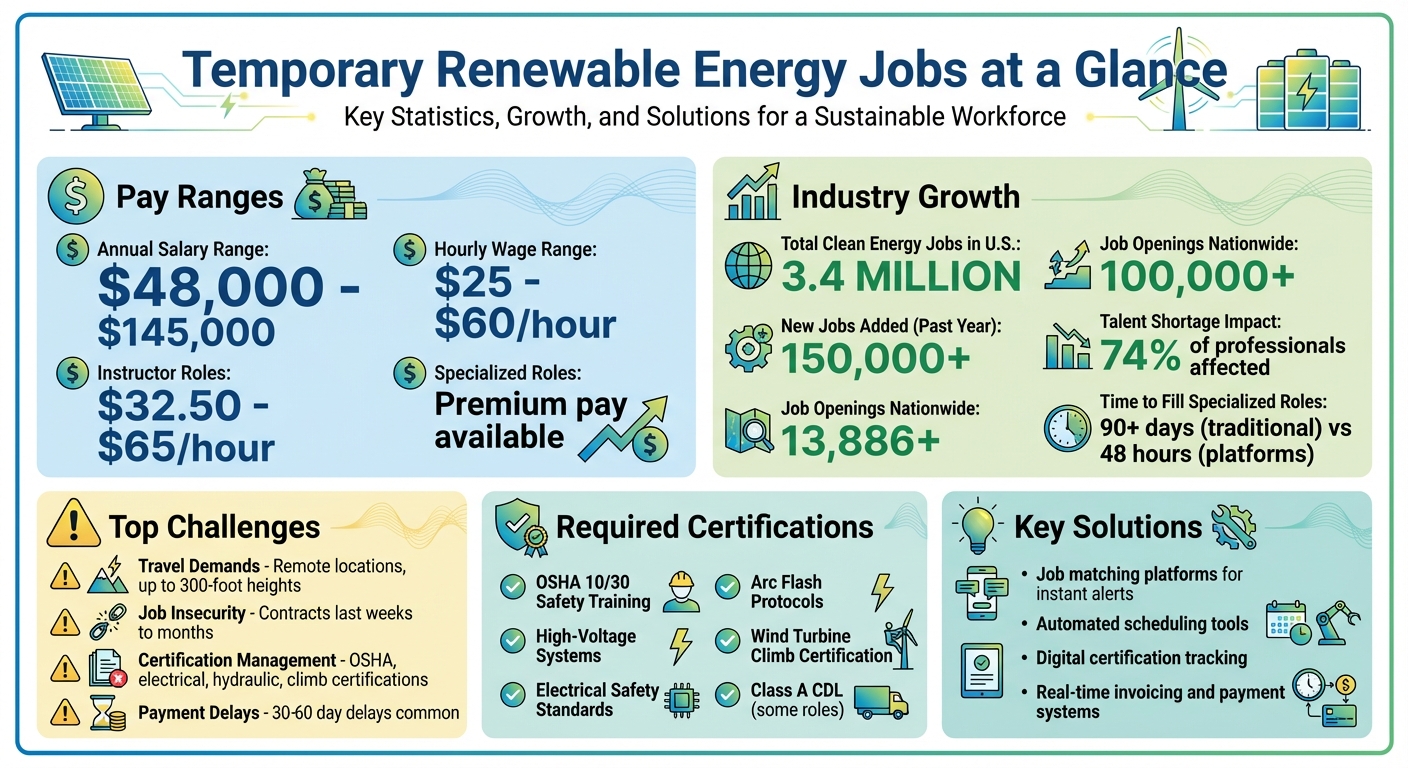
Temporary Renewable Energy Jobs: Pay Ranges, Challenges, and Key Statistics
Career Opportunity: Renewable Energy Technician Roles in Today’s Green Economy
Common Challenges for Temporary Renewable Energy Workers
Temporary renewable energy technicians face a unique set of challenges that can disrupt both their career paths and financial stability. The rapid growth of the clean energy sector has only added to these pressures, particularly given the unpredictable nature of temporary assignments.
Travel Demands and Remote Work Locations
Many renewable energy projects are located far from cities, requiring technicians to travel long distances or frequently relocate. For instance, wind technicians may find themselves climbing turbines as tall as 300 feet, while solar installers often work on sprawling arrays in deserts or other remote areas. Adding to the complexity, some roles require a Class A commercial driver’s license (CDL) to transport equipment or handle emergency repairs.
These travel demands bring significant challenges: high transportation costs, limited access to amenities, and poor connectivity, which can make it difficult to stay in touch with family. Extended periods away from home can lead to fatigue, strained relationships, and mental health struggles. Offshore wind technicians face even tougher conditions, working long shifts in harsh weather with limited support nearby.
Beyond the physical toll, the temporary nature of these roles adds another layer of uncertainty.
Job Insecurity and Short-Term Contracts
Renewable energy jobs are often tied to specific project phases, such as construction or maintenance, which means contracts typically last only a few weeks or months. Once a solar farm is operational or a wind turbine is repaired, the job may end without any promise of renewal. This constant cycle leaves workers scrambling to find their next assignment.
The financial instability caused by inconsistent income and unpaid downtime makes budgeting a challenge. Many workers worry about covering bills during gaps between projects. Meanwhile, retention issues arise as experienced technicians are often recruited by competitors offering better pay or more flexible schedules – particularly in high-demand fields like project management and sustainability consulting.
Keeping Certifications and Training Up to Date
To stay employable, technicians must keep various certifications current, including OSHA, electrical, hydraulic, wind turbine climb, and site-specific protocols. For workers who frequently switch jobs and travel, scheduling recertifications can be tricky. These courses often require time off work and come with additional costs.
Specialized skills are becoming increasingly important in areas like energy storage, grid modernization, and offshore safety, making ongoing training essential. For example, hydro maintenance apprentices must juggle hands-on work with training in welding, fabrication, and troubleshooting – all while managing personal responsibilities. With 74% of renewable energy professionals reporting talent shortages and specialized roles taking over 90 days to fill, staying certified is critical. Falling behind not only limits current opportunities but could also jeopardize future ones.
Payment Delays and Financial Strain
Payment delays are another significant stressor for temporary workers, disrupting their ability to manage finances. Slow payroll processes, contractor disputes, and inefficient invoicing can delay payments by 30–60 days. Even when earning competitive hourly wages, these delays make it hard to cover immediate expenses like rent, transportation, or emergencies.
This financial uncertainty often forces workers to rely on credit or take on side jobs to make ends meet, especially in remote high-cost areas. Unlike full-time employees, temporary technicians typically don’t have access to unemployment benefits or other safety nets to bridge gaps between assignments. With over 60 U.S. job openings requiring quick deployment but offering no clear payment timelines, the disconnect between urgent work demands and delayed compensation only adds to the financial burden.
Practical Solutions for Temporary Energy Workers
Temporary renewable energy technicians face plenty of challenges, but modern workforce platforms and digital tools are stepping up to make their lives easier. From finding jobs to managing certifications and getting paid, these solutions tackle the pain points that have long frustrated workers in this field.
Using Job Matching Platforms Like ABLEMKR
Platforms like ABLEMKR are changing how technicians connect with projects. By creating detailed profiles that include skills, certifications, travel preferences, and geo-location, workers can quickly match with nearby jobs. Imagine a wind technician in West Texas setting a 150-mile travel radius and a 14/14 rotation schedule. They’ll get instant alerts for assignments that align with their preferences, such as projects requiring OSHA-10 and high-angle rescue certifications. When developers or EPCs post urgent openings – like a two-week outage at a wind farm – pre-vetted workers are notified immediately, avoiding the scattershot approach of generic job ads.
This targeted system is a game-changer in an industry where 74% of professionals report being impacted by a talent shortage. With over 3.4 million clean energy jobs in the U.S., efficient job matching benefits everyone. These platforms can cut the time it takes to fill critical roles from over 90 days to as little as 48 hours, ensuring projects stay on track while giving workers the flexibility they need.
Flexible Scheduling and Automated Job Matching
Efficient job matching is just the start. Automated scheduling tools take it further by aligning open positions with workers’ availability, contract preferences, and pay expectations. For example, a solar electrician looking for 40–50 hours a week and four- to six-week contracts can be auto-matched to regional solar O&M or repowering projects that fit their needs. This minimizes downtime between assignments.
Technicians receive tailored job offers through an app, where they can accept or decline with a single tap. Features like calendar tools let workers block out dates for personal commitments or training, while transparent schedules provide clarity on expected hours, overtime rules, and pay rates upfront. Workers can even stack short-term assignments without scheduling conflicts, creating a steady stream of projects that mimics full-time income while still offering flexibility.
Simplified Certification and Compliance Management
Managing certifications is another big hurdle for technicians, but platforms like ABLEMKR simplify the process. Workers can upload all their licenses, safety cards (like OSHA 10/30, MSHA, or HAZWOPER), and equipment certifications into a single verified digital profile. The platform tracks expiration dates and sends reminders before certifications lapse, even suggesting nearby training providers when renewals are needed.
For instance, if a wind technician’s GWO Working at Heights certification is nearing expiration, they’ll be notified well in advance. Hiring managers can see a compliance "green light" for qualified workers, avoiding the chaos of last-minute paperwork or onboarding delays. Picture a large wind farm gearbox replacement campaign needing 30 technicians with specific certifications. With ABLEMKR, project managers can quickly filter for fully compliant workers, ensuring everyone is ready to hit the ground running. For technicians, this means fewer surprises and a lower risk of being turned away after traveling to a job site.
Real-Time Invoicing and Guaranteed Payment
Getting paid on time is crucial for temporary workers, and ABLEMKR addresses this with real-time invoicing and payment systems. Technicians log their hours through the app, which generates a digital invoice approved via GPS or supervisor confirmation. This eliminates the delays often caused by traditional timesheet processes.
Once hours are approved, they’re immediately processed for payroll. ABLEMKR acts as a labor operations layer, handling billing, approvals, and payments under a single master services agreement. This centralized system ensures workers are paid on a predictable schedule – weekly or biweekly – rather than waiting on individual project owners’ payment cycles. For traveling technicians covering hotel and meal costs out of pocket, the difference between getting paid in days versus weeks can mean avoiding high-interest credit cards or short-term loans. It also helps them budget for major expenses like travel to their next job site or purchasing safety equipment.
sbb-itb-aa28329
What to Expect in Temporary Renewable Energy Jobs
Temporary renewable energy jobs offer a mix of challenges and opportunities, especially for those with the right skills and certifications. Here’s a closer look at what workers can anticipate when stepping into these roles, from qualifications to compensation and industry trends.
Required Skills and Certifications
Working as a temporary renewable energy technician requires a solid foundation in technical skills, particularly in areas like solar PV systems, energy storage, electrical installations, and troubleshooting. Many roles involve hands-on work with low-voltage AC/DC systems, mechanical equipment, hydraulic systems, and power electronics. Safety is a big deal – technicians must be comfortable working at heights and managing complex electrical systems across different types of projects.
Certifications are often non-negotiable. OSHA safety training is a must, alongside credentials in high-voltage systems, electrical safety standards, and arc flash protocols. Many employers also expect candidates to complete a five-week certification program that covers system installation, commissioning, and performance evaluation. While entry-level positions might include on-the-job training, strict safety measures apply, especially in confined spaces or at significant heights. Most roles require at least a high school diploma and two years of experience in wind, solar, or battery energy systems, though strong safety credentials can sometimes offset the need for experience.
Specialized skills are also in high demand. Job postings frequently mention expertise in IV curve testing, thermal imaging, torque testing, battery capacity checks, and live electrical work. Wind energy roles may require a Class A CDL, particularly for hydro maintenance apprentices, and some technicians are expected to work independently on renewable systems for landfills or data centers. Familiarity with NEC standards, reading schematics, and diagnosing faults are critical for success in these positions.
Pay Ranges and Job Availability
Pay for temporary renewable energy jobs can vary widely, depending on the role, location, and experience level. Hourly wages for technicians range from $22 to $45, while other temporary positions offer annual salaries between $49,000 and $160,000. Instructor roles typically pay $32.50 to $65 per hour, with sales-related positions sometimes including bonuses and commissions. Higher pay is often found in energy hubs like Texas and Arizona, where utility-scale solar, wind, and battery projects are booming.
The job market for renewable energy technicians is strong, with over 13,886 positions available nationwide and 382 listed in Arizona alone. Demand is fueled by the need for maintenance of utility-scale assets, planned shutdowns, remote repairs, and energy transition projects. Traveling technicians are especially sought after for installations, troubleshooting, and inspections, with short-term contracts often offering premium pay.
Current Trends in Renewable Energy Staffing
The renewable energy industry is growing rapidly, with roles like wind technicians and solar installers among the fastest-expanding job categories in the U.S. This growth reflects the increasing prominence of renewables in the national energy mix. Currently, the sector supports more than 3.4 million clean energy jobs, with over 150,000 new positions added in the past year alone.
Temporary workers are playing an increasingly important role in this industry, particularly for maintenance, troubleshooting, and emergency tasks. Entry-level workers often benefit from on-the-job training and team-based learning environments, while new opportunities are emerging in areas like hydroelectric systems, battery storage, and renewable energy infrastructure for data centers.
Technology is also reshaping how the workforce is managed. Mobile-first platforms now streamline job assignments, enabling companies to quickly deploy workers for urgent repairs or scheduled projects. These systems provide real-time updates on worker availability and allow for flexible, well-paid opportunities. The shift toward project-based staffing models means companies can assemble and disband teams as needed, making the hiring process more efficient. With 74% of renewable energy professionals reporting a talent shortage, skilled workers have gained more leverage in negotiating pay and working conditions. These trends underscore the growing demand for qualified personnel and the importance of staying current with industry skills and certifications.
Preparing for Success in Temporary Renewable Energy Work
Getting ready for temporary roles in renewable energy can make all the difference in your career. With 74% of renewable energy professionals highlighting talent shortages, the demand for skilled workers is high. If you’re prepared and job-ready, you’ll have more negotiating power when it comes to pay and assignments. Think of temporary work as a series of projects rather than waiting for a single, long-term employer. Here’s how to set yourself up for success.
In your first three months, focus on the essentials: complete OSHA 10/30 training, invest in weather-appropriate PPE, and enroll in courses for solar or wind technician skills. Signing up with platforms like ABLEMKR can help you secure back-to-back assignments, minimizing gaps between contracts and turning short-term gigs into a steady income.
Keep meticulous records of your work. Track your hours, document projects, save supervisor contacts, and stay on top of certifications. Updating your profile regularly on platforms with compliance tracking and real-time invoicing can eliminate payment delays and open doors to better-paying opportunities. Plus, consistently demonstrating a strong safety record and reliability can turn temporary roles into permanent positions.
Financial preparation is just as important. Temporary work often comes with fluctuating cash flow, so aim to save one to two months of expenses during busy periods. Always get written confirmation of payment terms, including hourly wages, overtime, per diem, and travel reimbursements.
As renewable energy continues to grow, staying flexible about location, keeping your certifications current, and using job-matching platforms can help you navigate the challenges of temporary work. Workers who stay prepared and adaptable are best positioned to thrive in this expanding field.
FAQs
What challenges do temporary renewable energy workers face?
Temporary roles in the renewable energy sector often come with frequent travel demands, as projects are typically based in remote or constantly shifting locations. This can disrupt routines and make it harder to spend quality time with loved ones.
Another hurdle is job stability. Since many positions are tied to short-term projects, workers may experience gaps between assignments, which can lead to financial stress.
Platforms like ABLEMKR aim to tackle these challenges by connecting skilled professionals with steady, well-paying opportunities. They also simplify onboarding and compliance processes, offering workers in the renewable energy field greater stability and flexibility.
How does ABLEMKR simplify certification tracking and ensure timely payments?
ABLEMKR takes the hassle out of workforce management by verifying workers’ certifications to ensure they align with job requirements and industry standards. This helps minimize the chances of project delays or compliance issues, keeping everything on track.
The platform also simplifies payroll, making sure workers are paid correctly and on time. By cutting through common administrative red tape, ABLEMKR creates a more seamless experience for both employers and skilled workers.
What qualifications and skills do you need for temporary renewable energy jobs?
To land a temporary role in the renewable energy sector, you’ll need a combination of technical skills and industry-specific certifications. Some of the most common requirements include safety training programs like OSHA 10 or OSHA 30, along with specialized credentials such as NCCER or certifications for working at heights and handling hazardous environments. Depending on the project – whether it’s solar, wind, or large-scale utility installations – you might also need expertise in areas like electrical work, crane operation, or equipment maintenance.
Employers are particularly interested in candidates who are safety-focused, skilled in relevant tasks, and capable of adapting to the demands of the job. The right qualifications not only open doors to more opportunities but also ensure you can work effectively and safely in these high-stakes environments.


