
If I had to boil this down to one point, it’s this: temporary energy technicians get hired faster when they already have the right safety, trade, and site-access certifications in place.
In this article, I’d focus on five checks employers often look for first: OSHA 10/30, NCCER Industrial Maintenance Mechanic, NCCER Electrical, NABCEP PV Commissioning and Maintenance Specialist, and TWIC/HAZWOPER/site-access training. The big idea is simple: one cert may get you through the gate, but it may not clear you to do the work. And if a card is expired or missing, a project can stall.
Here’s the short version:
- OSHA 10 or 30 is often the basic safety screen
- NCCER Industrial Maintenance Mechanic shows hands-on mechanical job skill
- NCCER Electrical helps clear electrical work on many sites
- NABCEP PVCMS fits solar commissioning and maintenance roles
- TWIC, HAZWOPER, and local site training handle access and hazard rules
One stat stands out: on solar projects, 60% of EPCs said NABCEP certifications were important or required. That tells me site-specific proof matters just as much as past job history.
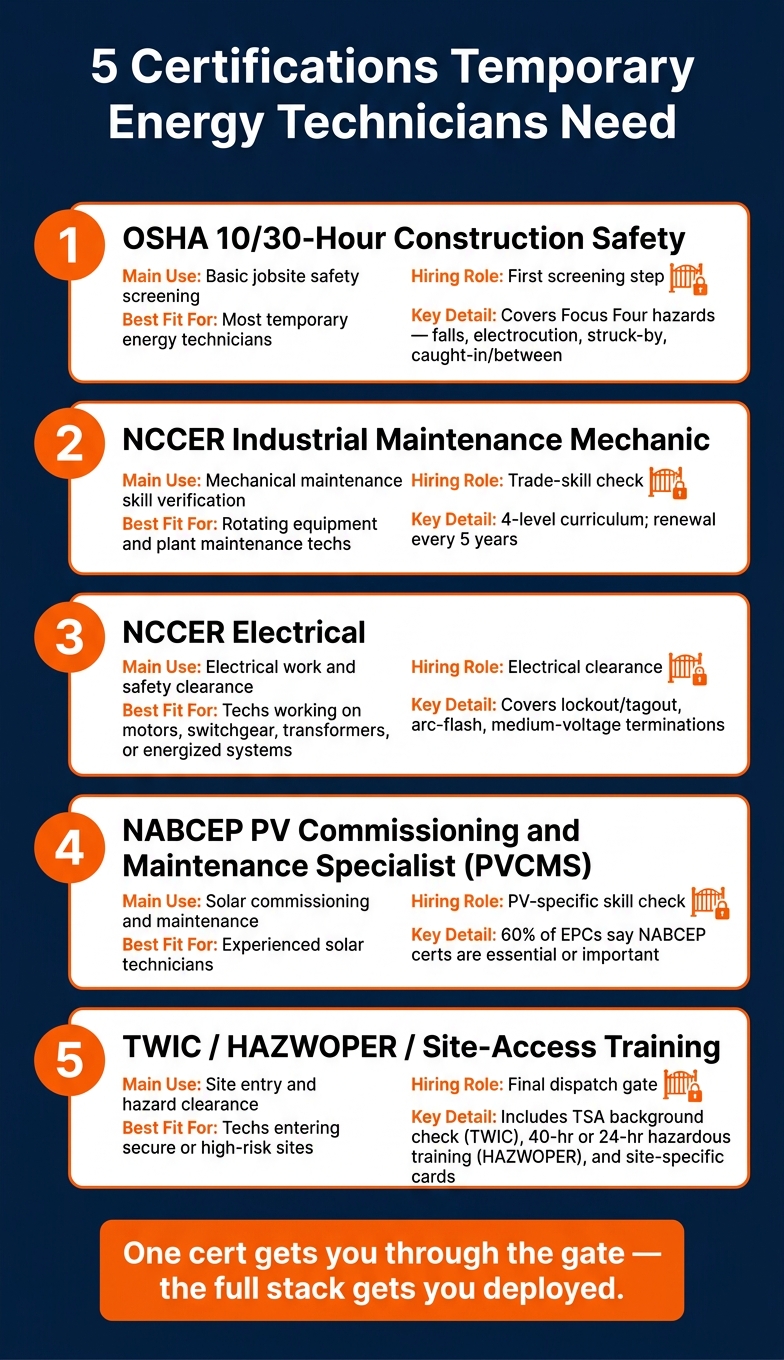
5 Certifications Temporary Energy Technicians Need
How to get a solar job with NABCEP certifications! Intro to Solar!
sbb-itb-aa28329
Quick Comparison
| Certification | Main use | Best fit for | Common hiring role |
|---|---|---|---|
| OSHA 10/30 | Basic jobsite safety | Most temp techs | First screening step |
| NCCER Industrial Maintenance Mechanic | Mechanical maintenance skill | Rotating equipment and plant maintenance techs | Trade-skill check |
| NCCER Electrical | Electrical work and safety | Techs working on motors, switchgear, transformers, or energized systems | Electrical clearance |
| NABCEP PVCMS | Solar commissioning and maintenance | Experienced solar techs | PV-specific skill check |
| TWIC / HAZWOPER / Site Training | Site entry and hazard clearance | Techs entering secure or high-risk sites | Final dispatch gate |
So if I were reading this to figure out what matters most, my answer would be: get the core certs, keep them current, and keep proof easy to verify. That’s what helps turn a qualified tech into one who can be sent out without delay.
Why Certifications Matter More for Temporary Energy Technicians
Permanent employees at a refinery or substation usually learn a site’s hazards over time. Temporary technicians don’t get that runway. They might be at a solar farm one month and a midstream terminal the next. Each site comes with its own hazards – and its own entry rules.
Being cleared for electrical work at one location doesn’t mean you’re cleared for a refinery or any other high-hazard site. The risk changes fast. Certifications are how employers check that a worker is ready for that specific setting, not just energy work in a broad sense.
There’s also a big difference between site access and task clearance. They sound similar, but they are not the same thing.
- Some credentials, like a Transportation Worker Identification Credential (TWIC), are needed just to get into a secure coastal facility or LNG terminal.
- Others, like HAZWOPER training, are needed before a worker can handle hazardous substances on-site.
- And credentials like NFPA 70E-aligned electrical safety training are needed before anyone can work on or near energized equipment.
Miss one of these, and a worker might get through the gate but still not be allowed to do the job.
That’s why host employers treat certification as a hard dispatch filter, not a nice-to-have.
For temporary technicians, the right credentials shape which assignments they can take – and how fast they can be sent out. That makes the first credential the baseline: OSHA 10-Hour or 30-Hour Construction Safety.
1. OSHA 10-Hour or 30-Hour Construction Safety
On many U.S. energy sites, an OSHA card is the basic proof of safety training a technician needs before dispatch. For temporary energy techs moving from outages to shutdowns to project sites, it’s often the first credential anyone checks. Site operators and contractors use it as an early screen to confirm that a worker understands common construction hazards before stepping on site. That’s why OSHA 10 or 30 is usually the first item employers look for.
The 10-hour course covers the Focus Four hazards: falls, electrocution, struck-by, and caught-in/between. It also covers PPE selection, tool safety, and worker rights under OSHA. The 30-hour course goes further, with more time spent on hazard recognition, hazard communication, and job planning. In most cases, OSHA 10 is the common minimum. OSHA 30 tends to fit lead techs and crew coordinators better. After those safety basics are checked, employers usually move on to hands-on maintenance skill.
For outage work, a current OSHA card can help speed up dispatch and start dates. If a technician doesn’t have a current card, the employer may need to set up training, gather documentation, and push back the start date. A worker who already has a verified card can often move through background checks and site access approval with less delay.
OSHA cards do not have a federal expiration date, but many employers set their own recency rules. Platforms like ABLEMKR store verified OSHA credentials in a worker profile, which helps employers confirm deployment-ready technicians faster. Once site safety is covered, trade and electrical credentials usually become the next filter.
2. NCCER Industrial Maintenance Mechanic

Once safety clearance is in place, employers usually want one more thing: proof that a technician can actually do the mechanical work. That’s where the NCCER Industrial Maintenance Mechanic credential comes in.
It’s a four-level curriculum aligned with U.S. Department of Labor standards for apprenticeship programs, which gives employers a standard way to check a temporary technician’s skill level. And for temp roles, that matters a lot. In many cases, the first question is simple: can this person step in and handle the mechanical work on day one?
The credential is recognized across power plants, refineries, and pipeline sites. That makes it a strong fit for temporary technicians who move from one job to the next.
It verifies:
| Curriculum Level | Key Competencies |
|---|---|
| Level 1 | Pumps, valves, basic rigging |
| Level 2 | Piping systems, bearings |
| Level 3 | Precision measuring, alignment, mechanical seals |
| Level 4 | Predictive maintenance, gearboxes, troubleshooting and repairing pumps |
In plain terms, this credential shows that a technician can work on pumps, piping, alignment, and troubleshooting across rotating equipment jobs. It must be renewed every 5 years through re-examination.
There’s also a practical screening upside. NCCER’s digital records, including NCCERconnect and online gradebooks, let employers check training history and module completions fast, which cuts down on manual screening. Platforms like ABLEMKR can help move placements along by keeping verified worker profiles easy to check.
Mechanical skill is one part of the job. Electrical work calls for a separate set of credentials.
3. NCCER Electrical
After mechanical skills, electrical clearance is often the next gate for temp energy jobs. If the work involves energized equipment, employers usually want separate proof that you can handle electrical tasks safely. Mechanical credentials help, but they don’t cover electrical work. NCCER Electrical is often the credential that fills that gap.
On regulated energy sites, NCCER Electrical may be required along with state licensing and site safety credentials before dispatch. It covers lockout/tagout, arc-flash safety, switchgear, motors, transformers, grounding, and medium-voltage terminations.
NCCER also offers specialized tracks for different job types:
- Power Generation Maintenance Electrician for plant and utility work
- Pipeline Electrical & Instrumentation for midstream oil and gas
- Industrial Maintenance E&I for shutdown and manufacturing sites
For temp placements, speed matters. Employers can verify NCCER records through the registry, which helps move screening along.
Solar sites then add PV-specific maintenance requirements.
4. NABCEP PV Commissioning and Maintenance Specialist
Solar sites come with their own commissioning and maintenance demands. The NABCEP PV Commissioning and Maintenance Specialist (PVCMS) is a NABCEP board certification that brings
"operations, maintenance, and commissioning into one role"
into a single credential, with a focus on verification protocols plus preventive and corrective maintenance. For temporary technicians, that matters. One certification can help cover more than one job on the same project.
That can be a big deal on commercial and utility-scale solar work. In one EPC survey, 60% said NABCEP certifications were essential or important. Employers can also check status fast through NABCEP badges and digital wallet records. On top of that, the certification requires OSHA 10-Hour or 30-Hour Construction Safety.
This is not built for entry-level workers. It is meant for experienced technicians.
Even if someone has the right technical certification, dispatch still depends on site access and hazardous-work training.
5. TWIC, HAZWOPER, and Task-Specific Site-Access Training
After trade and safety credentials, site access is the last dispatch gate. These items clear a technician to enter the site, not just do the work.
TWIC (Transportation Worker Identification Credential) is a TSA-issued biometric smart card for unescorted access to secure areas of U.S. maritime facilities and vessels. That includes many ports, LNG terminals, offshore support facilities, and some coastal refineries or tank farms. Getting a TWIC means identity verification, fingerprinting, and a federal background check. It can take weeks to secure, so waiting until a job offer lands can mean missing the project window.
HAZWOPER applies to hazardous waste operations and emergency response at contaminated sites. The right version depends on exposure level: 40-hour or 24-hour. After that, the annual refresher still matters. Miss it, and site access can stall until retraining is done. So this isn’t just a general safety class. For short-term assignments, it’s part of being ready to go.
Task-specific site-access training is the last piece. This clearance changes by employer and location, from regional safety council cards to MSHA orientation. The key point is simple: it has to be done before a technician starts work, not after showing up at the gate.
Put together, these credentials act like a site-entry checklist for a dispatch-ready technician. A Gulf Coast refinery turnaround, for example, might call for:
- OSHA 30-Hour
- HAZWOPER 40-Hour
- A regional safety council card
- TWIC, if the facility is inside a regulated maritime zone
Having all of this ready ahead of time makes mobilization much faster. Platforms like ABLEMKR can pre-verify these credentials, which helps operators dispatch compliant technicians faster.
Once access credentials are in hand, the next speed advantage is digital verification.
How Digital Credential Verification Speeds Up Hiring
Once the right credentials are in place, hiring speed comes down to one thing: verification. Collecting paper cards and chasing down email attachments slows everything down. And for turnarounds and emergency repairs, even a short delay can cost money.
Digital verification cuts that drag. Instead of waiting for candidates to send documents and HR teams to review them by hand, a platform keeps each technician’s OSHA, NCCER, NABCEP, TWIC, and HAZWOPER records in one central profile. The point isn’t to rehash what those credentials mean. It’s to make them instantly checkable.
When an employer posts a job, the system can filter for candidates with verified, current certifications. That’s a big deal when a company needs to hire from a verified pool right away, not begin screening from zero. One of the biggest time-savers is expiration tracking. HAZWOPER and CPR/First Aid are among the most common certification gaps because they need annual renewal. A digital platform flags those expirations on its own, so a technician doesn’t arrive at the gate only to get turned away.
ABLEMKR is built for this exact workflow. Its mobile-first platform matches pre-vetted technicians to job sites based on certifications, safety training, availability, and geo-location. If an operator posts a project that calls for OSHA 30, NCCER Industrial Maintenance Mechanic, and HAZWOPER 40-hour, the system filters for technicians who already meet those requirements and have been verified. That means no repeating the same checks every time a known technician comes back for a new job.
For technicians, that same verified digital profile shortens the gap between certification and dispatch. No need to resend the same documents over and over.
Conclusion
The certifications a temporary energy technician carries shape more than resume credibility. They often decide who gets picked first for shutdowns and emergency repairs. In this field, the right credentials matter just as much as experience.
Each certification clears a different hiring gate. Taken together, they cover safety, mechanical skill, electrical work, solar maintenance, and site access – the core checks that decide whether a temp technician can be sent to a job.
Treat certifications as active qualifications, not one-time wins. Track renewals before they expire.
Fast access to proof is what turns a qualified technician into a deployable one. Proof matters as much as the credential itself. Keep completion records in one easy-to-share profile so recruiters and project managers can verify them fast.
Build the right credential stack, keep it current, and keep proof ready – so technicians stay deployable across U.S. energy jobs.
FAQs
Which certification should I get first?
Start with the baseline safety certifications. An OSHA 10-hour or 30-hour construction safety card is often the first thing to get, because many energy jobs require it just to get on-site.
A First Aid/CPR certification also helps when you’re applying for work. After that, add job-specific credentials as needed, like H2S safety or confined space entry, based on the site and the role.
Do I need both OSHA and NCCER?
Yes, in most cases, you need both.
OSHA gives you the safety base. It covers workplace safety, hazard recognition, and compliance rules that many employers expect you to know.
NCCER shows your hands-on trade skills in a specific area, like electrical or mechanical maintenance. That matters because industrial job sites usually want more than safety awareness. They also want proof that you can do the work.
Put simply: OSHA says you understand how to work safely. NCCER shows you can work skillfully in the trade. Having both helps you meet the safety and job-skill standards on most industrial sites.
How do I know if a site requires TWIC or HAZWOPER?
Check with the project site or your employer during onboarding. The rules can change based on how the facility runs and what regulators require.
A TWIC is usually needed for maritime sites and secure industrial facilities with controlled access. HAZWOPER is required for uncontrolled hazardous waste work, TSD operations, or emergency response involving hazardous substance releases.


