
One weak handoff can stall an outage, trigger rework, or put people at risk. In energy projects, team management comes down to a few basic moves: set clear roles, lock in one reporting line per crew, run tight shift handovers, track training before mobilization, and use a set path to deal with conflict fast.
If I had to sum up the article in plain English, it would be this: energy projects run better when people know who owns each task, what safety rules apply, and who makes the call when plans go off track. That matters even more on jobs with high-voltage gear, confined spaces, hazardous materials, remote sites, and outage windows that can cost millions of dollars per day if missed.
Here’s the full picture at a glance:
- Energy teams are harder to run because safety, regulation, contractor overlap, and site risk show up every shift.
- Capital projects and O&M teams need different setups: one is built around delivery and commissioning, the other around uptime, handoffs, and repeat work.
- Crew structure should be set before work starts and changed as the job moves from design to construction, commissioning, and handoff.
- Daily leadership matters most in the field: toolbox talks, permit checks, lockout/tagout review, stop-work backing, and short coordination meetings keep work moving.
- Shift and contractor communication needs structure, especially on remote sites, night shifts, and multi-employer jobs.
- Stakeholder delays can wreck the schedule, so utilities, inspectors, landowners, and specialty subs need one owner, one calendar, and early notice.
- Training is not just admin work. OSHA training and NERC drill rules tie directly to safety and readiness. In 2021, hazardous exposures led to 798 worker deaths, and clean energy jobs grew by 114,000 in 2022.
- Skills mapping before mobilization cuts crew mismatch by checking licenses, certs, safety training, and job history against field needs.
- Front-line leaders need field judgment, not just trade skill, especially when schedule pressure and safety rules clash.
- Conflict usually starts small: unclear scope, weak handoffs, outage pressure, contractor friction, weather, or access problems.
- The fix is simple but strict: use written escalation paths, issue logs, and stop-work authority when safety is on the line.
If you want the short answer: good energy team management is less about org charts and more about control in the field. The rest of the article breaks down how to set that up and keep it working day after day.
Developing Competent Project Managers for the Renewable Energy Industry – Johannesen
How to Build the Right Team Structure for Your Energy Project
Once you’ve picked the work model, the next move is setting up the team around it. Do this before work begins. Roles, reporting lines, and field ownership should match the project’s scope, site location, risk level, and current phase.
That matters because different types of energy work need different team setups. Capital projects usually need temporary build teams. O&M work leans on steady crews and tighter handoffs between people and shifts. And the structure shouldn’t stay frozen. It needs to change as the project moves from design to construction, then commissioning, and finally handoff.
Core Roles and Responsibilities on Energy Job Sites
Every job site needs clear ownership across the main functions: engineering, construction, safety, quality, commissioning, and field execution. If nobody clearly owns a function, small issues can turn into delays fast.
It also helps to define handoff points early. That way, responsibility moves cleanly from one phase to the next instead of getting stuck in a gray area. For example, the team handling design shouldn’t leave open questions for the construction crew to sort out in the field if that can be avoided.
Governance, Reporting Lines, and Crew Accountability
Good governance starts simple. Each crew should have one reporting line, and each work package should have one decision maker. That cuts down on mixed signals and keeps the field moving.
You also need clear escalation rules for safety, schedule, and quality issues. When something goes wrong, people shouldn’t have to guess who to call or how far to push it. Clear accountability keeps crews aligned and helps problems get addressed before they spread.
Using ABLEMKR to Assemble Field-Ready Crews Faster

When crews need to mobilize fast, staffing tools should support the team structure, not slow it down. In many cases, the hardest part is filling roles on short timelines, at remote sites, or during shutdowns.
ABLEMKR helps employers match with pre-vetted workers based on certifications, safety training, availability, and geolocation. It also gives teams real-time visibility into worker status and includes embedded compliance tracking, which can make crew assembly much smoother when timing is tight.
Daily Leadership: Safety, Communication, and Crew Coordination
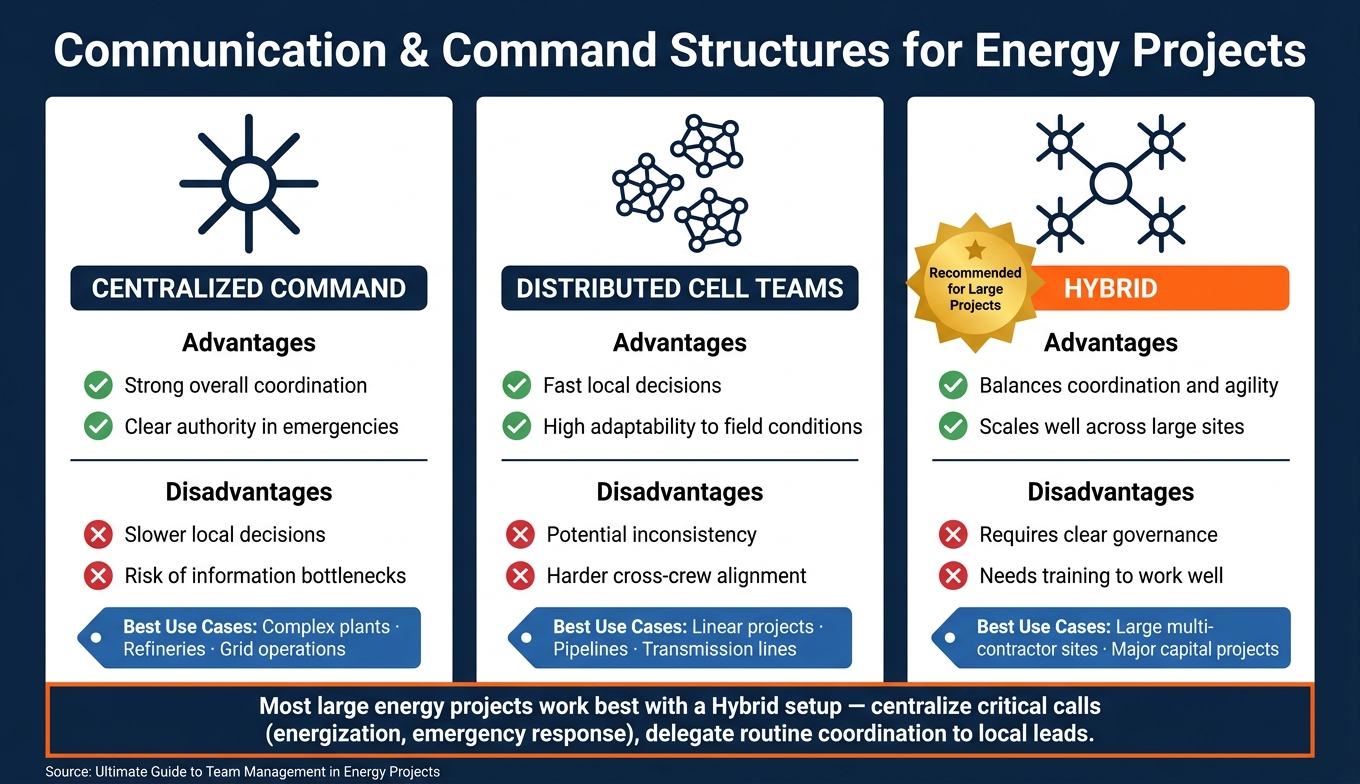
Energy Project Team Management: Command Structures Compared
Once roles are set, leadership is what keeps the job moving without losing control of safety or pace. Org charts help, sure. But on active energy sites, the day-to-day work gets held together by clear direction, tight communication, and steady follow-through.
Safety-First Leadership on High-Risk Job Sites
Good safety leadership comes from daily routines that make the safe choice the normal choice. Start every shift with a 10–15 minute toolbox talk focused on that day’s work and hazards. Before anyone starts, confirm permits, lockout/tagout status, and the controls in place.
Stop-work authority also needs daily backing. Every worker should know they can stop a task the second they spot a serious hazard, and that doing so won’t cost them on productivity. That only works if supervisors back it up in public and support workers who stop work in good faith.
Near misses should be treated like early warning signs, not paperwork. Review them in safety meetings, then carry those lessons into the next toolbox talk. For high-risk controls like lockout/tagout, fall protection, confined space entry, and struck-by hazards, repetition matters. If crews are working at height, fall protection should come up in every pre-task plan.
Communication Systems That Work Across Shifts and Contractors
On multi-employer energy sites, missed handoffs between shifts or contractors often lead to rework, delays, and safety incidents. A structured shift handover solves a big part of that problem. Outgoing leads should fill out a standard log that covers completed work, open tasks, equipment status, locked-out systems, and any unresolved safety issues. Then they should walk through it face-to-face with incoming leads before leaving the site.
Daily coordination meetings usually run 15–30 minutes before work starts. They should include reps from construction, operations, engineering, safety, and major contractors. Keep the agenda steady:
- What got finished yesterday
- What’s happening today
- Which work fronts overlap
- Permit and isolation status
- Critical risks like weather or access changes
Any decisions made in the meeting should be logged and shared afterward.
Dispersed crews, remote work fronts, and night operations need more structure, not less. Scheduled radio check-ins at the start, middle, and end of each shift help remote teams stay connected. Night crews need shorter briefings that take fatigue into account. They also need posted escalation contacts so anyone working nights knows exactly who to call for a permit issue, a technical question, or a safety event.
Communication should fit the project layout. A refinery doesn’t run like a transmission line job, and the communication model shouldn’t be the same either.
| Structure Type | Advantages | Disadvantages | Best Use Cases |
|---|---|---|---|
| Centralized Command | Strong overall coordination; clear authority in emergencies | Slower local decisions; risk of information bottlenecks | Complex plants, refineries, grid operations |
| Distributed Cell Teams | Fast local decisions; high adaptability to field conditions | Potential inconsistency; harder cross-crew alignment | Linear projects (pipelines, transmission lines) |
| Hybrid | Balances coordination and agility; scales well | Requires clear governance and training to work well | Large multi-contractor sites, major capital projects |
Most large energy projects work best with a hybrid setup. Critical calls like energization, overlapping high-risk work, and emergency response stay under central control. Routine crew-to-crew communication can stay with local leads, as long as the boundaries are clear.
Coordinating With Utilities and Stakeholders to Avoid Delays
Strong field discipline won’t save the schedule if permits and approvals are stuck. Permit delays, missed inspection windows, and energization holdups are some of the most avoidable schedule risks on energy projects, and they often come back to weak stakeholder coordination.
The fix starts early. Build a stakeholder map at the start of the project listing each utility, regulator, permitting authority, landowner, and specialty subcontractor. For each one, include required notice periods, contact points, and preferred communication channels.
Give one lead responsibility for each major stakeholder group. That person owns the relationship, tracks commitments, and surfaces conflicts early, like a utility outage window that clashes with a landowner’s access restriction. A shared calendar for permits, inspections, and energization windows gives the full team visibility and helps avoid the all-too-common mess where crews are ready but approvals are not.
For critical work windows, such as a substation upgrade tied to a 12-hour outage, a short call at the start of the window can confirm isolations, crew readiness, and inspection sequence. A debrief at the end helps cut deferrals and gives the team lessons to use on the next outage. Specialty subcontractors also need to be brought into planning early so their availability lines up with construction progress, instead of forcing the job to wait on them.
sbb-itb-aa28329
Training, Upskilling, and Retaining a Reliable Workforce
Training is a core management job, not paperwork. OSHA requires initial training and refreshers for confined space entry, lockout/tagout, and fall protection, and NERC’s PER-005 requires simulation-based drills for system operators on a repeating basis. When training slips, incident rates go up, citations follow, and crews can miss equipment updates or scope changes.
Hazardous exposures caused 798 worker fatalities in 2021, up 18.8% from the year before. Clean energy jobs grew by 114,000 in 2022 alone. More hiring sounds like good news, but it also puts pressure on employers to build crews that can handle new tasks. In plain terms: upskilling isn’t just about job performance. It also helps keep people.
That leads to a practical move: measure skills before mobilization.
Skills Mapping for Technical and Safety Readiness
Before mobilization, map each role to the skills it calls for in the field. Build role-by-role profiles for every position on the project – structural welder, high-voltage technician, turbine mechanic, trenching operator – and compare each worker’s credentials against those requirements.
Track:
- AWS welding certifications by process and position
- Journeyman or master electrician licenses
- OSHA 10- or 30-hour cards
- Confined space and fall protection training
- OEM turbine maintenance course completions
- Documented job history by asset type and environment
The goal is to catch gaps before crews arrive. For example, a structural steel welder may not be cleared for pressure piping.
The best way to handle this is with one digital registry that stores each worker’s credentials, expiration dates, and completed safety training, then keeps that record current. That gives supervisors a fast way to build crews whose combined skills match the risk profile of an outage or tie-in. No last-minute surprises on day one.
| Competency | Training Methods | Best Fit Project Phase |
|---|---|---|
| Technical | OEM courses, weld qualification tests, equipment-specific onboarding, on-the-job supervised practice | Pre-mobilization, commissioning |
| Safety | OSHA 10/30-hour courses, toolbox talks, job safety analyses, confined space and fall protection drills | Pre-mobilization and throughout execution |
| Leadership | Scenario-based supervisor training, mentoring from senior superintendents, coaching workshops | Early execution, ramp-up phase |
| Communication | Shift handover practice, cross-contractor coordination drills, documentation training | Throughout project execution |
Skill data matters only if supervisors can use it on the job site.
Developing Supervisors and Front-Line Leaders
Technical skill by itself doesn’t make a strong foreman. Supervisors on energy projects often run mixed crews – direct hires and subcontractors from different companies, each with its own procedures and ways of working – while trying to keep safety and schedule from colliding. That’s a lot to juggle at once: subcontractor coordination, shift transitions, and competing priorities.
Good supervisor development stays focused on field judgment. That includes giving behavior-based feedback during toolbox talks, spotting fatigue signs and adjusting rotation plans before performance slips, and using a set decision process when schedule pressure runs into a safety issue. Scenario-based training helps here because it puts people into situations that feel like the job itself – keep working in worsening weather or stand down, stop work or continue when a safety issue shows up. A classroom can teach rules. These exercises build judgment. Pair that training with mentoring and clear competency checks.
Foremen should also document incidents, quality issues, and crew conflicts in one standard format: date, location, task, and observed cause. Good records make root cause analysis possible and help stop the same issue from showing up again on the next project.
How ABLEMKR Supports Workforce Readiness and Compliance
ABLEMKR gives employers real-time visibility into worker credentials across multiple job sites, including certification expiration dates and completed safety training. That makes it easier to catch compliance gaps before they turn into field problems and to reassign crews when a credential is close to expiring. Integrated payroll workflows and built-in compliance tracking also cut the admin load that usually lands on site supervisors.
Even a qualified crew can struggle when pressure builds, which is why conflict control matters next.
Managing Conflict, Workforce Risk, and Project Disruptions
Once crews are trained and on site, the next test is how they deal with pressure. Most conflict doesn’t explode out of nowhere. It usually starts with small things: fuzzy ownership, poor handoffs, or plain old fatigue. If no one steps in, those issues turn into delays, rework, and safety problems. Good managers spot the warning signs early and deal with them before schedule, cost, or safety takes a hit.
| Workforce Risk | Likely Impact | Risk Level | Preventive Controls | Corrective Actions |
|---|---|---|---|---|
| Scope Ambiguity | Task ownership disputes, rework, contractor friction | High | Clear scope definitions, documented handoff points | Supervisor-led scope clarification, written task assignment |
| Shift Handoff Gaps | Missed isolations, duplicated or skipped work, safety incidents | High | Standardized shift logs, face-to-face lead handovers | Immediate briefing reset, updated handover checklist |
| Contractor Interface Conflict | Schedule delays, accountability gaps, stalled work fronts | Medium | Pre-mobilization interface agreements, daily coordination meetings | Direct escalation to project manager, scope arbitration |
| Outage-Window Pressure | Rushed work, safety shortcuts, incomplete commissioning | High | Pre-planned outage sequences, clear decision authority | Safety manager stop-work authority, schedule resequencing |
| Weather and Access Disruption | Schedule overruns, increased capital costs | High | Predictive scheduling, preplanned contingencies | Absorbing delays into float, permit extensions |
Where Conflict Most Often Occurs on Energy Projects
On energy job sites, the roughest friction points usually show up in a few familiar places. Scope disputes are near the top of the list, especially when several subcontractors are working side by side and their duties overlap. If scope definitions are loose and handoffs are weak, crews can get stuck arguing over who owns a task and who has to fix rework. That can slow the whole job in a hurry.
Outage windows and emergency repair work create another common pressure point. Operations teams want the system back online as fast as possible. Construction crews need enough time to finish the work safely. When those priorities clash and no one has clear decision authority, delays stack up.
Escalation Paths and Practical Ways to Resolve Issues
Once the source of friction is clear, managers need a set process to resolve it fast. Every dispute should follow a documented escalation path that spells out who handles the issue in the field, who steps in next if it stays unresolved, and when a safety manager can stop work at once. If a dispute creates a safety risk – say, a contractor wants to skip a required safety step to stay on schedule – the safety manager should be able to stop the work without waiting for approval from above.
A daily issue log also helps. Track the date, location, task, parties involved, and current status. That running record makes it less likely the same fight pops up twice, and it gives managers a clearer trail to follow when something goes wrong.
For weather delays, permit changes, or outage extensions, teams move faster when backup plans are ready to go. Teams that deal well with disruption don’t wing it. They plan for it ahead of time.
Conclusion: Core Practices Behind Strong Energy Project Teams
Strong team management in energy work comes down to clear roles, disciplined escalation, and a fast response when disruption hits. Conflict and disruption show up on every project. What sets strong teams apart is how fast they surface problems and how clearly they’ve defined who solves them.
FAQs
How should team structure change by project phase?
Team structure should change as the project moves from one phase to the next.
During planning, project sponsors and executives take the lead. They set the big-picture goals, approve budgets, and weigh feasibility.
Once construction starts, decision-making shifts to the people closer to the work. That usually means technical directors, engineering leads, and onsite teams handling equipment, construction methods, and safety.
Staffing needs to scale too. When demand peaks, teams often break work packages into specific roles and trades so the right people are in the right spots at the right time.
ABLEMKR can help by matching pre-vetted workers based on certifications and availability.
What should a strong shift handoff include?
A strong shift handoff needs a clear record of what’s done, what still needs attention, and which decisions were made.
After the verbal briefing, send a short written summary with the next steps and timeline. Archived chat logs and written records help the incoming team stay up to speed, keep work moving, and cut down on missed details.
How do you prevent crew skill gaps before mobilization?
Start with careful workforce planning that ties the right skills and certifications to each phase of the project. Use data-based assessments to estimate labor needs, and keep worker profiles current with verified certifications, safety records, and training status.
Platforms like ABLEMKR can help match pre-vetted workers to the right job sites. It also helps to use compliance tracking and look-ahead scheduling to catch expiring credentials and fix staffing gaps before work begins.


