
Misclassifying workers as independent contractors instead of employees can lead to severe financial and legal consequences for businesses. Here are the key penalties you should know:
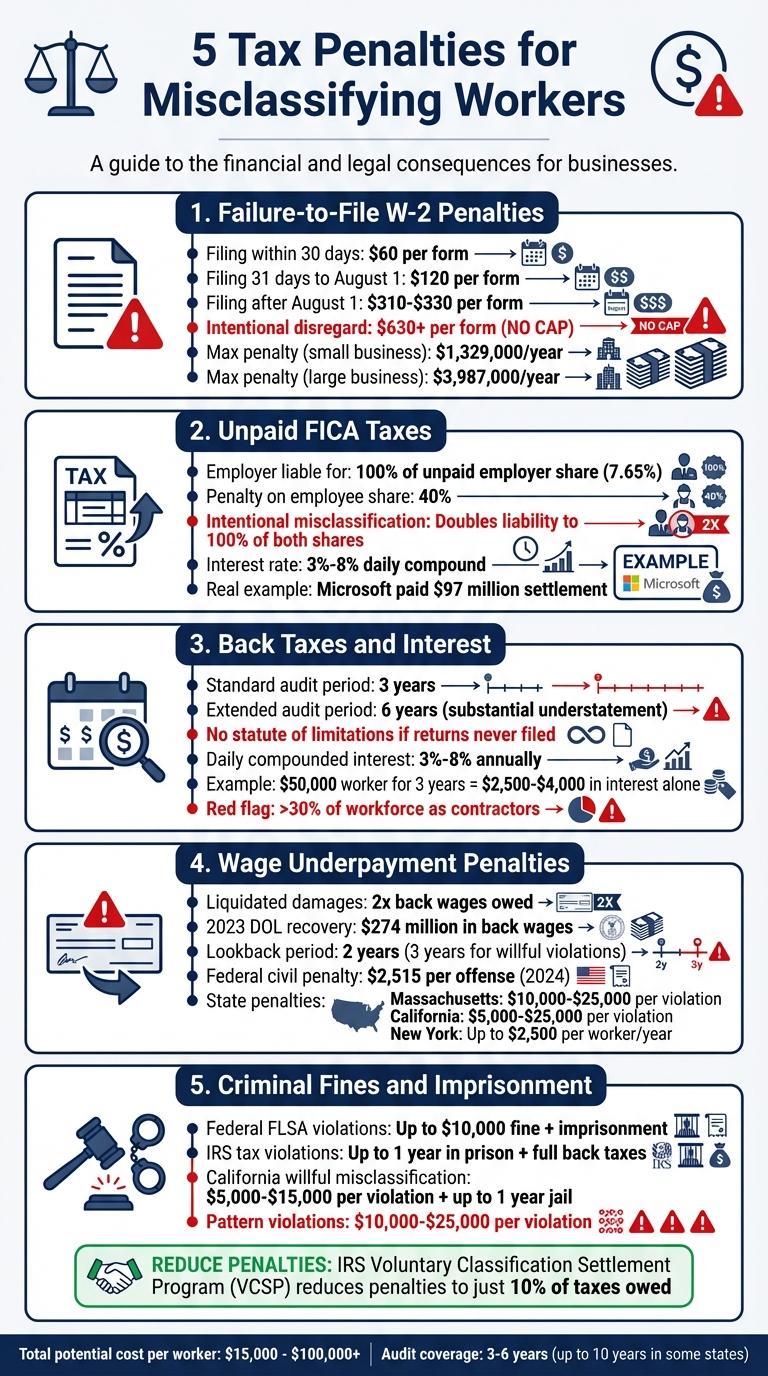
- Failure-to-File W-2 Penalties: Fines range from $60 to $330 per form, depending on how late the correction is. Intentional disregard results in penalties starting at $630 per form with no cap.
- Unpaid FICA Taxes: Employers are liable for 100% of the unpaid employer share (7.65%) and a 40% penalty on the employee share. Intentional misclassification can double the liability.
- Back Taxes and Interest: The IRS may audit up to six years of records, with daily compounded interest (3%-8%) on unpaid taxes.
- Wage Underpayment Penalties: Misclassified workers may claim back wages, overtime, and liquidated damages, effectively doubling the owed amount.
- Criminal Fines and Imprisonment: Willful misclassification can result in fines up to $10,000 and jail time, with additional state-level penalties ranging from $5,000 to $25,000 per violation.
Quick Tip: Participating in the IRS Voluntary Classification Settlement Program (VCSP) can reduce penalties to 10% of taxes owed. Regular audits and compliance tools can help avoid these costly mistakes.
5 Tax Penalties for Worker Misclassification: Costs and Consequences
Employee vs Contractor Classification – The $50,000 Penalty the IRS Just Issued
sbb-itb-aa28329
1. Failure-to-File W-2 Penalties
Misclassifying an employee as a contractor (subject to specific contractor terms and conditions) often results in issuing a 1099 or, in some cases, not issuing any form. This mistake can lead to two separate penalties from the IRS: one for failing to file a W-2 with the Social Security Administration and another for not providing the worker with their copy.
The penalties vary based on how quickly the error is corrected. Filing a missing W-2 within 30 days of the January 31 deadline incurs a $60 penalty per form. If filed between 31 days and August 1, the penalty increases to $120 per form. Filing after August 1 – or failing to file altogether – raises the penalty to a range of $310 to $330 per form. Small businesses with annual revenue under $5 million face a maximum penalty of $1,329,000 per year, while larger businesses could be liable for up to $3,987,000.
The situation becomes far more severe if the IRS concludes that the failure to file was intentional. In such cases, the penalty jumps to $630 or more per form, with no upper limit. Ben Golden, founder of IRS Trouble Solvers, emphasizes this point:
"If the IRS determines that you intentionally failed to file, the penalty increases significantly with no maximum cap."
| Filing Delay | Penalty Per Form | Max (Small Business) | Max (Large Business) |
|---|---|---|---|
| 30 days or less | $60 | $232,500 | $664,500 |
| 31 days to August 1 | $120 | $664,500 | $1,993,500 |
| After August 1 / Not Filed | $310–$330 | $1,329,000 | $3,987,000 |
| Intentional Disregard | $630+ | No Limit | No Limit |
To reduce penalties, submit Form W-2c within 30 days of discovering the error. Additionally, businesses filing more than 10 information returns must file electronically to avoid extra fines for non-compliance.
Next, we’ll look at the penalties associated with unpaid FICA taxes.
2. Unpaid FICA Tax Penalties
One of the biggest financial risks of misclassifying employees as independent contractors is the issue of unpaid FICA taxes. These are the payroll taxes that fund Social Security and Medicare. The total FICA tax rate is 15.3% of an employee’s wages – 12.4% for Social Security and 2.9% for Medicare. For employees on a W-2, this tax is split evenly between the employer and the employee, with each covering 7.65%.
When misclassification occurs, the employer avoids paying their share of FICA taxes. However, the IRS holds employers 100% responsible for the unpaid portion of the employer’s share (7.65%). On top of that, businesses face a 40% penalty on the uncollected employee share of FICA taxes. If the IRS decides the misclassification was intentional, the penalties can skyrocket to 100% of both the employer and employee shares, effectively doubling the tax liability.
The financial impact doesn’t stop there. Daily compound interest – ranging from 3% to 8% – is added to the unpaid taxes. For example, a mid-size company with 15 workers earning $55,000 annually, misclassified for three years, could face $35,000 to $45,000 in interest charges. A tech startup with 25 workers earning $75,000 annually over four years might see interest charges balloon to $125,000 to $175,000.
There are real-world examples of how severe these penalties can be. Microsoft, for instance, paid a staggering $97 million settlement for misclassifying long-term contractors as "permatemps." These workers performed the same duties as employees but didn’t receive FICA contributions or other benefits.
To reduce the risk of such penalties, businesses can use the Voluntary Classification Settlement Program (VCSP). This program allows companies to reclassify workers and settle their tax liabilities for roughly 10% of the taxes owed, without incurring interest or penalties. Additionally, conducting regular audits using the IRS Common Law Test can help businesses identify and correct misclassification issues before facing federal or state penalties.
3. Back Taxes and Interest Charges
When the IRS uncovers worker misclassification, businesses often face a hefty bill for back taxes – essentially, the taxes they should have been paying all along. This includes federal income tax withholdings, state unemployment insurance premiums, and workers’ compensation premiums, which can vary depending on the industry. State income tax withholdings also add to the total liability. These amounts can grow quickly over time.
Typically, the IRS reviews the past three years during an audit. However, if there’s a substantial understatement of tax, that window extends to six years. And if the required tax returns were never filed, there’s no statute of limitations at all. This means unpaid back taxes can snowball as time passes.
What makes matters worse is compounded interest. The IRS compounds interest daily, with annual rates ranging between 3% and 8% on unpaid taxes and any penalties assessed. For example, if a misclassified worker earned $50,000 annually for three years, the interest alone could add $2,500 to $4,000 to the total owed. And here’s the kicker: interest keeps piling up daily until the full balance is paid, even if you’re in the middle of disputing the penalty.
Another factor to consider is workforce composition. If more than 30% of your employees are classified as contractors, it raises a red flag that could trigger an audit. Once one agency identifies misclassification, information-sharing agreements between agencies often lead to additional audits by state tax departments and the Department of Labor. This can result in even more back taxes and interest charges across multiple jurisdictions.
4. Wage Underpayment Penalties
Misclassifying workers as independent contractors doesn’t just lead to tax issues – it can also result in hefty wage underpayment penalties. Workers classified incorrectly lose protections under the Fair Labor Standards Act (FLSA), such as the right to minimum wage and overtime pay at 1.5 times their regular rate for hours worked beyond 40 in a week. If the Department of Labor (DOL) later determines these workers should have been classified as employees, employers are held retroactively responsible for unpaid wages. These liabilities can add up fast, often leading to even more severe financial consequences.
Here’s where things get costlier: under the FLSA, employers may be required to pay not just the back wages but also liquidated damages. Essentially, this doubles the amount owed. For instance, if a company owes $30,000 in unpaid overtime, the total liability could jump to $60,000. In fiscal year 2023 alone, the DOL recovered over $274 million in back wages related to worker misclassification. While the standard lookback period for wage claims is two years, it extends to three years for willful violations. Employers who fail to maintain accurate time and wage records also face the burden of disproving the DOL’s claims.
The penalties don’t stop there. Willful or repeated violations can bring additional civil and criminal sanctions. Federal civil penalties for such violations can reach $2,515 per offense as of 2024. Many states tack on their own fines. For example:
- Massachusetts: $10,000 to $25,000 per violation
- California: $5,000 to $25,000 per violation for willful misclassification
- New York: Up to $2,500 per misclassified worker per year
On the criminal side, willful FLSA violations can result in fines up to $10,000 and even six months of imprisonment. Employers who neglect to keep proper payroll records only increase their risk of audits and penalties.
5. Criminal Fines and Imprisonment Risks
Willfully misclassifying workers can lead to severe consequences, including criminal fines, prosecution, and even imprisonment.
Under the Fair Labor Standards Act (FLSA), intentional violations carry hefty penalties, with fines reaching up to $10,000 and the possibility of imprisonment. Similarly, the IRS takes a hard line on tax-related misclassification. If authorities determine that you deliberately avoided federal tax withholding for income taxes, Social Security, and Medicare, you could face up to a year in prison, along with the responsibility to pay back the full amount of owed taxes. These liabilities can extend to individuals, such as executives with check-signing authority or those directly involved in classification decisions.
State-level penalties add another layer of risk. For example, in California, willful misclassification can result in fines ranging from $5,000 to $15,000 for each violation. If authorities identify a pattern of violations, fines may increase to $10,000–$25,000 per violation, along with the possibility of up to one year in county jail. Massachusetts imposes similar criminal charges, with fines ranging from $10,000 to $25,000 per violation. Preston Wickersham from Remote highlights the seriousness of these actions:
"Companies that willfully and deliberately misclassify their employees can face criminal penalties, fines, and even imprisonment".
Intent plays a critical role in these cases. If the IRS or Department of Labor can prove that you knowingly classified workers as contractors instead of employees – potentially to avoid payroll taxes or workers’ compensation premiums – penalties become much steeper. While criminal prosecution is rare and typically reserved for extreme cases, a single violation can trigger audits from multiple agencies, significantly increasing your exposure.
To reduce these risks, it’s essential to keep thorough records that justify your classification decisions. If contractors make up more than 30% of your workforce, consider conducting internal audits – this ratio often raises red flags for investigators scrutinizing potential tax avoidance. When you’re uncertain, consult legal experts before finalizing classifications, especially for long-term workers whose roles may blur the line between contractor and employee. Regular audits and clear documentation are key to avoiding these costly and damaging outcomes. These penalties highlight the importance of staying vigilant and ensuring compliance.
How Compliance Tools Reduce Misclassification Risks
Modern compliance platforms are a game-changer for businesses in industries like construction and energy, helping them avoid hefty tax penalties. These tools streamline the classification process by automating decisions and maintaining audit-ready records. They even apply the IRS "control test" in real time, evaluating key factors like behavioral control, financial control, and worker independence. This gives businesses instant insights into whether a role qualifies as an independent contractor.
One way to completely sidestep misclassification risks is through W-2 employment options. For instance, ABLEMKR‘s platform integrates W-2 employment, workers’ compensation coverage, and payroll workflows. This approach helps businesses avoid penalties such as a 1.5% wage penalty for failing to withhold federal income tax and a 40% penalty on unwithheld FICA taxes.
When contractors make up more than 30% of a company’s workforce, IRS scrutiny intensifies. At this point, embedded compliance tracking becomes essential. Advanced tools automate the documentation of deliverables, certifications, and independence factors, ensuring businesses have defensible records ready for audits. This detailed tracking can make all the difference during agency reviews.
Beyond tracking, these platforms also help businesses understand potential liabilities. With built-in cost calculators, they estimate back taxes, interest, and liquidated damages before hiring additional contractors. If a misclassification issue arises, these tools can assist companies in participating in the IRS Voluntary Classification Settlement Program (VCSP), which reduces penalties to just 10%. Considering that misclassifying a single worker could cost anywhere from $15,000 to over $100,000 in back taxes and fines, investing in compliance technology is a smart move.
Industries such as construction, energy, and extractives face heightened enforcement due to their reliance on contract labor. Adding to the complexity, more than 30 states now share misclassification audit findings with the IRS and Department of Labor. This creates a "cascading liability", where a discovery by one agency can lead to multiple investigations. Compliance platforms help businesses navigate these challenges by documenting every classification decision, shielding them from costly enforcement actions.
Conclusion
Understanding the full impact of worker misclassification is crucial for protecting your business. The financial risks are steep, with penalties ranging from $15,000 to over $100,000 per worker. Audits often cover 3 to 6 years of records, though some states extend the review period to as long as 10 years. What’s more, enforcement has become tougher – one misclassification can lead to cascading liabilities involving the IRS, Department of Labor, state tax authorities, and workers’ compensation boards.
The consequences don’t stop at fines and audits. Misclassification can damage your business valuation, credit rating, and ability to secure contracts. It can disrupt investment opportunities, increase insurance costs, and even block access to government contracts. For example, in 2026 Massachusetts construction cases, companies with just 10 misclassified workers faced state penalties ranging from $100,000 to $250,000 – excluding federal liabilities.
To steer clear of these risks, it’s essential to adopt systematic compliance measures. Options include automated tools, W-2 employment structures, or participating in the IRS Voluntary Classification Settlement Program, which reduces penalties to just 10%. Preventative measures are always more cost-effective than dealing with the fallout of misclassification.
FAQs
How does the IRS decide if someone is an employee or a contractor?
The IRS applies a three-factor test to decide whether a worker should be classified as an employee or an independent contractor. This test evaluates three key areas:
- Behavioral Control: Does the business dictate how, when, or where the worker performs their tasks?
- Financial Control: Does the company control the worker’s financial aspects, such as payment terms or reimbursement for expenses?
- Nature of the Relationship: Does the arrangement reflect an employer-employee relationship, or is it more independent?
The primary focus is on the degree of control the business has over how the work gets done.
What are the warning signs that my company is at high risk for a misclassification audit?
If your company treats independent contractors as though they’re employees, you could be setting yourself up for a misclassification audit. Here are some red flags to watch for:
- Exercising control over how, when, or where the work gets done.
- Supplying tools, equipment, or providing training to workers.
- Requiring adherence to specific schedules.
Other risk factors include reimbursing expenses, failing to maintain proper documentation, or having a track record of past misclassification issues. This is especially critical in industries like construction or energy, which are often under scrutiny.
Can the IRS VCSP fix past misclassification, and who qualifies?
The IRS Voluntary Classification Settlement Program (VCSP) offers businesses a chance to resolve past worker misclassification issues. By voluntarily reclassifying workers as employees, companies can address these concerns while potentially lowering the penalties they might face. To participate, businesses must meet specific eligibility requirements and sign a closing agreement with the IRS.


