
To reduce the construction industry’s 37% contribution to global greenhouse gas emissions, workforce training in sustainable practices is crucial. This includes skills in waste management, energy efficiency, water conservation, and renewable energy integration. Proper training ensures compliance with regulations, reduces costs, and meets growing demand for eco-friendly projects. Key steps include:
- Assess Skills: Conduct audits to identify gaps in green construction knowledge.
- Structured Training: Focus on areas like LEED certifications, ethical material sourcing, and renewable energy technologies.
- Hands-On Methods: Use VR, AR, and on-site mentorships for practical learning.
- Use Tools: Leverage digital platforms to track certifications and match skilled workers to projects.
- Measure Results: Monitor metrics like waste diversion, energy use, and compliance to validate training success.
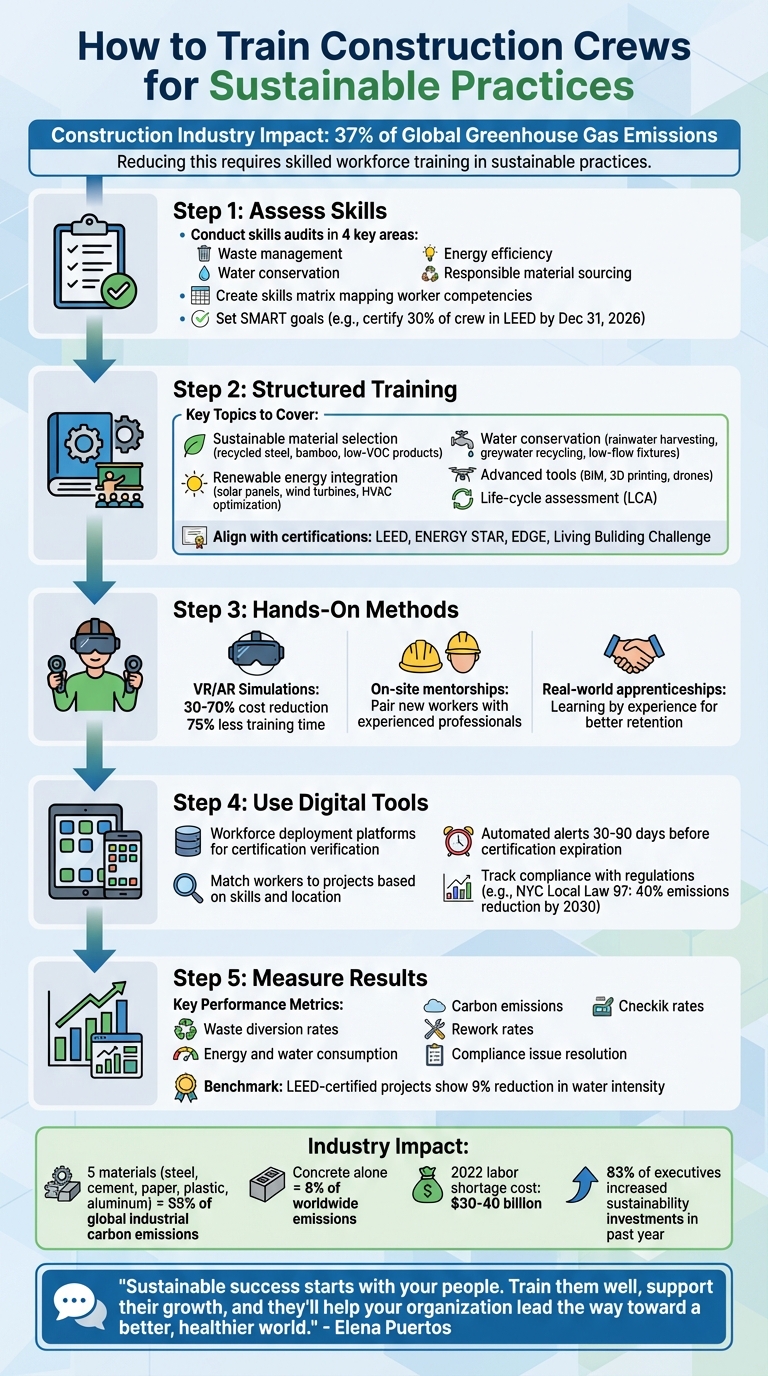
5-Step Process for Training Construction Crews in Sustainable Practices
Incorporating Sustainability into Construction
sbb-itb-aa28329
Assessing Crew Skills and Identifying Gaps
Before rolling out any training program, it’s crucial to understand where your crew stands in terms of their current skills. To address the gaps in sustainable practices, start with a thorough skills audit. This will help you identify who is already equipped to handle green building demands and who might need extra training. This assessment acts as a roadmap for aligning your workforce with the growing demands of sustainable construction.
Conducting Skills Audits
A solid skills audit focuses on four key areas: waste management, water conservation, energy efficiency, and responsible material sourcing. Combining input from both management and field teams ensures you get a full picture of where improvements are needed.
Use competency-based assessments to evaluate your team and create a skills matrix. This matrix maps out each worker’s name alongside the green skills they possess, such as LEED expertise, solar panel installation, or high-efficiency HVAC systems. As highlighted by NCCER, "Competency-based assessments can help leaders identify their workers’ strengths and areas where additional training is recommended". This visual tool makes it easy to pinpoint skill gaps and prioritize training efforts.
Start by addressing critical or high-risk skills tied to regulations before moving on to broader sustainability competencies. Pair your skills matrix with SMART goals – for example, aiming to certify 30% of your crew in LEED by December 31, 2026 – to keep training efforts focused and measurable.
Using Industry Standards and Tools
To ensure accuracy in identifying skill gaps, align your internal assessments with established industry standards. Frameworks like LEED BD+C (v4) pilot credit provide specific benchmarks, such as employing 30% of contractor management personnel with green certifications or a mix of 15% management and 15% tradespeople.
Programs like GPRO (Urban Green Council) and the Green Janitor Education Program offer structured training that meets LEED standards. These programs typically require at least four hours of basic sustainability training, plus an additional six hours focused on green materials, installation practices, and LEED documentation. Workforce management software can further streamline the process, offering tools like employee scorecards, resource tracking, and real-time monitoring of certifications and training progress. These platforms can even send automated alerts 30, 60, or 90 days before green certifications expire, helping you avoid project delays and stay prepared for client or inspector reviews.
Developing a Sustainable Construction Training Program
Once you’ve completed your skills audit, the next step is crafting a curriculum that equips crews with the knowledge and tools to embrace sustainable practices. A strong program strikes a balance between theory and hands-on application, ensuring workers not only understand how to implement green building techniques but also why these methods are essential. This is especially important as the construction industry strives to lower its carbon footprint.
Key Topics to Include in Training
Your training should dive deeper into areas like waste management, water conservation, energy efficiency, and ethical material sourcing. Start with sustainable material selection – think recycled steel, bamboo, and low-VOC products. Renewable energy integration should also be a focal point, covering high-performance insulation, optimized HVAC systems, and renewable technologies such as solar panels and wind turbines. Water conservation is equally vital, with training on rainwater harvesting, greywater recycling, low-flow fixtures, and strategies to minimize site runoff.
Incorporate advanced tools like Building Information Modeling (BIM), 3D printing, and drones to improve precision and cut waste. Another crucial component is life-cycle assessment (LCA), where workers learn to evaluate the environmental impact of materials from sourcing to demolition. With renewable energy sources like solar and wind projected to dominate green electricity consumption by 2028, these skills will only grow in importance.
Structuring the Curriculum
To make your program effective, structure it in tiers that cater to varying experience levels. Start with basic site orientation and sustainability principles during the first week, gradually building up to more complex tasks by the third month. Instead of rigid step-by-step instructions, focus on teaching adaptable processes. This approach allows experienced workers to exercise their judgment while giving beginners enough guidance to build confidence.
Align training modules with recognized certifications such as LEED, ENERGY STAR, EDGE, or the Living Building Challenge. For team leaders, ensure the curriculum meets state-specific continuing education requirements. Combine classroom learning – where workers can dive deeper into sustainability concepts – with mentorship opportunities that pair newer employees with seasoned professionals in green construction. Rose Morrison, Managing Editor of Renovated, emphasizes the importance of classroom-based learning:
"Classrooms allow students to have significant opportunities to study an aspect of their field in depth. Most of the time, construction workers are busy with their work once entering the workforce; they won’t have as many opportunities to learn the best sustainable practices".
Introduce sustainable practices gradually to avoid overwhelming trainees. Use tools like virtual reality (VR) and digital modeling to create immersive, hands-on learning experiences. These technologies let workers explore building systems and energy impacts in a controlled, risk-free environment. This step-by-step approach lays the groundwork for the hands-on training methods discussed in the next section.
Implementing Hands-On Training Methods
Classroom training lays the groundwork, but to truly master sustainable techniques, crews need hands-on experience. Immersive simulations and real-world apprenticeships bridge the gap between theory and practice. Workers need to interact with equipment, see the impact of their decisions, and learn from mistakes in a controlled environment. Combining these methods creates a feedback loop that transforms knowledge into instinctive action.
Simulation-Based Learning
Virtual Reality (VR) and Augmented Reality (AR) have expanded beyond safety drills, now teaching resource-efficient practices. Simulators offer operators a safe space to practice coordination and timing, which can directly reduce fuel usage and equipment wear. For instance, in January 2025, Bechtel Construction teamed up with Industrial Training International to create VR training modules for crane operators. This collaboration not only improved operator assessments but also protected equipment and cut training costs.
Simulators provide instant feedback, flagging errors like improper digging angles or inefficient material handling. This immediate response helps trainees correct their techniques before stepping onto a job site. Jim Ruhoff, Training Director at Real World Construction Training, highlights the value of this approach:
"Simulation completely mitigates that [tense learning situation]… It’s a miraculous training tool because the operators are picking it up. They can see what they’re doing on the screen right next to them and you can point out the inefficiencies".
AR takes this a step further by overlaying instructions directly onto equipment, guiding workers through complex tasks and offering real-time corrections to reduce errors and waste.
A structured progression works best: start with simulators to establish a baseline, gradually increase task complexity, and confirm readiness before moving to live equipment. Companies like BOND Civil & Utility Construction have embraced this method. In January 2025, they used Pixaera’s VR program to simulate hazardous scenarios, allowing workers to practice safety protocols in realistic, high-stakes environments. This approach can significantly cut costs – VR training has been shown to reduce expenses by 30% to 70%, and UPS reported a 75% reduction in training time without compromising effectiveness.
Once simulation training is complete, on-site experience cements these skills.
On-Site Training and Apprenticeships
On-site training remains irreplaceable. Pairing less experienced workers with seasoned professionals allows for the transfer of practical knowledge. This mentorship model thrives when leaders actively promote sustainable practices, sharing data on waste reduction during site meetings to keep teams motivated.
Real-world context is critical. Show workers how sustainable methods can make their jobs easier – like reducing workloads through better material planning or improving workflow with energy-efficient equipment. Research supports this approach:
"learning by experience is often effective, helping people remember what they are being taught with greater consistency and accuracy".
Involve everyone, from new hires to seasoned managers, in these training sessions to foster a unified commitment to sustainability across the project. This inclusive strategy ensures that when challenges arise, the team can collaboratively solve them using resource-efficient methods. Practical, hands-on training is the backbone of achieving the sustainability goals outlined in any program.
Using Technology and Resources for Training
Once hands-on training is complete, the next step is deploying certified workers to the right projects. Modern digital tools make this process seamless, ensuring certifications are verified before workers arrive on-site. This approach not only reduces guesswork but also helps keep projects on schedule.
Using Workforce Deployment Tools
Digital workforce platforms play a key role in verifying worker certifications before they step on-site. Contractors should prioritize tools that validate recognized green credentials, such as GPRO, LEED-specific training, or certifications from the Urban Green Council. This verification is especially crucial for meeting LEED Pilot Credit IPpc81, which requires that at least 30% of contractor management personnel – or a mix of 15% management and 15% tradespeople – hold certificates from an approved green training program.
Platforms like ABLEMKR take this a step further by matching pre-vetted workers to job sites based on factors like certifications, safety training, availability, and location. This mobile-first technology provides real-time visibility into workforce deployment and compliance tracking, ensuring that crews meet the standards for sustainable projects. For example, if a contractor needs workers trained in seismic retrofits or energy-efficient HVAC systems, the platform quickly identifies qualified candidates. Tools like these, which combine certification verification with real-time data, are essential for keeping projects efficient and on track.
These tools also monitor important sustainability metrics, such as waste diversion, energy and water consumption, and carbon emissions. This data is invaluable for adhering to regulations like New York City’s Local Law 97, which requires a 40% reduction in greenhouse gas emissions by 2030. Non-compliance can result in fines of $268 per metric ton of emissions. Automated compliance features help contractors stay aligned with local building codes and energy benchmarking requirements.
While digital tools are powerful, combining them with partnerships from industry experts can elevate your training program even further.
Partnering with Industry Experts
Digital tools are just one piece of the puzzle. Partnering with accredited training providers allows contractors to create custom programs that go beyond basic certification tracking. For instance, the Urban Green Council offers GPRO certification, which includes at least six hours of instruction for contractors on green materials and LEED-specific documentation. Building operators, on the other hand, complete eight hours of training focused on energy audits and indoor air quality. These programs are developed by non-profits with deep expertise in green building and meet ANSI/ASTM E2659-09 standards.
Collaboration can also include material suppliers. Workforce deployment tools should provide access to databases of approved sustainable material suppliers to ensure compliance with environmental management plans. This is especially important given that five materials – steel, cement, paper, plastic, and aluminum – account for 55% of global industrial carbon emissions, with concrete alone contributing 8% of worldwide emissions. By connecting workers trained in sustainable practices with suppliers offering low-carbon alternatives – such as Hydrotreated Vegetable Oil, which can cut CO₂ emissions by up to 90% – contractors can build a more integrated approach to green construction.
Measuring Training Outcomes and Continuous Improvement
Tracking Performance Metrics
Once workers are trained in sustainable practices, it’s essential to measure how well those skills are applied on the job. Clear, specific performance metrics help ensure sustainability is more than just a goal – it becomes a reality on-site. By focusing on measurable indicators, contractors can verify that crews consistently implement sustainable techniques.
Key metrics to track include waste segregation, rework rates, energy and water usage, and fuel consumption. These numbers provide a tangible way to gauge the success of training programs. For instance, aiming to match the performance of LEED-certified projects – known for high standards in waste diversion and resource efficiency – can serve as a benchmark. One example of success is water-efficient building practices, which have reduced water intensity by about 9% in facilities, offering a clear target for trained crews.
Operational metrics also give insight into how well crews execute sustainable techniques. For paving jobs, measuring average percent compaction or using infrared technology to monitor thermal segregation can provide immediate, actionable feedback. Compliance metrics are equally essential – track how effectively sustainability-related issues are resolved, the quality of near-miss reporting, and whether recurring audit findings are addressed. A recent survey highlighted that 83% of executives increased their sustainability investments over the past year, reflecting growing regulatory scrutiny.
Sharing these metrics during regular site meetings can boost morale and reinforce the importance of sustainable practices. When crews see hard data – like the tons of waste diverted or gallons of water saved – it validates their efforts and keeps motivation high. Field demonstration audits with objective rating scales can also evaluate individual operators on specific tasks, ensuring consistent application of sustainable techniques. Regular reviews of these insights allow training programs to evolve alongside changing sustainability standards.
Certifying Worker Proficiency
Once performance metrics confirm that crews are effectively applying sustainable practices, formal certifications can cement their skills and ensure adherence to industry benchmarks. Credentials like LEED and NCCER craft training validate workers’ abilities and demonstrate their commitment to meeting rigorous standards. Certifications are particularly important for key roles such as foremen, superintendents, crane operators, and riggers, as these positions significantly influence jobsite coordination and compliance.
Competency-based assessments and on-site evaluations are crucial. Instead of relying solely on classroom tests, assess workers during actual tasks using objective rating scales and field demonstration audits. Maintain a live "Best Practices" document that evolves as new techniques and standards emerge. This ensures the crew stays aligned with current methods and avoids falling back on outdated practices.
To address non-compliance, establish clear escalation protocols. Even minor errors can snowball into significant regulatory issues if left unchecked. At the same time, encourage workers to propose and test new sustainable methods without fear of penalty. Many innovative ideas come directly from on-site experimentation. Pairing less-experienced workers with seasoned green-building professionals can also help transfer practical knowledge that goes beyond theoretical training.
Finally, monitor the credibility of sustainability claims in project proposals. This metric reflects whether certifications and training are translating into real, verifiable results that clients can trust. With the construction sector responsible for 37% of global greenhouse gas emissions, certified proficiency isn’t just a credential – it’s a way to stand out in a competitive market.
Conclusion
Investing in training for sustainable construction and resource-efficient practices delivers benefits that ripple through every aspect of your business. Begin by conducting a detailed skills audit to pinpoint areas needing improvement, then craft a customized training program. Focus on key areas like green materials, energy efficiency, water conservation, and waste management. This aligns seamlessly with the earlier step-by-step processes – from initial assessments to practical, on-site applications. Combining digital learning tools with hands-on simulations ensures workers can translate their knowledge into real-world results. Regular performance reviews and certifications, such as LEED, validate your team’s expertise and keep them up to date with industry standards.
The advantages extend well beyond meeting regulations. Companies gain a stronger position in the market by addressing the rising demand for sustainable infrastructure while cutting costs through energy efficiency and reduced waste disposal expenses. Employees benefit from career advancement opportunities through recognized certifications and enjoy safer working conditions with better air quality and less exposure to harmful substances. For the planet, the impact is significant – LEED-certified projects already divert millions of tons of waste from landfills, with these numbers expected to grow dramatically by 2030.
"Sustainable success starts with your people. Train them well, support their growth, and they’ll help your organization lead the way toward a better, healthier world." – Elena Puertos, Author, Sustainable Business Toolkit
This sentiment highlights the dual economic and environmental drivers behind robust workforce training. With the construction industry contributing heavily to global greenhouse gas emissions, equipping teams with sustainable skills is no longer optional – it’s essential. In 2022, the sector faced a financial hit of $30-$40 billion due to labor shortages and skill gaps. By focusing on workforce development and embracing technological advancements, contractors can thrive in an industry where sustainability has shifted from being a competitive advantage to an expected standard.
FAQs
How much does sustainable construction training cost?
The price for training in sustainable construction can differ significantly. For instance, online courses focusing on green building practices may begin at approximately $170. On the other hand, certification fees – such as those for LEED registration – can range anywhere from $1,200 to $27,500, depending on the size of the project. In total, costs can span from a few hundred dollars for introductory courses to several thousand dollars for more extensive certifications.
How long does it take to get crews LEED-ready?
The time it takes to prepare crews for LEED certification depends on the project’s scope and the team’s existing knowledge. Generally, it can range from a few days to several weeks. During this period, crews learn about green building practices, certification processes, and compliance standards. If the team has prior experience or access to robust training resources, the process may move more quickly. However, maintaining LEED credentials isn’t a one-time effort – it requires continuous education to stay current with evolving sustainability practices.
What metrics show the training is effective?
Metrics that highlight the success of training programs include improvements in labor utilization rate – the ratio of billable hours to total available hours – and project contribution margin, which is calculated as revenue minus costs, divided by revenue. Additionally, metrics tied to resource use, such as decreased energy consumption, water usage, waste production, and carbon emissions, provide insights into the program’s effectiveness. These indicators collectively reflect enhanced workforce efficiency, better resource management, and progress toward sustainability goals driven by the training.


