
If you want structural welding work in 2026, the best odds are in buildings, bridges, and travel-heavy industrial jobs. In the U.S., demand is being pushed by a 499,000-worker gap, plus bridge funding, chip fabs, data centers, and battery plants.
Here’s the short version:
- Buildings and high-rise work usually means more local jobs and steadier weeks.
- Bridge and highway work often brings tighter weld testing and closer inspection.
- Industrial and shutdown work often means travel, 50–60+ hour weeks, and higher total pay.
- Most employers want OSHA 10, blueprint reading, and the ability to pass an AWS D1.1 stick weld test.
- Union pay stays higher on average: $33.86/hour vs. $25.16/hour for non-union construction workers.
- Travel jobs may offer per diem and rates up to $40/hour, based on skill, location, and weld test results.
Quick comparison
| Path | Work style | Travel | Pay range | What matters most |
|---|---|---|---|---|
| Buildings & high-rise | Fast-paced commercial steel | Low | Mid | Schedule fit, field welding, code work |
| Bridge & highway | Public infrastructure | Medium | High | Clean welds, testing, inspection |
| Industrial & shutdown | Plant, fab, outage work | High | High to top-end | Fast start, overtime, safety, weld test |
If I boil the article down to one point, it’s this: workers who can pass the test, show up ready, and travel when needed have the clearest path to better-paying structural welding jobs in 2026.
sbb-itb-aa28329
Main Job Paths for Structural Welders
Structural welding in construction usually falls into three main paths. Each one comes with its own job sites, work rhythm, and pay range.
Structural Steel Work for Buildings and High-Rise Projects
This path covers commercial jobs like office towers, data centers, and semiconductor fabs. Those last two are major growth areas for 2026. On these projects, welders usually work to match the steel erection schedule, so the pace can move fast and change day to day.
Once the work moves from vertical steel into public infrastructure, the testing bar gets tighter.
Bridge, Highway, and Heavy Infrastructure Welding
Bridge and highway welding is supported by long-term infrastructure funding. These jobs often come with weld tests, close inspection, and more direct oversight from engineers.
The pace can feel less like private building work and more like working under a microscope. Every weld matters, and inspection standards are often stricter.
Industrial, Energy, and Shutdown Work
Industrial and energy work includes fabs, battery plants, and refineries. Demand is strong in states such as Texas, Arizona, Ohio, and Georgia. These jobs often mean more travel, but they can also bring premium pay and heavy overtime during outages or shutdowns.
In June 2026, ABLEMKR listed a two-month Boulder project for experienced SMAW welders at up to $40/hour, with a weld test required.
That tradeoff is pretty simple: less day-to-day stability, more hours, and often more money.
| Path | Typical Employers | Travel | Pay | Key Standard |
|---|---|---|---|---|
| Buildings & High-Rise | Private contractors | Mostly local | Moderate | AWS code compliance |
| Bridge & Highway | Public/union contractors | Regional | High | Tighter, engineer-led inspection |
| Industrial & Energy | Industrial/energy firms | High | Very high | Strict safety and inspection standards |
The biggest differences between these paths usually come down to travel, inspection pressure, and overtime.
Project Types, Work Conditions, and Pay in 2026
Construction Projects That Hire Structural Welders
These job paths show up most often across a handful of project types. Commercial steel-frame buildings, data centers, semiconductor fabs, and EV battery plants are driving strong demand for structural welders. On these sites, welders handle the steel that keeps everything standing and usable: stairs, mezzanines, girders, pipe racks, ladders, platforms, and supports.
Transportation work is another steady lane. IIJA funding is still backing roads, bridges, and transit projects, with most of that money moving through the Department of Transportation. Industrial and energy jobs add another big chunk of hiring, especially in states like Texas, Arizona, Ohio, and Georgia, where new plants and facility builds are piling up.
What Drives Hourly Pay, Overtime, and Total Compensation
Project type doesn’t just affect the work itself. It also shapes hourly pay, overtime, and per diem.
Pay shifts based on union status, location, certifications, and how tough the project is. In 2025, union construction workers averaged $33.86/hour in base wages, compared with $25.16/hour for non-union workers. Location matters too. Base pay runs highest in high-cost states like California, New York, and Massachusetts. At the same time, Sun Belt states like Texas, Arizona, and Florida are posting the fastest wage growth as manufacturing and infrastructure projects keep expanding.
Certifications and stick-welding skill can also push pay up. Fast-tracked projects like data centers and industrial fabs often bring more overtime and premium pay because they need heavy structural support for electrical and HVAC systems. And for travel assignments, per diem can make a big difference by helping cover lodging and meals.
Travel Work vs. Local Work: Key Differences
Local structural welding usually means a steadier routine. You’re more likely to get regular hours, stay close to home, and know what your week looks like.
Travel work flips that tradeoff. The schedule is less predictable, but the upside is often more money. Travel jobs often run 50–60+ hours per week, with per diem added on top of the base rate to help cover lodging and meals.
A mid-2026 ABLEMKR posting in Boulder, CO, for example, offered up to $40/hour for experienced SMAW welders and required a weld test during the interview process.
| Factor | Local Work | Travel/Shutdown Work |
|---|---|---|
| Pay stability | Higher; consistent weekly hours | Variable; tied to project cycles |
| Overtime | Moderate | High; 50–60+ hrs/week common |
| Per diem | Rarely offered | Standard for non-local assignments |
| Schedule control | Better; more predictable | Lower; driven by project timelines |
| Time away from home | Minimal | Significant |
| Work intensity | Steady | High; often tied to shutdowns/outages |
That gap between local and travel work helps explain why certifications, weld test results, and fast mobilization carry so much weight in hiring.
Hiring Demand and What Workers Need to Get Started
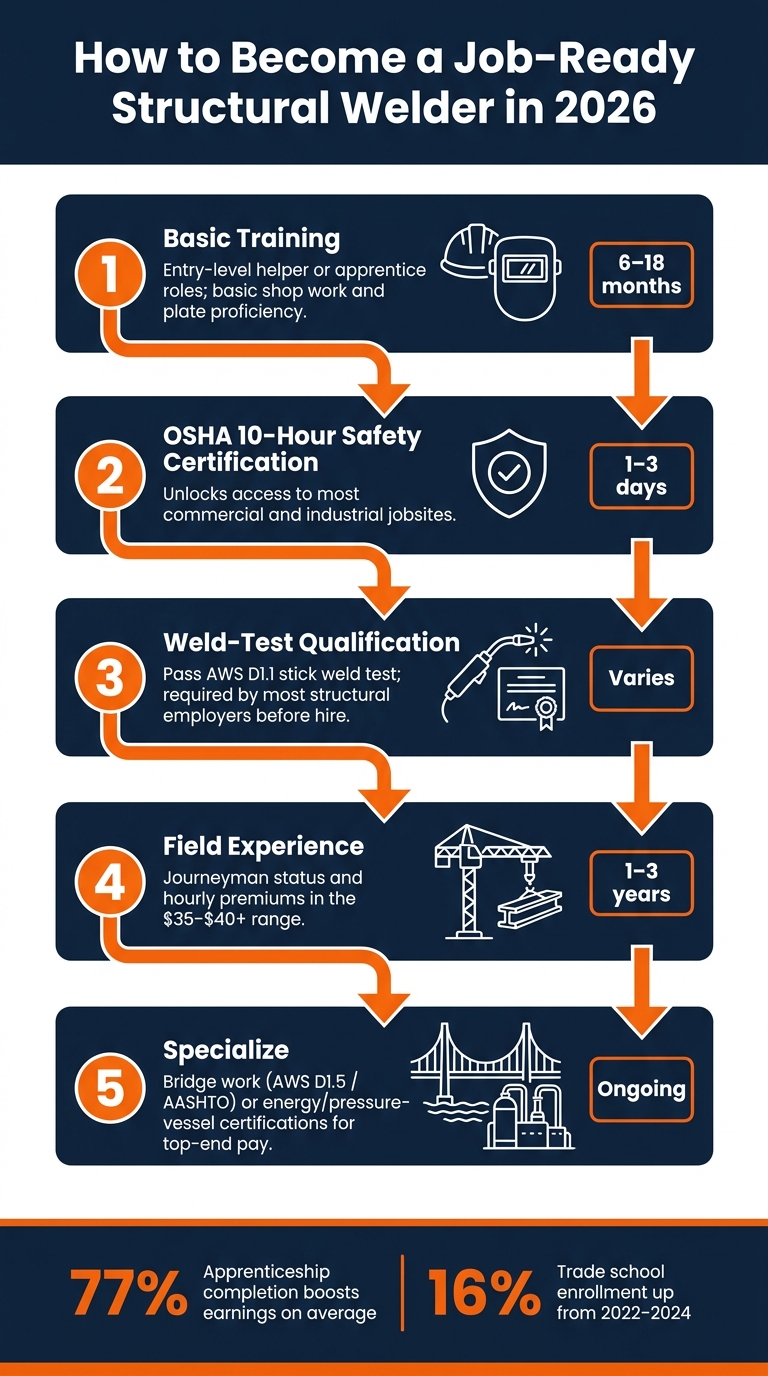
How to Become a Job-Ready Structural Welder in 2026
Why Demand for Structural Welders Stays Strong
Building work, bridge jobs, and shutdown projects are keeping demand for structural welders high in 2026. Hiring is still tight, and the labor shortage hasn’t eased up. IIJA projects, CHIPS-era fabs, EV battery plants, and data centers are all pulling skilled workers from the same labor pool across the country.
Retirements are making the skills gap even bigger. That puts more pressure on employers to hire fast and pushes up the value of welders who can step in and work right away. In plain terms, workers who can train fast, pass tests cleanly, and get to the jobsite without delay have an edge.
For most workers, that means one thing: meet the basic training and testing standards employers use to screen applicants.
Entry Requirements, Training, and Core Certifications
Most employers want a high school diploma or GED, proof that you’re at least 18, and the physical stamina for demanding site work. They also expect basic math skills and the ability to read blueprints.
Training usually begins in one of two places: trade school or a registered apprenticeship. Trade school programs usually take 6–18 months, and enrollment rose 16% between 2022 and 2024. Registered apprenticeships usually take 3–5 years and pay from day one. Finishing an apprenticeship can increase earnings by an average of 77%.
On the safety side, many employers treat OSHA 10-hour training as the baseline requirement for most commercial and industrial jobsites. They also often want workers who can pass an AWS D1.1 weld test. For bridge work, AWS D1.5 may be required. Port and marine jobs may call for a TWIC card, and some industrial employers also ask for NCCER.
When hiring moves fast, test results often matter more than time spent in a classroom. Most structural welding jobs still require an on-site SMAW (stick) weld test before hire.
A Step-by-Step 2026 Path from Beginner to Job-Ready Welder
The fastest path is simple: get basic training, earn OSHA certification, and pass a weld test.
| Step | Action | Typical Timeline |
|---|---|---|
| 1 | Basic training: entry-level helper or apprentice roles; basic shop work and plate proficiency | 6–18 months |
| 2 | OSHA 10-hour safety certification: access to most commercial and industrial jobsites | 1–3 days |
| 3 | Weld-test qualification: ability to pass AWS D1.1 weld tests | Varies |
| 4 | Field experience: journeyman status and higher hourly premiums in the $35–$40+ range | 1–3 years |
| 5 | Specialize: bridge (AASHTO/AWS D1.5) or energy/pressure-vessel work | Ongoing |
How to Find Structural Welding Jobs and Key Takeaways
What Workers and Employers Should Look for in Hiring
Once a worker is ready for the job, the hiring checklist becomes the fastest way to sort good opportunities from bad ones.
Before taking any structural welding job, workers should check a few core details: hourly rate, project timeline, and W-2 status. W-2 status matters because it means you’re covered by workers’ compensation and employer insurance protections. It also helps to ask whether travel is part of the job. Construction makes up about 21% of all U.S. workplace fatalities, so safety can’t be treated like a side issue.
For employers, the checklist matters just as much. Verify OSHA 10 or OSHA 30 certifications before the worker starts, and require a hands-on weld test. A card or certificate helps, but a live weld test shows whether someone can actually do the work.
Fast hiring also matters. Automated screening and live status tracking can cut delays and help crews get filled without the usual back-and-forth.
That’s why verified skills and fast onboarding matter more than a polished resume.
Where ABLEMKR Fits for Construction and Industrial Staffing
When time is tight, staffing platforms can help employers get vetted welders onto projects fast.
ABLEMKR matches pre-vetted workers to job sites based on certifications, safety training, availability, and location. The platform brings payroll, invoicing, and compliance tracking into one place, which cuts admin work for employers and helps make sure workers get paid on time.
"Relationships with workforce providers who deliver vetted workers in 24-48 hours cost less than scrambling at crunch time." – ABLEMKR Report
ABLEMKR supports construction, heavy infrastructure, energy, and industrial projects across the U.S.
Conclusion: Key Points to Remember About Structural Welding Jobs in 2026
Structural welding jobs in 2026 reward speed, verified credentials, and safe work habits. Workers who can pass weld tests and travel when needed have the clearest edge.
FAQs
Which structural welding path pays the most?
The highest-paying path usually has less to do with a single job title and more to do with specialized certifications.
Many structural welders make around $50,000 to $70,000 per year. But if you add credentials like OSHA 30 or NCCER, your pay can move well past entry-level rates. Those certifications show employers you can handle more responsibility, and that often leads to better offers.
Higher pay also tends to show up in union roles. In many cases, union jobs come with stronger base wages and better benefits than non-union positions.
Do I need AWS D1.1 to get hired in 2026?
Not always. But AWS D1.1 can give you a strong edge in 2026.
A lot of hiring teams use verified credentials to screen candidates before they move them forward. And for structural welding roles, you may still need to pass a hands-on weld test.
If you have AWS D1.1 plus the required OSHA-aligned hazard training, you’re often in a better spot. It can make you more competitive and may help you get placed faster on high-demand projects.
Is travel welding worth the longer hours?
Travel welding is often worth the longer hours because it can lead to higher pay and better career growth. In 2026, skilled labor shortages are pushing pay up for welders who are willing to hit the road.
Travel welders can earn more through higher hourly rates, per diems, and housing stipends. In some cases, total annual income can reach six figures. This kind of work also puts welders in front of more infrastructure and energy projects, which can strengthen their long-term job prospects.


